This lesson uses 2 sample plans — switch anytime; color matches the bar between the columns.
On the right now: Dana - Savings Alone

 The risks to think about
The situation Dana and Lee are both 60, both single, and both plan to retire at 62 on $70,000 a year. Dana has $1.3 million saved, mostly in stocks, and nothing else but Social Security. Lee has less saved, mostly in bonds, and a pension of $42,000 a year with no cost-of-living raise. Which risks should each of them worry about most?
How to use this case study
New to the Learning Center, or want a map of the panels? Start with a tour: Reading Lesson (Getting Around) or Screencast Lesson (Getting Around) — both walk through Tutilis next to a live planThe running Tutilis product next to this lesson — navigation, Bird's Eye, Forecaster, tools, and more — loaded with a teaching sample. A dossier is the plan data; the live plan is the full product surface with a sample dossier already open so you can explore. On the web, teaching samples are not editable the way your own dossier will be in the full app.Full entry → (to the right on a desktop-width screen, or below when stacked on a tablet).
This page — The risks to think about — can open more than one live sample planThe running Tutilis product next to this lesson — navigation, Bird's Eye, Forecaster, tools, and more — loaded with a teaching sample. A dossier is the plan data; the live plan is the full product surface with a sample dossier already open so you can explore. On the web, teaching samples are not editable the way your own dossier will be in the full app.Full entry → next to the text (to the right on a wide screen, or below on a tablet). Use the Live plans chips (and matching colored links in the prose) to switch without leaving this page; the colored bar near the plans shows which one is loaded. The walk-through stays in the text.
The live planThe running Tutilis product next to this lesson — navigation, Bird's Eye, Forecaster, tools, and more — loaded with a teaching sample. A dossier is the plan data; the live plan is the full product surface with a sample dossier already open so you can explore. On the web, teaching samples are not editable the way your own dossier will be in the full app.Full entry → next to this page — usually to the right on a wide screen, or below on a tablet — is Tutilis running a teaching sample: the same financial planning product available as a desktop application (early preview). A dossierYour full plan in Tutilis: the people in the household, what they own and owe, cash flows in and out, tax setting, and planning assumptions. One dossier is one complete situation as the product models it.Full entry → is the plan data; the live plan is the full product (navigation, Bird's Eye, Forecaster, tools) with a sample dossier already open so you can try the panels. See planned pricing. On the web, Learning Center samples are not editable the way your own dossier will be in the full app. Your own household goes in the Tutilis desktop app — the Learning Center front page has a short clip of that.
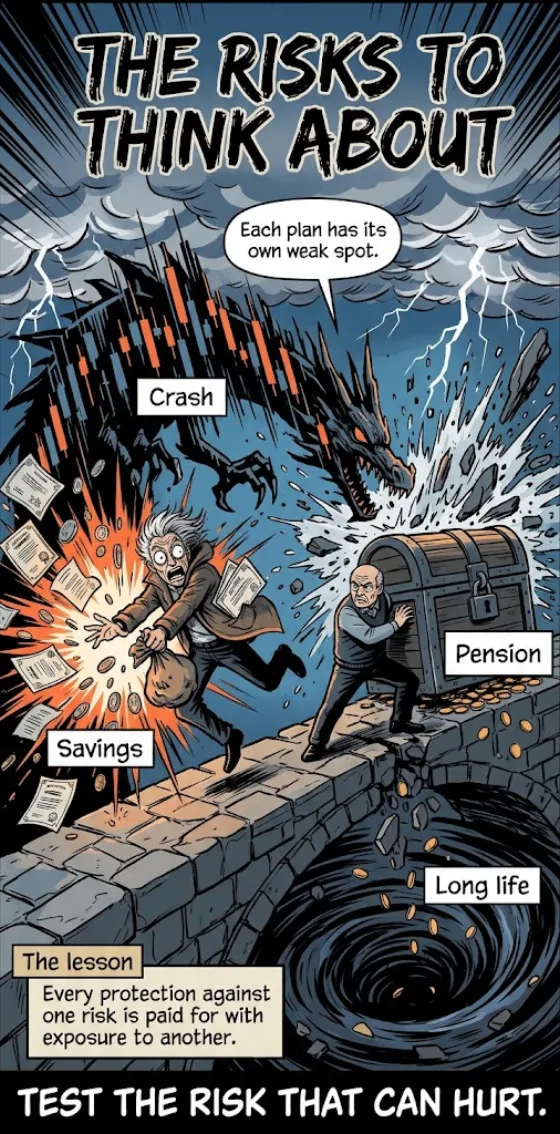
A financial plan is a bet on one future, and the future it bets on will not arrive exactly as written. Markets fall, prices rise, people live longer than they expected, and laws change. Each of these is a risk, and every plan is exposed to all of them, but not equally: the shape of a plan decides which ones can do it real harm. This lesson lays out the risks worth thinking about, the kinds of plans each one hits hardest, and where to test each one in Tutilis. It starts with two retirees who have the same budget and very different weak spots.
Dana and Lee are both 60, both single, and both plan to retire at 62, in 2028, and to spend $70,000 a year, rising with prices. Both will claim Social Security at 67. The rest of their plans differ.
| Dana - Savings Alone | Lee - Fixed Pension | |
|---|---|---|
| Saved | About $1.3 million | About $590,000 |
| Stocks in the mix | About 80% | About 37% |
| Pension | None | $42,000 a year for life, with no cost-of-living raise |
- Dana - Savings Alone is Dana's plan. Everything Dana spends before Social Security, and most of it after, comes out of savings.
- Lee - Fixed Pension is Lee's plan. A pension from a former employer covers more than half of Lee's spending at first, so Lee's savings are smaller and held mostly in bonds.
As planned, the two plans are about equally sound. Over 1,000 simulated futures, Dana - Savings Alone succeeds on about 85% of paths and Lee - Fixed Pension on about 88%. The plans have no state selected, so every tax in this lesson is federal.
A forecast already carries ordinary uncertainty: each simulated future draws its own returns, and the spread of outcomes shows it. Some risks are not ordinary years, though. They are one specific bad event, and they are tested by laying that event over the plan. That is what  TransformsA main-rail area. The name is Transforms because you transform a copy of the plan — a what-if — without rewriting the original dossier. Compare original vs modified side by side. is for. Its Modifiables card lists the events you can lay over a plan without changing the plan itself.
Desktop app only
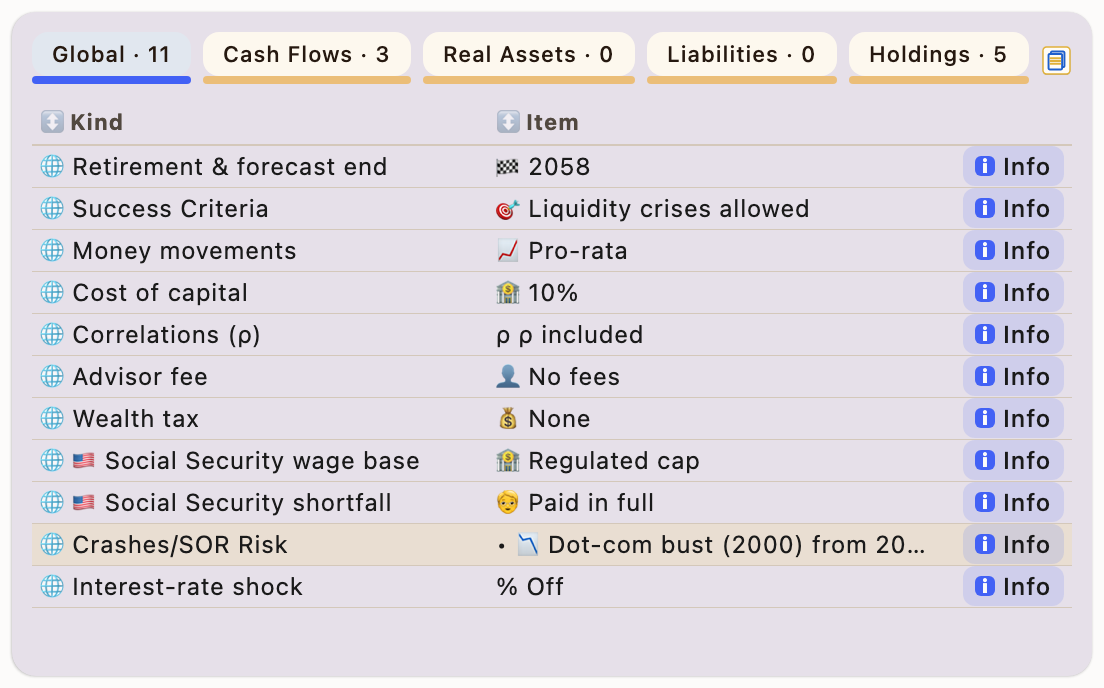
This lesson uses four of them on both plans:
- Sequence-of-returns risk (the Crashes/SOR Risk row) with the dot-com bust of 2000, starting in 2028, the year both retire. The episode replays three falling years for stocks, then the recovery.
- Interest-rate shock, with rates two points higher from 2028 for five years.
- Social Security shortfall, paying 83% of every benefit from 2034, the Trustees' projection for the combined trust funds. Will Social Security be there? explains where that number comes from.
- Retirement & forecast end, with the death age moved from 92 to 100.
Turn on the dot-com bust for Dana - Savings Alone. Transforms draws the plan as written beside the plan with the crash.

Dana - Savings Alone, as planned (left) and with the dot-com bust from 2028 (right), on one scale. The crash takes about $550,000 off net worth by 2030, and on this path Dana ends the plan with about $450,000 instead of about $2 million.
The crash lands in the worst possible years for Dana. Dana has just stopped earning, Social Security is five years away, and every dollar spent comes from a portfolio that is mostly stocks and falling. Selling shares at low prices to pay the bills leaves fewer shares to recover. That is sequence-of-returns riskThe order the good and bad years arrive in. Two plans with identical average returns can end in very different places if one takes its losses early while money is being withdrawn — selling into a fall removes shares that are then not there for the recovery. It is why retirement risk is not summarized by an average, and why the years either side of the day you stop working carry more weight than their count suggests.Full entry →, and it is largest for an early retiree with a large stock share and no other income.
Now switch to Lee - Fixed Pension and turn on the same crash.

Lee - Fixed Pension, as planned and with the same crash, on one scale. The gap is about $46,000 in 2030.
Lee barely notices. The pension pays most of the bills in the crash years, so Lee sells little, and most of what Lee owns is bonds, which held up while stocks fell. Over 1,000 futures, the crash lowers Lee's success rate by less than two points and Dana's by about nineteen.
Run all four tests on both plans and read the success rate from the outcome cards each time.
| Test | Dana - Savings Alone | Lee - Fixed Pension |
|---|---|---|
| As planned | 85% | 88% |
| Dot-com bust at retirement | 66% | 87% |
| Rates two points higher for five years | 82% | 89% |
| Social Security paid at 83% from 2034 | 78% | 69% |
| Living to 100 | 69% | 55% |
Each plan has its own weak spot. Dana's is a crash at the start of retirement. Lee's is a long life and a Social Security cut, and both of those come back to one thing about Lee's pension.
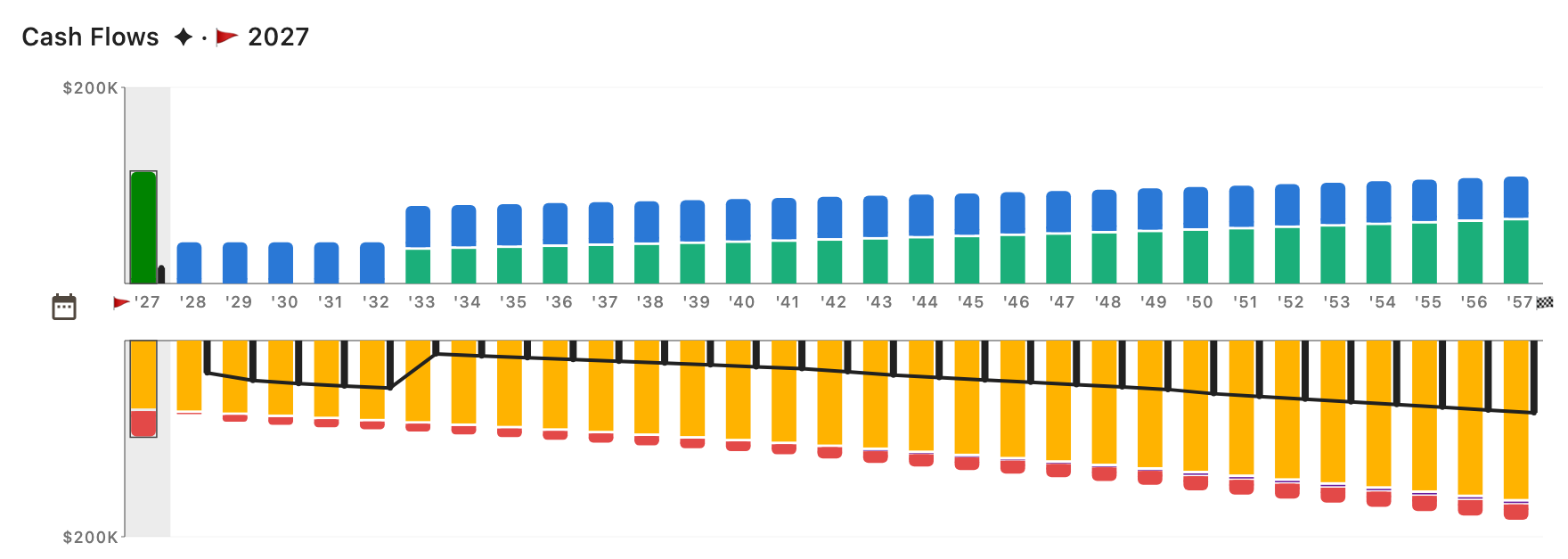
Lee - Fixed Pension's cash flows. From 2028 to 2032 the pension is the only income, and it is the same $42,000 every year. Living expenses grow from about $76,000 in 2029 to about $135,000 in 2050, so the share the pension covers shrinks every year, and the sales from savings grow from about $16,000 in 2034 to about $54,000 in 2050.
The pension pays for life, but it pays the same number of dollars each year, and each year those dollars buy less. That is inflationA rise in the price level. The same basket of goods costs more dollars than it did. A household plan carries a growth rate on each bill, because one published inflation number is one basket. The reporting rate that restates future dollars into today's dollars is a separate assumption.Full entry → working slowly, and it is why a longer life costs Lee more than it costs Dana: every extra year is a year when the pension covers less and Lee's smaller savings cover more. A Social Security cut lands on the same gap. Dana's savings, mostly in stocks, are expected to grow faster than prices, so Dana has more room for both.
The rate shock barely moves either plan, and it nudges Lee's up. Bond prices fall when rates rise, but cash and bonds then earn more for the years that follow, and Lee holds a lot of both. Interest rates: the price of money in your plan shows the same thing on a bond-heavy plan.
None of this says one plan is better. It says a plan's shape decides which risks matter for it, and those are the ones to test first.
The table lists the risks most worth thinking about in a long-range plan. Each risk's name is a glossary word: hoverOn a desktop or laptop, rest the pointer on a row, chip, or control to open a detail card — attributes, amounts, and often a small path chart. We put a lot of teaching detail in those cards on purpose. Hover needs a pointer, so it does not work on tablets or phones (tap may show a simpler view or nothing). Hold Alt if the tips become a nuisance — many product hovers stay closed while Alt is down so you can move the pointer freely.Full entry → it for the definition. The second column names the plans each risk hits hardest, the third says where to test it, and the fourth links to the lesson that treats it on a plan.
| Risk | Plans most exposed | Test it in Tutilis | Lesson |
|---|---|---|---|
| Market riskHow much an investment's returns bounce around from year to year, not whether it goes up or down overall. Written σ (sigma) in the product. Two holdings can have the same average return and feel completely different to live through — and high volatility drags the growth you actually compound below that average.Full entry → | A large stock share and a short time until the money is needed | Risk panel, and the spread of outcomes | Risk and return |
| Sequence of returnsThe order the good and bad years arrive in. Two plans with identical average returns can end in very different places if one takes its losses early while money is being withdrawn — selling into a fall removes shares that are then not there for the recovery. It is why retirement risk is not summarized by an average, and why the years either side of the day you stop working carry more weight than their count suggests.Full entry → | Early retirees with a large stock share and no pension | Sequence-of-returns risk, at retirement | Timing a crash |
| Retirement-date riskThe chance that a bad market in the last years of work pushes the retirement date back. Near the end of a career the portfolio is so large that one poor year can undo several years of saving, so two savers with the same average return can reach their goal years apart depending on when the poor years fall. Michael Kitces named it in a 2016 article, *Retirement Date Risk and Sequence of Returns*. It is the working-years side of sequence of returns, and holding less stock as the date approaches is the usual answer when the plan needs only a modest return.Full entry → | Savers in their last five to ten working years, mostly in stocks | Sequence-of-returns risk, before retirement | Getting safer as retirement approaches |
| Behavior riskThe risk that the investor, not the market, does the damage: selling after a fall, buying after a rise, or abandoning a plan in a bad year. Its cost lands in the recovery years spent out of the market. A rule written down in advance is the usual protection.Full entry → | Investors with no written rule for a fall | The plan's glide path, written down in advance | Stay the course |
| Longevity riskThe chance of living longer than the money lasts. It is largest for someone who pays for retirement from savings alone, and for anyone whose lifetime income does not rise with prices. Income that lasts for life and keeps up with inflation, such as Social Security, is the usual protection.Full entry → | Single people on savings alone, and anyone whose lifetime income is flat | Retirement & forecast end, with a later death age | Claim early vs live long |
| InflationA rise in the price level. The same basket of goods costs more dollars than it did. A household plan carries a growth rate on each bill, because one published inflation number is one basket. The reporting rate that restates future dollars into today's dollars is a separate assumption.Full entry → | Fixed pensions, long retirements, and large cash holdings | Each bill's growth rate | Prices on your plan, Who inflation helps |
| Interest-rate riskThe price of money: what a borrower pays each year for the use of it, as a share of the amount borrowed. Short rates follow the central bank's policy rate, and long rates are set by what the market expects short rates and inflation to do.Full entry → | Long-term bond funds, variable-rate debt, and savers who live on interest | Interest-rate shock | Interest rates |
| Credit riskThe chance that a borrower pays late, pays less than promised, or stops paying. Every bond carries some except US Treasuries, which are treated as free of it. A municipal bond is only as sound as the state, city, or project behind it, and a higher yield is usually the price a borrower pays for more of this risk.Full entry → | Bond holdings in corporate or high-yield bonds, or in one state's municipal bonds | Not modeled as a default; a bond category carries price swings only | When bracket-filling stops working |
| Currency riskForeign exchange — converting between currencies, and the rate that conversion happens at. A plan holding money in more than one currency carries the rate as an assumption like any other, which means part of what a balance is worth depends on something no portfolio choice controls.Full entry → | Income, savings or spending in another currency, including a retirement abroad | The currency-risk model | Currency risk in the forecast |
| Concentration riskThe risk of having a large share of your wealth in one company, one property or one business. A single holding can fall much further than a market, and it can fall at the same time as the paycheck from the same employer.Full entry → | Households with stock awards, a business, or one large inherited holding | Risk panel, item by item | Equity compensation as it vests, Selling the business |
| Liquidity riskHow readily something turns into spendable cash without a loss. A brokerage fund is liquid; a house is not, and neither is a retirement account you cannot reach yet without a penalty. A plan can be solvent on paper and still hit a liquidity problem in a particular year.Full entry → | Wealth held in a home or a business, and early retirees whose savings are in retirement accounts | A cash reserve in the plan | The five-year retirement runway |
| Policy riskThe risk that a law changes the rules a plan was built on: tax rates and brackets, Social Security benefits, the age for required distributions, or a new tax such as a wealth tax. Plans that defer a lot of tax, or lean heavily on one benefit, carry the most.Full entry → | Plans that lean on Social Security, large traditionalA retirement account where the tax is paid on the way out — not a description of an old-fashioned account. Money went in before income tax, grew untaxed, and is taxed as ordinary income when you take it out — traditional 401(k)s and IRAs work this way. The contrast is Roth (taxed going in, tax-free coming out) and taxable (brokerage, taxed as you go).Full entry → balances, and high-net-worth households | Social Security shortfall, Wealth tax | Will Social Security be there?, A wealth tax on your plan |
| Health and long-term careLong-term care — help with everyday living (in-home aide, assisted living, nursing care) rather than medical treatment for an illness. It is modeled separately because ordinary health coverage largely does not pay for it, and because it tends to arrive late in a plan as a large, multi-year expense.Full entry → | Early retirees before Medicare, and single people without family nearby | Healthcare expenses by phase, and a long-term care line | Healthcare expense phases, Long-term care |
| Survivor riskThe risk that one partner dies early and the household's income falls further than its costs. The survivor keeps only the larger of two Social Security benefits, may lose part of a pension, and soon files taxes as single, with narrower brackets. That last part is often called the widow's penalty.Full entry → | Couples whose income depends on one pension or one large Social Security benefit | An earlier death age for one partner | Life insurance on the plan |
| Counterparty riskThe risk that the institution that owes you money cannot pay: a pension plan, the insurer behind an annuity, or a bank. Guarantees exist (the PBGC for private pensions, state guaranty associations for annuities, the FDIC for bank deposits), but each has limits.Full entry → | A large pension from one employer, or a large annuity from one insurer | Payer pays only part, on the pension or annuity row | Counterparty risk |
Two things on the list are not risks at all, and they are worth naming because they are often confused with one. A fund's fees and the tax on its distributions are certain: they come out every year whatever the market does. Costs you keep paying treats them as what they are, a cost you can measure and choose.
Most of the risks above are handled the same few ways. DiversificationSpreading money across investments that do not all move together, so a bad year for one is not a bad year for everything. Owning many holdings is not the same thing — if they are highly correlated they behave like one large position wearing several names.Full entry → spreads market and concentration risk, and a simple diversified portfolio is in The three-fund portfolio. Income that lasts for life and rises with prices, such as Social Security claimed later, protects against longevity and inflation. A cash reserve handles liquidity, and a written rule handles behavior. Each of these costs something, so the plan's own weak spots decide which are worth paying for.
Some risks on the map have no test in a forecast.
- A bond default. Tutilis models a bond's price swings but not a borrower failing to pay. Credit risk is judged outside the plan, by spreading bonds across many issuers. A pension or annuityA contract that pays a stream of income, usually for life, in exchange for a sum up front. It trades flexibility and any leftover balance for the one thing a portfolio cannot promise: a payment that does not stop if you live a long time. Products vary enormously; the word alone says very little.Full entry → failing can be tested: Counterparty risk lays a cut over a plan in Transforms.
- Losing a job or the ability to work before the planned retirement date. Moving the retirement age earlier in Retirement & forecast end comes close, and it is a good test for anyone in their last working decade.
- Several risks at once. The four tests above were run one at a time. A real decade can bring a crash, high inflation and a benefit cut together. Transforms lets you stack a crash with a rate shock, and the hardest test of a plan is the combination its own weak spots point to.
- The rate shock moves returns, not prices. It shifts what bonds, cash and stocks earn. It does not raise what your bills cost, which is each bill's own growth rate.
Every plan carries every risk, but not equally. A plan that pays for retirement from a stock-heavy portfolio is most exposed to a crash in its first years. A plan built on a flat pension shrugs off the crash and is exposed instead to inflation, a long life and changes in the law. Find your plan's weak spots by its shape, test those first in Transforms, and pay for protection against the risks that can actually hurt it.
Rebuild this plan by hand
The cards on the canvas show the accounts and cash flows. These are the settings that live outside any card, read from each plan this lesson opens, with the label each control carries in the app. A value marked default is one to leave alone.
| Setting | Dana - Savings Alone | Lee - Fixed Pension |
|---|---|---|
| Household | ||
| Planning region | United States (default) | United States (default) |
| Dana (Primary) | ||
| birth year | 1966 | — |
| retirement age | 62 | — |
| death age | 92 | — |
| Lee (Primary) | ||
| birth year | — | 1966 |
| retirement age | — | 62 |
| death age | — | 92 |
| Taxes | ||
| Tax regime | United States | United States |
| Filing status | Single | Single |
| State of residence | None | None |
| First-year federal estimate | — | — |
| First-year state estimate | — | — |
| Strategy | ||
| Residual withdrawal strategy | Pro-rata (default) | Pro-rata (default) |
| Roth conversions | Off | Off |
| Definition of success | Liquidity crises allowed (default) | Liquidity crises allowed (default) |
| Glide path target | None (default) | None (default) |
| Advanced | ||
| Reporting inflation | Assumption set's rate (default) | Assumption set's rate (default) |
| Cost of capital | Assumption set's rate (default) | Assumption set's rate (default) |
| Growth assumptions | Growth overrides (default) | Growth overrides (default) |
| Currencies | Multiple currencies (default) | Multiple currencies (default) |
| Default currency | USD (default) | USD (default) |
| Display currency | USD (default) | USD (default) |

Educational content — not advice. These lessons teach how Tutilis models a plan and how to read what it shows. The households, balances, and outcomes in them are invented for teaching. Nothing here is financial, investment, tax, or legal advice, or a recommendation to buy, sell, or hold anything. A model cannot know your circumstances — check anything you take from a lesson against your own situation, and against a qualified professional where it matters.