
 Healthcare expense phases (employer → Medicare)
How to use this case study
New to the Learning Center, or want a map of the panels? Start with a tour: Reading Lesson (Getting Around) or Screencast Lesson (Getting Around) — both walk through Tutilis next to a live planThe running Tutilis product next to this lesson — navigation, Bird's Eye, Forecaster, tools, and more — loaded with a teaching sample. A dossier is the plan data; the live plan is the full product surface with a sample dossier already open so you can explore. On the web, teaching samples are not editable the way your own dossier will be in the full app.Full entry → (to the right on a desktop-width screen, or below when stacked on a tablet).
This page — Healthcare expense phases (employer → Medicare) — includes a live sample planThe running Tutilis product next to this lesson — navigation, Bird's Eye, Forecaster, tools, and more — loaded with a teaching sample. A dossier is the plan data; the live plan is the full product surface with a sample dossier already open so you can explore. On the web, teaching samples are not editable the way your own dossier will be in the full app.Full entry → next to the text. On a wide screen it usually sits to the right of the text; on a tablet it usually sits below. Use the text for the walk-through, then try the same ideas in the live plan.
The live planThe running Tutilis product next to this lesson — navigation, Bird's Eye, Forecaster, tools, and more — loaded with a teaching sample. A dossier is the plan data; the live plan is the full product surface with a sample dossier already open so you can explore. On the web, teaching samples are not editable the way your own dossier will be in the full app.Full entry → next to this page — usually to the right on a wide screen, or below on a tablet — is Tutilis running a teaching sample: the same financial planning product available as a desktop application (early preview). A dossierYour full plan in Tutilis: the people in the household, what they own and owe, cash flows in and out, tax setting, and planning assumptions. One dossier is one complete situation as the product models it.Full entry → is the plan data; the live plan is the full product (navigation, Bird's Eye, Forecaster, tools) with a sample dossier already open so you can try the panels. See planned pricing. On the web, Learning Center samples are not editable the way your own dossier will be in the full app. Your own household goes in the Tutilis desktop app — the Learning Center front page has a short clip of that.
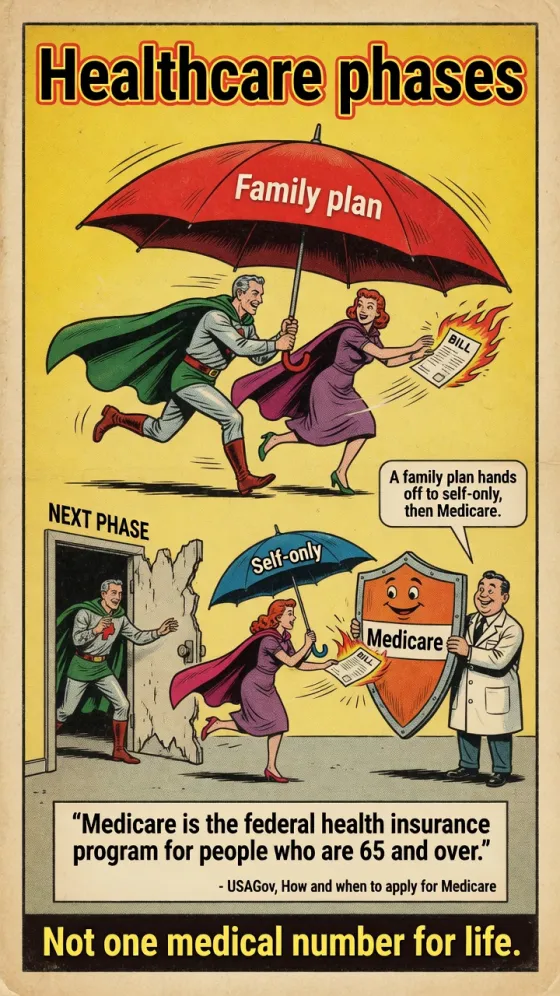
Healthcare in a US plan is usually not one number for life. Retirement healthcare costs move in steps, from employer coverage to Medicare. Costs change when employer coverage ends, when marketplace or private coverage fills a pre-Medicare gap, and when Medicare starts around age 65. This lesson shows that handoff as phases on a medical cash-flow template so the forecast does not pretend medical spend is free until someone notices.
This lesson uses the same household as Meet the Springfield household, Homer and Marge, and the plan already carries a few medical lines: one family health plan that covers both of them, and a Medicare line for each. The amounts are planning placeholders rather than quotes.
A couple crosses 65 twice, so the handoff is a chain of three phases across three templates rather than one step:
| Phase | Years on Springfield | Template · label |
|---|---|---|
| Family policy, both covered | Plan start → 2041 (Homer 65) | Family health plan · Employer / private, family |
| Self-only policy for Marge | 2041 → 2043 (Marge 65) | Family health plan · Employer / private, self-only (Marge) |
| Medicare, per person | From each owner's own 65 | Homer Medicare, Marge Medicare · Medicare |
The boundaries are each owner's Medicare year, picked by name in the phase's active years rather than typed — correct a birth year and the handoff moves with it.
If the left/right layout feels unfamiliar, skim Getting around the app first. MAGI-driven premiumWhat you pay for coverage — a monthly insurance or Medicare cost — and not a bonus or a prize. Confusingly, the same word means "above face value" when applied to a bond. In a plan it is nearly always the insurance sense: a recurring outflow that rises with age and, past a threshold, with income.Full entry → cliffs after 65: MAGI cliffs — IRMAA, NIIT, and friends.
The live plan on the right is Springfield HSAHealth Savings Account — paired with a high-deductible health plan, and the only common account that is untaxed at all three points: going in, growing, and coming out for medical costs. That is why plans treat it as a retirement account that happens to pay doctors.Full entry → — the family baseline plus a health savings account that pays those medical phases. Shaping the expense is half the story; the other half is what pays for it.
Definitional —  Bird's EyeWhen you are not on Dossier, this control sits in the top toolbar. Opens a household overview as a modal — people, assets and liabilities, cash flow — without leaving the area you are in. Hidden on Dossier, because that same overview already sits at the top of that area. with Cash Flow selected
- Stay on
 DossierA main-rail area. Where the household plan is defined — people, assets and liabilities, cash flows. In these lessons you mainly view; on desktop you enter and edit your own plan. (Bird's EyeWhen you are not on Dossier, this control sits in the top toolbar. Opens a household overview as a modal — people, assets and liabilities, cash flow — without leaving the area you are in. Hidden on Dossier, because that same overview already sits at the top of that area. at the top), or open Bird's EyeWhen you are not on Dossier, this control sits in the top toolbar. Opens a household overview as a modal — people, assets and liabilities, cash flow — without leaving the area you are in. Hidden on Dossier, because that same overview already sits at the top of that area. from the tool rail.
- Select Cash Flow.
- Look for four
 Medical outflows (not one). HoverOn a desktop or laptop, rest the pointer on a row, chip, or control to open a detail card — attributes, amounts, and often a small path chart. We put a lot of teaching detail in those cards on purpose. Hover needs a pointer, so it does not work on tablets or phones (tap may show a simpler view or nothing). Hold Alt if the tips become a nuisance — many product hovers stay closed while Alt is down so you can move the pointer freely.Full entry → for phase attributes and a sparkline of
when each stream runs.
Three medical templates → four outflow line items. A phased healthcare generator expands to one cash-flow outflow per phase, and Springfield carries three of them:
- Family health plan (Employer / private, family) — both owners, to Homer's Medicare year
- Family health plan (Employer / private, self-only (Marge)) — the two years between the
couple's 65ths
- Homer Medicare (Medicare) — from 2041
- Marge Medicare (Medicare) — from 2043
They sort independently by present valueWhat a future amount is worth today, after discounting for the years between. A multi-year outflow shown as one present value is not a sum of its rows — a dollar due in twenty years counts for less than one due next year. The product's PV rollups and "amount mode" switches are this idea applied to a whole flow.Full entry → with other outflows (largest first within outflows) — which is why the two Medicare lines sit high and the two-year self-only phase sits last.
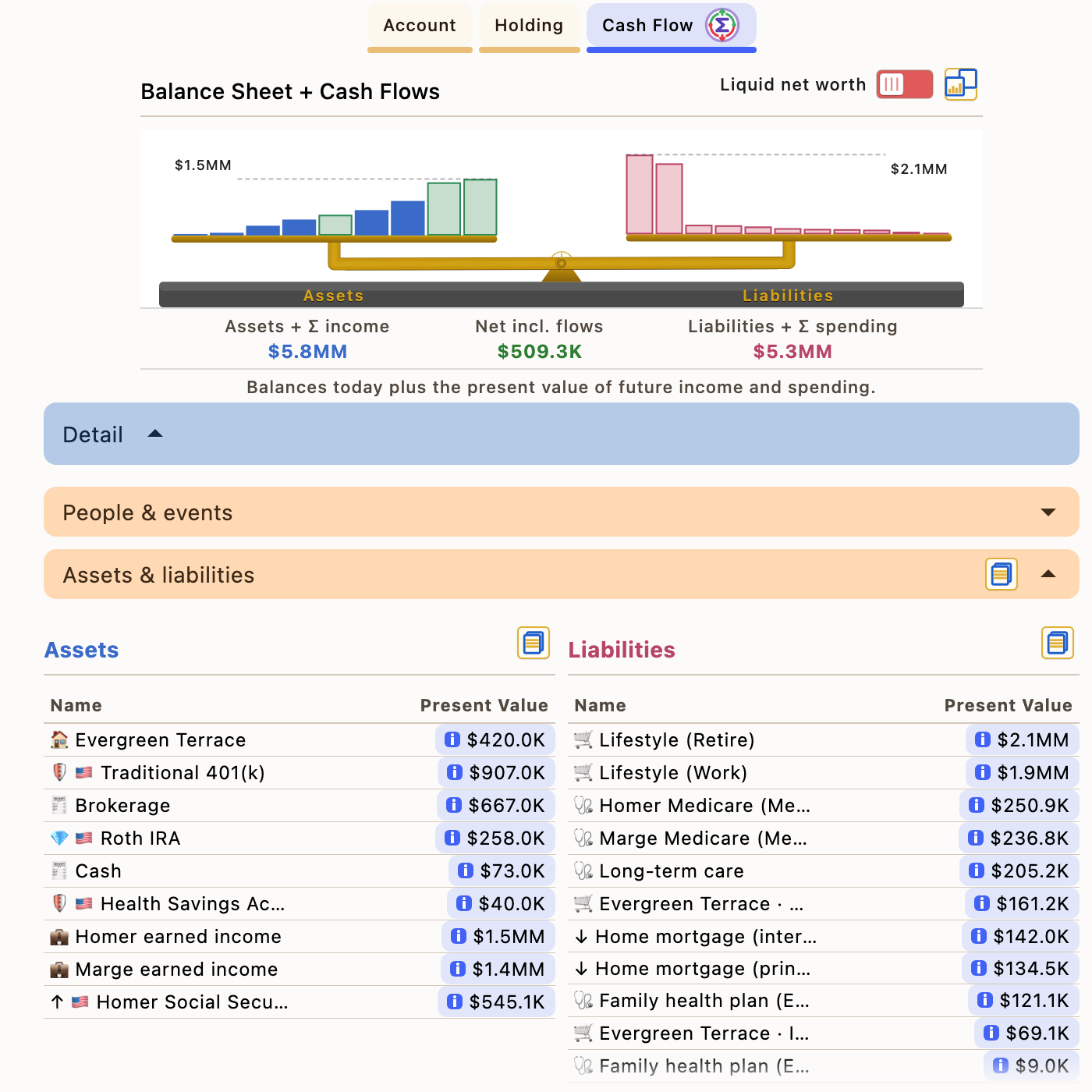
Bird's EyeWhen you are not on Dossier, this control sits in the top toolbar. Opens a household overview as a modal — people, assets and liabilities, cash flow — without leaving the area you are in. Hidden on Dossier, because that same overview already sits at the top of that area. → Cash Flow. Three healthcare templates expand into four outflow rows — the family policy's two phases and a Medicare line per owner — plus other outflows. Present values are multi-year sums (or your selected amount mode), sorted largest first within outflows.
What changes at each milestone
The three templates are not a modeling flourish. They are the three policies a US couple actually buys between mid-career and old age, and each one starts and stops on a different trigger.
- While someone is still employed, the household is usually on one family plan with one premium. The number you see on a pay stub is the employee share; the employer pays the rest, and that subsidy is the first thing that disappears at retirement.
- Retiring before 65 opens a gap. COBRA continues the employer plan for up to 18 months, at the full premium rather than the employee share. After that, the choices are a spouse's plan or the ACAAffordable Care Act — the law behind the individual health-insurance marketplace and its income-based subsidies. It matters to a plan mostly before Medicare age: retiring early means buying coverage here, and the subsidy is tested against income you partly control.Full entry → marketplace, where the premium depends on age and on income. For a couple who retires early these are typically the most expensive healthcare years of their lives per person, and they are the years a plan most often leaves out, because the family plan "just continued" in the planner's head.
- Medicare starts at 65, per person, not per household. Part B and Part D carry monthly premiums, a Medigap or Medicare Advantage policy sits on top, and all of it is enrolled and billed under one person's name. A couple therefore crosses 65 twice: one spouse moves to Medicare while the other stays on whatever covered them before, then the second follows. Springfield's version is Homer in 2041 and Marge in 2043, with Marge on a self-only tail of the family plan in between.
- Income raises the Medicare bill. The IRMAA surcharge is set from MAGIModified Adjusted Gross Income — AGI with certain deductions added back. It matters far out of proportion to the small adjustment, because MAGI is the figure that triggers cliffs: Medicare surcharges, the investment surtax, and health-subsidy eligibility all test against a MAGI, and each rule uses a slightly different one.Full entry → two years back and charged per enrollee, so a spouse who is still working when the other enrolls can push the retiree's premium up for the first Medicare years. The surcharge fades on its own once the lookback sees retirement income.
- Medical costs grow faster than general prices. Premiums, deductibles and drug costs have outrun headline inflationA rise in the price level. The same basket of goods costs more dollars than it did. A household plan carries a growth rate on each bill, because one published inflation number is one basket. The reporting rate that restates future dollars into today's dollars is a separate assumption.Full entry → for decades, which is why each phase carries its own growth rate rather than the plan-wide one. Commonly cited estimates for what a 65-year-old will spend on healthcare over retirement run into the low hundreds of thousands of dollars per person, before long-term careLong-term care — help with everyday living (in-home aide, assisted living, nursing care) rather than medical treatment for an illness. It is modeled separately because ordinary health coverage largely does not pay for it, and because it tends to arrive late in a plan as a large, multi-year expense.Full entry →.
Model one policy as one line, because that is how the bills arrive and how they end. A family plan is one premium covering two people, so it is one line that names both. Medicare is one premium per person, so it is one line per spouse with that spouse's own start year. You could squash the whole household into a single four-phase chain and the forecast would charge the same money, but "what does Homer's Medicare cost" would stop being a number in the plan, and the IRMAA surcharge would no longer sit beside the premium it surcharges.
Desktop app only
Where the policies are authored. Each medical line is a healthcare template with a Covers set (the people the policy is for, one name or both), an ordered chain of phases with annual cost, optional growth and active years, and a Funded by link (the HSA, below). The active-years dropdown offers each owner's Medicare year by name, beside their retirement and death, so a phase boundary follows a birth year rather than a year someone typed. The US ballpark help beside the cost field is guidance, not a quote engine.
The coverage check reads per covered person across every template covering them: Homer needs pre-Medicare coverage for any year he is retired before 65 and a Medicare-era phase from 65 on, and so does Marge. The family plan satisfies the first for both; each Medicare line satisfies the second for one. Delete "Marge Medicare" and only Marge's line lights up, which is the reason to keep one template per policy: a merged four-phase chain says "both covered" for every phase, so the check can no longer tell whose coverage is missing.
Projected —  ForecasterA main-rail area with two jobs: (1) run the plan year by year and inspect Forecast Detail, and (2) Simulation Summary — many paths summarized into something like a probability of success.
Turn on  CF ChartA Forecast Detail chip. CF = cash flows. Money in above the line, money out below, by category over the years. The net line, drawn in thick black, is net cash flow — often the thing you came for. /
 CF TableA Forecast Detail chip. CF = cash flows for the selected year — incomes, expenses, taxes, and invest / sell / borrow totals.. Healthcare should appear as health outflows in years the phases
are active. Prefer FID 0 / GMFHow the north star is labeled in the FID control: FID 0 is the deterministic GMF ✦ path, and every other FID is a randomized draw from the simulation. Choose it when you want the year-by-year read to hold still while you change something else about the plan.Full entry →.
| View | Role here |
|---|---|
| CF ChartA Forecast Detail chip. CF = cash flows. Money in above the line, money out below, by category over the years. The net line, drawn in thick black, is net cash flow — often the thing you came for. | Medical spend steps when phases hand off (e.g. at 65). |
| CF TableA Forecast Detail chip. CF = cash flows for the selected year — incomes, expenses, taxes, and invest / sell / borrow totals. | Selected year: health expense line. |
 TaxesA Forecast Detail tax-lens chip. Tax statement for the selected year (federal, state when modeled, property). | Not the home of IRMAA — that is a healthcare surcharge on cash flow when modeled (see MAGI lesson). |
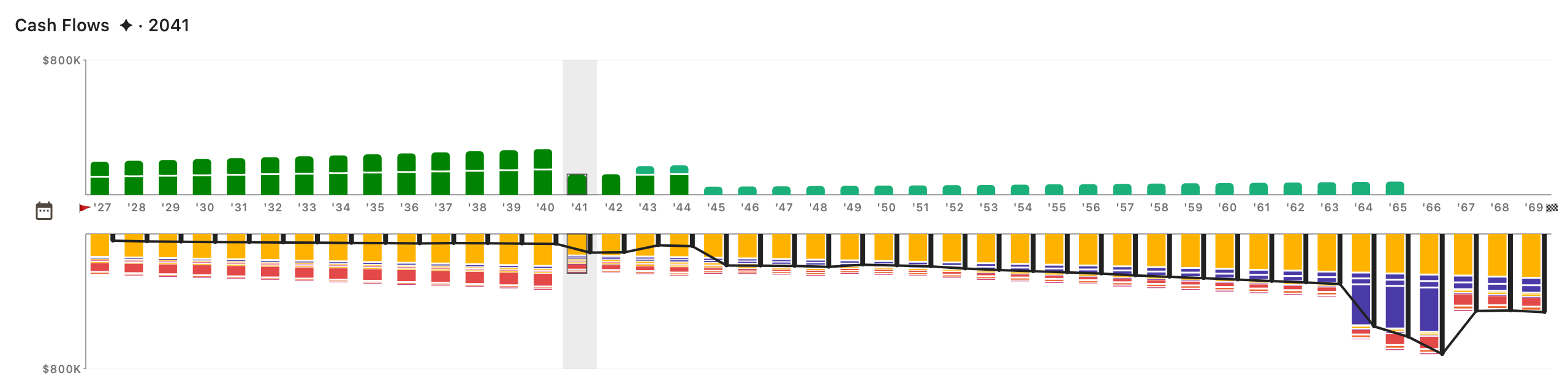
The Medicare hand-off year — 2041, Homer 65 — with the hover tip splitting the outflow into its parts. Health & medical is its own line, separate from Living & general and from Taxes, which is the point: healthcare is a modeled expense category, not a tax and not a lump in general spending. Scrub the year across 65 and the amount steps as one phase hands off to the next, while the category stays put.
One more row hides inside that Health & medical figure: an IRMAA surchargeIncome-Related Monthly Adjustment Amount — a surcharge on Medicare premiums for higher-income households. It works in tiers, so one dollar of extra income can raise the premium for a whole year. It looks back at a tax return from a couple of years earlier, which is why a one-off spike (a big conversion, a property sale) shows up as a bill much later.Full entry →. Open CF TableA Forecast Detail chip. CF = cash flows for the selected year — incomes, expenses, taxes, and invest / sell / borrow totals. for
2041 and it sits beside Homer's Medicare premium as its own line. It is there because Medicare
looks back two years for MAGIModified Adjusted Gross Income — AGI with certain deductions added back. It matters far out of proportion to the small adjustment, because MAGI is the figure that triggers cliffs: Medicare surcharges, the investment surtax, and health-subsidy eligibility all test against a MAGI, and each rule uses a slightly different one.Full entry →, and two years before 2041 this household still had two salaries.
The surcharge runs until two years after Marge's last paycheck, then drops away on its own — a
fact about this plan's income, not a constant of Medicare. See
MAGI cliffs.
Phases say how much medical costs and when. They say nothing about where the money comes from — and for healthcare there is an account built for precisely this expense.
On the canvasWhat we call the right side of this page (or the bottom on a narrow screen) where the Tutilis application is drawn in this web Learning Center setting. It is the same product surface as the live plan — navigation, Bird's Eye, Forecaster, and so on — not a separate product.Full entry →: Bird's EyeWhen you are not on Dossier, this control sits in the top toolbar. Opens a household overview as a modal — people, assets and liabilities, cash flow — without leaving the area you are in. Hidden on Dossier, because that same overview already sits at the top of that area. → Assets & liabilities with Cash Flow on. The Health
Savings Account sits on the Assets side; hover any medical row — the family policy or either
Medicare line, since all three templates draw on it — and its tip carries a Funded by section
naming that account. That link is why medical spend draws the HSA first and pools whatever it cannot
cover with every other obligation.
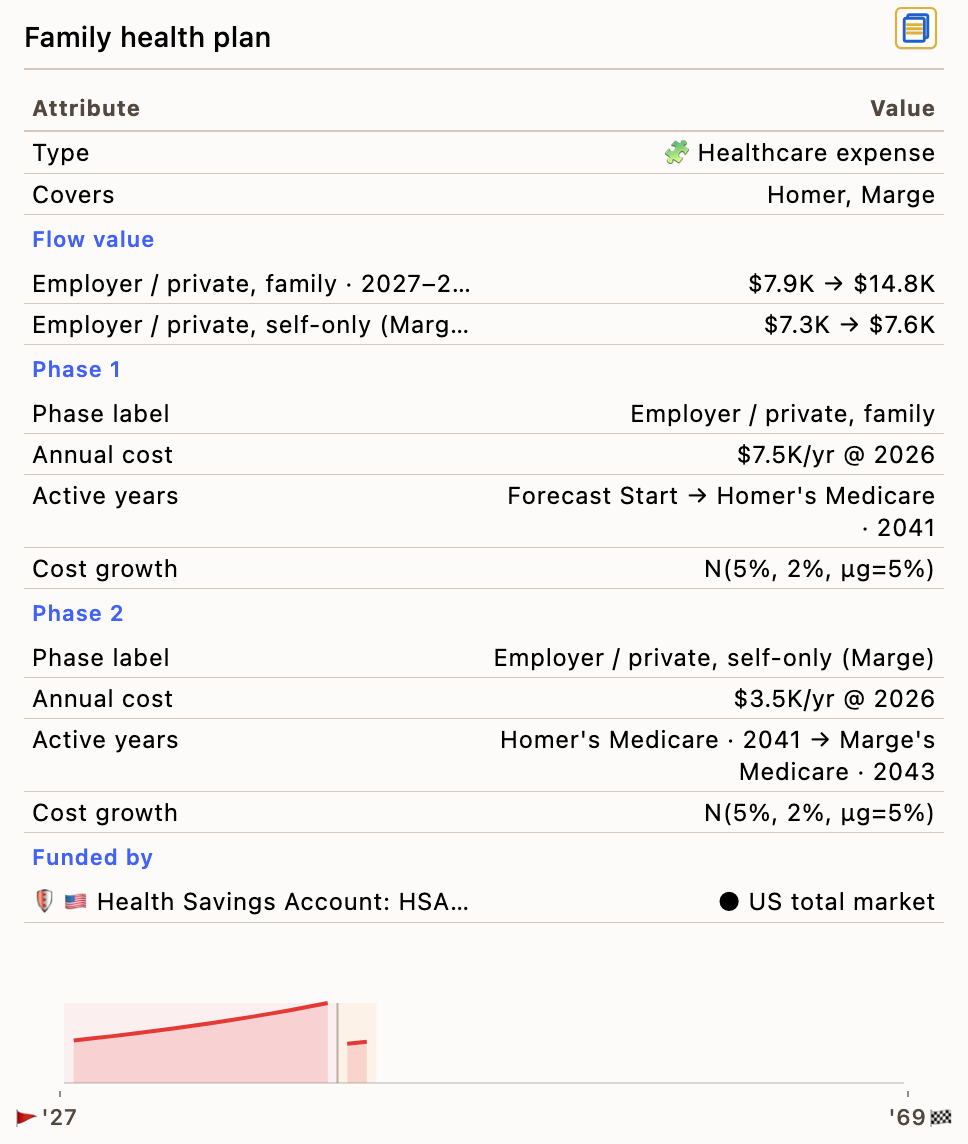
The family health plan's card. Its first phase is the family policy, which runs until Homer's Medicare year. Its second phase is Marge's self-only coverage, which bridges the two years until her own Medicare starts. The Funded by section at the bottom points both phases at the Health Savings Account. Two separate facts, "medical costs this" and "we hold an HSA," become one story the forecast acts on.
Desktop app only
Where the account and the link are authored. On the desktop app: Assets → Health Savings Account for the balance and the $8,000/yr contribution, near the family limit; and the Family health plan template's Funded by control for the link itself (and its Covers row, naming Homer and Marge). The live plan beside this lesson is read-only for structure, so both are described here rather than practised — everything above and below reads on the canvas.
What an HSA is, in the real world
The three legs, side by side:
| Leg | Real-world treatment |
|---|---|
| Going in | Contributions are deductible (or pre-tax via payroll) |
| While invested | Growth is not taxed year to year |
| Coming out | Withdrawals for qualified medical are tax free |
Contributions stop at 65 — and that is not a modeling shortcut
Open the contribution and look at Active years: it ends in 2041, the year Homer turns 65. HSA eligibility ends when Medicare enrollment begins — you may spend an HSA for the rest of your life, but you may not put money in once you are on Medicare.
That real rule lands on the very year this lesson's employer → Medicare handoff already turns on. The same birthday that changes what medical costs also closes the account that was funding it.
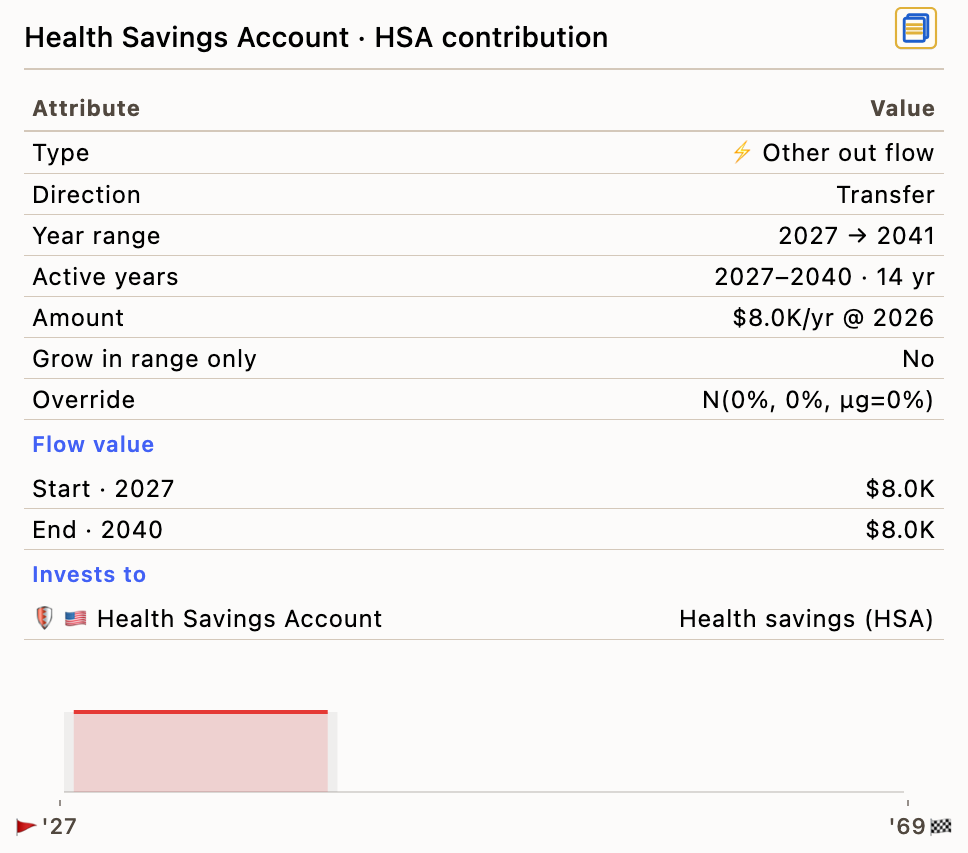
Bird's EyeWhen you are not on Dossier, this control sits in the top toolbar. Opens a household overview as a modal — people, assets and liabilities, cash flow — without leaving the area you are in. Hidden on Dossier, because that same overview already sits at the top of that area. → Transfers, hovering the HSA contribution. Direction: Transfer — money
moving between the household's own accounts, so it sits outside Assets and Liabilities. The window
runs to 2041 and the last year money actually goes in is 2040: the year range is half-open,
so the end year is the first year the contribution no longer runs.
How far does it carry?
Because the account is funded during working years and drawn on for life, its balance has a shape
worth reading. Scrub the ForecasterA main-rail area with two jobs: (1) run the plan year by year and inspect Forecast Detail, and (2) Simulation Summary — many paths summarized into something like a probability of success. year and watch the HSA rise, turn, and empty:
| Watch for | What is happening |
|---|---|
| Rising | The $8k contribution outruns current medical spend |
| The turn | Medical inflation overtakes the contribution — before Homer reaches 65 |
| Contributions stop | The Medicare year: the account can no longer be fed, only drawn on |
| Empty | Ordinary assets take the medical expense back |
The years those happen in depend on which forecast path you are viewing — scrub to find them rather than taking a date from this page. On the default GMF path the account is spent in the early 2040s, so it carries about three Medicare years and no more.
That is the useful planning answer, and it is not a tax number: how many years of a known, dated, lifelong expense does this account absorb before the rest of the plan has to?
Reading the numbers. Balances on the canvas move with the display settings — today's-dollars vs nominal — and with the forecast path selected. Watch the shape (rise, turn, empty) and read your own dates off the plan; a figure quoted in prose would be wrong for half the views you can put the canvas in.
What the forecast does not give the HSA
Be careful reading a benefit into the net-worth line here. This product models an HSA as a tax-deferredTax postponed, not avoided. Growth compounds without a yearly tax drag, and the bill arrives when the money comes out — which is why a large tax-deferred balance and a required withdrawal age are the same conversation.Full entry → account — the same treatment a traditionalA retirement account where the tax is paid on the way out — not a description of an old-fashioned account. Money went in before income tax, grew untaxed, and is taxed as ordinary income when you take it out — traditional 401(k)s and IRAs work this way. The contrast is Roth (taxed going in, tax-free coming out) and taxable (brokerage, taxed as you go).Full entry → 401(k) gets. Growth is not taxed year to year, but the third leg, tax-freeNo income tax due when the money comes out — the Roth promise, and the reason Roth dollars keep a withdrawal clear of income-driven thresholds. The word hides a condition: the withdrawal has to be qualified, which turns on age and how long the account has been open. It also hides a scope: municipal-bond interest is tax-free on the federal return yet still counts toward whether Social Security is taxed.Full entry → withdrawal for qualifiedA tax word meaning the conditions were met, not a judgment of quality. A qualified Roth withdrawal is tax-free; an unqualified one is not. Qualified dividends get the lower capital-gain rates; ordinary ones do not. Whenever you see it, the interesting question is *which* conditions.Full entry → medical, is not modeled, and no deductionAn amount subtracted from income before the tax is computed, so it saves tax at your marginal rate rather than dollar for dollar. That is the difference from a credit, which comes off the tax itself: a $1,000 deduction is worth a few hundred dollars, a $1,000 credit is worth $1,000.Full entry → is modeled going in either.
So the plan is conservative about an HSA: a real one is worth more than this forecast shows. Use this canvas for the mechanics — the contribution, the 65 cut-off, the funding link, the years covered — and treat the tax advantage as a real-world reason to prefer the account, not as something you can read off the chart.
That is also why the balance above is the honest headline rather than a net-worth comparison: what the account demonstrably does here is absorb an expense, and absorbing an expense is worth knowing about on its own.
A. Read the default handoff (this plan)
- On the right, open Bird's EyeWhen you are not on Dossier, this control sits in the top toolbar. Opens a household overview as a modal — people, assets and liabilities, cash flow — without leaving the area you are in. Hidden on Dossier, because that same overview already sits at the top of that area.
 A Bird's Eye / Assets & Liabilities mode. Weaves recurring cash flows into the sheet — inflows with assets, outflows with liabilities. The Σ badge (when on) rolls a series into a present-value-style total. Not a CPA balance sheet on purpose. (or inspect cash flows on the canvas).
- Find the four Medical lines — the Family health plan's two phases and Homer Medicare / Marge Medicare — not a single combined Medical row. The family phase ends at Homer's 65 (2041); the self-only phase runs to Marge's (2043); each Medicare line starts at its owner's.
- Scrub Forecaster Year across 2041 and again across 2043 — outflow character should still be healthcare, with a step in amount at each handoff.
A2. Read the account that pays for it
- DossierA main-rail area. Where the household plan is defined — people, assets and liabilities, cash flows. In these lessons you mainly view; on desktop you enter and edit your own plan. → Assets → Health Savings Account — note the Contributions row
($8,000/yr) and its Active years ending 2041, the year Homer turns 65 and HSA
eligibility ends.
- Open the Medical template and find Funded by → the HSA holding. That link is why medical draws this account before anything else.
- Bird's EyeWhen you are not on Dossier, this control sits in the top toolbar. Opens a household overview as a modal — people, assets and liabilities, cash flow — without leaving the area you are in. Hidden on Dossier, because that same overview already sits at the top of that area. → Assets & liabilities with Cash Flow — open Transfers. The HSA
contribution is there, in neither Assets nor Liabilities: putting money into your own account is
not a cost, it is a change of pocket.
- ForecasterA main-rail area with two jobs: (1) run the plan year by year and inspect Forecast Detail, and (2) Simulation Summary — many paths summarized into something like a probability of success. — scrub forward and find two years for yourself: where the HSA balance turns
over, and where it is spent. The gap between the Medicare year and that second date is how
many Medicare years this account absorbed.
B. See the coverage check catch a gap
Desktop app only
- Open Springfield Baseline (or any plan with early retirement).
- Delete the Family health plan template, leaving only the two Medicare lines, with retirement age < 65 on a person.
- Expect an inline warning on each Medicare template: that owner's pre-65 years have no marketplace / employer / private phase — coverage would look free until 65. The check reads every template covering a person, so a family plan that stops at 65 and a Medicare line that starts there satisfy it together.
- Add a pre-Medicare template (a new healthcare entry seeds US defaults ending at the primary's Medicare year; set Covers to both owners) — the warning should clear.
- Symmetric check: delete an owner's Medicare template while their death age > 65 — warning that the plan runs past 65 without a Medicare-era boundary for that person.
C. Related cliffs (not this lesson’s focus)
IRMAA, NIITNet Investment Income Tax — an extra tax (commonly cited at 3.8%) on investment income once income passes a threshold. It applies on top of ordinary income tax rather than instead of it, which is why a plan can show the same dollar taxed on more than one line.Full entry →, and ACAAffordable Care Act — the law behind the individual health-insurance marketplace and its income-based subsidies. It matters to a plan mostly before Medicare age: retiring early means buying coverage here, and the subsidy is tested against income you partly control.Full entry → warnings are about income thresholds and premiums — see MAGI cliffs. This lesson only checks that coverage phases are present for the ages you model, not premium math.
| Not this lesson | Where that lives |
|---|---|
| IRMAA Part B/D steps from lookback MAGI | MAGI cliffs |
| ACA premium tax credit dollars | Modeled only for a phase marked as a marketplace plan. This plan's phases are not marked, so a marketplace-shaped phase gets the honesty warning instead |
| LTC custodial care | Long-term care on the family plan / LTC generators |
| The HSA's tax-free withdrawal for qualified medical | Not modeled — the engine treats an HSA as tax-deferred, so the plan understates a real HSA |
| SS benefit taxation | Social Security treatment |
| If you only… | You can miss… |
|---|---|
| Enter one flat medical number forever | Pre-65 private / marketplace costs vanish from the plan |
| Retire at 58 with only a Medicare phase | Years 58–64 look underfunded for real coverage |
| Skip Medicare after 65 | Post-65 medical spend understated while IRMAA samples still look fine |
| Model medical without saying what pays it | How many years an HSA actually absorbs — and the year it runs out |
Phases are the cheap honesty layer; MAGI cliffs are the next layer once the person is on Medicare.
| Lesson | Why |
|---|---|
| MAGI cliffs — IRMAA, NIIT, and friends | Premium steps and surtaxes on high MAGI |
| Social Security treatment | FICA vs benefit inclusion; statement paste warning |
| Forced traditional RMD | Forced sales, and the required RMD path on the Brackets chart |
| Meet the Springfield household | Full household plan (living, SS, medical, LTC) |
| Getting around the app | Forecaster chips and CF surfaces |
Illustrative phase shape. Prefer “handoff at 65 is modeled” and “gaps get a warning” over any placeholder dollar amount.
Rebuild this plan by hand
The cards on the canvas show the accounts and cash flows. These are the settings that live outside any card, read from the plan itself, with the label each control carries in the app. A value marked default is one to leave alone.
| Setting | Springfield HSA |
|---|---|
| Household | |
| Planning region | United States (default) |
| Homer (Primary) | |
| birth year | 1976 |
| retirement age | 65 |
| death age | 90 |
| Marge (Secondary) | |
| birth year | 1978 |
| retirement age | 67 |
| death age | 92 |
| Taxes | |
| Tax regime | United States |
| Filing status | Married, filing jointly |
| State of residence | Ohio |
| First-year federal estimate | — |
| First-year state estimate | — |
| Strategy | |
| Residual withdrawal strategy | Pro-rata (default) |
| Roth conversions | Off |
| Definition of success | Liquidity crises allowed (default) |
| Glide path target | None (default) |
| Advanced | |
| Reporting inflation | Assumption set's rate (default) |
| Cost of capital | Assumption set's rate (default) |
| Growth assumptions | Growth overrides (default) |
| Currencies | Multiple currencies (default) |
| Default currency | USD (default) |
| Display currency | USD (default) |

Educational content — not advice. These lessons teach how Tutilis models a plan and how to read what it shows. The households, balances, and outcomes in them are invented for teaching. Nothing here is financial, investment, tax, or legal advice, or a recommendation to buy, sell, or hold anything. A model cannot know your circumstances — check anything you take from a lesson against your own situation, and against a qualified professional where it matters.