This lesson uses 3 sample plans — switch anytime; color matches the bar between the columns.
On the right now: Treasuries, fill to 24%

 When bracket-filling stops working
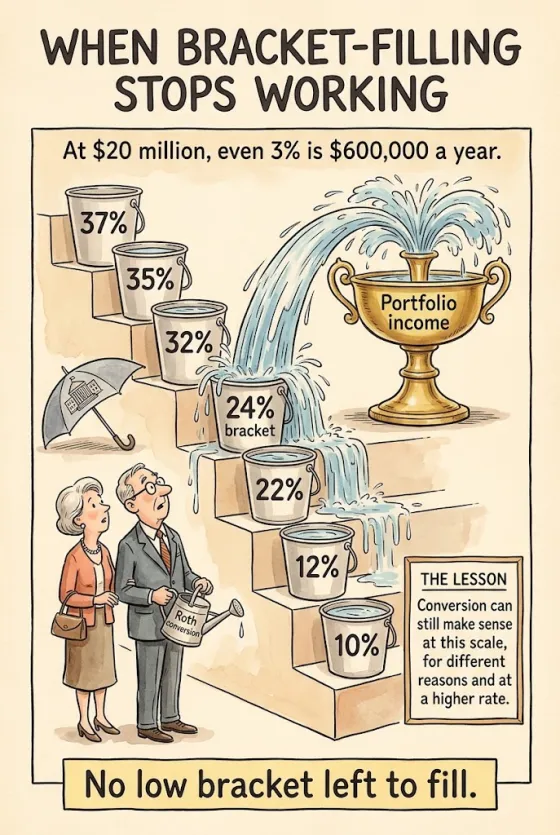
The situation Helen and Arturo Vance are 66 and 64 and retired after selling a business. Most of their money sits in a taxable brokerage account, with $10 million of it in a Treasury fund, and $5.5 million is in a traditional IRA. Everything they read says retirees should convert to Roth in their low-income years. Their portfolio's interest alone already puts them in the 32% bracket. Is a Roth conversion still worth doing, and how?
How to use this case study
New to the Learning Center, or want a map of the panels? Start with a tour: Reading Lesson (Getting Around) or Screencast Lesson (Getting Around) — both walk through Tutilis next to a live planThe running Tutilis product next to this lesson — navigation, Bird's Eye, Forecaster, tools, and more — loaded with a teaching sample. A dossier is the plan data; the live plan is the full product surface with a sample dossier already open so you can explore. On the web, teaching samples are not editable the way your own dossier will be in the full app.Full entry → (to the right on a desktop-width screen, or below when stacked on a tablet).
This page — When bracket-filling stops working — can open more than one live sample planThe running Tutilis product next to this lesson — navigation, Bird's Eye, Forecaster, tools, and more — loaded with a teaching sample. A dossier is the plan data; the live plan is the full product surface with a sample dossier already open so you can explore. On the web, teaching samples are not editable the way your own dossier will be in the full app.Full entry → next to the text (to the right on a wide screen, or below on a tablet). Use the Live plans chips (and matching colored links in the prose) to switch without leaving this page; the colored bar near the plans shows which one is loaded. The walk-through stays in the text.
The live planThe running Tutilis product next to this lesson — navigation, Bird's Eye, Forecaster, tools, and more — loaded with a teaching sample. A dossier is the plan data; the live plan is the full product surface with a sample dossier already open so you can explore. On the web, teaching samples are not editable the way your own dossier will be in the full app.Full entry → next to this page — usually to the right on a wide screen, or below on a tablet — is Tutilis running a teaching sample: the same financial planning product available as a desktop application (early preview). A dossierYour full plan in Tutilis: the people in the household, what they own and owe, cash flows in and out, tax setting, and planning assumptions. One dossier is one complete situation as the product models it.Full entry → is the plan data; the live plan is the full product (navigation, Bird's Eye, Forecaster, tools) with a sample dossier already open so you can try the panels. See planned pricing. On the web, Learning Center samples are not editable the way your own dossier will be in the full app. Your own household goes in the Tutilis desktop app — the Learning Center front page has a short clip of that.
Most advice about a Roth conversionDeliberately moving money from a traditional account into a Roth one and paying the income tax on it now, so it grows and comes out tax-free later. The usual reason is a low-income year — between retiring and claiming benefits, say — where the conversion is taxed at a lower rate than the future withdrawal would be. It also shrinks later RMDs.Full entry → describes the same picture. A household stops working, its income drops, and for a few years before Social Security and required distributions begin, the low tax bracketsA band of income taxed at a given rate. The common misreading is that entering a higher bracket taxes all your income at that rate — it does not. Only the dollars inside that band pay the higher rate, so a raise never leaves you with less after tax.Full entry → sit empty. Converting enough each year to fill them moves money into a Roth at a low rate. That picture assumes the household's income really does drop. A large taxable portfolio pays interest and dividends every year whether anyone works or not, and at $20 million even 3% is $600,000 a year. This lesson follows one HNWHigh net worth — shorthand for a household wealthy enough that different planning problems dominate. Surcharge tiers, the investment surtax, and estate questions bind earlier, while running out of money is rarely the binding risk. There is no single official dollar line.Full entry → couple through three plans to show where bracket-filling stops working, what municipal bonds change and what they cost, and the reasons a conversion can still make sense at the top of the brackets.
Helen is 66 and Arturo is 64. They sold their business, retired, and now have about $27 million. They spend about $420,000 a year, and both will claim Social Security at 70. The three main plans have no state selected, so their tax figures are federal. Two more plans repeat the bond comparison in California, and Where to retire on $20 million takes up the state in full.
| Account | Balance | What it holds |
|---|---|---|
| Joint brokerageAn ordinary taxable investment account — no special retirement wrapper, no contribution limit, and no withdrawal age rules. The trade-off is that dividends and realized gains are taxed as they happen rather than deferred. Often called the taxable bucket next to traditional and Roth.Full entry → | $18.5 million | A US stock index fund ($7 million), an international stock fund ($1.5 million), and an intermediate Treasury fund ($10 million) |
| Helen's traditionalA retirement account where the tax is paid on the way out — not a description of an old-fashioned account. Money went in before income tax, grew untaxed, and is taxed as ordinary income when you take it out — traditional 401(k)s and IRAs work this way. The contrast is Roth (taxed going in, tax-free coming out) and taxable (brokerage, taxed as you go).Full entry → IRA | $5.5 million | A US stock index fund |
| Helen's RothA retirement account where you pay income tax on the money going in, and qualified withdrawals later come out tax-free — the mirror image of traditional. Named after the senator behind the law, so the word tells you nothing on its own. Plans care because Roth dollars do not add to taxable income later, which keeps them clear of income-driven cliffs.Full entry → IRA | $400,000 | A US stock index fund |
| Cash | $600,000 | A money market fund |
| Home | $2.5 million | Paid off |
They spend from the taxable account first and leave the IRAIndividual Retirement Account — a retirement wrapper you open yourself rather than through an employer. It comes in traditional (pre-tax going in) and Roth (taxed going in) flavors, so naming the flavor matters more than the acronym does.Full entry → alone, the order most planners suggest. Each plan carries a Roth conversion policy for every forecast year from 2027 through 2034, the years before Helen's first required distribution in 2035.
- Treasuries, fill to 24% asks the plan to convert enough each year to fill ordinary incomeIncome taxed at the regular graduated rates — wages, interest, pension payments, and withdrawals from traditional retirement accounts. The point of the label is the contrast: long-term capital gains and qualified dividends get their own, usually lower, rate schedule.Full entry → to the top of the 24% bracket.
- Munis, fill to 24% is the same plan with the $10 million bond sleeve in a national municipal bond fund instead of Treasuries.
- Fixed $500k a year keeps the Treasuries and converts a fixed $500,000 a year instead of filling a bracket.
A taxable portfolio pays three kinds of income without being asked. A bond fund pays interest, which is ordinary income. A stock fund pays dividends, which are mostly qualifiedA dividend that meets the holding-period and issuer conditions, so it is taxed on the lower long-term capital-gain schedule rather than at ordinary rates. Same cash as an unqualified one; a materially smaller tax bill.Full entry → and taxed at lower rates. A fund that sells holdings at a gain passes the gain out as a capital-gain distributionA fund passing its own realized gains through to you. The trap is that it is taxable in the year it is paid even though you sold nothing — the fund did the selling. Distinct from the gain you realize by selling your shares.Full entry →. None of it waits for the household to decide it needs the money.
For Helen and Arturo the bond sleeve is the large one. Ten million dollars in a Treasury fund paying about 4.4% is about $440,000 of interest a year, and the cash adds more. Open the federal statement for 2027 on Treasuries, fill to 24%.
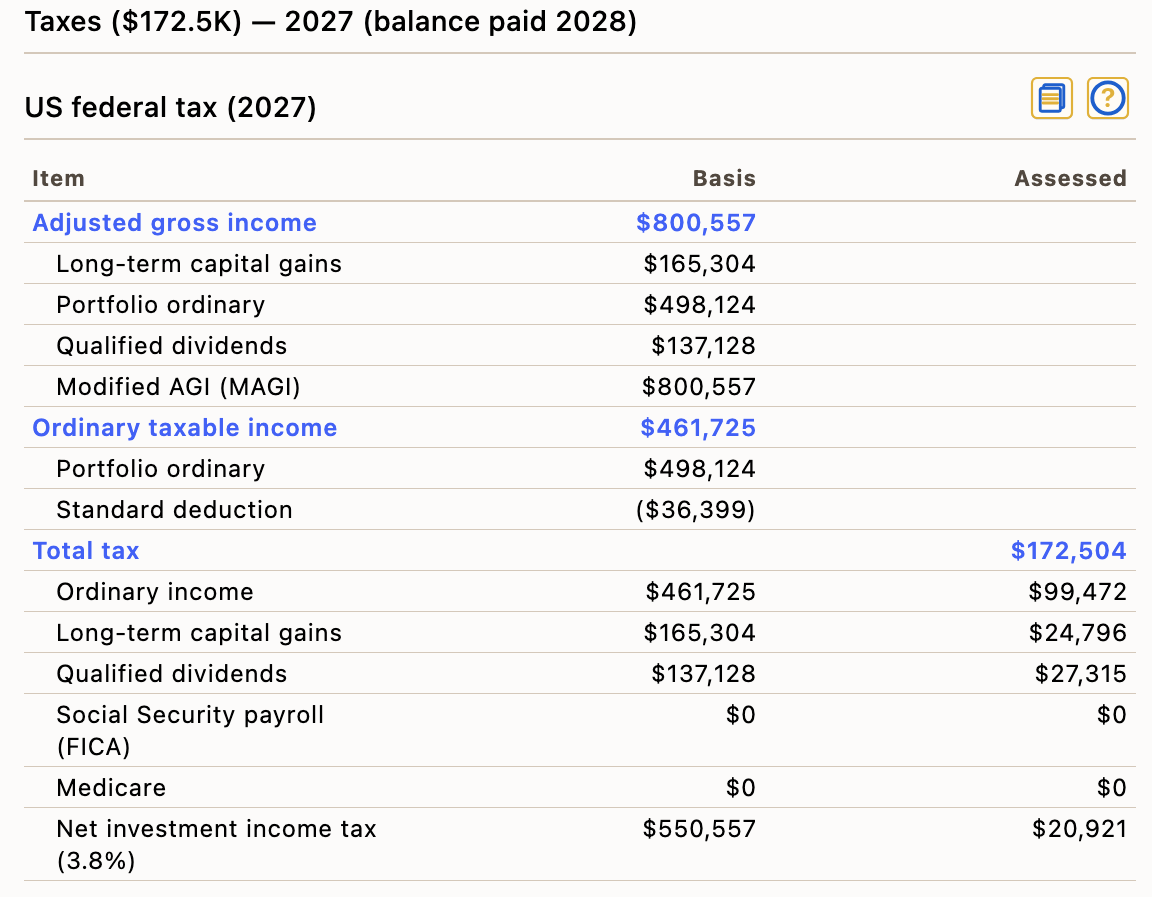
The 2027 federal statement. Portfolio ordinary income is about $498,000. There is no IRA withdrawal at all, yet ordinary taxable income is about $462,000 after the standard deduction.
The top of the 24% bracket for a married couple is about $414,000 of taxable incomeWhat the rates are finally applied to — income after adjustments and deductions, not what you earned. It sits at the bottom of the page: gross income, then AGI, then this. Most people's taxable income is meaningfully smaller than their pay, which is why a bracket alone never tells you the tax.Full entry → in 2027. Their interest alone is past it, before any Social Security and eight years before any required distribution. Every extra dollar of ordinary income they could add this year is taxed at 32%, and their interest also owes the 3.8% net investment income taxNet Investment Income Tax — an extra tax (commonly cited at 3.8%) on investment income once income passes a threshold. It applies on top of ordinary income tax rather than instead of it, which is why a plan can show the same dollar taxed on more than one line.Full entry →.
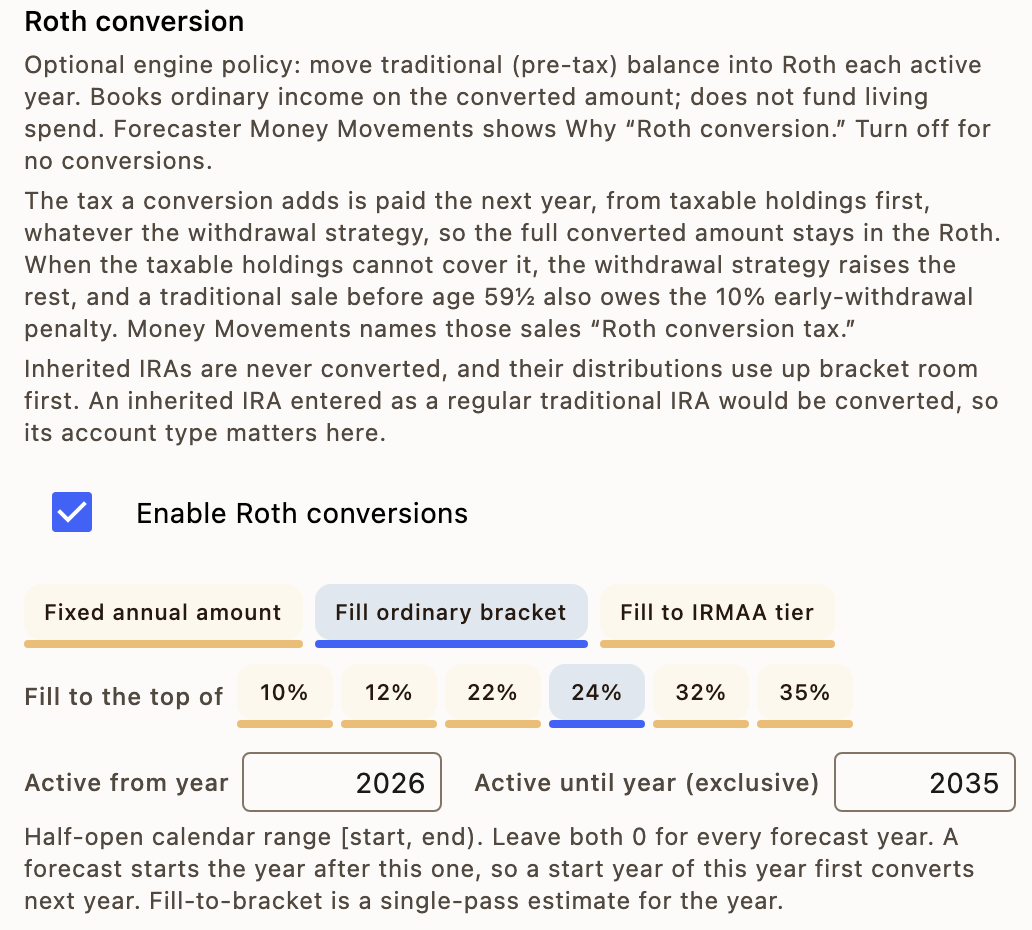
The Roth conversion policy on this plan is the one most guides describe. It converts just enough each year to fill ordinary income up to the top of the 24% bracket.
Desktop app only
The policy is Roth conversion under  AssumptionsA main-rail area. The rules the forecast runs under — growth, taxes, movements, success definition, locality, currency. Read and write.. Choose a fixed yearly amount, fill to a tax bracket, or fill to an IRMAAIncome-Related Monthly Adjustment Amount — a surcharge on Medicare premiums for higher-income households. It works in tiers, so one dollar of extra income can raise the premium for a whole year. It looks back at a tax return from a couple of years earlier, which is why a one-off spike (a big conversion, a property sale) shows up as a bill much later.Full entry → tier, and the years it runs.
The bracket is already full, so the policy has nothing to fill. In the Brackets view each year is a column of income stacked through the brackets. Every column from 2027 to 2034 reaches into the 32% bracket from portfolio income alone, and no year has a conversion layer.
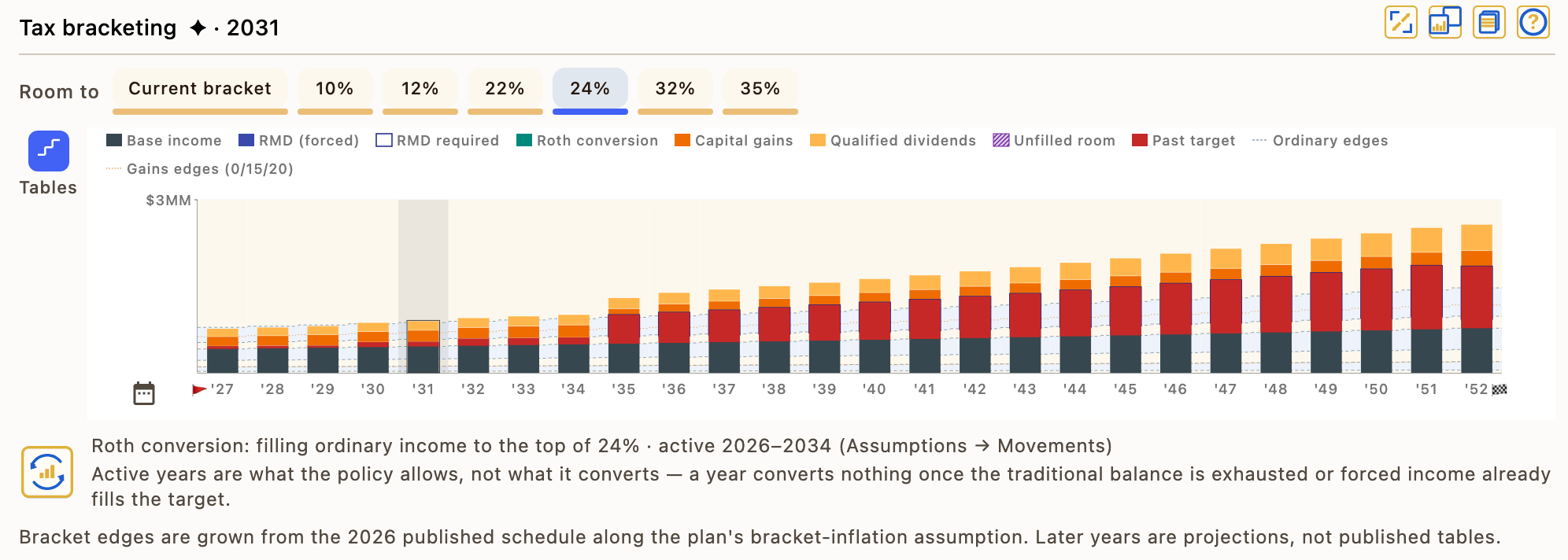
The Brackets view for Treasuries, fill to 24%. Portfolio income fills each column into the 32% bracket and the policy converts nothing. From 2035 the required distributions on the untouched IRA push every year into the 37% bracket.
This is the policy working correctly. A fill-to-bracket rule only has something to do when there is an empty bracket below the household's income, and a portfolio this size fills those brackets itself. Raising the target does not rescue it either. The 37% bracket has no top, so "fill to 37%" has no amount to aim at, and a household at this level chooses a conversion amount on purpose instead of filling a bracket.
The cost of doing nothing arrives in 2035. The IRA has grown untouched for eight years, and its first required distribution is about $385,000. Stacked on the interest, that puts every year from then on in the 37% bracket. Forced traditional RMDs shows the same pressure on a smaller household.
A municipal bondDebt issued by a state or local government. Its interest is normally excluded from federal AGI — which is what the industry label *tax-exempt* means, and all it means. The same dollars still count in MAGI, and most states add back interest from other states' issuers on their own return.Full entry → pays interest that is excluded from federal taxable income. Swapping the Treasury fund for a municipal fund lowers the floor the conversion has to sit on. Switch to Munis, fill to 24%, where nothing has changed except the bond sleeve.
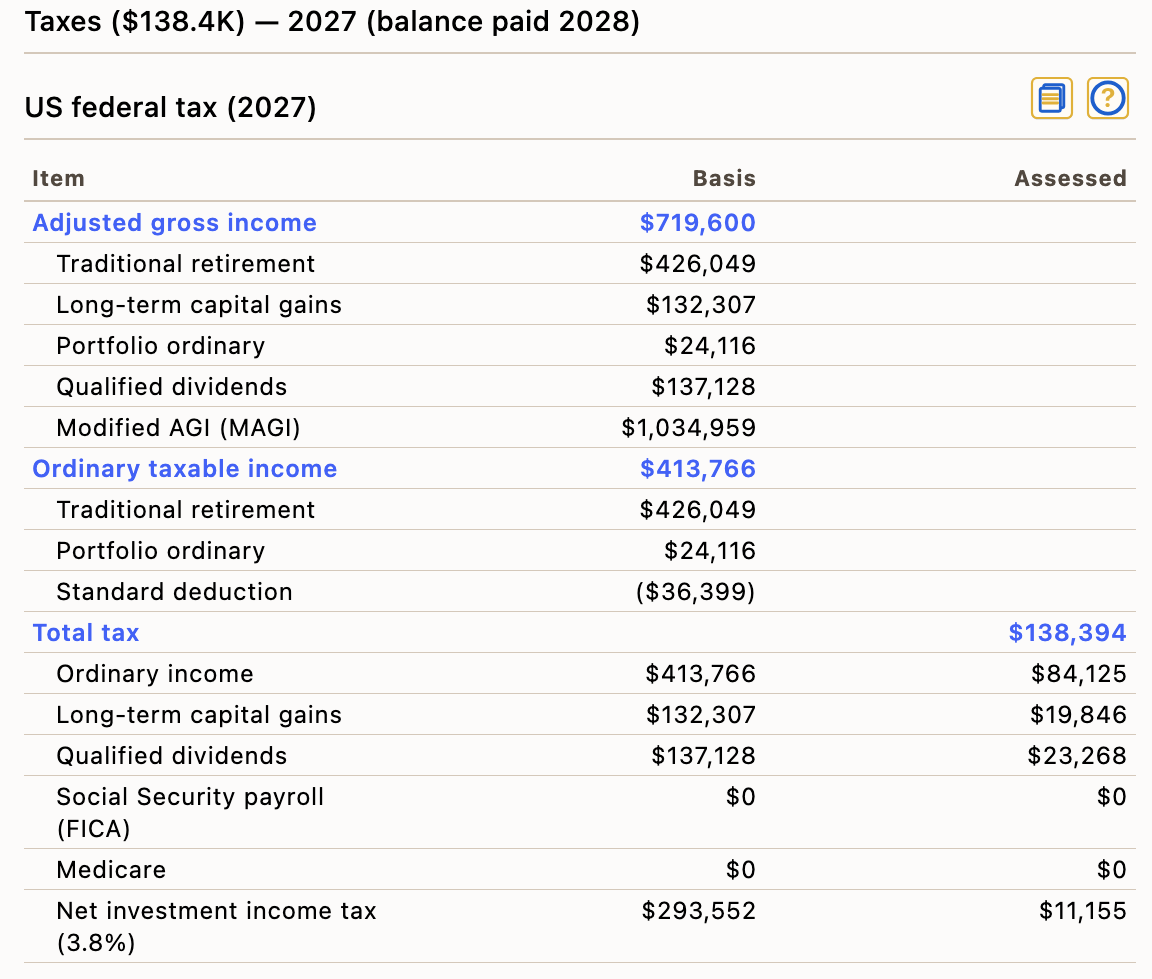
The 2027 federal statement on Munis, fill to 24%. Portfolio ordinary income falls to about $24,000, the cash fund's interest. The conversion adds about $426,000 of traditional retirement income, and ordinary taxable income lands exactly at the top of the 24% bracket.
The same policy now converts about $426,000 in 2027 and a similar amount every year through 2034. The conversion room did not come from earning less. It came from income that the federal return no longer counts as taxable.
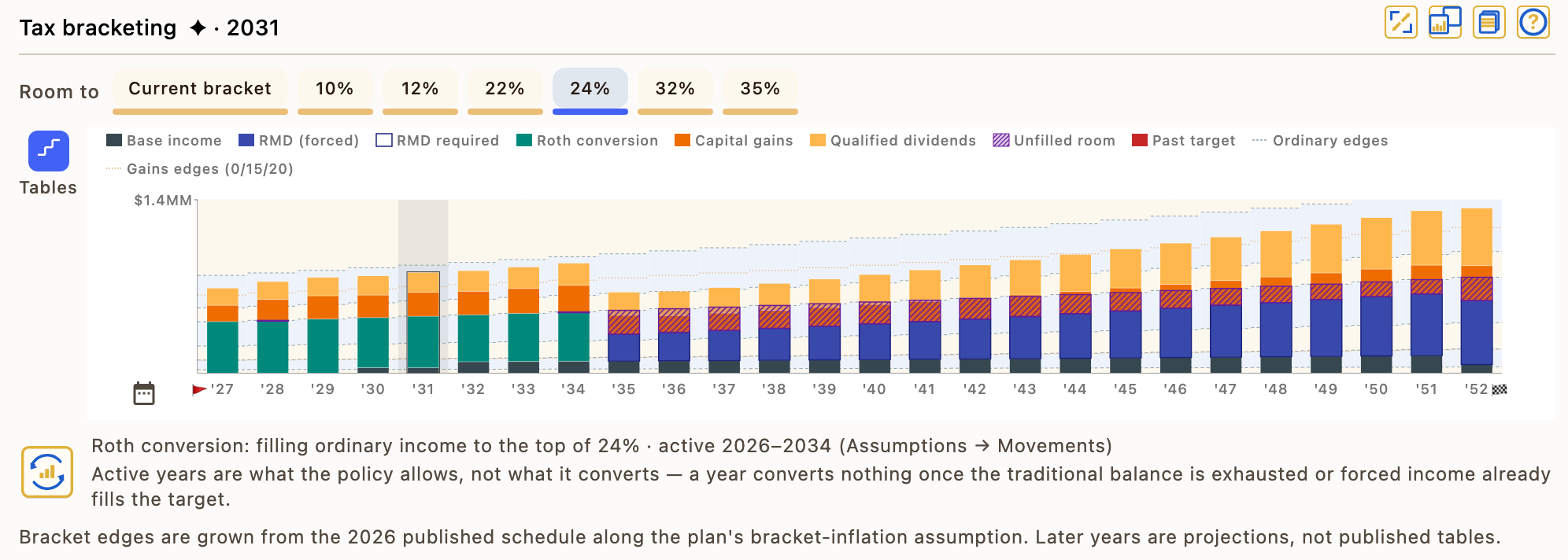
The Brackets view for Munis, fill to 24%. From 2027 to 2034 each column is almost entirely Roth conversion, stopping at the top of the 24% bracket. The IRA is smaller by 2035, so the required distributions that follow stay inside the 24% bracket.
Two things about munis stay true even here. The interest still counts in MAGIModified Adjusted Gross Income — AGI with certain deductions added back. It matters far out of proportion to the small adjustment, because MAGI is the figure that triggers cliffs: Medicare surcharges, the investment surtax, and health-subsidy eligibility all test against a MAGI, and each rule uses a slightly different one.Full entry →, so the 2027 statement shows MAGI about $315,000 above AGIAdjusted Gross Income — total income minus a specific set of adjustments, and the number many other tax rules build on. It is a midpoint, not your taxable income: deductions still come off after it.Full entry →, and Medicare premiums are figured on MAGI. At this income both plans already pay the top Medicare surchargeAn extra amount added on top of a normal charge once income passes a line — in planning, almost always the Medicare premium surcharge. It is not a tax rate, so it does not show up in a bracket; it arrives as a higher premium, in tiers, based on a tax return from two years earlier.Full entry →, so the added MAGI costs nothing more. When tax-exempt interest still shows up on the bill covers the MAGI and state-tax side in detail.
Munis also pay less. The municipal fund here yieldsThe income an investment pays out — interest or dividends — as a percentage of its price. It is not total return: a holding can yield 4% and still lose value over the year. Chasing yield alone is how a portfolio quietly takes on risk it was not paid for.Full entry → 3%, against about 4.4% for the Treasury fund. Whether the swap pays depends on the bracket. At a marginal rate of 32% plus the 3.8% investment income tax, a 3% tax-freeNo income tax due when the money comes out — the Roth promise, and the reason Roth dollars keep a withdrawal clear of income-driven thresholds. The word hides a condition: the withdrawal has to be qualified, which turns on age and how long the account has been open. It also hides a scope: municipal-bond interest is tax-free on the federal return yet still counts toward whether Social Security is taxed.Full entry → yield is worth about as much as a 4.7% taxable one. Helen and Arturo are in that bracket or higher, so the muni sleeve keeps more after tax even before the conversion room it opens. A household in the 12% bracket would usually do better with the taxable bond.
That comparison has no state in it, and a state can change it. States cannot tax Treasury interest, and California taxes the interest on other states' municipal bonds, so a national muni fund gives up about 11.3% of its yield there at this income. On the $10 million sleeve the two funds compare like this.
| After-tax yield | No state tax | In California |
|---|---|---|
| Treasury fund, 4.4% | 2.82% | 2.82% |
| National muni fund, 3.0% | 3.00% | 2.66% |
| Better yield | Munis, by about $18,000 a year | Treasuries, by about $16,000 a year |
So in California the muni fund loses its yield advantage. The conversion room still opens, because that part is federal, and the conversions are worth more than the yield. Region's comparison shows it, with cost of living and wages off so that only the taxes differ. Click either figure to open it on its plan. On the GMFGMF ✦ (also FID 0 / GMF) is the product north star — the deterministic geometric mean forecast path you steer by, not a random Monte Carlo draw and not “most likely.” Prefer it for a stable year-by-year read of the plan. Switch away when you want to explore other randomized scenarios or paths in the multi-path cloud. The ✦ mark matches the live FID control (compass / north star, not a rating star).Full entry → path, Munis, fill to 24% still ends ahead of Treasuries, fill to 24% in California, about $65.9 million to about $63.3 million, a smaller lead than the roughly $4.8 million it has with no state tax. Over 1,000 paths the medianThe middle outcome — half above, half below — as against the average, which a few enormous results can drag upward. Over long horizons the two come apart badly, and the median is the one that answers "what does a typical path look like?"Full entry → says the same, about $71.6 million to about $67.8 million. The weak paths say otherwise: at the 10th percentileA position along outcomes sorted from worst to best. The 10th percentile (P10) is the outcome only one in ten falls below; the 50th is the median; the 90th (P90) is the one only one in ten beats. Forecasts report P10 and P90 to show the downside and upside without leaning on the single best or worst run.Full entry → the muni plan ends about $2 million behind, against about $700,000 behind with no state tax. New York works much the same way, and a household that might move has a reason to look at both states before it converts.

Treasuries, fill to 24% with California added.

Munis, fill to 24% with California added.
A municipal bond is a loan to a state, a city, or an authority that runs a project such as a toll road, a hospital or a water system. Some are paid from the issuer's general taxes. Others are paid only from what the project earns. Either way, the bond is only as good as the borrower's ability to pay. The chance that it pays late, pays less, or stops paying is credit riskThe chance that a borrower pays late, pays less than promised, or stops paying. Every bond carries some except US Treasuries, which are treated as free of it. A municipal bond is only as sound as the state, city, or project behind it, and a higher yield is usually the price a borrower pays for more of this risk.Full entry →.
Treasuries are treated as free of credit risk, because the federal government borrows in the currency it issues. Municipal bonds are not. Defaults on rated municipal bonds have been rare, far rarer than on corporate bonds of the same rating, but they happen. Detroit's bankruptcy in 2013 cut payments to some of its bondholders, and Puerto Rico restructured most of its debt after 2017. A household that buys the bonds of its own state for the state tax break also ties a large share of its money to one state's finances.
The forecast cannot show this risk. The muni fund in this plan carries price swings like any bond fund, but no plan in Tutilis models a default as an event. When Munis, fill to 24% ends ahead of the Treasury plan, part of what it is showing is the absence of a risk the model does not draw.
Bracket-filling is one reason to convert, and at this level of wealth it is usually unavailable. Other reasons get stronger as wealth rises.
- Required distributions stack on the floor. A large IRA left alone grows, and its required distributions are added on top of the portfolio income. A dollar converted at 35% now may otherwise come out at 37% later.
- A survivor files alone. When one spouse dies, the other files as single, and the single brackets are about half as wide. The same income is taxed at higher rates for the rest of the survivor's life.
- Heirs pay the tax on what is left. Most heirs must empty an inherited traditional IRAA traditional IRA held by someone who inherited it. It keeps its tax character, so every withdrawal is ordinary income, but the owner's lifetime RMD rules stop at the death and the beneficiary rules take over: for most adult children, the account must be empty by the end of the tenth year after the death. No one may contribute to it, and withdrawals carry no 10% early-withdrawal tax at any age.Full entry → within ten years, on top of their own earnings. Inheriting an IRA: the 10-year rule shows how that lands. A Roth passes to them tax-free.
- A gift to charity can skip the income altogether. From age 70½, an IRA owner can send up to $111,000 a year (2026) straight from a traditional IRA to a charity. This qualified charitable distributionFrom age 70½, an IRA owner can send money straight from a traditional IRA to a charity, up to $111,000 per owner in 2026. It counts toward the required distribution and never enters income, so it stays out of AGI, MAGI and the taxes figured on them.Full entry → counts toward the required distribution and is never taxed. It helps a household that gives, and the plans here do not assume these two do.
- Above the estate exemption, conversion tax leaves the estate. The federal estate taxA tax on what a person owns at death, paid by the estate before heirs receive it. The federal tax applies only above a large exemption ($15 million per person in 2026) at a top rate of 40%. About a dozen states and the District of Columbia have their own estate tax, most with far lower exemptions.Full entry → takes up to 40% of an estate above the exemption, which is $15 million per person in 2026. The estate here, about $70 million, is well above it. Income tax paid on a conversion is money that is no longer in the estate, and a traditional IRA gets no step-up in basisAt death, the cost basis of investments in a taxable account, and of real estate, resets to their market value that day. The gains built up during the owner's life are never taxed as income, and an heir who sells right away owes little or no capital-gains tax. A traditional IRA gets no step-up.Full entry → at death, while the taxable account does.
Fixed $500k a year keeps the Treasuries and converts $500,000 every year from 2027 through 2034. With the floor already in the 32% bracket, that $500,000 runs through the 35% bracket into the 37% bracket. The household pays more tax in those eight years. In return, the IRA is about half the size by 2035, and the first required distribution is about $182,000 instead of about $385,000. The later years stay in the 35% bracket instead of the 37% bracket.
Comparing these plans by ending net worth misleads, because net worth counts a dollar in a traditional IRA the same as a dollar in a Roth. The traditional dollar still owes income tax, and the Roth dollar owes none. Tutilis's outcome card adds a row for this: the ending net worth after the income tax heirs would still owe on traditional balances, at 24% unless you choose another rate.
Read that row on each plan, with the simulation set to 1,000 paths so the comparison is steady. At the medianThe middle outcome — half above, half below — as against the average, which a few enormous results can drag upward. Over long horizons the two come apart badly, and the median is the one that answers "what does a typical path look like?"Full entry →, Fixed $500k a year leaves the heirs about $1.2 million more than Treasuries, fill to 24%, on an estate of about $70 million. Heirs of an estate this size are likely to pay more than 24%, and at a 37% heir rate the fixed plan's lead grows.
The weak paths tell the other half. At the 10th percentileA position along outcomes sorted from worst to best. The 10th percentile (P10) is the outcome only one in ten falls below; the 50th is the median; the 90th (P90) is the one only one in ten beats. Forecasts report P10 and P90 to show the downside and upside without leaning on the single best or worst run.Full entry → the fixed plan ends a little behind. The conversion tax is paid up front, and in a poor market the Roth has less growth with which to earn it back. A conversion at the top rate is a bet that the money will grow and that later rates will be at least as high, and on most paths that bet pays modestly.
The difference is small beside the estate, and that is a fair description of the trade at this level. A conversion at 37% is close to even, and it wins at the margins: smaller required distributions, fewer years at the top rate for the survivor, and less taxable income for the heirs. The estate-tax argument from the last section adds to it. These plans have estate tax switched on, so the outcome card also has an After estate tax column. At the median, the fixed plan's estate pays about $260,000 less federal estate tax than the fill-to-24% plan's, because the conversion tax has already left the estate. The card keeps the two adjustments apart: the after-estate column does not also take off the income tax the heirs still owe on the traditional IRA, and the heirs' row does not take off the estate tax. Read together, both favor the conversion.
Munis, fill to 24% ends well ahead of both, because it pays far less tax every year. That holds with no state tax. Read the lead together with the credit-risk section above and the California plans under Lowering the floor with munis.
- The estate tax and the heirs' income tax are not combined. The outcome card shows each on its own. Heirs who inherit a traditional IRA from a taxable estate can also deduct the estate tax paid on it from their income tax, which this does not model.
- The plan stops before a survivor's first return. The forecast changes a survivor's filing statusWhich set of tax tables applies — single, married filing jointly, and the less common ones. It sets the bracket widths, the standard deduction, and most of the income thresholds a plan tests against, so a household's filing status changes what every other tax number means.Full entry → the year after a death, but Arturo dies in 2052 and that is the plan's last year, so these plans file jointly for their whole length. To see the survivor's narrower brackets, raise Helen's death age so the plan runs past 2052.
- The heirs' rate is one flat number. Real heirs spread an inherited IRA over ten years at their own rates, which this does not model.
- No default is ever modeled. The municipal fund's credit risk is described, not simulated.
- Only the two California plans have a state. State income tax on a conversion, and state tax on municipal interest from other states, both change the answer. Where to retire on $20 million takes up the state.
A conversion at this size is usually planned with a tax professional and an estate attorney, alongside trusts, gifts and charitable plans this forecast does not represent. The plan gives that conversation numbers.
A large taxable portfolio pays an income floor of its own, and at this level the floor can fill the brackets that conversion advice is built around. A fill-the-bracket policy then converts nothing, and that is the correct answer to the question it was asked. Municipal bonds lower the floor and bring the room back, at the price of credit risk. Above the floor, a conversion is an amount chosen on purpose, and it is judged by later rates, the survivor's brackets, the heirs and the estate rather than by the bracket it fills.
Rebuild this plan by hand
The cards on the canvas show the accounts and cash flows. These are the settings that live outside any card, read from each plan this lesson opens, with the label each control carries in the app. A value marked default is one to leave alone.
| Setting | Treasuries, fill to 24% | Munis, fill to 24% | Fixed $500k a year |
|---|---|---|---|
| Household | |||
| Planning region | United States (default) | United States (default) | United States (default) |
| Helen (Primary) | |||
| birth year | 1960 | 1960 | 1960 |
| retirement age | 64 | 64 | 64 |
| death age | 93 | 93 | 93 |
| Arturo (Secondary) | |||
| birth year | 1962 | 1962 | 1962 |
| retirement age | 62 | 62 | 62 |
| death age | 90 | 90 | 90 |
| Taxes | |||
| Tax regime | United States | United States | United States |
| Filing status | Married, filing jointly | Married, filing jointly | Married, filing jointly |
| State of residence | None | None | None |
| First-year federal estimate | — | — | — |
| First-year state estimate | — | — | — |
| Strategy | |||
| Residual withdrawal strategy | Tax-account order | Tax-account order | Tax-account order |
| Roth conversions | Fill ordinary bracket, to the top of 24% | Fill ordinary bracket, to the top of 24% | Fixed annual amount, $500,000 |
| Roth conversions active | 2026 → 2035 (exclusive) | 2026 → 2035 (exclusive) | 2026 → 2035 (exclusive) |
| Definition of success | Liquidity crises allowed (default) | Liquidity crises allowed (default) | Liquidity crises allowed (default) |
| Glide path target | None (default) | None (default) | None (default) |
| Advanced | |||
| Reporting inflation | Assumption set's rate (default) | Assumption set's rate (default) | Assumption set's rate (default) |
| Cost of capital | Assumption set's rate (default) | Assumption set's rate (default) | Assumption set's rate (default) |
| Growth assumptions | Growth overrides (default) | Growth overrides (default) | Growth overrides (default) |
| Currencies | Multiple currencies (default) | Multiple currencies (default) | Multiple currencies (default) |
| Default currency | USD (default) | USD (default) | USD (default) |
| Display currency | USD (default) | USD (default) | USD (default) |

Educational content — not advice. These lessons teach how Tutilis models a plan and how to read what it shows. The households, balances, and outcomes in them are invented for teaching. Nothing here is financial, investment, tax, or legal advice, or a recommendation to buy, sell, or hold anything. A model cannot know your circumstances — check anything you take from a lesson against your own situation, and against a qualified professional where it matters.