This lesson uses 2 sample plans — switch anytime; color matches the bar between the columns.
On the right now: Well over the line

 A wealth tax on your plan: what 2% a year above $50 million would cost
The situation Nadia and Graham are 59 and 61. They sold the company they built in 2025, retired, and now have about $110 million. Their federal income tax runs a little under $1 million a year. Every few months a headline says a wealth tax is coming. Would 2% a year above $50 million be a rounding error for them, or would it change their plans?
How to use this case study
New to the Learning Center, or want a map of the panels? Start with a tour: Reading Lesson (Getting Around) or Screencast Lesson (Getting Around) — both walk through Tutilis next to a live planThe running Tutilis product next to this lesson — navigation, Bird's Eye, Forecaster, tools, and more — loaded with a teaching sample. A dossier is the plan data; the live plan is the full product surface with a sample dossier already open so you can explore. On the web, teaching samples are not editable the way your own dossier will be in the full app.Full entry → (to the right on a desktop-width screen, or below when stacked on a tablet).
This page — A wealth tax on your plan: what 2% a year above $50 million would cost — can open more than one live sample planThe running Tutilis product next to this lesson — navigation, Bird's Eye, Forecaster, tools, and more — loaded with a teaching sample. A dossier is the plan data; the live plan is the full product surface with a sample dossier already open so you can explore. On the web, teaching samples are not editable the way your own dossier will be in the full app.Full entry → next to the text (to the right on a wide screen, or below on a tablet). Use the Live plans chips (and matching colored links in the prose) to switch without leaving this page; the colored bar near the plans shows which one is loaded. The walk-through stays in the text.
The live planThe running Tutilis product next to this lesson — navigation, Bird's Eye, Forecaster, tools, and more — loaded with a teaching sample. A dossier is the plan data; the live plan is the full product surface with a sample dossier already open so you can explore. On the web, teaching samples are not editable the way your own dossier will be in the full app.Full entry → next to this page — usually to the right on a wide screen, or below on a tablet — is Tutilis running a teaching sample: the same financial planning product available as a desktop application (early preview). A dossierYour full plan in Tutilis: the people in the household, what they own and owe, cash flows in and out, tax setting, and planning assumptions. One dossier is one complete situation as the product models it.Full entry → is the plan data; the live plan is the full product (navigation, Bird's Eye, Forecaster, tools) with a sample dossier already open so you can try the panels. See planned pricing. On the web, Learning Center samples are not editable the way your own dossier will be in the full app. Your own household goes in the Tutilis desktop app — the Learning Center front page has a short clip of that.
Nadia is 59 and Graham is 61. In 2025 they sold the software company they had built over twenty years, and both of them retired. They now have about $110 million. Most of it sits in a taxable brokerageAn ordinary taxable investment account — no special retirement wrapper, no contribution limit, and no withdrawal age rules. The trade-off is that dividends and realized gains are taxed as they happen rather than deferred. Often called the taxable bucket next to traditional and Roth.Full entry → account, and about $12 million is in two houses in Florida. They plan to spend $1.4 million a year, and their federal income tax comes to a little under $1 million a year. This lesson measures the wealth tax impact on a plan like theirs.
Every few months a headline tells them a wealth tax is coming. In March 2026, Senator Elizabeth Warren reintroduced a bill that would tax every household's net worth above $50 million at 2% a year. In November 2026, Californians voted on a one-time 5% tax on billionaires. Nadia and Graham want to know whether a tax like that would be a rounding error for them or would change their plans.
This lesson answers that question in two parts. The first part covers the background: what a wealth tax is, what is proposed today, whether the US has ever had one, how other countries have fared and what the revenue studies say. The second part lays Warren's first bracket over their plan with a what-if in  TransformsA main-rail area. The name is Transforms because you transform a copy of the plan — a what-if — without rewriting the original dossier. Compare original vs modified side by side. and reads what it costs them each year and over their lives.
It opens two plans:
- Well over the line is Nadia and Graham's plan, about $110 million, retired and spending $1.4 million a year.
- Under the line today is Priya and Sam, a working couple in their late forties worth about $28 million. A $50 million exemption leaves them out today, and the lesson asks how long that lasts.
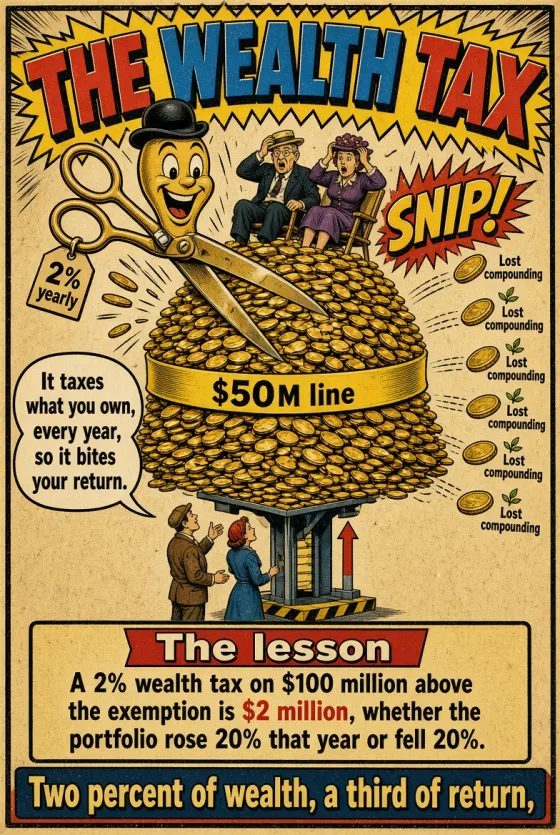
An income tax is charged on what you earn in a year. A wealth tax is charged on what you own. Each year the household adds up the value of everything it holds, subtracts its debts, subtracts an exemption, and pays a percentage of what is left. A 2% wealth tax on $100 million above the exemption is $2 million, whether the portfolio rose 20% that year or fell 20%.
Most Americans already pay one wealth tax without calling it that. A property tax is a yearly percentage of what a house is worth, and it is due whether or not the house earned anything. Property tax, the silent killer shows what that does to a household over a lifetime. A net worth tax applies the same idea to stocks, bonds, private businesses and everything else.
The difference that matters most for a plan is what the tax is measured against. Because a wealth tax takes a share of the whole pile every year, it is best understood as a share of the pile's return. A portfolio that earns 6% a year and pays 2% of its value in wealth tax gives up a third of its return before any income tax is charged. That is why a rate that sounds small can change a plan a great deal.
The math — a wealth tax as a tax on the return
Let W be the taxable wealth, r the return it earns in a year and τ the wealth tax rate. The wealth tax is τW. The return is rW. As a share of the return, the wealth tax is
τW ÷ rW = τ ÷ r
At τ = 2% and r = 6%, that is one third, an income tax of about 33% on the year's return. At r = 4% it is one half. In a year when the return is zero or negative, the share is undefined, because the tax is still due and there is nothing to take it from but the principalThe amount itself — the money lent, borrowed, or invested, as against the interest or growth on top of it. On a mortgage payment it is the part that actually reduces the debt; early on, most of the payment is not principal. (Not *principle*, and not a person.)Full entry →.
An exemption changes the arithmetic only for the part of the wealth below the line. For Nadia and Graham, the first $50 million is untaxed, so in 2027 their bill is about 1.2% of their whole net worth, which is still about a fifth of a 6% return. It is charged on top of the income tax already due on the same return.
There is no federal wealth tax in the United States today, and none of the bills below has passed a committee. These are the proposals a household like Nadia and Graham's hears about most often.
| Proposal | Who pays | Rate | Threshold indexed? | Status (October 2026) |
|---|---|---|---|---|
| Ultra-Millionaire Tax Act (Warren), S.4246, 2026 | Households worth more than $50 million | 2% a year on net worth from $50 million to $1 billion, 3% above $1 billion | No | Introduced March 2026, referred to the Senate Finance Committee |
| Make Billionaires Pay Their Fair Share Act (Sanders and Khanna), S.3956, 2026 | Individuals and trusts worth more than $1 billion | 5% a year | Yes | Introduced March 2026, in committee |
| California Proposition 40, the 2026 Billionaire Tax Act | Billionaires who lived in California on January 1, 2026 | Up to 5%, once | Not applicable | On the November 3, 2026 ballot |
Warren's bill taxes "all property, real or personal, tangible or intangible, wherever situated," less debts. It does not exclude a home or a retirement account. The only carve-out is for personal belongings worth $50,000 or less each. It also includes a 40% exit tax on the net worth of anyone who gives up citizenship to avoid it. Its two thresholds are fixed dollar amounts written into the bill, a detail this lesson returns to in A line that does not move.
California's Proposition 40 is a one-time tax. It measures net worth on December 31, 2026, applies to anyone who was a resident on January 1, 2026, and can be paid over five years with an interest charge. Unlike Warren's bill, it leaves out real estate held directly, retirement accounts, and up to $5 million of other assets. California's Legislative Analyst's Office expects it to raise tens of billions of dollars over several years, and also expects the state to lose some income tax every year afterward from billionaires who move away.
Other states have debated wealth taxes without passing one. In January 2023, legislators in eight states introduced coordinated bills to tax the very rich, and several of them were wealth taxes, including California's AB 259 at 1% above $50 million. None passed. Washington considered two wealth tax bills in 2025 and passed neither. It taxes capital gains above a threshold, a tax its Supreme Court upheld in 2023 as a tax on the sale of assets rather than on the assets themselves.
Reference — taxes on the rich that are not wealth taxes
Several proposals and laws that are often mentioned alongside wealth taxes are taxes on income instead.
- The Billionaire Minimum Income Tax appeared in the Biden administration's budgets from 2023 to 2025. It would have charged households worth more than $100 million at least 25% of their income, counting gains on assets they had not sold. Treasury scored the 2025 version at about $503 billion over ten years. It was never enacted.
- The Billionaires Income Tax (Wyden, 2021 and 2023) would have taxed the yearly gain on billionaires' assets as if they had been sold. The Joint Committee on Taxation put it at $557 billion over ten years.
- Massachusetts' millionaires' surtax adds 4% to income above about $1.08 million (2025). It raised about $3 billion in fiscal 2025.
- Washington's 2026 income tax charges 9.9% on household income above $1 million starting in 2028. It is being challenged in court, and a repeal initiative went to voters in November 2026.
The federal government has never taxed net worth. The Constitution is the main reason. It requires a "direct" tax to be divided among the states by population, which a tax on wealth could never do fairly, because wealth is not spread among the states in proportion to people. In 1895, in Pollock v. Farmers' Loan & Trust Co., the Supreme Court held that a tax on income from property was a direct tax. The Sixteenth Amendment, ratified in 1913, let Congress tax incomes without dividing them among the states. It says nothing about wealth.
Whether a federal wealth tax would survive in court is still an open question. In Moore v. United States (2024), the Court upheld a one-time tax on American shareholders of foreign companies, but it took care to say what it was not deciding. Its opinion states that it does not address "taxes on holdings, wealth, or net worth" or "taxes on appreciation." Two justices who dissented would have held that the Sixteenth Amendment only allows a tax on income that has been realizedA gain that has been locked in by selling — and, in a taxable account, the moment it becomes taxable. Until then it is unrealized: the holding is worth more than you paid, but nothing has happened yet and no tax is due. The same word cuts the other way: a loss is only realized once you sell, which is why a downturn you ride through costs nothing you did not sell.Full entry →, for example by a sale. The question would be decided only if a wealth tax passed and someone challenged it.
States and cities face no such limit, and they tax wealth every day through property taxes. Some states have also taxed financial assets.
Wealth taxes were once common in Europe and have mostly been repealed. According to the OECD, 12 of its member countries taxed net wealth in 1990, and only four did in 2017: France, Norway, Spain and Switzerland. Austria, Denmark, Germany, the Netherlands, Finland, Iceland, Luxembourg and Sweden all dropped theirs, and France replaced its general wealth tax with a tax on real estate alone in 2018. The OECD found that most of these taxes raised little money. The countries that repealed them pointed to their economic and administrative costs and to their failure to reduce inequality as much as intended.
| Country | What happened |
|---|---|
| Switzerland | Has taxed wealth for more than a century, through its cantons, with low exemptions that reach the middle class. It raises about 1% of GDP, the most in the OECD, but rates are low, mostly under 1%. |
| Norway | Raised its top rate to 1.1% in 2022. Dozens of wealthy residents moved, mostly to Switzerland. Whether the change gained or lost revenue overall is still argued over. |
| Spain | Has a regional wealth tax, plus a national "solidarity" tax on fortunes above €3 million added in 2022. Its Constitutional Court upheld the national tax in 2023. |
| France | Replaced its general wealth tax with a real estate wealth tax in 2018. A proposal for a 2% minimum tax on fortunes above €100 million, the "Zucman tax," failed in 2025. |
| Germany | The Constitutional Court ruled in 1995 that valuing different assets in different ways was unconstitutional. The tax has not been collected since 1997. |
Even where wealth taxes survive, they raise a small share of revenue. In 2016 they brought in between 0.2% of GDP (Spain) and 1.0% (Switzerland), and between 0.5% and 3.7% of all tax revenue. Supporters answer that a tax with a high exemption and few loopholes, applied to a whole economy as large as the US, would perform better than Europe's taxes did. In 2024, a report commissioned by Brazil's G20 presidency proposed a coordinated 2% minimum tax on the world's roughly 3,000 billionaires, on the grounds that coordination would leave them nowhere to go.
How much a federal wealth tax would raise depends on two hard questions. The first is how well the government could value assets that do not trade, such as private companies, art and real estate. The second is how much the wealthy would do to avoid it. The estimates for Warren's plan differ mostly on the second.
| Estimate | Plan | Ten-year revenue |
|---|---|---|
| Emmanuel Saez and Gabriel Zucman, 2019 | Warren's campaign plan | $2.75 trillion |
| Penn Wharton Budget Model, 2019 | Warren's campaign plan | $2.3 to $2.7 trillion |
| Tax Foundation, 2020 | Warren's campaign plan | About $2.2 trillion, after economic effects |
| Penn Wharton Budget Model, 2021 | S.510 (2021 bill) | $2.0 to $2.3 trillion |
| Saez and Zucman, 2026 | S.4246 (2026 bill) | $6.17 trillion, assuming 15% avoidance and evasion, from about 260,000 families |
Lawrence Summers and Natasha Sarin argued in 2019 that the Saez and Zucman estimate was far too high. They pointed to the estate taxA tax on what a person owns at death, paid by the estate before heirs receive it. The federal tax applies only above a large exemption ($15 million per person in 2026) at a top rate of 40%. About a dozen states and the District of Columbia have their own estate tax, most with far lower exemptions.Full entry →, where appraisals, discounts and trusts shrink what is reported, and suggested a wealth tax might raise as little as 40% of the projection. Saez and Zucman answered that a well-designed tax could close those loopholes. The Congressional Budget Office has not scored any of the net worth tax bills.
Research on Europe's taxes measures how strongly the wealthy respond:
- Sweden. Reported wealth responded only modestly to the tax, and the response came from avoidance and evasion rather than from saving less (Seim, 2017).
- Denmark. The response was clear, and it was larger for the very wealthy (Jakobsen, Jakobsen, Kleven and Zucman, 2020).
- Switzerland. A one-point cut in the wealth tax rate raised reported wealth by at least 43% after six years. About a quarter of that came from people moving between cantons (Brülhart and others, 2022).
- Scandinavia. A one-point rise in the top rate reduced the number of wealthy taxpayers by about 2%, as some moved abroad, with small effects on the wider economy (Jakobsen, Kleven, Kolsrud, Landais and Muñoz, 2026 revision).
None of these studies says what a household should do. They do say that the revenue a wealth tax raises depends on design details, which are the same details that decide what it would cost any one household.
A plan has no wealth tax unless you add one. To price a proposal against Nadia and Graham's plan, open TransformsA main-rail area. The name is Transforms because you transform a copy of the plan — a what-if — without rewriting the original dossier. Compare original vs modified side by side. and unfold Modifications. Its Modifiables card opens on the Global tab, which lists the what-ifs that apply to the whole plan. One of them is Wealth tax. Select it:
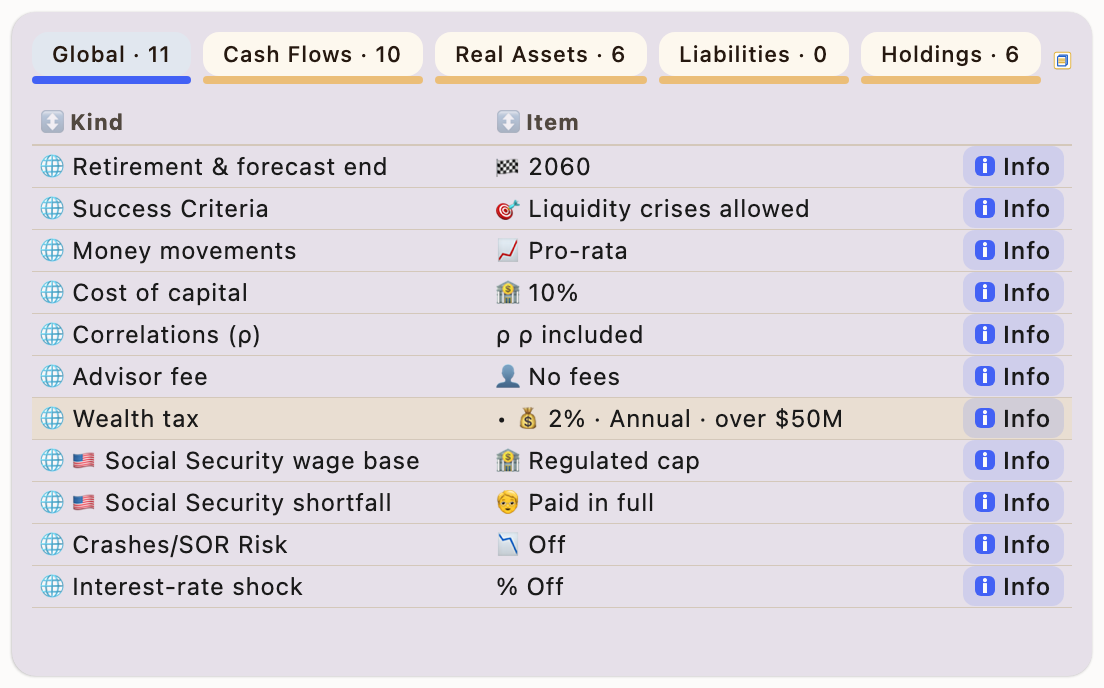
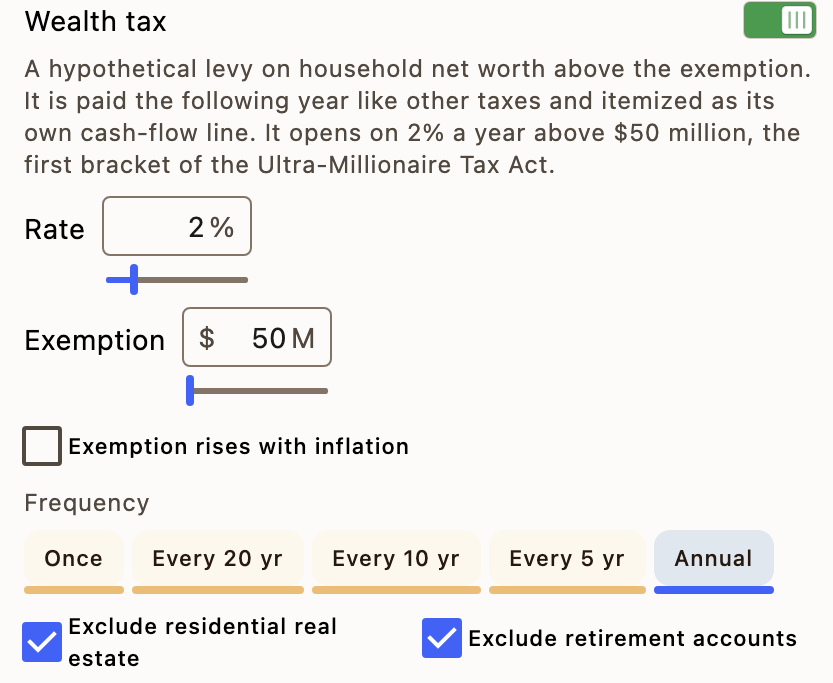
The editor beside the card holds the tax. Switch it on and it opens on the first bracket of Warren's bill: 2% a year on net worth above $50 million, with the $50 million held at that dollar amount every year, as the bill writes it.
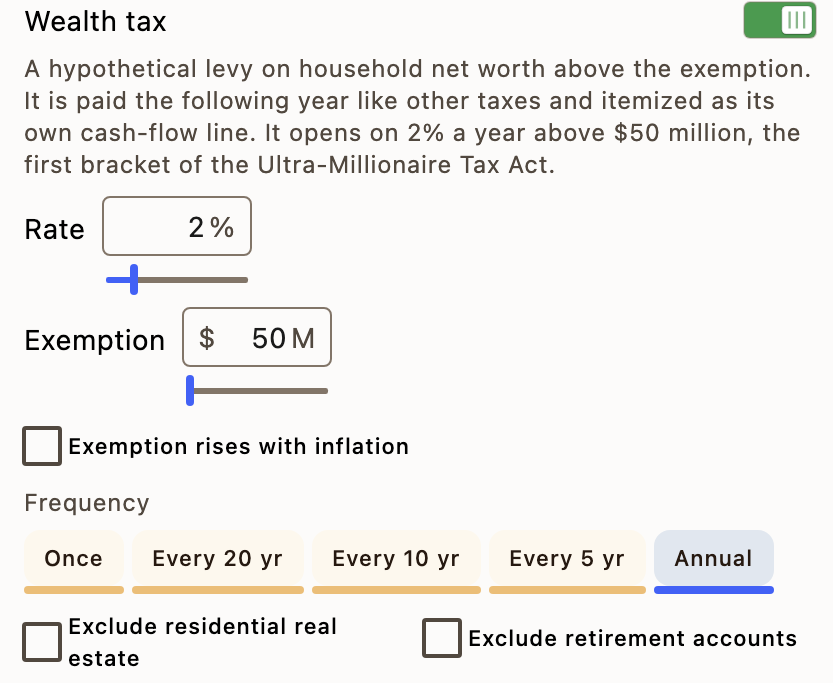
The editor has five settings:
| Setting | What it does |
|---|---|
| Rate | The share of the taxable base charged each time the tax is assessed |
| Exemption | The amount, in millions of dollars, subtracted before the rate applies |
| Exemption rises with inflation | When checked, the exemption grows each year with the tax brackets. When clear, it stays at its dollar amount. |
| Frequency | Every year, every 5, 10 or 20 years, or once |
| Exclusions | Leave residential real estate, retirement accounts or both out of the base |
Each assessment year, the tax is measured on the household's year-end net worth, which is every account and property less every debt, after the exclusions and the exemption. It is paid the following year, the way the plan pays tax on sales, distributions and investment income, and it shows on the cash-flow chart as its own line. Nothing in the plan itself changes. Transforms shows the plan as authored under Original and the plan with the tax under Modified.
The editor charges one rate above one exemption. Warren's bill adds a second bracket, 3% above $1 billion, which the editor does not model. Nadia and Graham are well below $1 billion for most of their plan, so for them the single bracket is Warren's bill.
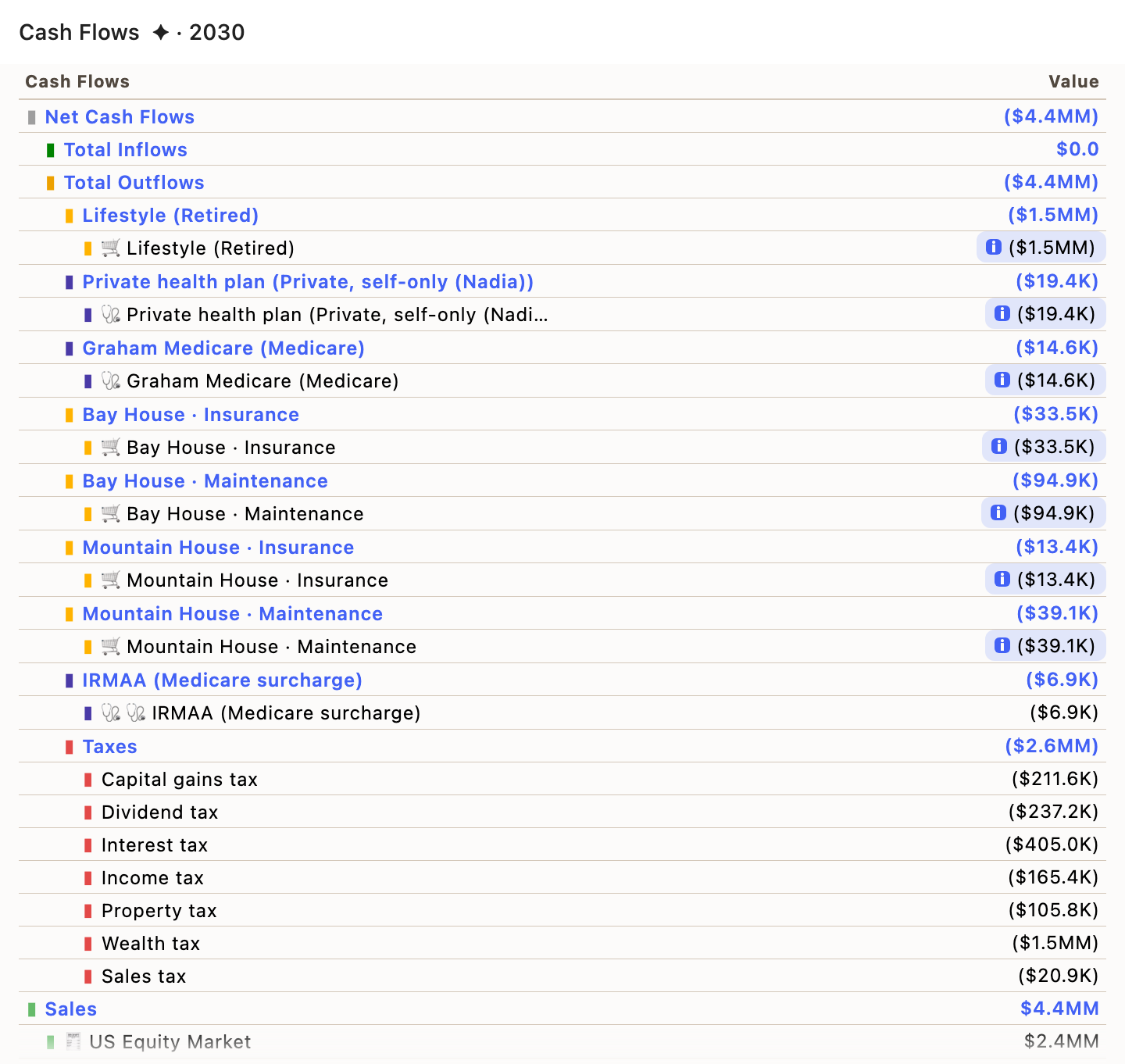
Here is the cash-flow comparison with 2030 selected, when Nadia is 63 and Graham is 65. The wealth tax is broken out as its own band so it can be read against the other taxes:

On the GMFGMF ✦ (also FID 0 / GMF) is the product north star — the deterministic geometric mean forecast path you steer by, not a random Monte Carlo draw and not “most likely.” Prefer it for a stable year-by-year read of the plan. Switch away when you want to explore other randomized scenarios or paths in the multi-path cloud. The ✦ mark matches the live FID control (compass / north star, not a rating star).Full entry → path, the forecast that takes each year's expected return, their wealth tax for 2029, paid in 2030, is about $1.48 million. In the same year, their income tax, tax on capital gains, tax on dividends and tax on interest come to about $1.02 million together. The wealth tax is the largest tax they pay, and it stays the largest in every year of the plan. The cash-flow statement for 2030 shows the lines side by side:
Nadia and Graham have no paycheck, so every dollar of that tax is sold from the portfolio. The balance-sheet comparison shows what that does over time:

On the GMF path their net worth in 2040 is about $190 million as authored and $155 million with the tax. In 2059, the last year of the forecast, it is about $416 million as authored and $225 million with the tax. Over those years they pay about $76 million of wealth tax, yet the gap at the end is about $191 million. The difference is compoundingGrowth on top of previous growth — this year's return is earned on last year's gains as well as the original money. It is why a plan curve bends upward instead of climbing in a straight line, and why the early years matter more than their size suggests.Full entry →: each dollar sent to the Treasury in 2028 would otherwise have grown for thirty more years.
The expected path is only one of many. The Monte CarloThe method behind a multi-path run: draw many randomized return paths, run the plan down each one, and read the spread of what happened. Named after the casino, because the engine is repeated random sampling rather than a formula — which is why two runs of one plan differ a little, and why a success rate is a proportion of sampled futures rather than a promise.Full entry → simulation runs the plan through 1,000 possible market histories:

Both versions of the plan succeed on essentially every path, because Nadia and Graham spend far less than their wealth earns. The tax does not threaten their retirement. What it changes is how much is left. The medianThe middle outcome — half above, half below — as against the average, which a few enormous results can drag upward. Over long horizons the two come apart badly, and the median is the one that answers "what does a typical path look like?"Full entry → ending net worth falls from about $459 million to about $249 million, and the 10th percentileA position along outcomes sorted from worst to best. The 10th percentile (P10) is the outcome only one in ten falls below; the 50th is the median; the 90th (P90) is the one only one in ten beats. Forecasts report P10 and P90 to show the downside and upside without leaning on the single best or worst run.Full entry →, the line below which the weakest tenth of paths end, falls from about $179 million to about $104 million. For a household this size, a wealth tax is a question about legacy, giving and what their children inherit, rather than about whether the money lasts.
The headline rate is only one part of a proposal. The editor makes it quick to try others, and this table shows what each one does to Nadia and Graham's median ending net worth over 1,000 paths:
| Wealth tax | Median net worth at the end |
|---|---|
| None | $459 million |
| 5% once, above $50 million | $437 million |
| 1% a year above $50 million (California's AB 259, 2023) | $336 million |
| 2% a year above $50 million, exemption indexed to inflation | $278 million |
| 2% a year above $50 million, home and retirement accounts excluded | $285 million |
| 2% a year above $50 million (Warren's first bracket) | $249 million |
| 3% a year above $50 million | $187 million |
Three lessons come out of the table.
Frequency matters more than rate. A one-time 5% tax costs them about $3.5 million at the start, and then their plan grows almost alongside the original. A yearly 2% tax costs far more, because it comes back every year and takes a share of each year's growth. Here is the one-time tax:

Exclusions matter in proportion to what they exclude. Nadia and Graham hold about $12 million in their two homes and about $3.5 million in retirement accounts. Leaving both out of the base keeps more of their wealth below the line every year, and it raises their median ending net worth by about $35 million. A household with more of its wealth in real estate or a large IRAIndividual Retirement Account — a retirement wrapper you open yourself rather than through an employer. It comes in traditional (pre-tax going in) and Roth (taxed going in) flavors, so naming the flavor matters more than the acronym does.Full entry → would see a bigger difference.
Each point of rate costs about the same share of what is left. Going from no tax to 1% lowers the median by about $123 million. Going from 2% to 3% lowers it by another $62 million, but on a base that has already shrunk by almost half. Read as a share of what each plan has left, every step costs about the same proportion.
An exemption decides who pays, and Warren's bill writes its $50 million line as a fixed amount. That sounds like a detail. Over a long plan, it decides whether a household pays at all.
Switch to Under the line today. Priya and Sam are 49 and 47, they earn $950,000 a year between them, and they are worth about $28 million. Under a $50 million exemption they owe nothing today. Lay the same tax over their plan, 2% a year above a fixed $50 million:

For the first decade nothing changes. On the GMF path, their net worth passes $50 million in 2037, and from then on they pay. The band is thin at first and grows every year, because their wealth keeps growing while the line stays put. Now check Exemption rises with inflation, so the line grows with the tax brackets:

With an indexed line, their first wealth tax comes in 2050, thirteen years later, and the amounts stay much smaller. On the GMF path they pay about $27 million in wealth tax under the fixed line and about $7 million under the indexed one. Over 1,000 paths, their median ending net worth is about $214 million with no tax, $187 million with the indexed line and $149 million with the fixed line.

The reason is inflationA rise in the price level. The same basket of goods costs more dollars than it did. A household plan carries a growth rate on each bill, because one published inflation number is one basket. The reporting rate that restates future dollars into today's dollars is a separate assumption.Full entry →. A fixed $50 million line is worth less every year in real terms, so a household whose wealth only keeps pace with prices drifts over it. Federal income tax bracketsA band of income taxed at a given rate. The common misreading is that entering a higher bracket taxes all your income at that rate — it does not. Only the dollars inside that band pay the higher rate, so a raise never leaves you with less after tax.Full entry → have been indexed to inflation since the 1980s for this reason, and the estate tax exemption is indexed too. Warren's bill indexes neither of its thresholds. The Sanders and Khanna bill indexes its $1 billion line. If a wealth tax passed, whether its threshold were indexed would decide whether a household like Priya and Sam's paid in the 2030s, around 2050 or not at all.
The wealth tax what-if is a stress test, and it is not a forecast of what Congress will pass. A real law would differ from it in several ways.
- One bracket. The editor charges one rate above one exemption. Warren's 3% bracket above $1 billion, and any phase-in, are not modeled. On Nadia and Graham's best paths, the ones that end above $1 billion, the real bill would be larger than the picture shows.
- Valuation. The plan values every holding at its modeled market value. A real tax would rely on appraisals, and a private business or a piece of art can be valued in more than one way. That is the single biggest practical problem the studies describe.
- Behavior. The plan does not move, give money away early, change how it invests or renounce citizenship in response to the tax. Real households do some of these things, which is why the revenue estimates differ so much.
- Liquidity. The plan pays the tax by selling holdings. A household whose wealth is mostly a private company or real estate might have to borrow or sell at a bad time. Warren's bill allows illiquid taxpayers to defer payment over five years, which the what-if does not model.
- The courts. A federal wealth tax that passed would face a constitutional challenge, and the plan assumes it survives.
What the lesson does claim is narrower and more useful. A wealth tax is charged on what you own, so it is best read as a share of your return, and its cost compounds. For a household far above the line, the question it raises is how much is left rather than whether the money lasts. For a household below the line, the most important detail in any proposal is whether the line rises with inflation. Transforms can price any combination of these against a real plan in a few seconds.
The figures in this lesson come from these publications. Bills and ballot measures change, so check for a newer version before relying on any detail.
Works cited — the publications behind the figures
Federal proposals
- S.4246, Ultra-Millionaire Tax Act of 2026, 119th Congress, introduced March 2026, and Senator Warren's announcement. The earlier S.510 (2021) has the same rates, thresholds and base.
- Emmanuel Saez and Gabriel Zucman, letter scoring the Ultra-Millionaire Tax Act, March 23, 2026.
- S.3956, Make Billionaires Pay Their Fair Share Act, 119th Congress, introduced March 2026, and its bill summary.
- US Treasury, FY2025 budget revenue proposals, March 2024, for the Billionaire Minimum Income Tax.
- Senate Finance Committee, statement on the JCT score of the Billionaires Income Tax.
States
- California Legislative Analyst's Office, analysis of Proposition 40, November 2026 ballot.
- Holland & Knight, "California's Proposed Billionaire Tax: What You Need to Know", September 2026.
- California Assembly, AB 259 (2023), and the coordinated eight-state announcement, January 2023.
- Washington Supreme Court, Quinn v. State, March 2023; Washington Legislature, HB 1319 and SB 6346, and FOX 13 Seattle on the repeal initiative.
- "Massachusetts collected $2 billion more", on fiscal 2025 collections from the millionaires' surtax.
- Florida Department of Revenue, Tax Information Publication 07C02-01, on the repeal of the intangible personal property tax.
The Constitution
- Supreme Court of the United States, Moore v. United States, June 20, 2024.
- Congressional Research Service, Legal Sidebar LSB11185 on Moore v. United States, and report R46551 on direct taxes and apportionment.
Other countries
- OECD, The Role and Design of Net Wealth Taxes in the OECD, 2018.
- Tax Foundation, Wealth Taxes in Europe, 2026.
- swissinfo.ch, "Rich Norwegians flee to low-tax Switzerland as wealth levy bites", December 2022.
- Cuatrecasas, on the Spanish Constitutional Court's ruling on the solidarity tax, November 2023.
- Gabriel Zucman, A Blueprint for a Coordinated Minimum Effective Taxation Standard for Ultra-High-Net-Worth Individuals, report to the G20 Brazilian presidency, June 2024.
Revenue estimates and research
- Penn Wharton Budget Model, Senator Elizabeth Warren's wealth tax, December 2019, and Budgetary effects of Senator Warren's wealth tax, March 2021.
- Tax Foundation, Analysis of Senators Warren's and Sanders' wealth tax plans, January 2020.
- Lawrence Summers and Natasha Sarin, "A wealth tax presents a revenue estimation puzzle", April 2019, and Saez and Zucman's response.
- David Seim, "Behavioral Responses to Wealth Taxes: Evidence from Sweden", American Economic Journal: Economic Policy, 2017.
- Katrine Jakobsen, Kristian Jakobsen, Henrik Kleven and Gabriel Zucman, "Wealth Taxation and Wealth Accumulation: Theory and Evidence from Denmark", Quarterly Journal of Economics, 2020.
- Marius Brülhart, Jonathan Gruber, Matthias Krapf and Kurt Schmidheiny, "Behavioral Responses to Wealth Taxes: Evidence from Switzerland", American Economic Journal: Economic Policy, 2022.
- Katrine Jakobsen, Henrik Kleven, Jonas Kolsrud, Camille Landais and Mathilde Muñoz, "Taxing Top Wealth: Migration Responses and their Aggregate Economic Implications", NBER Working Paper 32153.
| Lesson | Why |
|---|---|
| Property tax, the silent killer | The wealth tax most households already pay, on their house |
| Erin On The Wage Cap | Another proposed tax change priced against a plan in Transforms: payroll tax on every dollar of wages |
| Will Social Security be there? | A different Transforms stress test, for a benefit cut rather than a new tax |
Rebuild this plan by hand
The cards on the canvas show the accounts and cash flows. These are the settings that live outside any card, read from each plan this lesson opens, with the label each control carries in the app. A value marked default is one to leave alone.
| Setting | Well over the line | Under the line today |
|---|---|---|
| Household | ||
| Planning region | United States (default) | United States (default) |
| Nadia (Primary) | ||
| birth year | 1967 | — |
| retirement age | 58 | — |
| death age | 93 | — |
| Graham (Secondary) | ||
| birth year | 1965 | — |
| retirement age | 60 | — |
| death age | 90 | — |
| Priya (Primary) | ||
| birth year | — | 1977 |
| retirement age | — | 62 |
| death age | — | 93 |
| Sam (Secondary) | ||
| birth year | — | 1979 |
| retirement age | — | 60 |
| death age | — | 91 |
| Taxes | ||
| Tax regime | United States | United States |
| Filing status | Married, filing jointly | Married, filing jointly |
| State of residence | Florida | Florida |
| First-year federal estimate | — | — |
| First-year state estimate | — | — |
| Strategy | ||
| Residual withdrawal strategy | Pro-rata (default) | Pro-rata (default) |
| Roth conversions | Off | Off |
| Definition of success | Liquidity crises allowed (default) | Liquidity crises allowed (default) |
| Glide path target | None (default) | None (default) |
| Advanced | ||
| Reporting inflation | Assumption set's rate (default) | Assumption set's rate (default) |
| Cost of capital | Assumption set's rate (default) | Assumption set's rate (default) |
| Growth assumptions | Growth overrides (default) | Growth overrides (default) |
| Currencies | Multiple currencies (default) | Multiple currencies (default) |
| Default currency | USD (default) | USD (default) |
| Display currency | USD (default) | USD (default) |

Educational content — not advice. These lessons teach how Tutilis models a plan and how to read what it shows. The households, balances, and outcomes in them are invented for teaching. Nothing here is financial, investment, tax, or legal advice, or a recommendation to buy, sell, or hold anything. A model cannot know your circumstances — check anything you take from a lesson against your own situation, and against a qualified professional where it matters.