
 Life insurance on the plan
The situation Alex carries a 20-year term policy and a whole-life policy. What do they cost the plan each year, what is the whole-life policy worth along the way, and does either one ever pay out inside this forecast?
How to use this case study
New to the Learning Center, or want a map of the panels? Start with a tour: Reading Lesson (Getting Around) or Screencast Lesson (Getting Around) — both walk through Tutilis next to a live planThe running Tutilis product next to this lesson — navigation, Bird's Eye, Forecaster, tools, and more — loaded with a teaching sample. A dossier is the plan data; the live plan is the full product surface with a sample dossier already open so you can explore. On the web, teaching samples are not editable the way your own dossier will be in the full app.Full entry → (to the right on a desktop-width screen, or below when stacked on a tablet).
This page — Life insurance on the plan — includes a live sample planThe running Tutilis product next to this lesson — navigation, Bird's Eye, Forecaster, tools, and more — loaded with a teaching sample. A dossier is the plan data; the live plan is the full product surface with a sample dossier already open so you can explore. On the web, teaching samples are not editable the way your own dossier will be in the full app.Full entry → next to the text. On a wide screen it usually sits to the right of the text; on a tablet it usually sits below. Use the text for the walk-through, then try the same ideas in the live plan.
The live planThe running Tutilis product next to this lesson — navigation, Bird's Eye, Forecaster, tools, and more — loaded with a teaching sample. A dossier is the plan data; the live plan is the full product surface with a sample dossier already open so you can explore. On the web, teaching samples are not editable the way your own dossier will be in the full app.Full entry → next to this page — usually to the right on a wide screen, or below on a tablet — is Tutilis running a teaching sample: the same financial planning product available as a desktop application (early preview). A dossierYour full plan in Tutilis: the people in the household, what they own and owe, cash flows in and out, tax setting, and planning assumptions. One dossier is one complete situation as the product models it.Full entry → is the plan data; the live plan is the full product (navigation, Bird's Eye, Forecaster, tools) with a sample dossier already open so you can try the panels. See planned pricing. On the web, Learning Center samples are not editable the way your own dossier will be in the full app. Your own household goes in the Tutilis desktop app — the Learning Center front page has a short clip of that.
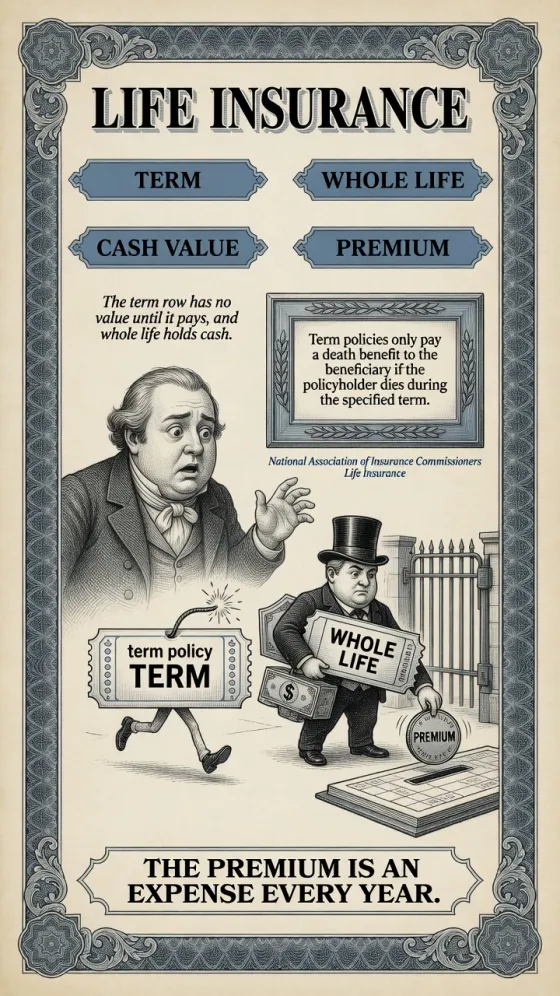
Alex has two life policies. One is a twenty-year term policy bought at 57, the other is a whole-life policy that has been building cash value for years. Neither belongs in an account, and neither is a real asset in the way a house is, but both cost money every year, one of them is worth something today, and each promises a payment at a death the plan already has a year for. This lesson shows where each of those three things lands. It is a practical look at term vs whole life insurance, and at how life insurance in a financial plan is counted.
Open the  DossierA main-rail area. Where the household plan is defined — people, assets and liabilities, cash flows. In these lessons you mainly view; on desktop you enter and edit your own plan.. On the Bird's Eye, each policy has a row under Assets, and hovering
the row raises the policy's card. The whole-life policy's row is its cash value, which is net worth;
the term policy's row carries no value at all, because a term policy is not worth anything until it
pays. In the desktop app the same cards sit under Insurance on the balance sheet.
The term policy is the simpler one. It has a death benefit, a premium, and coverage years. If Alex dies inside those years, it pays; if the years run out first, it has cost its premiums and pays nothing, which is what most term policies do.
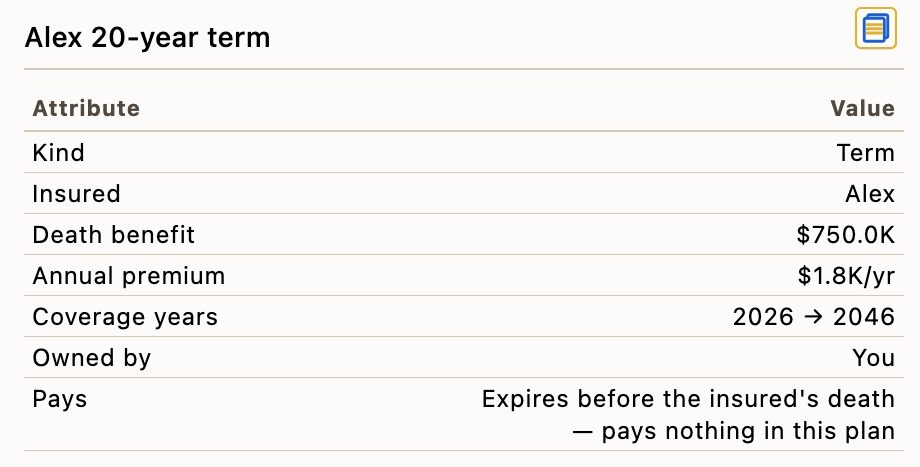
The card says so plainly. Its Pays row reads Expires before the insured's death, because the coverage ends in 2046 and Alex's death age puts the death after the plan's last year.
The whole-life policy is permanent. It covers Alex for life while the premium is paid, and it has a cash value that grows at a modest crediting rate.
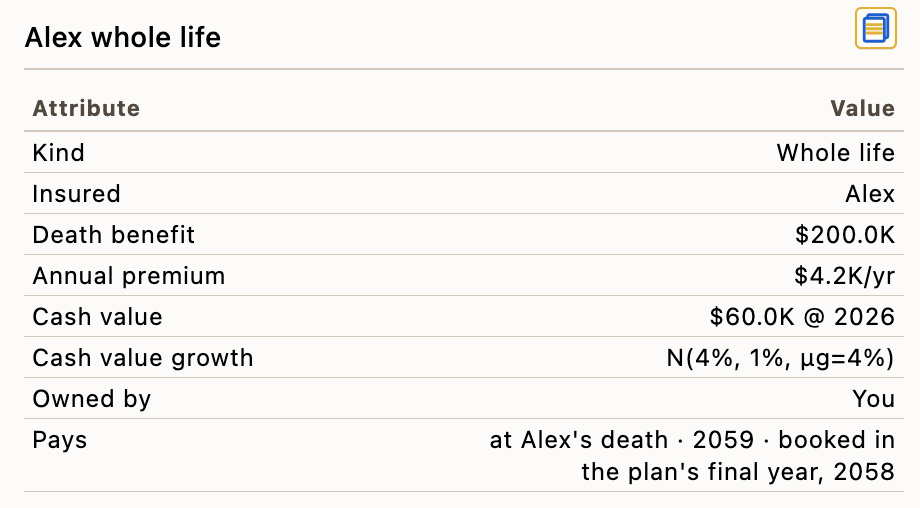
Its Pays row names Alex's death year, and the card carries the cash value and its growth as well as the benefit and the premium.
Open the  CF TableA Forecast Detail chip. CF = cash flows for the selected year — incomes, expenses, taxes, and invest / sell / borrow totals. on any year before 2046 and both premiums are there among the expenses,
each under the policy's own name.
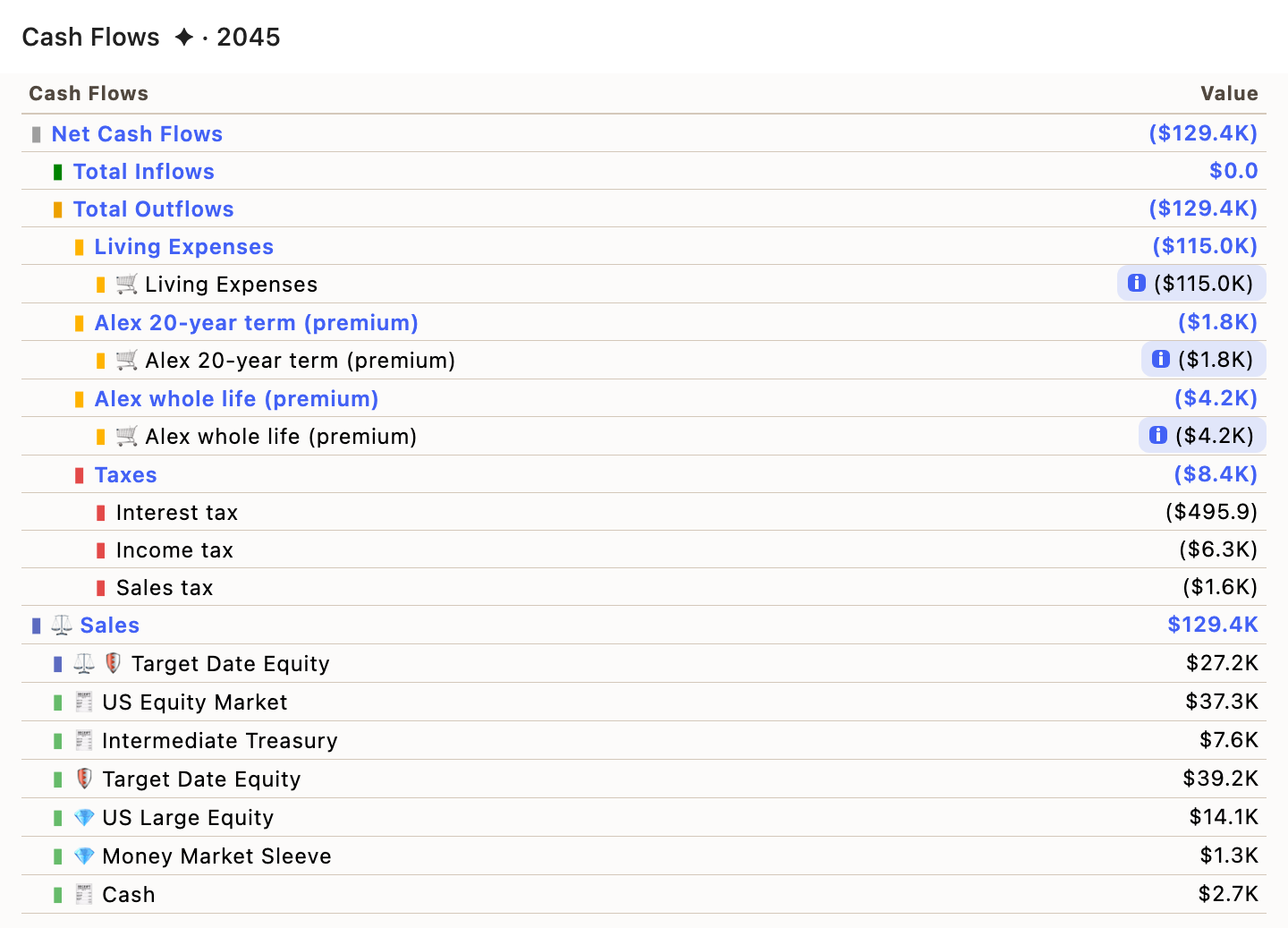
The year after, only the whole-life premium remains. A term policy's premium stops with its coverage. A permanent policy's premium stops when the insured dies, or earlier if its premium years say the policy is paid up.
Open the  BS TableA Forecast Detail chip. BS = balance sheet for the selected year — real assets, accounts, liabilities, net worth. Copyable companion to BS Chart.. The whole-life policy's cash value is listed among the real assets, under
the policy's name, and it counts toward net worth from the first year.
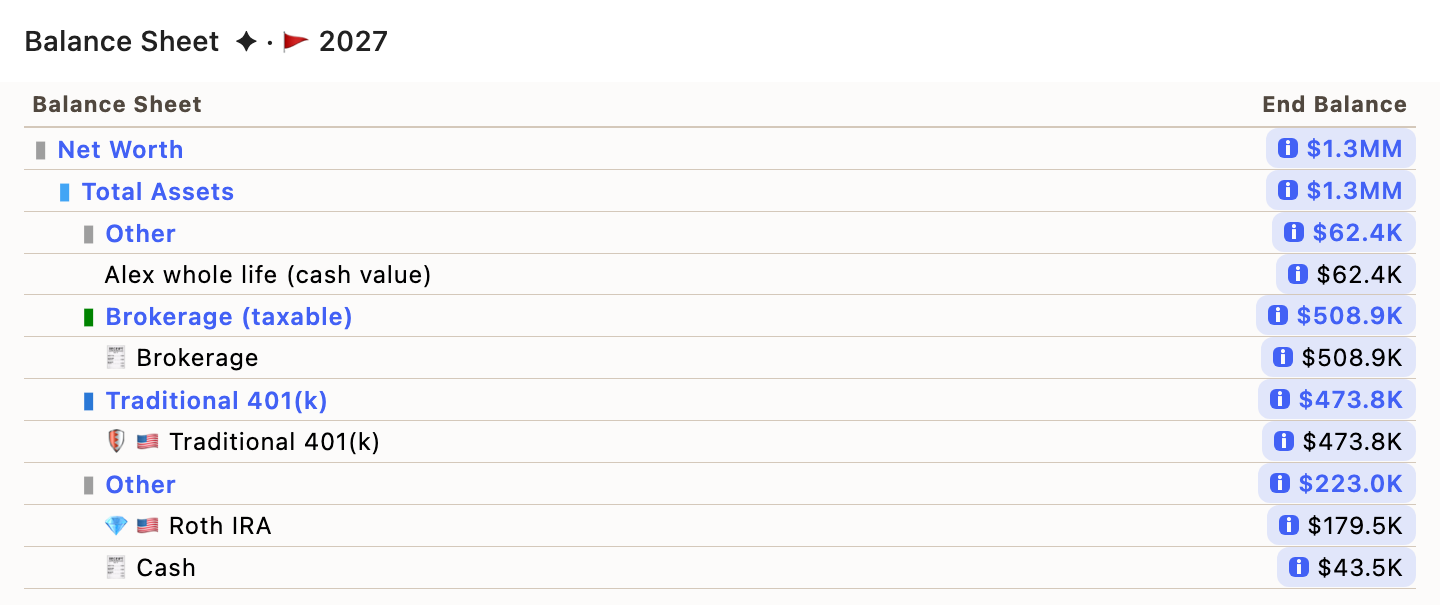
It grows at its own rate, four percent a year unless the policy says otherwise, and the forecast never sells it or borrows against it. A term policy has no line here, because it has no cash value.
A death benefit is paid in the year the insured dies. Who receives it depends on who is left. When one of two owners dies first, the benefit is the survivor's cash, and the plan invests it like any other surplus. When the insured is the last owner, the plan ends at that death, and the benefit lands in the plan's final year, which is where an estate reads it.
Alex is the only owner here, so the whole-life benefit lands in 2058, the last year of the plan.
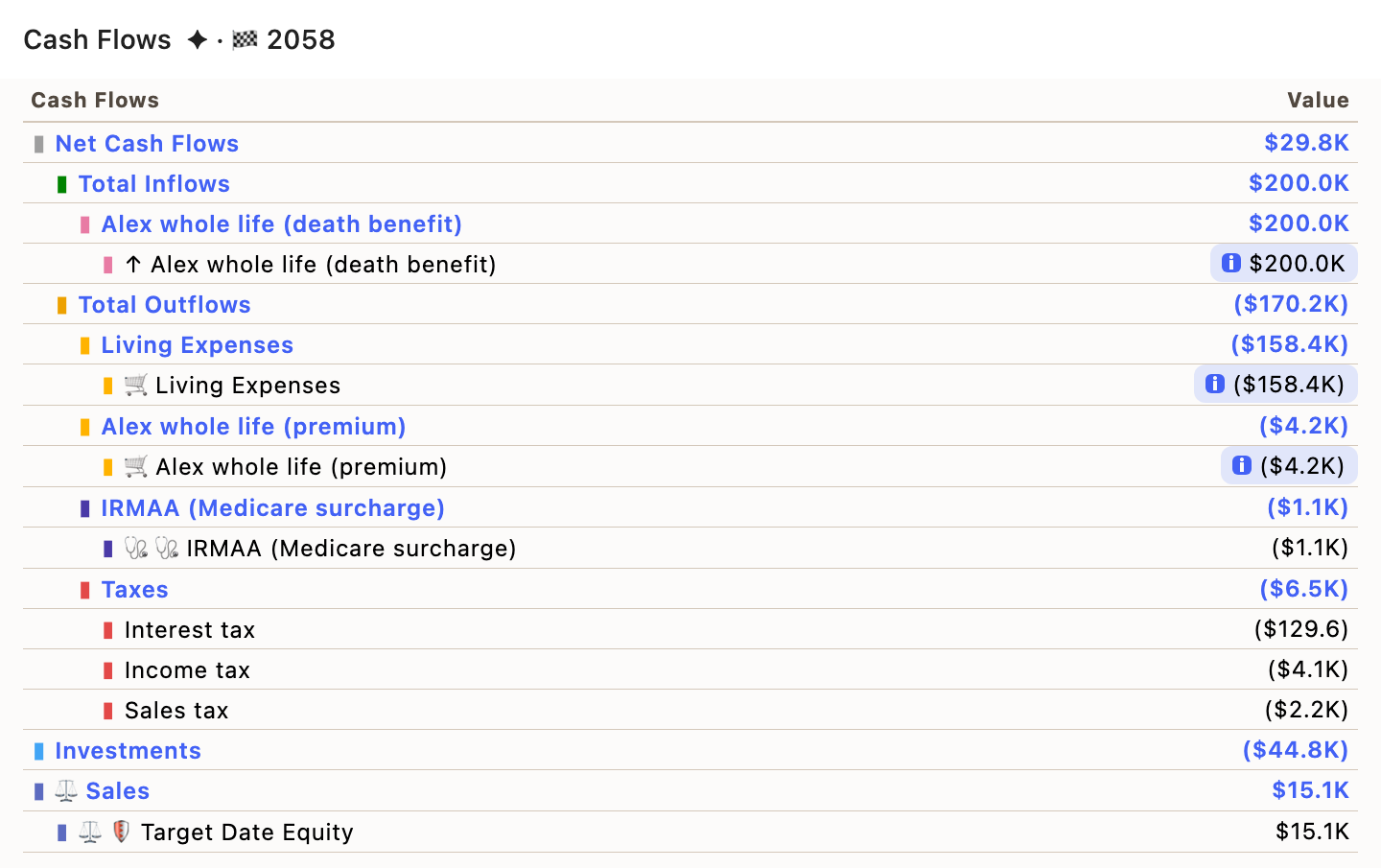
It is the year's only inflow, and no tax is assessed on it. A life-insurance death benefit is not income, and the tax pass leaves it alone.
Desktop app only
Open the term policy and push its coverage end past 2059. Its Pays row changes to name Alex's death year, and the final year's statement gains a second benefit line.
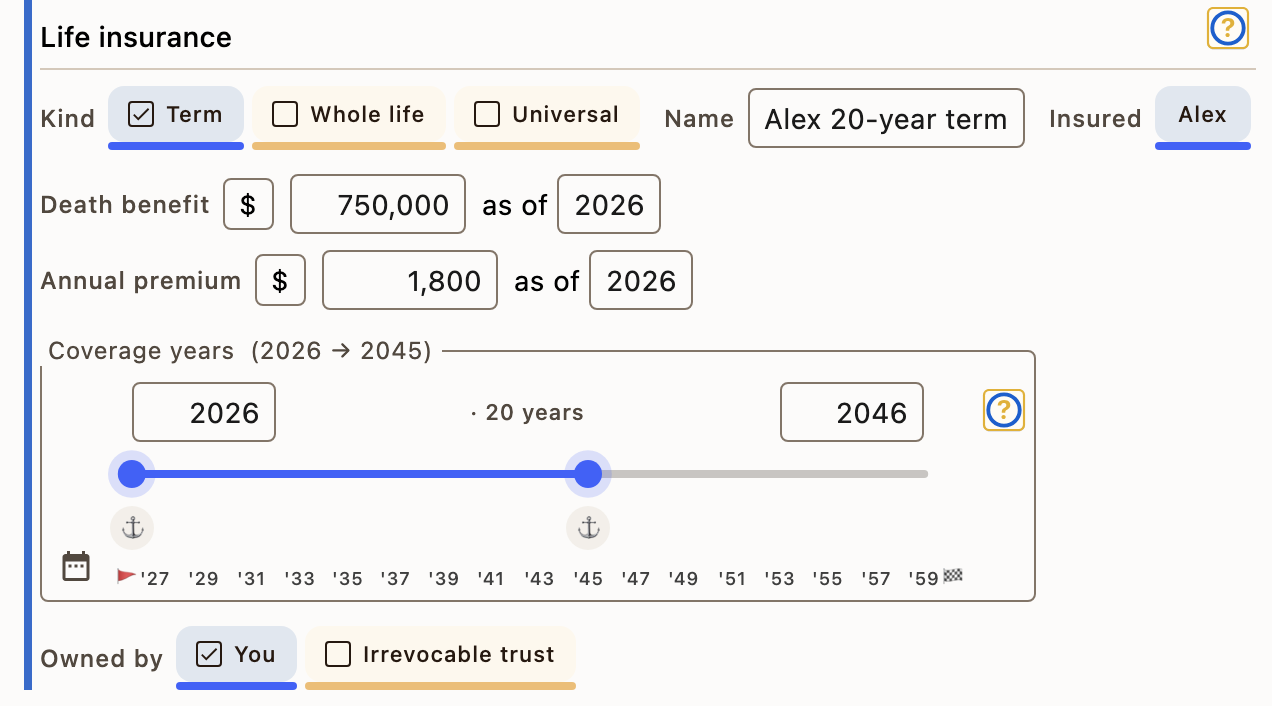
The term policy, Alex 20-year term. Coverage years are what you push past 2059.
Then open the whole-life policy and set Owned by to Irrevocable trust. Nothing on the cash-flow statement changes; the benefit still arrives. What changes is the estate: on the Net Worth Distribution card, with estate taxA tax on what a person owns at death, paid by the estate before heirs receive it. The federal tax applies only above a large exemption ($15 million per person in 2026) at a top rate of 40%. About a dozen states and the District of Columbia have their own estate tax, most with far lower exemptions.Full entry → on, the trust-owned proceeds are left out of the taxable estate and pass to heirs untaxed.
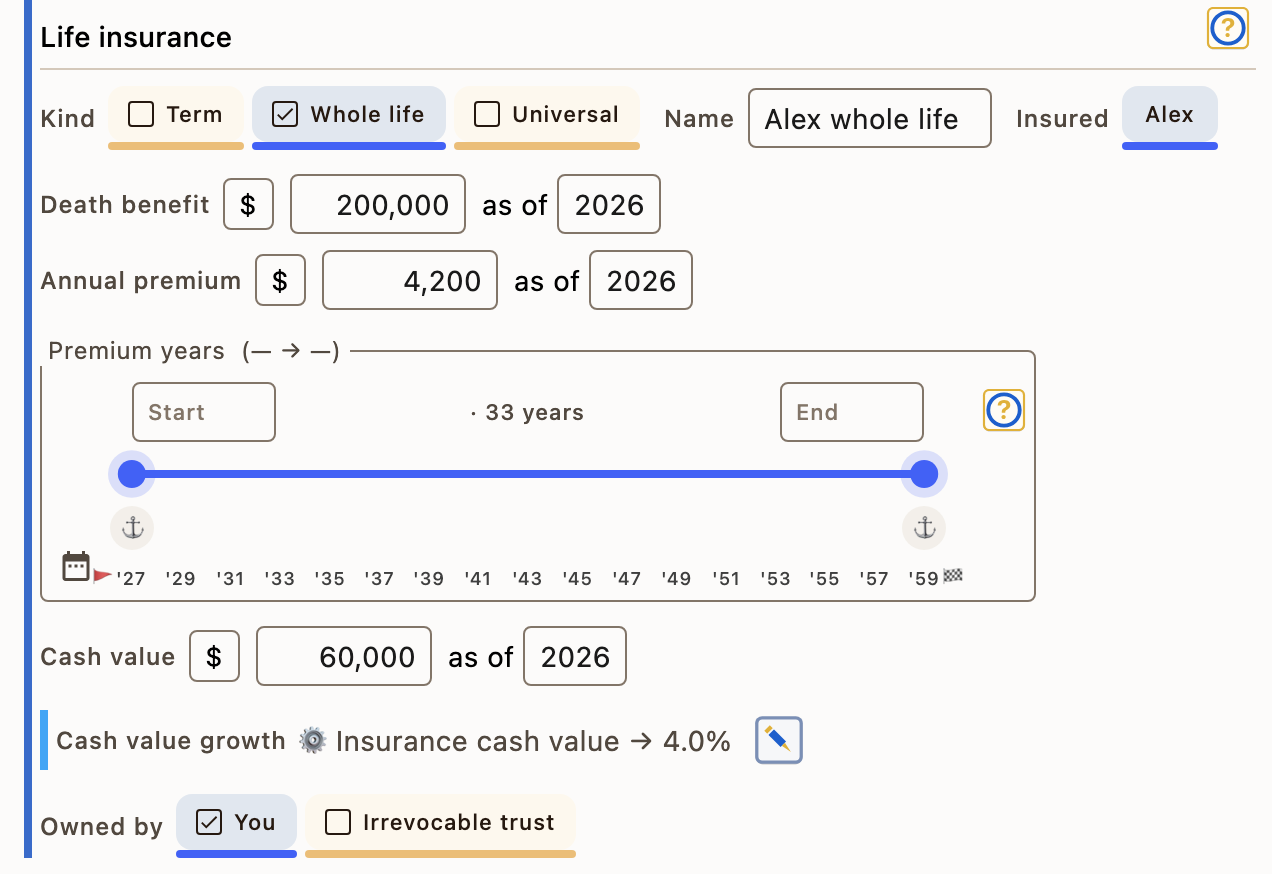
The whole-life policy. Owned by is the toggle at the bottom of the editor.
The plan never draws on the cash value. A policy loan, or surrendering the policy for its cash value, are both real choices, and neither is modeled yet. The benefit is level, so a decreasing-term policy is entered at its average, and a policy on a dependent's life pays in that person's death year like any other.
Rebuild this plan by hand
The cards on the canvas show the accounts and cash flows. These are the settings that live outside any card, read from the plan itself, with the label each control carries in the app. A value marked default is one to leave alone.
| Setting | Term and whole life |
|---|---|
| Household | |
| Planning region | United States (default) |
| Alex (Primary) | |
| birth year | 1969 |
| retirement age | 65 |
| death age | 90 |
| Taxes | |
| Tax regime | United States |
| Filing status | Single |
| State of residence | Ohio |
| First-year federal estimate | — |
| First-year state estimate | — |
| Strategy | |
| Residual withdrawal strategy | Pro-rata (default) |
| Roth conversions | Off |
| Definition of success | Liquidity crises allowed (default) |
| Glide path target | None (default) |
| Advanced | |
| Reporting inflation | Assumption set's rate (default) |
| Cost of capital | Assumption set's rate (default) |
| Growth assumptions | Growth overrides (default) |
| Currencies | Multiple currencies (default) |
| Default currency | USD (default) |
| Display currency | USD (default) |

Educational content — not advice. These lessons teach how Tutilis models a plan and how to read what it shows. The households, balances, and outcomes in them are invented for teaching. Nothing here is financial, investment, tax, or legal advice, or a recommendation to buy, sell, or hold anything. A model cannot know your circumstances — check anything you take from a lesson against your own situation, and against a qualified professional where it matters.