
 The three-fund portfolio
The situation Robin and Jae Marsh, 52 and 50, hold their whole $1.1 million in three funds: US stocks, international stocks and bonds. Friends ask whether something that simple can be enough. What does each fund do, where did the idea come from, and what happens to the three of them in a year like 2008?
How to use this case study
New to the Learning Center, or want a map of the panels? Start with a tour: Reading Lesson (Getting Around) or Screencast Lesson (Getting Around) — both walk through Tutilis next to a live planThe running Tutilis product next to this lesson — navigation, Bird's Eye, Forecaster, tools, and more — loaded with a teaching sample. A dossier is the plan data; the live plan is the full product surface with a sample dossier already open so you can explore. On the web, teaching samples are not editable the way your own dossier will be in the full app.Full entry → (to the right on a desktop-width screen, or below when stacked on a tablet).
This page — The three-fund portfolio — includes a live sample planThe running Tutilis product next to this lesson — navigation, Bird's Eye, Forecaster, tools, and more — loaded with a teaching sample. A dossier is the plan data; the live plan is the full product surface with a sample dossier already open so you can explore. On the web, teaching samples are not editable the way your own dossier will be in the full app.Full entry → next to the text. On a wide screen it usually sits to the right of the text; on a tablet it usually sits below. Use the text for the walk-through, then try the same ideas in the live plan.
The live planThe running Tutilis product next to this lesson — navigation, Bird's Eye, Forecaster, tools, and more — loaded with a teaching sample. A dossier is the plan data; the live plan is the full product surface with a sample dossier already open so you can explore. On the web, teaching samples are not editable the way your own dossier will be in the full app.Full entry → next to this page — usually to the right on a wide screen, or below on a tablet — is Tutilis running a teaching sample: the same financial planning product available as a desktop application (early preview). A dossierYour full plan in Tutilis: the people in the household, what they own and owe, cash flows in and out, tax setting, and planning assumptions. One dossier is one complete situation as the product models it.Full entry → is the plan data; the live plan is the full product (navigation, Bird's Eye, Forecaster, tools) with a sample dossier already open so you can try the panels. See planned pricing. On the web, Learning Center samples are not editable the way your own dossier will be in the full app. Your own household goes in the Tutilis desktop app — the Learning Center front page has a short clip of that.
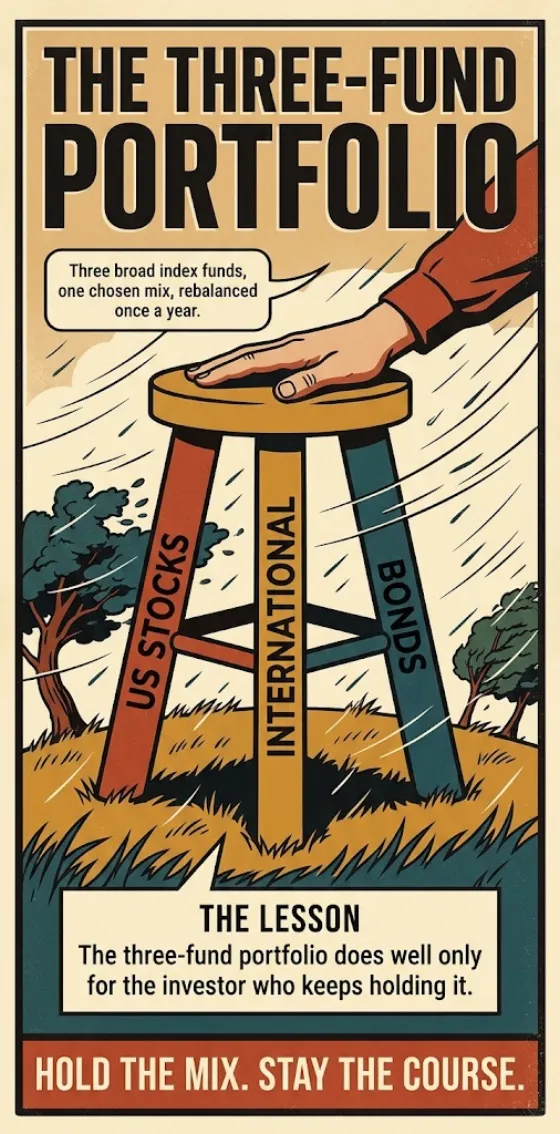
A three-fund portfolioA portfolio built from three broad index funds: a total US stock market fund, a total international stock fund and a total US bond fund. It holds most of the world's listed companies and the US bond market at a very low cost, and its upkeep is rebalancing back to one chosen mix.Full entry → holds three broad index fundsA fund that holds the securities in a market index, in the index's proportions, instead of choosing among them. Its return follows the market it tracks, less its cost. Index funds typically have low expense ratios and low turnover, so in a taxable account they tend to pay few capital-gain distributions.Full entry → and nothing else: one for US stocks, one for international stocks, and one for bonds. It is the most common portfolio in the Bogleheads community, and many do-it-yourself investors hold some version of it for their whole lives. This lesson looks at what each fund does, where the idea came from, and what the three of them do in a year like 2008, on the plan of a couple who hold it.
Robin and Jae Marsh are 52 and 50, and they are the couple from Costs you keep paying and Stay the course. Their plan, Three funds, holds about $1.1 million in the three funds and a little cash, spread across two 401(k)sAn employer-sponsored retirement account, named after the section of tax law that created it — so the name says nothing about what it does. Contributions are usually payroll-deducted, often matched by the employer, and come in traditional (pre-tax) and Roth flavors. A 403(b) is the same idea for schools and nonprofits, a 457 for government workers.Full entry →, two RothA retirement account where you pay income tax on the money going in, and qualified withdrawals later come out tax-free — the mirror image of traditional. Named after the senator behind the law, so the word tells you nothing on its own. Plans care because Roth dollars do not add to taxable income later, which keeps them clear of income-driven cliffs.Full entry → IRAs and a joint brokerageAn ordinary taxable investment account — no special retirement wrapper, no contribution limit, and no withdrawal age rules. The trade-off is that dividends and realized gains are taxed as they happen rather than deferred. Often called the taxable bucket next to traditional and Roth.Full entry → account.
| Fund | What it holds | Its job | Share of the Marshes' mix |
|---|---|---|---|
| Total US stock market | Nearly every listed US company, large and small | Growth | 61% |
| Total international stock | Thousands of companies outside the US | Growth from the rest of the world | 16% |
| Total US bond market | US government and investment-grade bonds | Steadiness, and money to rebalance with | 22% |
Each fund holds a whole market in proportion to its size, so no one company, sector or country decides the outcome. Each costs a few hundredths of a percent a year. The Marshes' plan carries expense ratiosWhat a fund charges each year to run it, as a percent of what you hold. It is taken out of the fund's assets day by day, so it never arrives as a bill; it shows up as a slightly lower return. Broad index funds commonly charge well under 0.1% a year, and many actively managed funds charge 0.5% to 1%.Full entry → of 0.03% to 0.05%, and Costs you keep paying shows what that low cost is worth over their lifetime.
Between the three funds, a household owns a share of most of the world's listed companies and most of the US bond market. The rest of the work is choosing the mix and keeping it.
The three funds became possible because of John BogleInvestors who follow the ideas of John C. Bogle, who founded Vanguard and in 1976 launched the first index fund sold to individual investors: own broad index funds, keep costs low, choose a simple mix and hold it through good years and bad. The community gathers on the forum and wiki at bogleheads.org.Full entry →, who founded Vanguard and in 1976 launched the first index fund sold to individual investors. Over the next two decades, Vanguard added a total US stock market fund, a total bond market fund and a total international fund, so a household could own nearly every market through three funds.
The person who turned them into a portfolio was Taylor Larimore. Larimore was a paratrooper with the 101st Airborne Division in the Battle of the Bulge. By his own account he once owned 16 funds, and after reading Bogle he set out to simplify them. In 1999 he described a four-fund version, with cash as the fourth fund, on the online forum where Bogle's admirers gathered. As he simplified further, the cash fell away and the three-fund portfolio took the shape it has today.
That forum began on Morningstar in 1998 and later moved to its own home at bogleheads.org. Larimore and Mel Lindauer hosted the first Bogleheads meeting at Larimore's Miami condo in 2000, with Bogle as the speaker, and Bogle took to calling Larimore the "King of the Bogleheads." Larimore wrote The Bogleheads' Guide to Investing (2006) with Lindauer and Michael LeBoeuf, and later The Bogleheads' Guide to the Three-Fund Portfolio (2018), with an introduction by Bogle. The community's wiki keeps a page on the three-fund portfolio.
The appeal to the community is easy to see. Bogle's ideas were low cost, broad diversification, and holding on. The three-fund portfolio is those three ideas in the fewest possible pieces. It needs no forecast, no fund picking and no advice, so it suits investors who want to do the work themselves. It also suits households who work with an advisor, and many advisors build portfolios on the same three pieces.
A US stock fund on its own is already diversified across thousands of companies. The other two funds add something different: holdings that do not rise and fall at the same time.
Open  RiskA main-rail area. Analytic risk views — how holdings and categories sit on risk/return. Useful later; not required for first tours. on Three funds and light the Holdings chip.
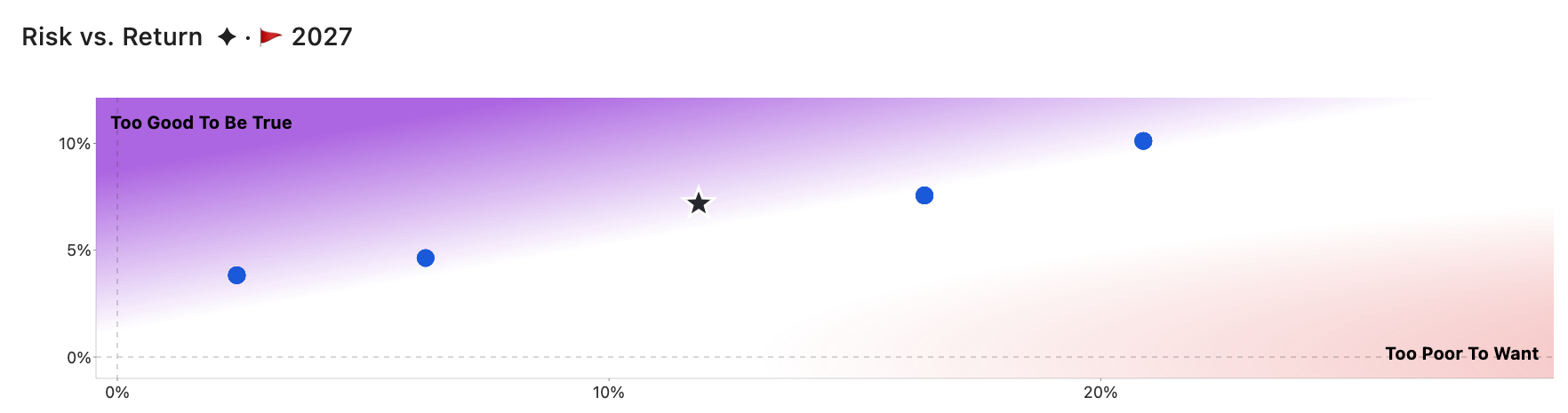
Risk vs. Return for the Marshes' three funds. Each dot is a fund at its expected return and its volatility. The star is the whole portfolio.
The two stock funds sit high and to the right: they are expected to earn the most and swing the most. The bond fund sits low and to the left. The star for the whole portfolio sits between them, with less volatilityHow much an investment's returns bounce around from year to year, not whether it goes up or down overall. Written σ (sigma) in the product. Two holdings can have the same average return and feel completely different to live through — and high volatility drags the growth you actually compound below that average.Full entry → than either stock fund, because the funds do not move in step. In the catalog's assumptions, US and international stocks have a correlationHow closely two investments tend to move together, from −1 (opposite) through 0 (unrelated) to +1 (lockstep). Written ρ (rho). It is what decides whether holding several things actually spreads risk: assets that all fall at once are less diversified than a count of holdings suggests.Full entry → of 0.67, so they often fall together but not always by the same amount. US stocks and intermediate Treasury bonds have a correlation of about −0.3, so in many years one rises while the other falls.
That is diversificationSpreading money across investments that do not all move together, so a bad year for one is not a bad year for everything. Owning many holdings is not the same thing — if they are highly correlated they behave like one large position wearing several names.Full entry →, and it is the one place where a lower risk does not have to cost a lower return. Correlation and diversification works through the math.
Diversification is easy to see on a chart and hard to feel in a crash. Put one into the plan to see what the three funds do. In  TransformsA main-rail area. The name is Transforms because you transform a copy of the plan — a what-if — without rewriting the original dossier. Compare original vs modified side by side., turn on the Sequence-of-returns risk modifiable with the Global Financial Crisis of 2007, starting in 2031. Its large fall lands in 2032. Then open the realized returns for two of the funds in Robin's 401(k).
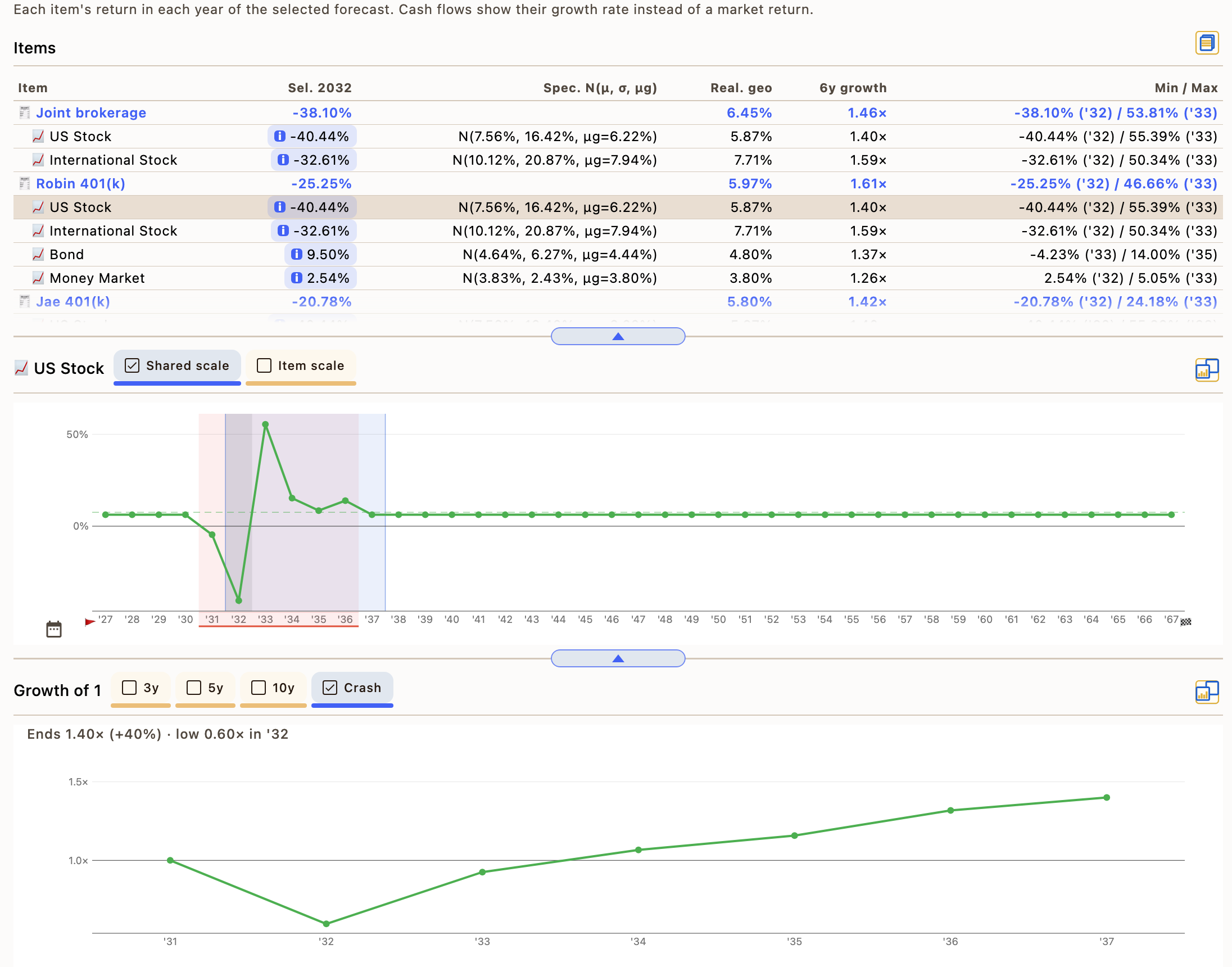
The US stock fund on Three funds: about −40% in 2032 and about +55% in 2033.
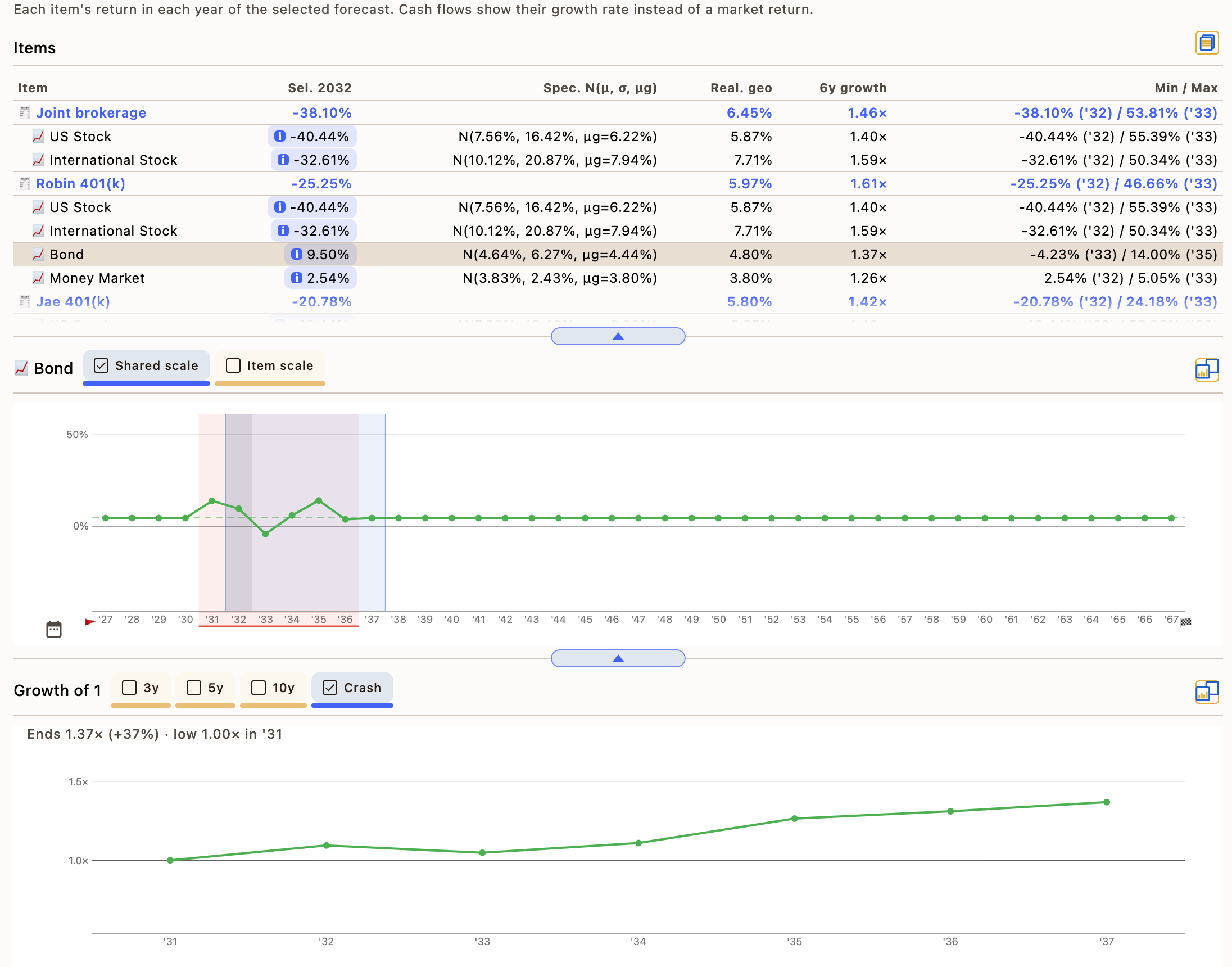
The bond fund on Three funds, in the same years: about +9.5% in 2032 and about −4% in 2033.
In the year the stock funds fell by about a third or more, the bond fund rose. In the year they recovered, it slipped a little. That difference is what the yearly rebalanceSelling some of what grew and buying what lagged, to bring the mix back to the target you chose. Without it a portfolio quietly drifts toward whatever has been winning, and gets riskier than intended precisely when it feels safest.Full entry → works with: it sells some of the fund that held up and buys the funds that fell, at their low prices. The next year the stock funds recover, and the shares bought at the bottom recover with them.
The asset mix shows the result. Through the whole crash, each of the Marshes' four classes stays within about two points of its target, because every year's rebalance brings it back. The Marshes do not decide anything in 2032. The plan holds a target mix and rebalances to it inside the 401(k)s and IRAs, where a trade owes no tax, and the crash passes through a portfolio that looks the same afterward as it did before.
The three-fund portfolio leaves the investor two choices, and they matter more than anything else about it.
How much goes into bonds. Bonds are the brake. More of them makes a fall smaller and the long-run growth slower. An old rule of thumb, which Bogle offered as a rough starting point, is to hold about your age in bonds. The Marshes hold 22%, well under their ages, because they are still saving and have ten working years before they need the money. Many households hold more bonds as retirement approaches, and Glide paths through retirement compares the ways to do it.
How much of the stock share goes abroad. Companies outside the US make up a little under 40% of the world's stock market. Bogle himself thought a US investor needed little or none, and Vanguard's target-date funds hold about 40% of their stocks abroad. The common answer on the forum falls between, often 20% to 40% of the stock share. The Marshes hold about a fifth of their stocks internationally.
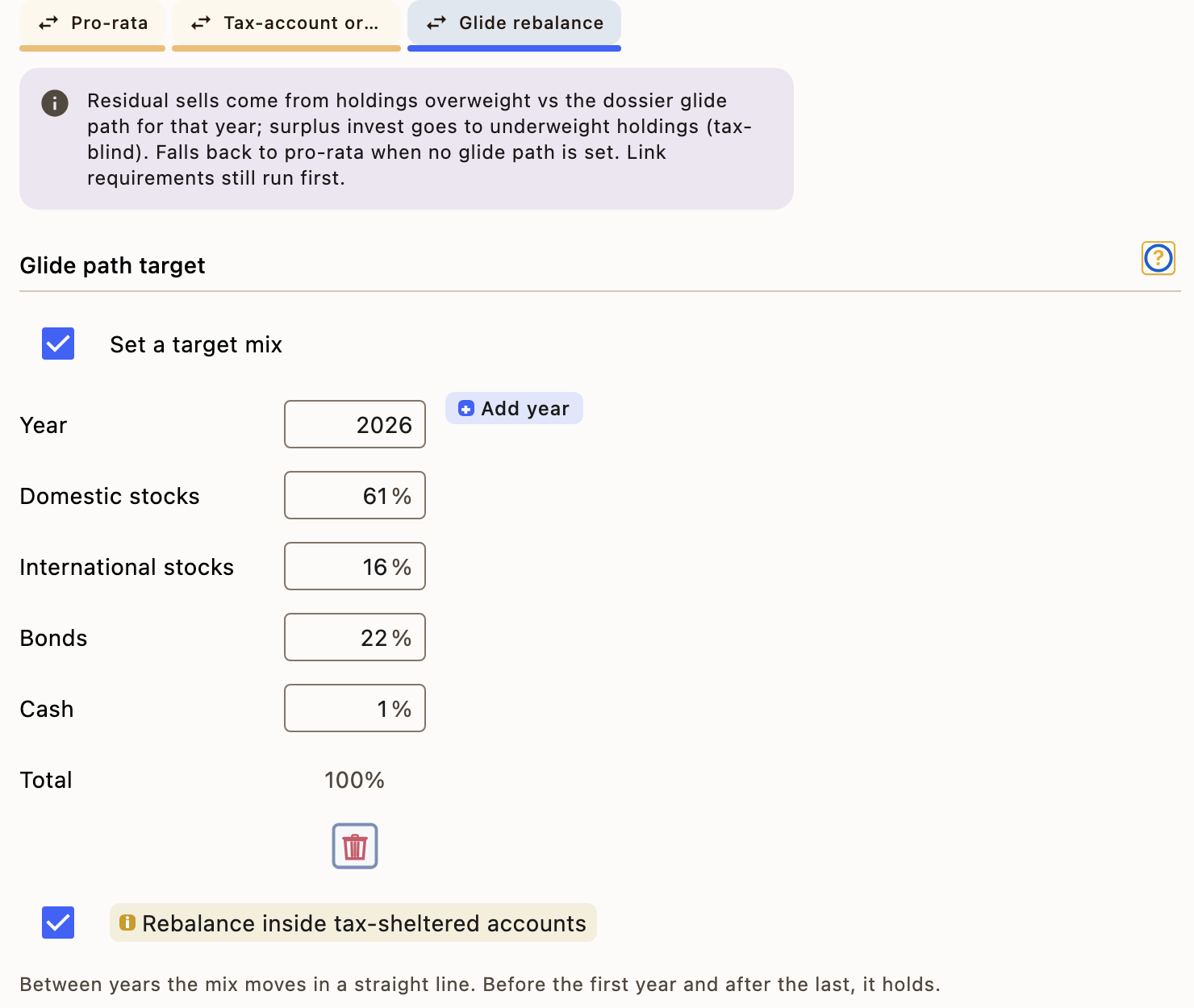
Once both are chosen, they are written into the plan as one target mix. In Tutilis that is the plan's glide pathA planned shift in allocation over time — classically toward bonds as retirement approaches, so risk comes down as the years available to recover from a loss come down with it. The word that matters is *planned*: a portfolio drifting toward whatever has been winning is not on a glide path, it is unrebalanced.Full entry → under  AssumptionsA main-rail area. The rules the forecast runs under — growth, taxes, movements, success definition, locality, currency. Read and write., with one target held every year and the box ticked to rebalanceSelling some of what grew and buying what lagged, to bring the mix back to the target you chose. Without it a portfolio quietly drifts toward whatever has been winning, and gets riskier than intended precisely when it feels safest.Full entry → inside tax-sheltered accounts.
Desktop app only
A three-fund portfolio does not try to beat the market. It is built to earn the market's return and keep almost all of it, and three things help it do that.
- It costs almost nothing. An index fund's fee is a small fraction of an actively managed fund's. On the Marshes' plan the difference compounds into more than $750,000 of fees over their lifetime, which Costs you keep paying shows year by year.
- It owes little tax. Index funds rarely sell, so they pay few capital-gain distributionsA fund passing its own realized gains through to you. The trap is that it is taxable in the year it is paid even though you sold nothing — the fund did the selling. Distinct from the gain you realize by selling your shares.Full entry →, and with three funds it is easy to keep the bonds in tax-deferredTax postponed, not avoided. Growth compounds without a yearly tax drag, and the bill arrives when the money comes out — which is why a large tax-deferred balance and a required withdrawal age are the same conversation.Full entry → accounts. That is asset locationWhich kind of account each holding sits in: taxable, tax-deferred, or tax-free. Asset allocation is the mix of stocks and bonds; asset location is where each piece of that mix lives. The same mix can cost more or less tax each year depending on its location.Full entry →, and the third plan in the same lesson tests it.
- It is simple enough to keep. The biggest risk to a portfolio is often its owner selling in a fall. Three funds and one written mix leave very little to second-guess in a bad year.
The third reason is the one that makes the other two count. Over 1,000 simulated futures with the 2007 crisis in place, Three funds succeeds on about 90% of paths with a medianThe middle outcome — half above, half below — as against the average, which a few enormous results can drag upward. Over long horizons the two come apart badly, and the median is the one that answers "what does a typical path look like?"Full entry → ending net worth of about $7.0 million. Stay the course runs the same couple and the same crash with one change: they move their retirement accounts to cash after the fall. That version ends with a median of about $2.9 million.
- Two funds stand in for their markets. The plan's international fund grows as developed markets do, and a total international fund also holds emerging markets. The bond fund grows as intermediate Treasury bonds do, and a total bond market fund also holds corporate and mortgage bonds.
- The catalog expects more from international stocks than from US stocks over the coming decades, 10.1% a year against 7.6%. That is a forward view built from today's prices, not a promise, and over the 2010s US stocks did far better. The point of holding both is not knowing which will lead.
- The crash is one historical episode. Other falls have lasted longer or recovered more slowly, and the Sequence-of-returns risk modifiable carries several.
- The rebalance happens once a year, at the year's prices. Real rebalancing happens on a particular day, and some investors rebalance only when a fund drifts several points from its target.
- Many other portfolios work. Some investors add small-company or value funds, real estate, or inflation-protected bonds, and a single target-date or balanced fund holds a similar mix in one fund. The three-fund portfolio is a sound default, not the only sound answer.
Works cited — the history behind the portfolio
- Taylor Larimore, The Bogleheads' Guide to the Three-Fund Portfolio: How a Simple Portfolio of Three Total Market Index Funds Outperforms Most Investors with Less Risk, introduction by John C. Bogle, Wiley, 2018.
- Taylor Larimore, Mel Lindauer and Michael LeBoeuf, The Bogleheads' Guide to Investing, Wiley, 2006.
- John C. Bogle, Stay the Course: The Story of Vanguard and the Index Revolution, Wiley, 2018.
- AARP, profile of Taylor Larimore, March 30, 2022, for Larimore's service, the forum's start on Morningstar in 1998, and the first meeting in 2000.
- Bogleheads wiki, "Three-fund portfolio", for the portfolio as the community describes it.
The three-fund portfolio is three broad index funds held at one chosen mix and rebalanced once a year. It came out of John Bogle's ideas and Taylor Larimore's work to make them as simple as possible, and it is the Bogleheads community's most common portfolio. Its funds do not fall together, its costs are tiny, and it leaves almost nothing to decide in a crash, which is when most of its advantage is won or lost.
Rebuild this plan by hand
The cards on the canvas show the accounts and cash flows. These are the settings that live outside any card, read from the plan itself, with the label each control carries in the app. A value marked default is one to leave alone.
| Setting | Three funds |
|---|---|
| Household | |
| Planning region | United States (default) |
| Robin (Primary) | |
| birth year | 1974 |
| retirement age | 62 |
| death age | 92 |
| Jae (Secondary) | |
| birth year | 1976 |
| retirement age | 62 |
| death age | 92 |
| Taxes | |
| Tax regime | United States |
| Filing status | Married, filing jointly |
| State of residence | None |
| First-year federal estimate | — |
| First-year state estimate | — |
| Strategy | |
| Residual withdrawal strategy | Glide rebalance |
| Roth conversions | Off |
| Definition of success | Liquidity crises allowed (default) |
| Glide path target | Set (1 target allocation) |
| Target for 2026 | Domestic stocks 61% · International stocks 16% · Bonds 22% · Cash 1% |
| Rebalance inside tax-sheltered accounts | On |
| Advanced | |
| Reporting inflation | Assumption set's rate (default) |
| Cost of capital | Assumption set's rate (default) |
| Growth assumptions | Growth overrides (default) |
| Currencies | Multiple currencies (default) |
| Default currency | USD (default) |
| Display currency | USD (default) |

Educational content — not advice. These lessons teach how Tutilis models a plan and how to read what it shows. The households, balances, and outcomes in them are invented for teaching. Nothing here is financial, investment, tax, or legal advice, or a recommendation to buy, sell, or hold anything. A model cannot know your circumstances — check anything you take from a lesson against your own situation, and against a qualified professional where it matters.