
 Counterparty risk: when the payer cannot pay
The situation Lee is 60, single, and plans to retire at 62 with a pension of $42,000 a year from a former employer, no cost-of-living raise, about $590,000 saved and Social Security at 67. The pension pays more than half of Lee's bills at first. What happens to the plan if the pension fund cannot pay what it promised?
How to use this case study
New to the Learning Center, or want a map of the panels? Start with a tour: Reading Lesson (Getting Around) or Screencast Lesson (Getting Around) — both walk through Tutilis next to a live planThe running Tutilis product next to this lesson — navigation, Bird's Eye, Forecaster, tools, and more — loaded with a teaching sample. A dossier is the plan data; the live plan is the full product surface with a sample dossier already open so you can explore. On the web, teaching samples are not editable the way your own dossier will be in the full app.Full entry → (to the right on a desktop-width screen, or below when stacked on a tablet).
This page — Counterparty risk: when the payer cannot pay — includes a live sample planThe running Tutilis product next to this lesson — navigation, Bird's Eye, Forecaster, tools, and more — loaded with a teaching sample. A dossier is the plan data; the live plan is the full product surface with a sample dossier already open so you can explore. On the web, teaching samples are not editable the way your own dossier will be in the full app.Full entry → next to the text. On a wide screen it usually sits to the right of the text; on a tablet it usually sits below. Use the text for the walk-through, then try the same ideas in the live plan.
The live planThe running Tutilis product next to this lesson — navigation, Bird's Eye, Forecaster, tools, and more — loaded with a teaching sample. A dossier is the plan data; the live plan is the full product surface with a sample dossier already open so you can explore. On the web, teaching samples are not editable the way your own dossier will be in the full app.Full entry → next to this page — usually to the right on a wide screen, or below on a tablet — is Tutilis running a teaching sample: the same financial planning product available as a desktop application (early preview). A dossierYour full plan in Tutilis: the people in the household, what they own and owe, cash flows in and out, tax setting, and planning assumptions. One dossier is one complete situation as the product models it.Full entry → is the plan data; the live plan is the full product (navigation, Bird's Eye, Forecaster, tools) with a sample dossier already open so you can try the panels. See planned pricing. On the web, Learning Center samples are not editable the way your own dossier will be in the full app. Your own household goes in the Tutilis desktop app — the Learning Center front page has a short clip of that.
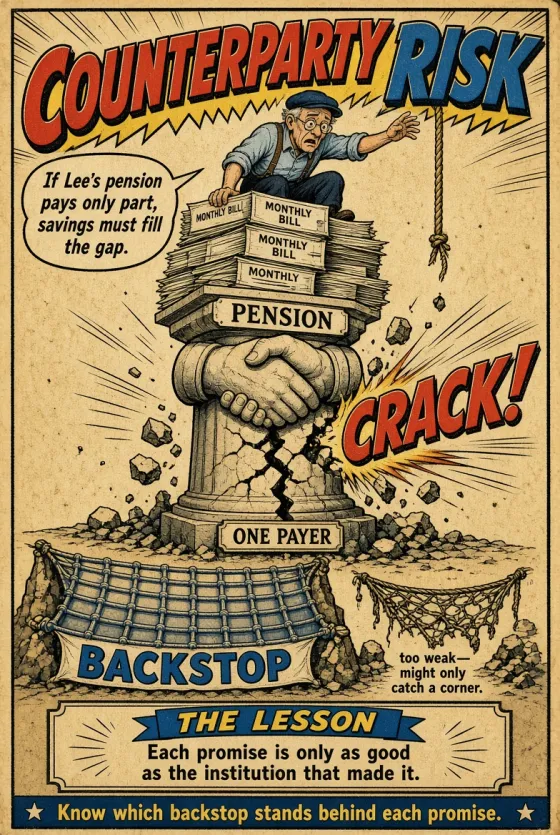
A pension is a promise from an employer's plan. An annuity is a promise from an insurance company, and a bank deposit is a promise from a bank. Each promise is only as good as the institution that made it, and the risk that it cannot pay is counterparty riskThe risk that the institution that owes you money cannot pay: a pension plan, the insurer behind an annuity, or a bank. Guarantees exist (the PBGC for private pensions, state guaranty associations for annuities, the FDIC for bank deposits), but each has limits.Full entry →. Most of these promises are kept, and each kind has a backstop that pays when one is not, but every backstop has limits. This lesson lays a pension cut over a retiree's plan, shows why the kind of pension decides how large the risk is, and walks through the limits on pensions, annuities, bank deposits and brokerage accounts.
Lee is 60, single, and plans to retire at 62, in 2028, and to spend $70,000 a year, rising with prices. A former employer's pensionIncome for life from a former employer's defined-benefit plan, set by salary and years of service rather than drawn from a balance you own. The federal return taxes it as ordinary income, while many states exclude some or all of it, which is why it shows on both tax statements.Full entry → will pay Lee $42,000 a year for life, with no cost-of-living raise. Lee has about $590,000 saved, mostly in bonds, and will claim Social SecuritySocial Security — the US government retirement and disability benefit, funded by payroll tax while you work and paid as a monthly check once you claim. How much you get depends on your earnings history (your PIA) and the age you claim relative to full retirement age.Full entry → at 67.
Lee - Pension Promise is Lee's plan. It is the same plan as Lee's in The risks to think about, where the pension made a market crashA rare, sharp fall across markets — 2008 and March 2020 are the recent ones — lasting months to a couple of years and arriving perhaps once a decade. Not the everyday case, and not a prediction: it matters in planning because these are the moments correlations rise toward +1, so holdings that usually differ fall together and diversification helps least exactly when it is needed most.Full entry → almost harmless. As planned, the plan succeeds on about 88% of 1,000 simulated futures.
The pension pays more than half of Lee's bills in the first years, and all of it comes from one place. If that one payer could not keep its promise, the hole in Lee's income would be larger than anything a bad year in the markets could make. This is the risk the lesson tests.
A pension or annuity in a plan pays exactly what the plan says. To ask what happens if it does not, open  TransformsA main-rail area. The name is Transforms because you transform a copy of the plan — a what-if — without rewriting the original dossier. Compare original vs modified side by side., unfold Modifications, and pick the Pension row on the Cash Flows tab. Under the benefit, the start age and the cost-of-living raise is a switch called Payer pays only part. Turn it on, and choose the share that is still paid and the year the cut starts.
Desktop app only
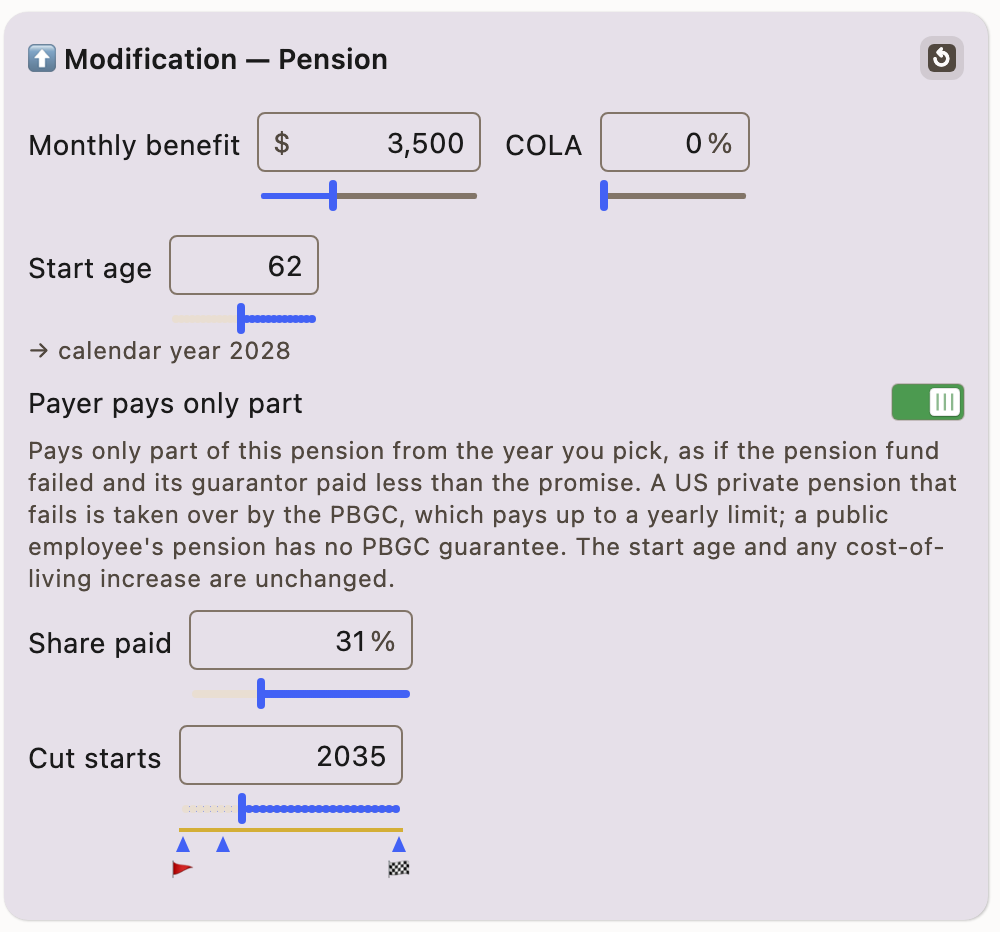
The cut applies to that one pension, from the year you choose, and leaves everything else about it alone. Nothing in the plan changes. Transforms shows the plan as written under Original and the plan with the cut under Modified. An annuity row has the same switch.
How much of a failed pension is still paid depends on what kind of pension it is.
A private pension from one employer. Most private pensions in the United States are insured by the Pension Benefit Guaranty Corporation (PBGC), a federal agency. When such a plan fails, the PBGC takes it over and pays the promised benefit up to a yearly maximum. For a plan that ends in 2026, the maximum is $6,153.92 a month for someone who starts at 62 and $7,789.77 a month at 65, so about $74,000 and $93,000 a year. Lee's pension is $3,500 a month. If it is this kind of plan, a failure would barely touch Lee, because the whole pension is under the maximum.
A union plan shared by many employers. A multiemployer plan, common in trucking, construction and other unionized trades, has a much smaller guarantee. The PBGC pays at most $35.75 a month for each year of service. For someone with 30 years of service, that is $1,072.50 a month, or $12,870 a year, whatever the pension promised. If Lee's $42,000 came from a multiemployer plan after 30 years, the guarantee would be about 31% of it. In 2021 Congress created a program that gave failing multiemployer plans enough money to pay full benefits through 2052, and about 100 plans covering more than a million people have received it. It is a rescue of plans that already existed, and nothing promises another one.
A public employee's pension. A pension from a state, a city or a school district has no PBGC guarantee. It is protected by state law, and in some states by the state constitution. Cuts are rare, but they have happened when a city went bankrupt. In Central Falls, Rhode Island, retirees' pensions were first cut by as much as 55% in 2011, and the state later softened the cut. In Detroit's bankruptcy in 2014, retirees' pensions were cut by 4.5% and their cost-of-living raises were reduced or ended.
The table shows the plan's chance of success over 1,000 futures with each kind of failure in 2035, seven years into Lee's retirement.
| The pension in 2035 | Share paid from 2035 | Success |
|---|---|---|
| Kept, or a single-employer failure the PBGC covers | 100% | 88% |
| A public pension cut in a city bankruptcy | 80% | 70% |
| A multiemployer plan at the PBGC's maximum | 31% | 24% |
The 80% row is an illustration of a deep cut, and the 31% row is the multiemployer maximum for 30 years of service. Neither is a forecast for any real plan.

Lee - Pension Promise's cash flows as planned (left) and with 31% of the pension paid from 2035 (right). The pension falls from $42,000 a year to about $13,000, so the green income bar drops in 2035, and from then on savings pay about half of the bills.

Lee - Pension Promise's balance sheet as planned and with the same cut, on one scale. As planned, net worth is about $760,000 in 2045 and about $490,000 at the end. With the cut it is about $370,000 in 2045, and savings run out in 2052.
A deep cut to a pension that pays most of the bills is far worse for Lee than the crash in The risks to think about. The crash cost Lee less than two points. The multiemployer case costs more than sixty. Lee's bonds and the pension protected the plan against a falling market, and they cannot protect it against the pension itself.
The year of the failure matters almost as much as its size. Move Cut starts later in the editor and the plan recovers much of its success rate.
| 31% paid from | Success |
|---|---|
| 2035 | 24% |
| 2045 | 59% |
A cut in 2045 leaves Lee ten more years of full payments and ten fewer years of the smaller one. The earlier a pension fails in a retirement, the more years the plan has to fill the gap.
The same switch works on an annuityA contract that pays a stream of income, usually for life, in exchange for a sum up front. It trades flexibility and any leftover balance for the one thing a portfolio cannot promise: a payment that does not stop if you live a long time. Products vary enormously; the word alone says very little.Full entry → row, and the same idea applies to the other places a plan keeps money.
- An annuity. When an insurer fails, its state regulator takes it over, and the state's life and health insurance guaranty association pays annuity owners up to a limit. In most states the limit is $250,000 of present valueWhat a future amount is worth today, after discounting for the years between. A multi-year outflow shown as one present value is not a sum of its rows — a dollar due in twenty years counts for less than one due next year. The product's PV rollups and "amount mode" switches are this idea applied to a whole flow.Full entry → of annuity benefits per person, per insurer. Some states set it higher. A household buying a large annuity can stay under the limit by splitting the purchase between insurers.
- A bank deposit. The FDIC insures deposits up to $250,000 per depositor, per insured bank, for each ownership category, such as individual, joint and retirement accounts.
- A brokerage account. SIPC protects customers of a brokerageAn ordinary taxable investment account — no special retirement wrapper, no contribution limit, and no withdrawal age rules. The trade-off is that dividends and realized gains are taxed as they happen rather than deferred. Often called the taxable bucket next to traditional and Roth.Full entry → account when the firm fails and their securities or cash are missing, up to $500,000 per customer, of which up to $250,000 can be cash. It does not protect against a fall in the value of what you own.
- Social Security. Social Security is a promise from the federal government, set by law rather than by contract, and Congress can change it. That is policy riskThe risk that a law changes the rules a plan was built on: tax rates and brackets, Social Security benefits, the age for required distributions, or a new tax such as a wealth tax. Plans that defer a lot of tax, or lean heavily on one benefit, carry the most.Full entry → more than counterparty risk, and Will Social Security be there? tests it on a plan.
Buying an annuity, taking a pension as a lifetime payment instead of a lump sum, and holding cash in a bank are all reasonable choices, and many people make them with a planner and many on their own. Counterparty risk is one more thing to weigh: know which backstop stands behind each promise, how far it reaches, and how much of the plan rests on one institution.
A pension or annuity removes market risk from part of a plan by moving it to one payer. For most people the payer keeps its promise, and when it does not, a backstop usually pays much or all of it. The size of what is left depends on the kind of promise: a private single-employer pension like Lee's is almost fully guaranteed, a multiemployer pension much less, and a public pension depends on state law. Find out which kind yours is, test a cut on the plan in Transforms, and spread large purchases so that each one stays inside its guarantee.
Works cited — the publications behind the figures
- Pension Benefit Guaranty Corporation, Maximum monthly guarantee tables, for the 2026 single-employer maximums at 62 and 65.
- Pension Benefit Guaranty Corporation, Multiemployer benefit guarantees, for the $35.75 per year of service maximum.
- U.S. Department of Labor, news release on Special Financial Assistance, November 2024, for the plans and people protected under the American Rescue Plan Act of 2021.
- National Organization of Life and Health Insurance Guaranty Associations, How you're protected, for annuity coverage limits.
- Federal Deposit Insurance Corporation, Deposit insurance, for the $250,000 limit.
- Securities Investor Protection Corporation, What SIPC protects, for the $500,000 limit and its $250,000 cash portion.
Rebuild this plan by hand
The cards on the canvas show the accounts and cash flows. These are the settings that live outside any card, read from the plan itself, with the label each control carries in the app. A value marked default is one to leave alone.
| Setting | Lee - Pension Promise |
|---|---|
| Household | |
| Planning region | United States (default) |
| Lee (Primary) | |
| birth year | 1966 |
| retirement age | 62 |
| death age | 92 |
| Taxes | |
| Tax regime | United States |
| Filing status | Single |
| State of residence | None |
| First-year federal estimate | — |
| First-year state estimate | — |
| Strategy | |
| Residual withdrawal strategy | Pro-rata (default) |
| Roth conversions | Off |
| Definition of success | Liquidity crises allowed (default) |
| Glide path target | None (default) |
| Advanced | |
| Reporting inflation | Assumption set's rate (default) |
| Cost of capital | Assumption set's rate (default) |
| Growth assumptions | Growth overrides (default) |
| Currencies | Multiple currencies (default) |
| Default currency | USD (default) |
| Display currency | USD (default) |

Educational content — not advice. These lessons teach how Tutilis models a plan and how to read what it shows. The households, balances, and outcomes in them are invented for teaching. Nothing here is financial, investment, tax, or legal advice, or a recommendation to buy, sell, or hold anything. A model cannot know your circumstances — check anything you take from a lesson against your own situation, and against a qualified professional where it matters.