
 Sheltering money — taxable, traditional, and Roth
How to use this case study
New to the Learning Center, or want a map of the panels? Start with a tour: Reading Lesson (Getting Around) or Screencast Lesson (Getting Around) — both walk through Tutilis next to a live planThe running Tutilis product next to this lesson — navigation, Bird's Eye, Forecaster, tools, and more — loaded with a teaching sample. A dossier is the plan data; the live plan is the full product surface with a sample dossier already open so you can explore. On the web, teaching samples are not editable the way your own dossier will be in the full app.Full entry → (to the right on a desktop-width screen, or below when stacked on a tablet).
This page — Sheltering money — taxable, traditional, and Roth — includes a live sample planThe running Tutilis product next to this lesson — navigation, Bird's Eye, Forecaster, tools, and more — loaded with a teaching sample. A dossier is the plan data; the live plan is the full product surface with a sample dossier already open so you can explore. On the web, teaching samples are not editable the way your own dossier will be in the full app.Full entry → next to the text. On a wide screen it usually sits to the right of the text; on a tablet it usually sits below. Use the text for the walk-through, then try the same ideas in the live plan.
The live planThe running Tutilis product next to this lesson — navigation, Bird's Eye, Forecaster, tools, and more — loaded with a teaching sample. A dossier is the plan data; the live plan is the full product surface with a sample dossier already open so you can explore. On the web, teaching samples are not editable the way your own dossier will be in the full app.Full entry → next to this page — usually to the right on a wide screen, or below on a tablet — is Tutilis running a teaching sample: the same financial planning product available as a desktop application (early preview). A dossierYour full plan in Tutilis: the people in the household, what they own and owe, cash flows in and out, tax setting, and planning assumptions. One dossier is one complete situation as the product models it.Full entry → is the plan data; the live plan is the full product (navigation, Bird's Eye, Forecaster, tools) with a sample dossier already open so you can try the panels. See planned pricing. On the web, Learning Center samples are not editable the way your own dossier will be in the full app. Your own household goes in the Tutilis desktop app — the Learning Center front page has a short clip of that.
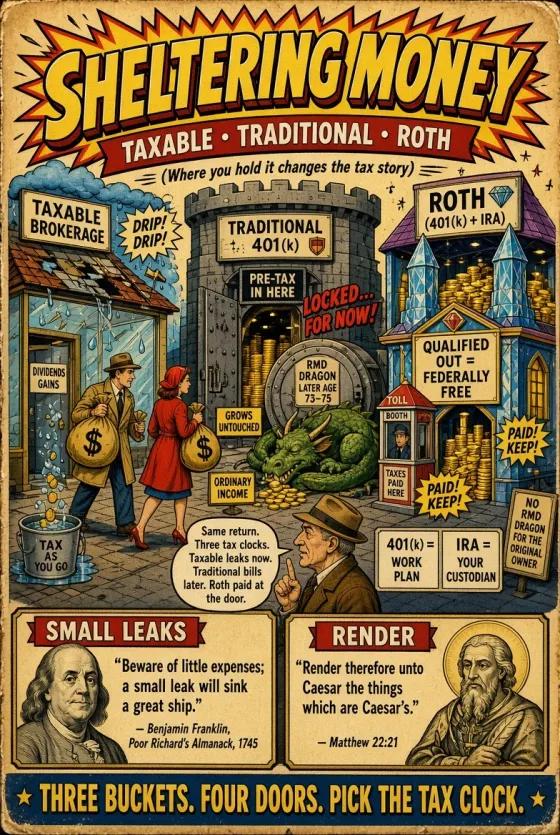
Where you hold investments can matter as much as what you hold. The same stock market return behaves differently in a taxable brokerageAn ordinary taxable investment account — no special retirement wrapper, no contribution limit, and no withdrawal age rules. The trade-off is that dividends and realized gains are taxed as they happen rather than deferred. Often called the taxable bucket next to traditional and Roth.Full entry →, a traditional 401(k)An employer-sponsored retirement account, named after the section of tax law that created it — so the name says nothing about what it does. Contributions are usually payroll-deducted, often matched by the employer, and come in traditional (pre-tax) and Roth flavors. A 403(b) is the same idea for schools and nonprofits, a 457 for government workers.Full entry →, a RothA retirement account where you pay income tax on the money going in, and qualified withdrawals later come out tax-free — the mirror image of traditional. Named after the senator behind the law, so the word tells you nothing on its own. Plans care because Roth dollars do not add to taxable income later, which keeps them clear of income-driven cliffs.Full entry → 401(k), and a Roth IRAIndividual Retirement Account — a retirement wrapper you open yourself rather than through an employer. It comes in traditional (pre-tax going in) and Roth (taxed going in) flavors, so naming the flavor matters more than the acronym does.Full entry → — for taxes today, taxes in retirement, required distributions, and how freely you can reach the money. This lesson compares taxable vs traditional vs Roth accounts side by side.
This lesson names those four account types, compares the rules that actually differ, and points at the live Banks household so you can see each type on a real balance sheet. It is content-first: the forecast will not invent IRS forms for you, but the product does tax each account type according to its tax bucketWhich tax rule a dollar lives under, rather than which institution holds it: taxable (taxed as you go), traditional (taxed on the way out), Roth (taxed on the way in). Two accounts showing the same balance in different buckets are not worth the same amount to spend, which is why a plan tracks the mix and not only the total. Legal wrappers differ by country; the three buckets are the durable idea.Full entry →, force traditional RMDs when age and balance require them, and treat Roth withdrawals as federally tax-freeNo income tax due when the money comes out — the Roth promise, and the reason Roth dollars keep a withdrawal clear of income-driven thresholds. The word hides a condition: the withdrawal has to be qualified, which turns on age and how long the account has been open. It also hides a scope: municipal-bond interest is tax-free on the federal return yet still counts toward whether Social Security is taxed.Full entry → retirement income.
| Account (this plan) | Tax bucket icon | Role in one line |
|---|---|---|
| Brokerage |  Taxable | After-tax dollars; cost basis; gains taxed when sold |
| Traditional 401(k) |  Tax-deferred | Pre-tax in; ordinary income out; RMD later |
| Roth 401(k) |  Taxes already paid | After-tax in (usually); qualified growth tax-free |
| Roth IRA | Taxes already paid | Same Roth tax story; different contribution / access rules |
The live plan on the right is Banks Baseline (banks_baseline) — Philip and Vivian with all
four accounts (plus Cash and a paid-off home). Cast continuity with other Banks lessons; wealth
scale is HNWHigh net worth — shorthand for a household wealthy enough that different planning problems dominate. Surcharge tiers, the investment surtax, and estate questions bind earlier, while running out of money is rarely the binding risk. There is no single official dollar line.Full entry →, but the tax mechanics are the same ones a mass-affluent plan uses.
About numbers: Amounts on the live plan (and any dollars mentioned here) should look similar to what you see when you open this sample, but they may not match exactly. Forecast detail, model updates, and fixes can move figures. Watch the story — tax buckets, labels, and order of magnitude — not every total to the dollar.
Looking at a household with taxable, traditional, and Roth accounts, can I:
- Name how contributions, growth, and withdrawals are taxed in each tax bucket (and in each of these four account types)?
- Point to the four named accounts on
 Bird's EyeWhen you are not on Dossier, this control sits in the top toolbar. Opens a household overview as a modal — people, assets and liabilities, cash flow — without leaving the area you are in. Hidden on Dossier, because that same overview already sits at the top of that area. /
 BS TableA Forecast Detail chip. BS = balance sheet for the selected year — real assets, accounts, liabilities, net worth. Copyable companion to BS Chart. and read their tax-bucket icons?
- Explain required minimum distributions (RMDs) — who they apply to, when they start, and how the amount is roughly determined — without confusing them with residual “spend this first” strategy?
- Leave Roth conversionDeliberately moving money from a traditional account into a Roth one and paying the income tax on it now, so it grows and comes out tax-free later. The usual reason is a low-income year — between retiring and claiming benefits, say — where the conversion is taxed at a lower rate than the future withdrawal would be. It also shrinks later RMDs.Full entry → as a deliberate, brief next step rather than a full policy lesson?
Think in buckets first, then in product names:
| Bucket | Product idea | Contribution (typical) | Growth while held | Withdrawal (qualified / ordinary path) |
|---|---|---|---|---|
| Taxable | Brokerage (and similar) | After-tax cash | Dividends / interest may be taxed as they occur; unrealized gains wait | Capital gain on (sale price − basis), not the whole balance |
| Tax-deferred (traditional) | Traditional 401(k), traditional IRA, … | Often pre-tax (or deductible) | Not taxed inside the account | Ordinary income on the amount distributed |
| Taxes paid (Roth) | Roth 401(k), Roth IRA, … | After-tax | Not taxed inside the account | Federally tax-free when rules for a qualified distribution are met |
Cash / demand accounts in this product sit with the taxable bucket for tax treatment: no retirement shelter, no RMDRequired Minimum Distribution — once you reach an age set by statute, the law makes you withdraw a minimum amount each year from traditional retirement accounts, whether or not you need the money. The withdrawal is taxable income, so RMDs can push a household into a higher bracket or over a surcharge threshold. Roth accounts are generally not subject to them.Full entry → engine.
On Banks you see both a Roth 401(k) and a Roth IRA. Same Roth tax story in the forecast (taxes-paid growth and tax-free retirement character). Different real-world plumbing: employer payroll vs individual IRA, contribution ceilings, and income limits for direct Roth IRA contributions. The plan does not auto-enforce every IRS contribution cap — it does apply the tax bucket when money is sold or withdrawn.
College 529 plans are another taxes-paid-style vehicle aimed at education (and, in some cases, limited later paths into retirement accounts). That story is separate from these four account types.
The table below is the main comparison for the lesson — return here when you need the differences in one place. Annual contribution ceilings change with inflationA rise in the price level. The same basket of goods costs more dollars than it did. A household plan carries a growth rate on each bill, because one published inflation number is one basket. The reporting rate that restates future dollars into today's dollars is a separate assumption.Full entry → and legislation — the rows describe how the limits work, not a frozen calendar-year dollar amount.
| Axis | Brokerage (taxable) | Traditional 401(k) | Roth 401(k) | Roth IRA |
|---|---|---|---|---|
| Who offers it | Brokerage / custodian | Employer plan | Employer plan (if offered) | Individual IRA at a custodian |
| Money going in | After-tax | Usually pre-tax elective deferrals (+ possible employer money) | Usually after-tax elective deferrals; match often lands traditional (plan-dependent) | After-tax; direct Roth IRA contributions can phase out at higher MAGI |
| Annual ceiling | None special (you can deposit what you have) | Shared employee elective deferral ceiling with Roth 401(k) under the same plan family; catch-up ages exist | Same employee-deferral family as traditional 401(k) | Lower IRA annual limit (traditional + Roth IRA share a limit); separate from 401(k) deferrals |
| Growth in the account | Taxable events possible (dividends, interest, realized gains) | Sheltered | Sheltered | Sheltered |
| Selling / withdrawing | Cap gains on gain above cost basis | Ordinary traditional retirement income | Roth retirement (federally tax-free when qualified) | Same Roth story |
| RMD (original owner) | No | Yes after RMD start age (72 / 73 / 75 by birth year under SECURE 2.0 — see table below) | No lifetime RMD under current SECURE 2.0 rules for employer Roth | No lifetime RMD for the original owner |
| Early access friction | High flexibility (taxes still apply) | Plan rules + possible 10% additional tax before 59½ on many traditional distributions | Plan rules; Roth contributions vs earnings rules differ | More portable; still contribution vs earnings and 5-year / age tests for fully tax-free earnings |
Where the icons appear: Bird's EyeWhen you are not on Dossier, this control sits in the top toolbar. Opens a household overview as a modal — people, assets and liabilities, cash flow — without leaving the area you are in. Hidden on Dossier, because that same overview already sits at the top of that area. and balance-sheet tables decorate account names with / /
so the bucket is readable at a glance. Same vocabulary as the
Financial plan glossary / Tutilis glossary.
Three sets of rules separate these accounts in practice: required minimum distributions, early withdrawals, and contribution eligibility.
Required minimum distributions (RMDs)
What they are. Once you reach RMD age and hold a traditional (tax-deferredTax postponed, not avoided. Growth compounds without a yearly tax drag, and the bill arrives when the money comes out — which is why a large tax-deferred balance and a required withdrawal age are the same conversation.Full entry →) retirement balance, the IRS expects you to take a minimum distribution each year — whether or not you need the cash for living expenses. The money is generally ordinary incomeIncome taxed at the regular graduated rates — wages, interest, pension payments, and withdrawals from traditional retirement accounts. The point of the label is the contrast: long-term capital gains and qualified dividends get their own, usually lower, rate schedule.Full entry →. Missing an RMD can trigger a large excise tax on the shortfall (this product models a default penalty rate; reduced “timely correction” rates are not the focus here).
When they start (SECUREThe law (and its sequel) that moved several retirement-account rules: the age RMDs start, catch-up contributions, and how quickly an inherited account must be emptied. Its practical effect on a plan is that dates you may remember from a decade ago are no longer the dates.Full entry → 2.0, by birth year — the engine’s approximation):
| Birth year | RMD start age (approx.) |
|---|---|
| 1950 or earlier | 72 |
| 1951–1959 | 73 |
| 1960 or later | 75 |
Philip and Vivian on Banks Baseline are still mid-career in the plan year — they are not in RMD years yet. The large traditional account is still the future RMD story. To see forced RMD sales every year with reason codes, open the dedicated sample: Forced traditional RMD vs residual tax order (Philip aged past RMD start, large traditional IRA, residual still set to prefer taxable cash).
How the amount is determined. For a calendar year, a common rule of thumb is:
prior year-end balance ÷ life-expectancy divisor (Uniform Lifetime Table for many owners)
The divisor falls with age, so the required fraction of the account grows. When the force is active, this product shows the required amount each year on the Brackets chart and Money Movements Why lines such as RMD · Traditional ….
Which of these four account types?
| Account | Original-owner RMD? |
|---|---|
| Brokerage | No |
| Traditional 401(k) | Yes |
| Roth 401(k) | No (current law / product model) |
| Roth IRA | No |
Inherited accounts and spouse rules are out of scope here.
Early withdrawals (brief)
Before 59½, many traditional retirement spending distributions can face a base 10% additional tax on top of ordinary income (exceptions exist; the product models the base case). A Roth conversion is treated as a transfer, not spending — see the conversion lesson. Taxable brokerage sales are not “early withdrawal penalties”; they are capital-gains events.
Contribution and eligibility (what to remember)
Reference — the 2026 contribution limits
| 2026 IRS reference | Amount |
|---|---|
| 401(k) / Roth 401(k) elective deferral | $24,500 |
| Catch-up (age 50+) | $8,000 |
| Higher catch-up (ages 60–63) | $11,250 |
| Traditional + Roth IRA (combined) | $7,500 |
| IRA catch-up (age 50+) | $1,100 |
- 401(k) traditional vs Roth 401(k): same plan family, different tax timing of the employee elective deferral. One shared employee ceiling (plus catch-up contributionExtra room to contribute to a retirement account once you reach a set age — the ordinary limit plus an additional amount, with a still-higher amount in a narrow age band. The name is aspirational: nothing has to be caught up on to use it.Full entry → when eligible). Employer match rules are plan-specific.
- Roth IRA: income phaseouts can block direct contributions even when a Roth 401(k) is still available through work. “Backdoor” and conversion strategies are advanced topics.
- Caps change. The reference table above is calendar 2026 IRS figures only — confirm the current notice or plan documents when you contribute.
- In the app: set account types so the tax bucket is right; contribution flows are modeled where you author them.
A Roth conversion moves balance from traditional → Roth. You pay ordinary income tax on the converted amount now so qualifiedA tax word meaning the conditions were met, not a judgment of quality. A qualified Roth withdrawal is tax-free; an unqualified one is not. Qualified dividends get the lower capital-gain rates; ordinary ones do not. Whenever you see it, the interesting question is *which* conditions.Full entry → later growth and withdrawals can be tax-free — and so you may reduce future traditional RMDs.
That trade is most interesting in lower-income years (often after paychecks stop and before RMDs force large traditional withdrawals). Planners call that span the conversion window.
This lesson does not walk conversion policy, Money Movements Why: Roth conversion, or MAGIModified Adjusted Gross Income — AGI with certain deductions added back. It matters far out of proportion to the small adjustment, because MAGI is the figure that triggers cliffs: Medicare surcharges, the investment surtax, and health-subsidy eligibility all test against a MAGI, and each rule uses a slightly different one.Full entry → / IRMAAIncome-Related Monthly Adjustment Amount — a surcharge on Medicare premiums for higher-income households. It works in tiers, so one dollar of extra income can raise the premium for a whole year. It looks back at a tax return from a couple of years earlier, which is why a one-off spike (a big conversion, a property sale) shows up as a bill much later.Full entry → traps year by year. Use:
| Next step | Lesson |
|---|---|
| How the plan states and executes a conversion | Roth conversion in the window |
| MAGI, IRMAA, NIIT when income is high | MAGI cliffs — IRMAA, NIIT, and friends |
| When conversion year choice hurts (later full lesson) | Coming separately — not required for this comparison |
Open Banks Baseline on the right and read it in two passes, definitional views first and projected views second.
Definitional
- Bird's EyeWhen you are not on Dossier, this control sits in the top toolbar. Opens a household overview as a modal — people, assets and liabilities, cash flow — without leaving the area you are in. Hidden on Dossier, because that same overview already sits at the top of that area. → People — Philip and Vivian; retirement ages still in the future relative to
RMD start for their birth years.
- Bird's EyeWhen you are not on Dossier, this control sits in the top toolbar. Opens a household overview as a modal — people, assets and liabilities, cash flow — without leaving the area you are in. Hidden on Dossier, because that same overview already sits at the top of that area. → Assets (Account mode) — find Brokerage, Traditional 401(k),
Roth 401(k), Roth IRA, and Cash. Read the tax-bucket emoji before each name.
- Account editor (optional) — open an account’s type help for the plan-family comparison table (401(k), 403(b), IRA, …). That popover is the in-app reference twin of this lesson’s tables.
- Bel-Air Tech on Brokerage is a concentration story for other Banks lessons — ignore it for tax-bucket mechanics.
Projected
Select  BS ChartA Forecast Detail chip. BS = balance sheet. Assets above the line, liabilities below, over the forecast years. The net line, drawn in thick black, is net worth — often the thing you came for. Click a year to load the tables., BS TableA Forecast Detail chip. BS = balance sheet for the selected year — real assets, accounts, liabilities, net worth. Copyable companion to BS Chart., and optionally
 TaxesA Forecast Detail tax-lens chip. Tax statement for the selected year (federal, state when modeled, property). /
 Moves TableA Forecast Detail chip. Mov = Movements. Holding-level trades for the selected year — sold or invested, after, %, and Why.. Prefer FID 0 / GMFHow the north star is labeled in the FID control: FID 0 is the deterministic GMF ✦ path, and every other FID is a randomized draw from the simulation. Choose it when you want the year-by-year read to hold still while you change something else about the plan.Full entry →.
| Preview | View | Role here |
|---|---|---|
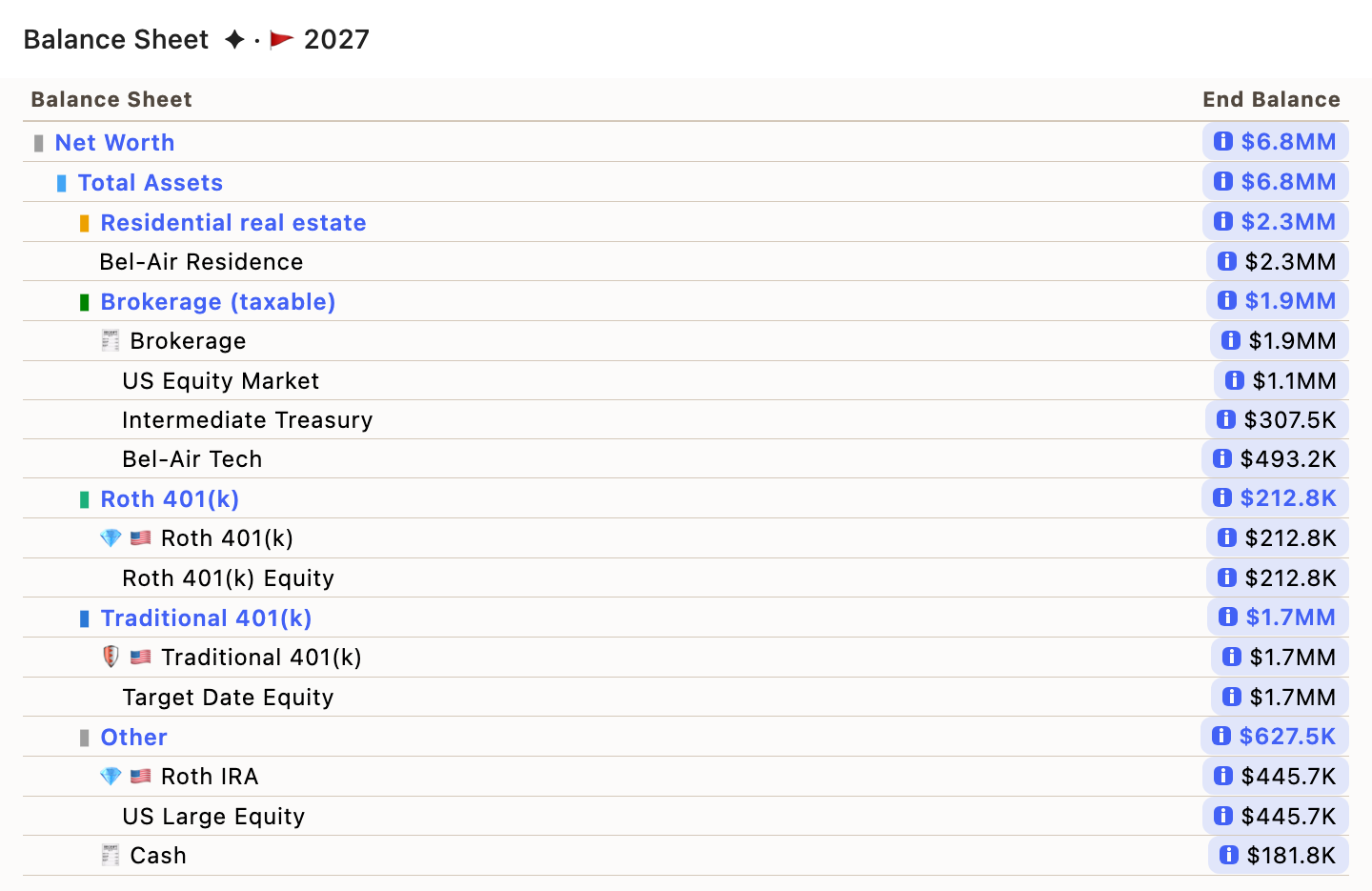 | BS TableA Forecast Detail chip. BS = balance sheet for the selected year — real assets, accounts, liabilities, net worth. Copyable companion to BS Chart. | Spot each account and tax-bucket totals in a selected year. |
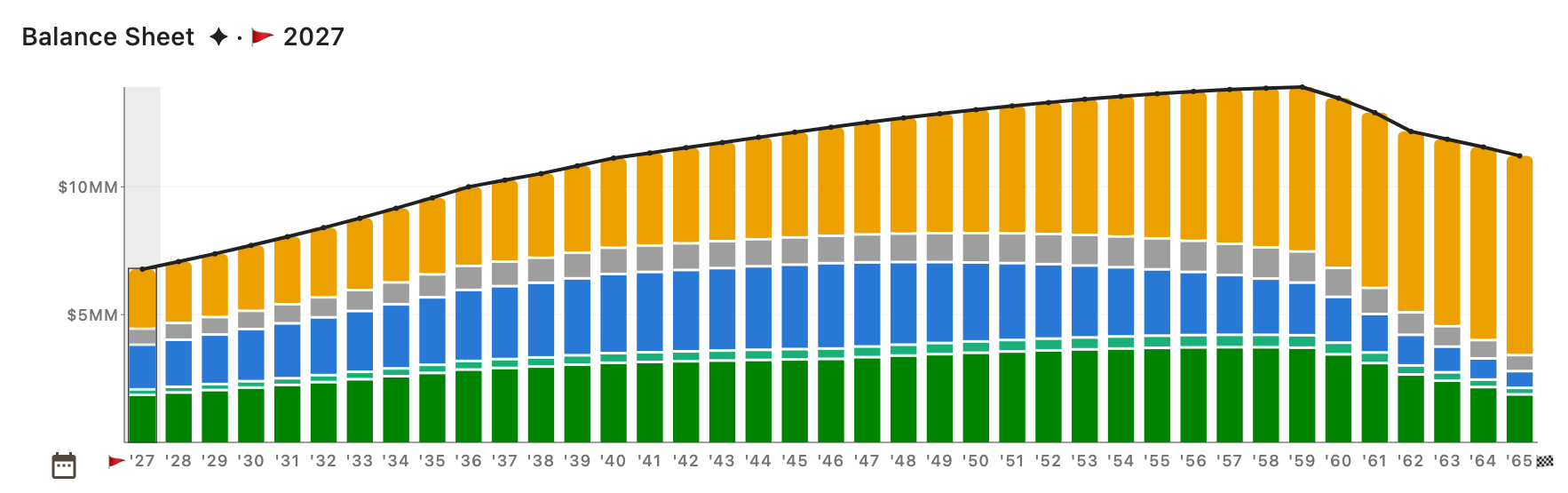 | BS ChartA Forecast Detail chip. BS = balance sheet. Assets above the line, liabilities below, over the forecast years. The net line, drawn in thick black, is net worth — often the thing you came for. Click a year to load the tables. | Multi-bucket wealth over the horizon (home + accounts). |
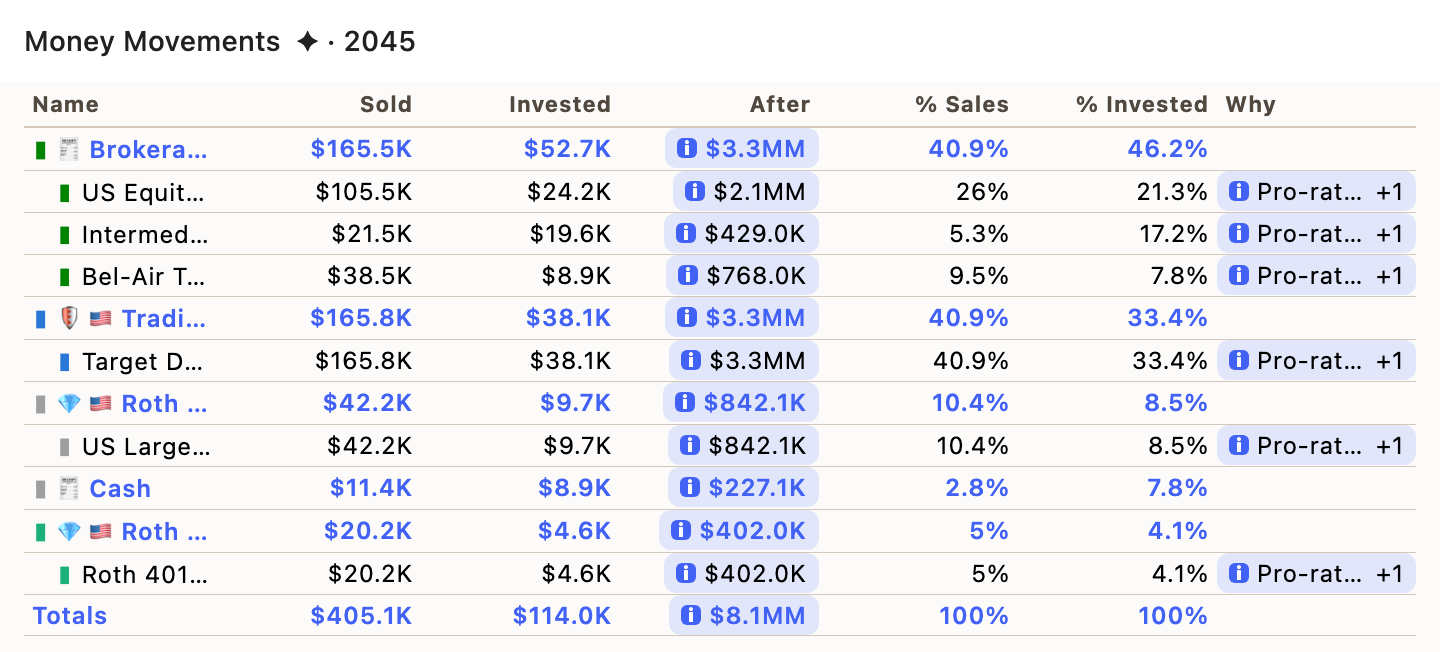 | Moves TableA Forecast Detail chip. Mov = Movements. Holding-level trades for the selected year — sold or invested, after, %, and Why. | Later drawdown years: residual reasons by account / tax bucket — not RMD force yet on this baseline. |
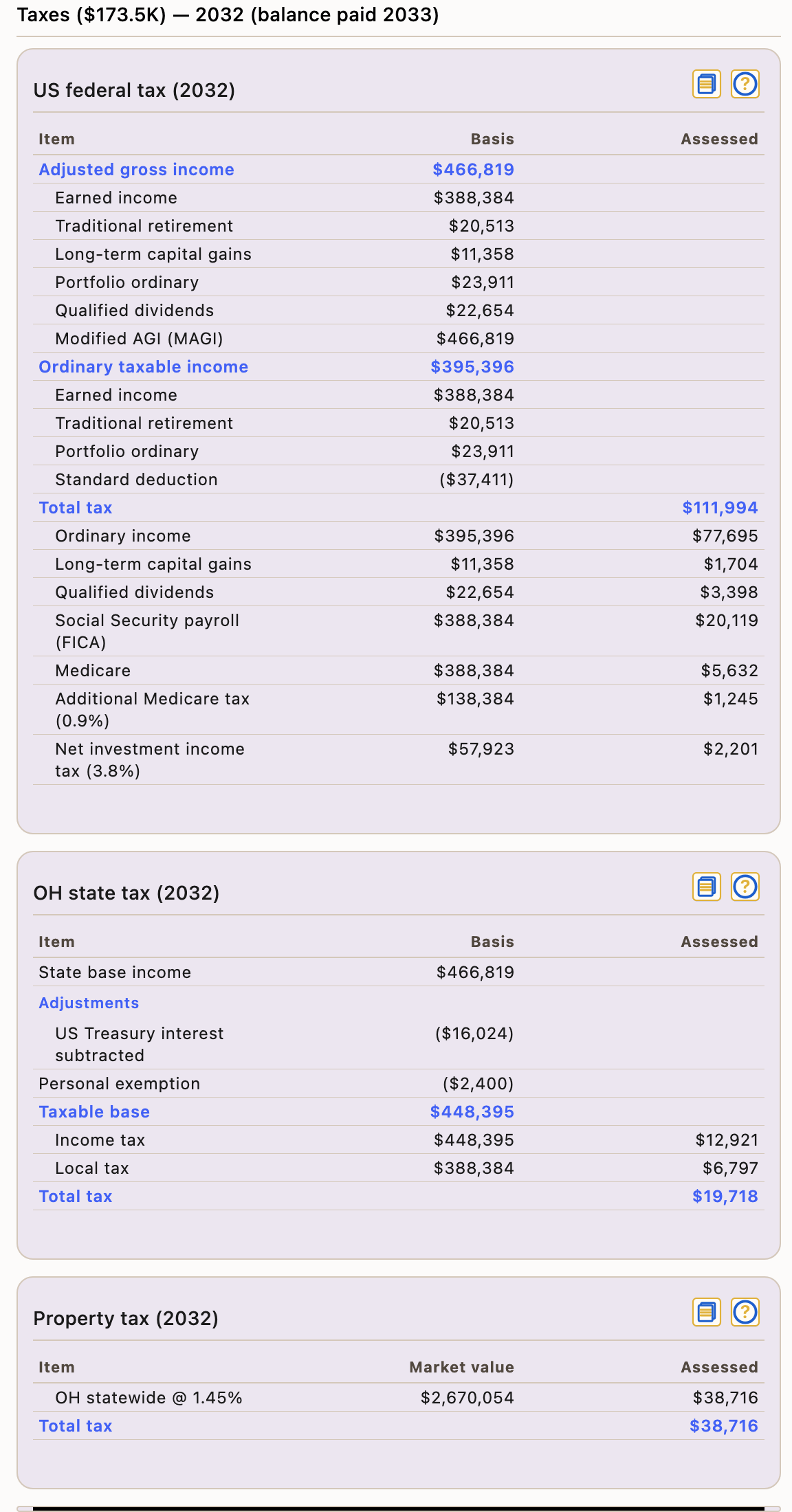 | TaxesA Forecast Detail tax-lens chip. Tax statement for the selected year (federal, state when modeled, property). | Federal / state / property statement. Mid-horizon work year is high earned income; later traditional distributions show as ordinary-income character — qualified Roth does not. |
You will not see annual RMD · … forced sales on this mid-career baseline. That is intentional. Switch to Forced traditional RMD when the question is “does residual strategy override the statute?”
Chart controls: Close up / zoom / Reveal.
- On Bird's EyeWhen you are not on Dossier, this control sits in the top toolbar. Opens a household overview as a modal — people, assets and liabilities, cash flow — without leaving the area you are in. Hidden on Dossier, because that same overview already sits at the top of that area., list the four accounts and say out loud: when taxed in, when taxed out.
- Open BS TableA Forecast Detail chip. BS = balance sheet for the selected year — real assets, accounts, liabilities, net worth. Copyable companion to BS Chart. and confirm Traditional 401(k) is the large tax-deferred account that will
drive future RMDs.
- Contrast Roth 401(k) vs Roth IRA as two taxes-paid accounts with different real-world contribution rules — same forecast tax treatment.
- Open Forced traditional RMD and find RMD · … on Money Movements — then return here for the definitional map.
- Optional: Roth conversion in the window if you want the policy → tax → MAGI path next.
The teaching claim is that tax location changes the character of withdrawals and whether RMDs apply — not any particular balance on the Banks sample.
| Topic | Lesson |
|---|---|
| Forced RMD vs residual tax-account order | Forced traditional RMD |
| Conversion policy and Money Movements Why | Roth conversion in the window |
| Which tax bucket to spend first | Tax-account order vs pro-rata |
| MAGI cliffs (IRMAA, NIIT, …) | MAGI cliffs |
| Banks HNW orientation / concentration | Meet the Banks household |
| Term lookup | Financial plan glossary · Tutilis glossary |
Not tax, legal, or investment advice. Contribution limits, RMD ages, and plan documents change; verify current rules for real decisions. Educational framing matches the Learning Center disclaimer on every lesson.
Rebuild this plan by hand
The cards on the canvas show the accounts and cash flows. These are the settings that live outside any card, read from the plan itself, with the label each control carries in the app. A value marked default is one to leave alone.
| Setting | Banks Baseline |
|---|---|
| Household | |
| Planning region | United States (default) |
| Philip (Primary) | |
| birth year | 1972 |
| retirement age | 65 |
| death age | 90 |
| Vivian (Secondary) | |
| birth year | 1974 |
| retirement age | 67 |
| death age | 92 |
| Taxes | |
| Tax regime | United States |
| Filing status | Married, filing jointly |
| State of residence | Ohio |
| First-year federal estimate | — |
| First-year state estimate | — |
| Strategy | |
| Residual withdrawal strategy | Pro-rata (default) |
| Roth conversions | Off |
| Definition of success | Liquidity crises allowed (default) |
| Glide path target | None (default) |
| Advanced | |
| Reporting inflation | Assumption set's rate (default) |
| Cost of capital | Assumption set's rate (default) |
| Growth assumptions | Growth overrides (default) |
| Currencies | Multiple currencies (default) |
| Default currency | USD (default) |
| Display currency | USD (default) |

Educational content — not advice. These lessons teach how Tutilis models a plan and how to read what it shows. The households, balances, and outcomes in them are invented for teaching. Nothing here is financial, investment, tax, or legal advice, or a recommendation to buy, sell, or hold anything. A model cannot know your circumstances — check anything you take from a lesson against your own situation, and against a qualified professional where it matters.