
 MAGI cliffs — IRMAA, NIIT, and friends
The situation A retired couple in Ohio with a large IRA and investment income — how close are they to the income lines where Medicare surcharges and extra taxes switch on?
How to use this case study
New to the Learning Center, or want a map of the panels? Start with a tour: Reading Lesson (Getting Around) or Screencast Lesson (Getting Around) — both walk through Tutilis next to a live planThe running Tutilis product next to this lesson — navigation, Bird's Eye, Forecaster, tools, and more — loaded with a teaching sample. A dossier is the plan data; the live plan is the full product surface with a sample dossier already open so you can explore. On the web, teaching samples are not editable the way your own dossier will be in the full app.Full entry → (to the right on a desktop-width screen, or below when stacked on a tablet).
This page — MAGI cliffs — IRMAA, NIIT, and friends — includes a live sample planThe running Tutilis product next to this lesson — navigation, Bird's Eye, Forecaster, tools, and more — loaded with a teaching sample. A dossier is the plan data; the live plan is the full product surface with a sample dossier already open so you can explore. On the web, teaching samples are not editable the way your own dossier will be in the full app.Full entry → next to the text. On a wide screen it usually sits to the right of the text; on a tablet it usually sits below. Use the text for the walk-through, then try the same ideas in the live plan.
The live planThe running Tutilis product next to this lesson — navigation, Bird's Eye, Forecaster, tools, and more — loaded with a teaching sample. A dossier is the plan data; the live plan is the full product surface with a sample dossier already open so you can explore. On the web, teaching samples are not editable the way your own dossier will be in the full app.Full entry → next to this page — usually to the right on a wide screen, or below on a tablet — is Tutilis running a teaching sample: the same financial planning product available as a desktop application (early preview). A dossierYour full plan in Tutilis: the people in the household, what they own and owe, cash flows in and out, tax setting, and planning assumptions. One dossier is one complete situation as the product models it.Full entry → is the plan data; the live plan is the full product (navigation, Bird's Eye, Forecaster, tools) with a sample dossier already open so you can try the panels. See planned pricing. On the web, Learning Center samples are not editable the way your own dossier will be in the full app. Your own household goes in the Tutilis desktop app — the Learning Center front page has a short clip of that.
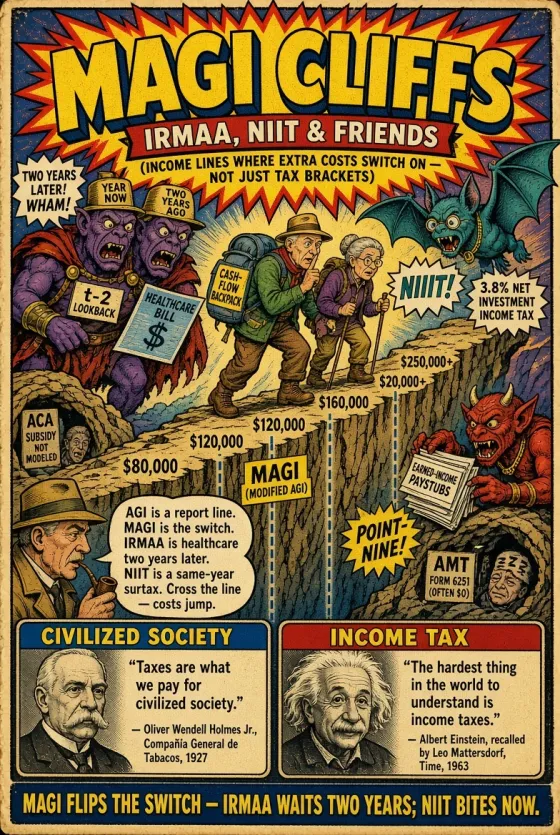
Adjusted gross income (AGIAdjusted Gross Income — total income minus a specific set of adjustments, and the number many other tax rules build on. It is a midpoint, not your taxable income: deductions still come off after it.Full entry →) is not just a report line. Modified AGI (MAGIModified Adjusted Gross Income — AGI with certain deductions added back. It matters far out of proportion to the small adjustment, because MAGI is the figure that triggers cliffs: Medicare surcharges, the investment surtax, and health-subsidy eligibility all test against a MAGI, and each rule uses a slightly different one.Full entry →) drives later costs that are not “just the tax brackets.” This lesson names those mechanisms, shows where each appears, and walks a live sample where income is high enough for the cliffs to matter. Among the MAGI cliffs in retirement, the IRMAA two-year lookback surprises people most: this year's income sets the Medicare premium two years later.
| Mechanism | What it is | Where you see it |
|---|---|---|
| AGI / MAGI | Sparse worksheet AGI; MAGI ≈ AGI + tax-exempt interest | Federal tax statement |
| IRMAA | Medicare Part B/D premium steps from MAGI two years prior | Cash flow — healthcare surcharge (not a tax line) |
| Additional Medicare (0.9%) | Extra tax on high earned income | Federal tax statement, next to base Medicare |
| NIIT (3.8%) | Surtax on net investment income above a MAGI threshold | Federal tax statement — explicit line |
| ACA marketplace | Premium tax credits move with MAGI | Priced for a healthcare phase marked as a marketplace plan; otherwise a warning only |
| AMT | Sparse Form 6251–shaped floor (AMTI ≈ AGI) | Explicit AMT line when owed (often $0) |
The live plan on the right is Banks MAGI Cliffs (magi_cliffs_sample): Philip and Vivian
(Banks HNWHigh net worth — shorthand for a household wealthy enough that different planning problems dominate. Surcharge tiers, the investment surtax, and estate questions bind earlier, while running out of money is rarely the binding risk. There is no single official dollar line.Full entry → cast) already on Medicare, with high traditionalA retirement account where the tax is paid on the way out — not a description of an old-fashioned account. Money went in before income tax, grew untaxed, and is taxed as ordinary income when you take it out — traditional 401(k)s and IRAs work this way. The contrast is Roth (taxed going in, tax-free coming out) and taxable (brokerage, taxed as you go).Full entry → retirement withdrawals and portfolio
income, plus Ohio state tax like other Banks roots. Run the forecast several years so year t
can read MAGI from t−2 for IRMAAIncome-Related Monthly Adjustment Amount — a surcharge on Medicare premiums for higher-income households. It works in tiers, so one dollar of extra income can raise the premium for a whole year. It looks back at a tax return from a couple of years earlier, which is why a one-off spike (a big conversion, a property sale) shows up as a bill much later.Full entry →.
When retirement income is large, can I open the federal tax statement and cash flow and see:
- AGI and MAGI as audit rows (MAGI equals AGI when there is no tax-exempt interest)?
- NIIT and Additional Medicare as explicit assessed lines — not folded into ordinary tax?
- IRMAA as a healthcare outflow driven by two-year-lookback MAGI — not as “more income tax”?
- An honest note that ACAAffordable Care Act — the law behind the individual health-insurance marketplace and its income-based subsidies. It matters to a plan mostly before Medicare age: retiring early means buying coverage here, and the subsidy is tested against income you partly control.Full entry → subsidies are not modeled when marketplace-shaped healthcare is active but not marked as a marketplace plan?
The federal statement reports AGI as a total, and MAGI builds on it as the named input that later cliff math reads.
1. AGI on the statement
The federal statement shows Adjusted gross income with non-zero ingredients (earned, pensions, traditional retirement, taxable SSSocial Security — the US government retirement and disability benefit, funded by payroll tax while you work and paid as a monthly check once you claim. How much you get depends on your earnings history (your PIA) and the age you claim relative to full retirement age.Full entry → inclusion, LTCGLong-Term Capital Gain — profit on something held longer than a year, taxed on its own lower schedule instead of at ordinary rates. The holding period is the whole trick: the same sale a day earlier is taxed as ordinary income.Full entry →, portfolio ordinary, …). That figure is the sparse worksheet AGI for the year.
2. MAGI
Modified AGI (MAGI) ≈ AGI + tax-exempt interest. When tax-exempt interest is zero (the usual case in our samples), MAGI equals AGI. The statement still labels MAGI so cliff math has a named input.
MAGI feeds:
- NIIT (same year)
- IRMAA (year t uses MAGI from year t−2)
- ACA warning (same year, when pre-Medicare / marketplace healthcare is active)
 ForecasterA main-rail area with two jobs: (1) run the plan year by year and inspect Forecast Detail, and (2) Simulation Summary — many paths summarized into something like a probability of success.
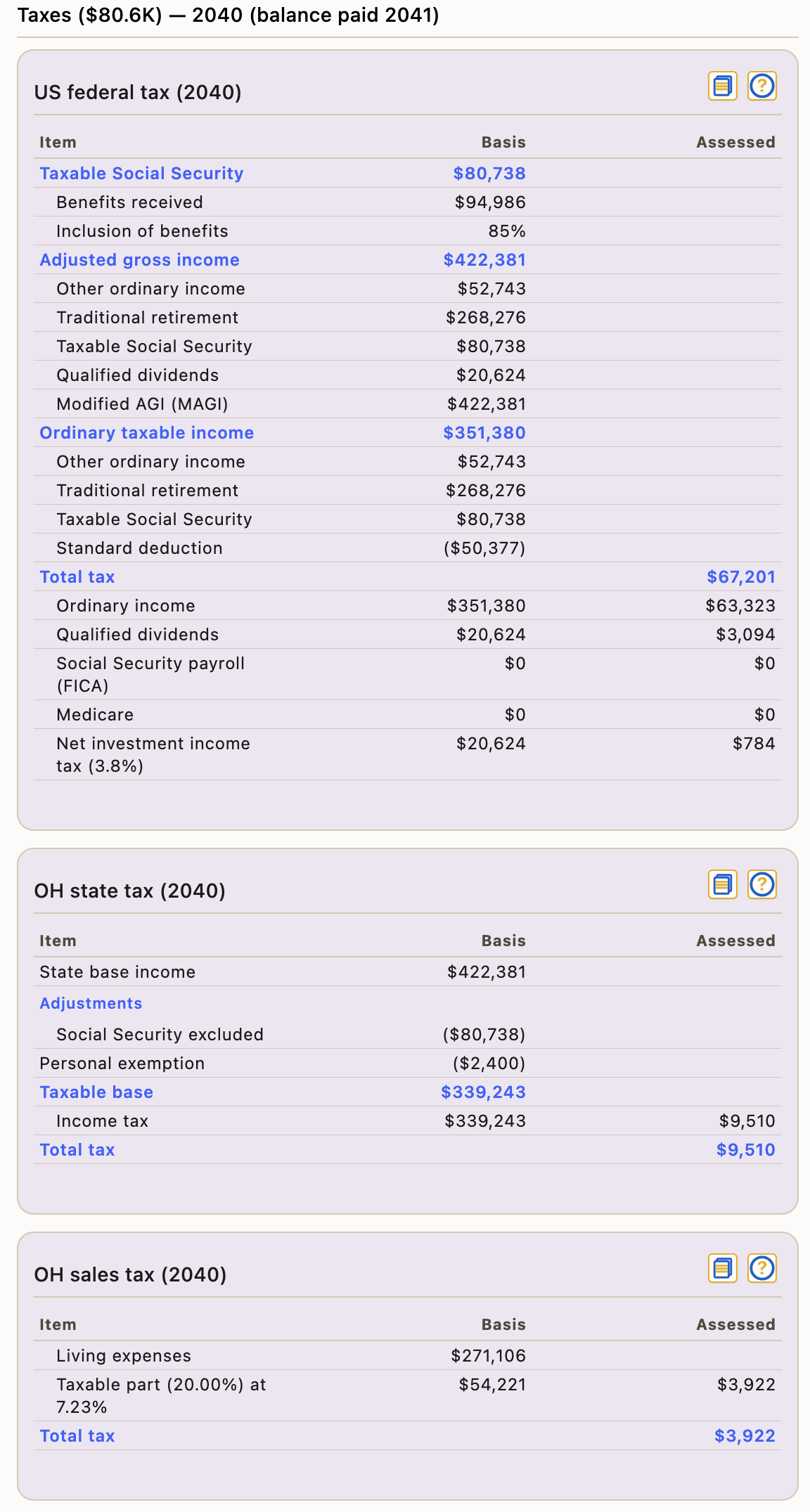
 TaxesA Forecast Detail tax-lens chip. Tax statement for the selected year (federal, state when modeled, property). (GMF ✦GMF ✦ (also FID 0 / GMF) is the product north star — the deterministic geometric mean forecast path you steer by, not a random Monte Carlo draw and not “most likely.” Prefer it for a stable year-by-year read of the plan. Switch away when you want to explore other randomized scenarios or paths in the multi-path cloud. The ✦ mark matches the live FID control (compass / north star, not a rating star).Full entry →, a settled year on this sample). Under US federal tax,
Adjusted gross income carries the AGI total and its ingredients; the next audit row is
Modified AGI (MAGI) — the same number, because tax-exempt interest is zero here. Dollar amounts
vary by year and FIDForecast ID — which of the simulated paths you are currently looking at. A simulation runs many paths; the FID control picks one so the year-by-year charts and tables have a single story to tell. FID 0 is the deterministic GMF ✦ north-star path rather than a random draw.Full entry →; match the row labels and the AGI = MAGI story, not the exact figures. The
state statement below is context only for this lesson.
IRMAA is the clearest cliff on this sample, and it arrives as a Medicare premium rather than as a tax.
Mechanism
Medicare Part B and Part D premiums step up at income brackets. The bracketA band of income taxed at a given rate. The common misreading is that entering a higher bracket taxes all your income at that rate — it does not. Only the dollars inside that band pay the higher rate, so a raise never leaves you with less after tax.Full entry → is based on MAGI from two years prior. Being one dollar over a line costs the full step for the year — for each Medicare enrollee (age 65+).
A conversion or large withdrawal at 63 can raise premiums at 65. That is the lookback.
Where it appears in this product
| Surface | Treatment |
|---|---|
| Federal tax total | Does not include IRMAA |
| Cash flow | IRMAA (Medicare surcharge) — same-year healthcare outflow |
| Cliff radar | In play / Nearby with lookback year + MAGI (see Cliff radar) |
| Annual detail | Lookback MAGI + surcharge amount for audit |
Why not a tax line? IRMAA is a premiumWhat you pay for coverage — a monthly insurance or Medicare cost — and not a bonus or a prize. Confusingly, the same word means "above face value" when applied to a bond. In a plan it is nearly always the insurance sense: a recurring outflow that rises with age and, past a threshold, with income.Full entry →, not Form 1040 income tax. Keeping it out of
totalTaxes matches how money leaves the plan: as healthcare cost, next to other medical spend.
What to look for on the sample
- Run the forecast at least three years so year 3 has a lookback MAGI from year 1.
- Confirm persons are Medicare age (65+).
- On cash flow for a later year, find IRMAA (Medicare surchargeAn extra amount added on top of a normal charge once income passes a line — in planning, almost always the Medicare premium surcharge. It is not a tax rate, so it does not show up in a bracket; it arrives as a higher premium, in tiers, based on a tax return from two years earlier.Full entry →) when lookback MAGI is above the first bracket.
- On the federal statement for a high-income year, confirm MAGI is large — that is what will bite premiums two years later.
Dollar amounts on your run may differ (seed, year, FID). The point is to see the same medical story in both places:
On the  CF ChartA Forecast Detail chip. CF = cash flows. Money in above the line, money out below, by category over the years. The net line, drawn in thick black, is net cash flow — often the thing you came for. (hover a year) | On the  CF TableA Forecast Detail chip. CF = cash flows for the selected year — incomes, expenses, taxes, and invest / sell / borrow totals. (same year) |
|---|---|
| Philip Medicare (Medicare) and Vivian Medicare (Medicare) as health outflows — one per enrollee | Matching Medicare lines |
| IRMAA (Medicare surcharge) as its own healthcare line — not under Income tax | Matching IRMAA line under outflows, separate from Income tax |
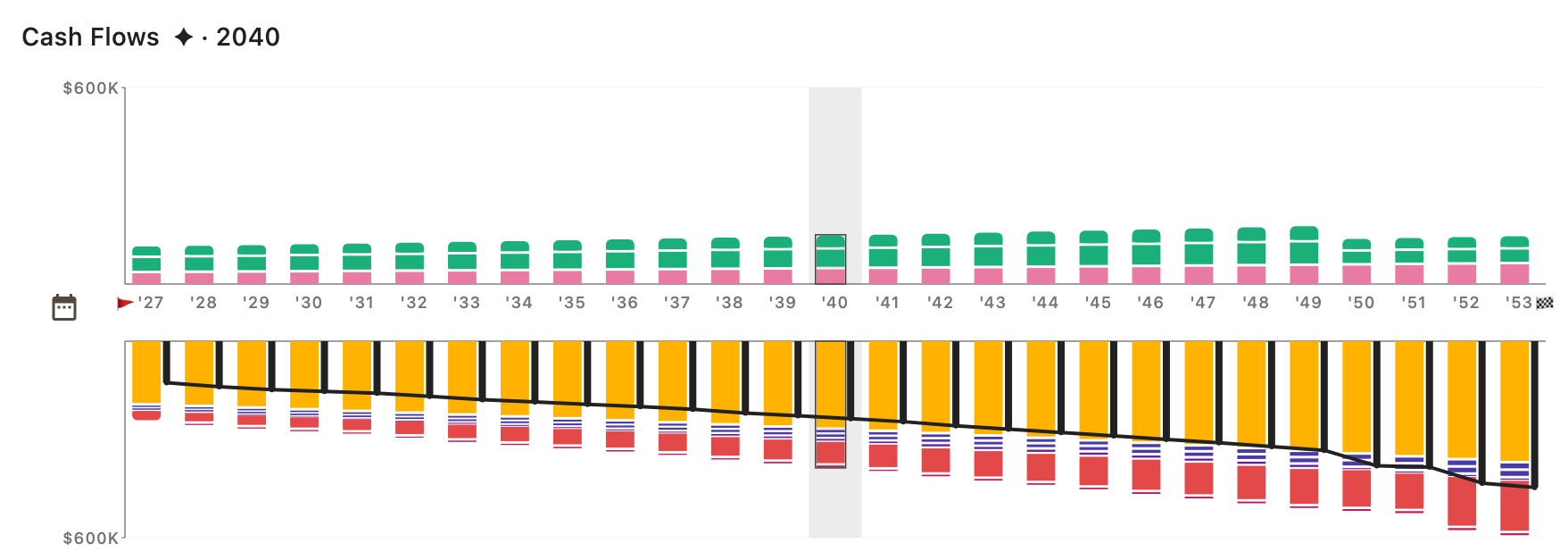
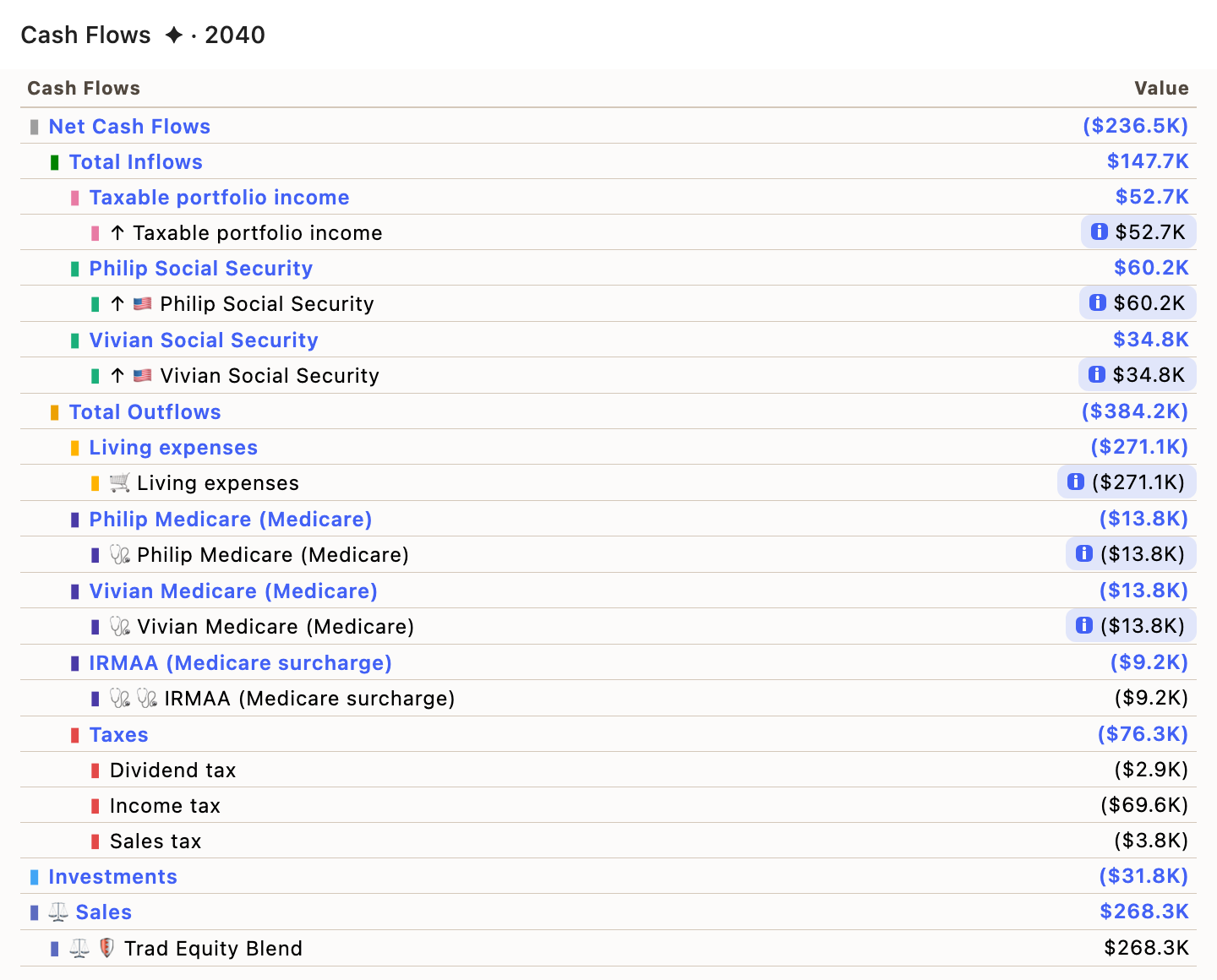
Forecaster → CF ChartA Forecast Detail chip. CF = cash flows. Money in above the line, money out below, by category over the years. The net line, drawn in thick black, is net cash flow — often the thing you came for. + CF TableA Forecast Detail chip. CF = cash flows for the selected year — incomes, expenses, taxes, and invest / sell / borrow totals. (GMF example year). HoverOn a desktop or laptop, rest the pointer on a row, chip, or control to open a detail card — attributes, amounts, and often a small path chart. We put a lot of teaching detail in those cards on purpose. Hover needs a pointer, so it does not work on tablets or phones (tap may show a simpler view or nothing). Hold Alt if the tips become a nuisance — many product hovers stay closed while Alt is down so you can move the pointer freely.Full entry → the chart year to list outflows;
confirm the two Medicare lines and IRMAA (Medicare surcharge) appear on both the chart and the
table, while Income tax stays a separate red tax line. Figures are illustrative — match the
labels and placement, not the exact dollars.
Several other income-driven rules sit beside IRMAA. Two of them, NIIT and the Additional Medicare tax, are explicit lines on the federal statement, and the others get a short note each.
Additional Medicare tax (0.9%)
- Applies to earned incomeMoney you were paid for working — wages, salary, self-employment profit. The distinction is not fussiness: earned income carries payroll tax and builds Social Security credit, while investment income does not. It is also what contribution limits and some credits are measured against.Full entry → above a filing-status threshold (e.g. $200k single / $250k joint).
- Thresholds are not inflation-indexed — held nominalA face-value figure, with no adjustment for inflation. A balance that doubles in nominal terms over 25 years may buy little more than it does today. The counterpart is real, which is inflation-adjusted and closer to what the money will actually buy — always check which one a chart shows.Full entry → in the engine (same honesty choice as Social Security provisional-income thresholds).
- Base Medicare 1.45% remains its own line; the 0.9% is additional and explicit.
This sample’s income is mostly retirement distributions, so Additional Medicare may be $0 while NIIT and IRMAA still matter — that contrast is intentional.
NIIT (3.8%)
- Tax = 3.8% × min(net investment income, MAGI − threshold).
- Thresholds match the Additional Medicare statutory dollars (also not indexed).
- Sparse NII: LTCG, dividends, interest, passive incomeIncome that arrives without work being done for it — rent, royalties, annuity-like payouts, a business you own but do not run. In a plan it is a flow that continues into retirement on its own; in tax law it is a specific category, and the two do not perfectly agree.Full entry → — not wages, not traditional IRAIndividual Retirement Account — a retirement wrapper you open yourself rather than through an employer. It comes in traditional (pre-tax going in) and Roth (taxed going in) flavors, so naming the flavor matters more than the acronym does.Full entry → distributions, not Social Security.
- Explicit Net investment income tax (3.8%) line on the federal statement.
Early-withdrawal penalty (honesty)
The base 10% early-withdrawal additional tax on pre-59½ traditional distributions is modeled. Statutory exemptions (rule of 55, 72(t), …) are not modeled — the statement label says so. This sample is Medicare-age, so the early-penalty line should stay dark.
AMT (footnote)
Sparse AMT (AMTIAlternative Minimum Taxable Income — the income figure the AMT calculation starts from: ordinary taxable income with certain deductions added back. A plan that adds nothing back treats AMTI as roughly equal to AGI, which is why its AMT line is so often zero.Full entry → ≈ AGI, no preference add-backs) may appear when tentative minimum exceeds regular income tax. On many realistic samples it is $0. It is not the star of this lesson.
ACA
When a healthcare phase is marked as a marketplace plan, the engine prices the premium tax credit from the household's income, the poverty lineThe federal poverty level: a yearly guideline, set by household size, that public programs measure income against. Written as a percentage, %FPL is income divided by the guideline for your household, so it moves when the household changes size as well as when income does. Marketplace premium credits, Medicaid and Medicare's Extra Help all test against it.Full entry → and the benchmark premium, and the year's Cash Flow shows it as its own income line. The five-year runway lesson walks through one. When a marketplace-looking phase is not marked, the engine records an honesty note instead: MAGI can change premium tax credits, and this phase gets none. This sample is on Medicare, so neither applies to it.
Use this checklist to audit a high-income year on the sample.
| Check | Pass looks like |
|---|---|
| AGI block | Parent total + non-zero ingredients |
| MAGI row | Present under AGI; equals AGI if no tax-exempt interest |
| NIIT | Own line under Total tax when basis > 0 |
| Additional Medicare | Own line only when earned income exceeds threshold |
| IRMAA | Cash-flow healthcare surcharge in years with lookback + enrollees + high prior MAGI |
| Early penalty | Label admits exemptions not modeled; $0 when not early |
| ACA | No credit on this Medicare sample; priced only for a marked marketplace plan, a note for an unmarked one |
This lesson deliberately makes no claim about the following:
- Full Form 8960 / 8959 / 6251 fidelity
- IRMAA life-changing-event appeals
- ACA premium tax creditThe ACA subsidy that pays part of a marketplace health premium, sized by income. It is the reason a dollar of extra income can cost far more than its tax: crossing the wrong line trims or ends the subsidy for the whole year.Full entry → dollars for a healthcare phase not marked as a marketplace plan, or Medicaid
- Early-withdrawal exemption matrix
Those omissions are product honesty, not missing polish.
- Cliff radar in the Forecaster — year-reactive strip: in play / nearby / not modeled without a CF scavenger hunt
- Social Security treatment — another AGI-adjacent federal rule (plus statement-paste vs early-retirement honesty)
- Healthcare expense phases (employer → Medicare) — employer → Medicare phases and pre-65 / Medicare-at-65 coverage warnings (phase shape, not IRMAA dollars)
- Forced traditional RMD — forced sales + projected RMDRequired Minimum Distribution — once you reach an age set by statute, the law makes you withdraw a minimum amount each year from traditional retirement accounts, whether or not you need the money. The withdrawal is taxable income, so RMDs can push a household into a higher bracket or over a surcharge threshold. Roth accounts are generally not subject to them.Full entry → series chip
- Roth conversion in the window — conversion policy, Money Movements Why, MAGI, and why IRMAA makes “fill the bracket” not free
Rebuild this plan by hand
The cards on the canvas show the accounts and cash flows. These are the settings that live outside any card, read from the plan itself, with the label each control carries in the app. A value marked default is one to leave alone.
| Setting | Banks MAGI Cliffs |
|---|---|
| Household | |
| Planning region | United States (default) |
| Philip (Primary) | |
| birth year | 1958 |
| retirement age | 65 |
| death age | 92 |
| Vivian (Secondary) | |
| birth year | 1960 |
| retirement age | 65 |
| death age | 94 |
| Taxes | |
| Tax regime | United States |
| Filing status | Married, filing jointly |
| State of residence | Ohio |
| First-year federal estimate | — |
| First-year state estimate | — |
| Strategy | |
| Residual withdrawal strategy | Pro-rata (default) |
| Roth conversions | Off |
| Definition of success | Liquidity crises allowed (default) |
| Glide path target | None (default) |
| Advanced | |
| Reporting inflation | Assumption set's rate (default) |
| Cost of capital | Assumption set's rate (default) |
| Growth assumptions | Growth overrides (default) |
| Currencies | Multiple currencies (default) |
| Default currency | USD (default) |
| Display currency | USD (default) |

Educational content — not advice. These lessons teach how Tutilis models a plan and how to read what it shows. The households, balances, and outcomes in them are invented for teaching. Nothing here is financial, investment, tax, or legal advice, or a recommendation to buy, sell, or hold anything. A model cannot know your circumstances — check anything you take from a lesson against your own situation, and against a qualified professional where it matters.