
 Roth conversion in the window
How to use this case study
New to the Learning Center, or want a map of the panels? Start with a tour: Reading Lesson (Getting Around) or Screencast Lesson (Getting Around) — both walk through Tutilis next to a live planThe running Tutilis product next to this lesson — navigation, Bird's Eye, Forecaster, tools, and more — loaded with a teaching sample. A dossier is the plan data; the live plan is the full product surface with a sample dossier already open so you can explore. On the web, teaching samples are not editable the way your own dossier will be in the full app.Full entry → (to the right on a desktop-width screen, or below when stacked on a tablet).
This page — Roth conversion in the window — includes a live sample planThe running Tutilis product next to this lesson — navigation, Bird's Eye, Forecaster, tools, and more — loaded with a teaching sample. A dossier is the plan data; the live plan is the full product surface with a sample dossier already open so you can explore. On the web, teaching samples are not editable the way your own dossier will be in the full app.Full entry → next to the text. On a wide screen it usually sits to the right of the text; on a tablet it usually sits below. Use the text for the walk-through, then try the same ideas in the live plan.
The live planThe running Tutilis product next to this lesson — navigation, Bird's Eye, Forecaster, tools, and more — loaded with a teaching sample. A dossier is the plan data; the live plan is the full product surface with a sample dossier already open so you can explore. On the web, teaching samples are not editable the way your own dossier will be in the full app.Full entry → next to this page — usually to the right on a wide screen, or below on a tablet — is Tutilis running a teaching sample: the same financial planning product available as a desktop application (early preview). A dossierYour full plan in Tutilis: the people in the household, what they own and owe, cash flows in and out, tax setting, and planning assumptions. One dossier is one complete situation as the product models it.Full entry → is the plan data; the live plan is the full product (navigation, Bird's Eye, Forecaster, tools) with a sample dossier already open so you can try the panels. See planned pricing. On the web, Learning Center samples are not editable the way your own dossier will be in the full app. Your own household goes in the Tutilis desktop app — the Learning Center front page has a short clip of that.
A Roth conversionDeliberately moving money from a traditional account into a Roth one and paying the income tax on it now, so it grows and comes out tax-free later. The usual reason is a low-income year — between retiring and claiming benefits, say — where the conversion is taxed at a lower rate than the future withdrawal would be. It also shrinks later RMDs.Full entry → moves money from a traditionalA retirement account where the tax is paid on the way out — not a description of an old-fashioned account. Money went in before income tax, grew untaxed, and is taxed as ordinary income when you take it out — traditional 401(k)s and IRAs work this way. The contrast is Roth (taxed going in, tax-free coming out) and taxable (brokerage, taxed as you go).Full entry → (pre-taxMoney that went in before income tax was taken — the traditional bucket. Not the same as untaxed: the tax was deferred, not forgiven, and it comes due as ordinary income on the way out. A pre-tax balance is worth less to spend than the same number in a Roth.Full entry →) retirement account into a RothA retirement account where you pay income tax on the money going in, and qualified withdrawals later come out tax-free — the mirror image of traditional. Named after the senator behind the law, so the word tells you nothing on its own. Plans care because Roth dollars do not add to taxable income later, which keeps them clear of income-driven cliffs.Full entry → (after-taxMoney that has already had income tax taken out of it. In an account it means you own that basis outright and will not be taxed on it again — only on the growth, and how *that* is taxed depends on the wrapper it grew in.Full entry →) account. You pay ordinary incomeIncome taxed at the regular graduated rates — wages, interest, pension payments, and withdrawals from traditional retirement accounts. The point of the label is the contrast: long-term capital gains and qualified dividends get their own, usually lower, rate schedule.Full entry → tax on the amount converted now, so future growth and qualifiedA tax word meaning the conditions were met, not a judgment of quality. A qualified Roth withdrawal is tax-free; an unqualified one is not. Qualified dividends get the lower capital-gain rates; ordinary ones do not. Whenever you see it, the interesting question is *which* conditions.Full entry → withdrawals can come out federally tax-freeNo income tax due when the money comes out — the Roth promise, and the reason Roth dollars keep a withdrawal clear of income-driven thresholds. The word hides a condition: the withdrawal has to be qualified, which turns on age and how long the account has been open. It also hides a scope: municipal-bond interest is tax-free on the federal return yet still counts toward whether Social Security is taxed.Full entry →. A Roth conversion strategy chooses how much to convert and in which years.
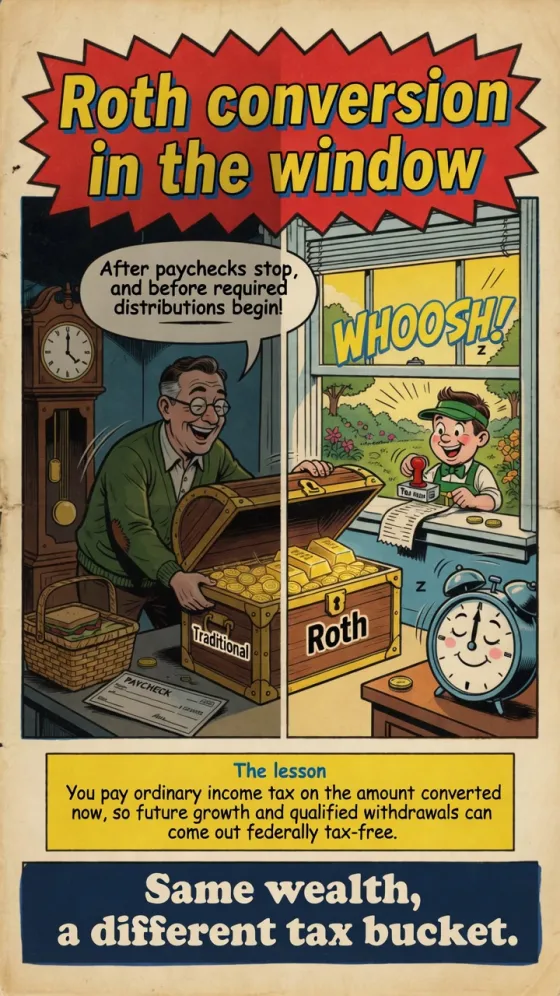
That trade is most attractive in low-income years — after paychecks stop and before required minimum distributions (RMDs) force large traditional withdrawals. Planners call that span the conversion window. This lesson shows how the plan states a conversion policy, how the forecast executes it without treating it like ordinary spending, and how the conversion shows up on tax, MAGIModified Adjusted Gross Income — AGI with certain deductions added back. It matters far out of proportion to the small adjustment, because MAGI is the figure that triggers cliffs: Medicare surcharges, the investment surtax, and health-subsidy eligibility all test against a MAGI, and each rule uses a slightly different one.Full entry →, and Movements
| Idea | Plain meaning | Where in the app |
|---|---|---|
| Conversion policy | How much to convert, in which years |  AssumptionsA main-rail area. The rules the forecast runs under — growth, taxes, movements, success definition, locality, currency. Read and write. → Movements → Roth conversion |
| Roth destination | A Roth account must already exist (no auto-create) | Assets — add Roth IRA / Roth 401(k) / … |
| Balance transfer | Traditional down, Roth up by the same dollars | Assets balances over years; Movements |
| Why: Roth conversion | Not residual spend, not RMD |  ForecasterA main-rail area with two jobs: (1) run the plan year by year and inspect Forecast Detail, and (2) Simulation Summary — many paths summarized into something like a probability of success. → Movements Why column |
| Tax on conversion | Converted amount is ordinary traditional retirement income | ForecasterA main-rail area with two jobs: (1) run the plan year by year and inspect Forecast Detail, and (2) Simulation Summary — many paths summarized into something like a probability of success. TaxesA Forecast Detail tax-lens chip. Tax statement for the selected year (federal, state when modeled, property). (federal statement) |
| MAGI this year | Conversion raises MAGI (cliff input) | Federal statement MAGI row |
| IRMAA later | High MAGI at t can raise Medicare premiums at t+2 | Cash flow surcharge; ForecasterA main-rail area with two jobs: (1) run the plan year by year and inspect Forecast Detail, and (2) Simulation Summary — many paths summarized into something like a probability of success. cliff radar (Custom →  CliffsA Forecast Detail tax-lens chip. MAGI / IRMAA / NIIT-style cliff radar — threshold lanes by year.; see cliff radar / MAGI cliffs) |
The live plan on the right is Roth Conversion Window (roth_conversion_sample). Alex is 60,
single, and retired. Alex has $450,000 in a taxable brokerage account, $1.1 million in a traditional
IRAIndividual Retirement Account — a retirement wrapper you open yourself rather than through an employer. It comes in traditional (pre-tax going in) and Roth (taxed going in) flavors, so naming the flavor matters more than the acronym does.Full entry →, and $50,000 in a Roth IRA, and spends $64,000 a year. Until Medicare at 65, Alex also buys
health coverage on the ACAAffordable Care Act — the law behind the individual health-insurance marketplace and its income-based subsidies. It matters to a plan mostly before Medicare age: retiring early means buying coverage here, and the subsidy is tested against income you partly control.Full entry → marketplace for about $12,000 a year. Alex will claim Social Security at 70,
in 2036, and required minimum distributions begin at 75, in 2041. The plan already carries a
conversion policy that fills the 12% bracket each year from 2026 through 2035.
The plan has no state selected, so every tax figure in this lesson is federal only. That keeps the
arithmetic easy to follow. A state income tax would add to the cost of each conversion, and you can
see by how much by choosing a state in  RegionA main-rail area. Explore the plan as if you lived elsewhere (today: US states; other countries are future work). The rail label is Region..
For the next ten years Alex has no paycheck, no Social Security, and no required withdrawals, so the 12% bracket is almost empty. That changes later. From 2036 Social Security arrives, and from 2041 the required minimum distributions come out of a traditional IRA that will have grown past $2 million if nothing is converted. Together they push Alex into the 22% bracket, and late in life into 24%. A conversion moves traditional dollars out while they can still be taxed at 12%, so fewer of them are left to be taxed at 22% or 24% later.
The plan shows the result directly. The same household with the policy turned off is its own sample
(roth_conversion_off_sample), and the two can be compared in the Simulator.
| What changes | With conversions | Without |
|---|---|---|
| Taxes paid over the plan (Simulator, median path) | about $380,000 | about $550,000 |
| Chance the plan succeeds | about 94% | about 94% |
| Median net worth at the end | about the same | about the same |
| Traditional IRA still untaxed at the end (projected path) | about $1.3 million | about $2.4 million |
The two plans end with about the same net worth, but they do not leave the same amount to spend. The plan without conversions still holds about $1 million more in its traditional IRA, and every dollar of it will be taxed as ordinary income when Alex or an heir takes it out. Net worth counts those dollars at full value, which is why it hides the difference. The lower tax bill is the benefit, and it is real money.
A conversion is not always worth it. If Alex's later income would land in the same bracket as the conversion, prepaying the tax gains nothing. The lesson's household was chosen because the gap is large: 12% now against 22% to 24% later.
Is
| Behavior | Why it matters |
|---|---|
| Moves balance traditional → Roth | Portfolio tax location changes; the same wealth sits in a different tax bucket |
| Books the converted amount as ordinary income this year | You “pay tax to fill” the window |
| Records Movements trades with Why Roth conversion | You can audit the decision separately from RMD and residual strategy |
| Raises MAGI in conversion years | Cliffs (IRMAA, NIIT, ACA warnings) read MAGI |
Is not
| Not this | Why the product separates it |
|---|---|
| Free cash to spend | Conversion does not fund living expenses. Its tax is paid the next year, from taxable holdings first |
| A residual “sell strategy” choice | Residual pro-rata / tax-account order still run for deficits; conversion is a policy after those trades |
| An optimal solver | You state a policy (fixed dollars or fill a bracket); the engine shows consequences, not a solved “best path” |
| Early-withdrawal penalty on the conversion itself | Penalty applies to early spending distributions from traditional; conversion is treated differently |
1. State the policy (definitional)
- Open AssumptionsA main-rail area. The rules the forecast runs under — growth, taxes, movements, success definition, locality, currency. Read and write. → Movements (the side-by-side arrows chip).
- Below residual strategy, find Roth conversion.
- On this sample the policy is on. It fills the 12% ordinary bracket each year, active from 2026 until 2036 (the end year is exclusive, so 2035 is the last conversion year).
- The plan must already include a Roth account. If you remove it, conversion amount is zero and Assumptions shows a warning — the app does not invent accounts.
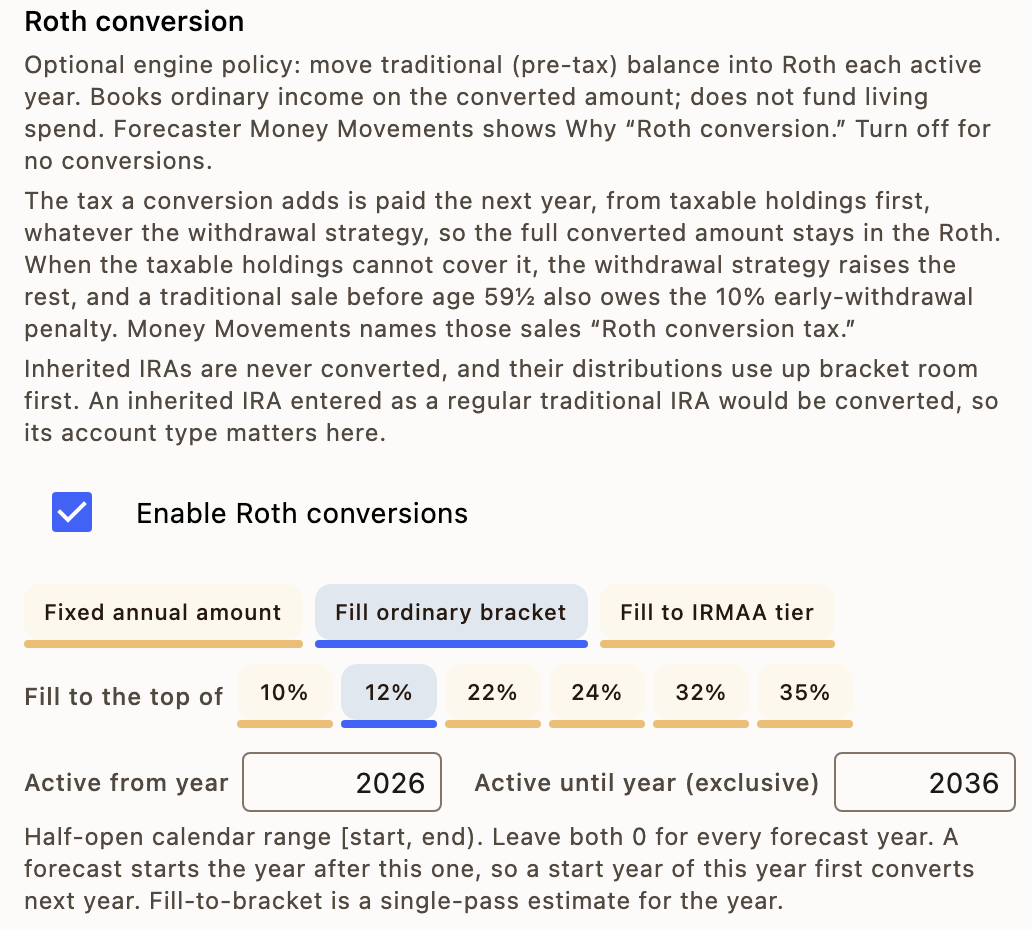
Assumptions → Movements. The residual withdrawal strategy stays separate; this plan draws in tax-account order, taxable first. Roth conversion is the engine policy: enable, a fixed amount or fill an ordinary bracketA band of income taxed at a given rate. The common misreading is that entering a higher bracket taxes all your income at that rate — it does not. Only the dollars inside that band pay the higher rate, so a raise never leaves you with less after tax.Full entry →, and active years. This sample fills the 12% bracket.
Optional modes on the control:
| Mode | Meaning |
|---|---|
| Fixed annual amount | Convert up to this many dollars each active year (capped by traditional balance) |
| Fill ordinary bracket | Convert enough (single-pass estimate) to fill ordinary taxable income up to the top of a chosen federal bracket rate (e.g. 22%) |
Fill-to-bracket is an estimate for the year (it does not re-solve every tax cliffA threshold where one extra dollar of income triggers a step cost — a surcharge tier, a lost subsidy — instead of a smooth increase. Cliffs are why plans care about landing just under a number, and why a small year-end decision can be worth far more than its size.Full entry → feedback in a loop). Filling a bracket is the way a planner usually sizes a conversion, because the bracket edge is the line that matters. A fixed amount is easier to read in a table but can spill into the next bracket in a year when other income is higher.
To see a bracket being filled, open Filling the cheap buckets. This lesson tells you the conversion becomes ordinary income; that one draws it — one stacked column per year showing how much of the bracket your base income, your forced RMDs, and your conversion each occupy, with the unfilled room hatched on top. It is also where fill-to-bracket stops being abstract: on that plan the conversion segment more than halves in a single year when RMDs begin, because forced income claims the room first.
2. Watch the transfer (projected)
First, glance at the balance sheet so the tax buckets are clear: taxable brokerageAn ordinary taxable investment account — no special retirement wrapper, no contribution limit, and no withdrawal age rules. The trade-off is that dividends and realized gains are taxed as they happen rather than deferred. Often called the taxable bucket next to traditional and Roth.Full entry →, traditional IRA, and Roth IRA. Conversion moves balance between traditional and Roth — it is not a new deposit from outside the plan.
Then set the Forecaster chips for the most useful view of conversions: turn on
 CF TableA Forecast Detail chip. CF = cash flows for the selected year — incomes, expenses, taxes, and invest / sell / borrow totals. and
 Moves TableA Forecast Detail chip. Mov = Movements. Holding-level trades for the selected year — sold or invested, after, %, and Why. (and keep
 Moves ChartA Forecast Detail chip. Mov = Movements. Chart of sales, invest, and borrow over the years — how the operating net is closed. if you want the multi-year
disposition story). TaxesA Forecast Detail tax-lens chip. Tax statement for the selected year (federal, state when modeled, property). (with CliffsA Forecast Detail tax-lens chip. MAGI / IRMAA / NIIT-style cliff radar — threshold lanes by year. /
 BracketsA Forecast Detail tax-lens chip. Ordinary-income tax ladder for the selected year — how full the brackets are and who filled them. when you audit MAGI
and ordinary brackets) sit on the tax-lens group for later checks.

With conversion on
Run a year inside the active window (e.g. 2027 on GMF ✦GMF ✦ (also FID 0 / GMF) is the product north star — the deterministic geometric mean forecast path you steer by, not a random Monte Carlo draw and not “most likely.” Prefer it for a stable year-by-year read of the plan. Switch away when you want to explore other randomized scenarios or paths in the multi-path cloud. The ✦ mark matches the live FID control (compass / north star, not a rating star).Full entry →). In 2027 Alex lives on the taxable account, so the only traditional dollars sold are the conversion's. You should see:
| Surface | What to notice |
|---|---|
| CF TableA Forecast Detail chip. CF = cash flows for the selected year — incomes, expenses, taxes, and invest / sell / borrow totals. → Sales | A traditional line tagged with the conversion marker ( next to the tax icon) for the converted dollars — separate from residual sales of the same holding |
| CF TableA Forecast Detail chip. CF = cash flows for the selected year — incomes, expenses, taxes, and invest / sell / borrow totals. → Investments | Matching dollars into Roth (when the transfer invests the other side of the conversion) |
| Moves TableA Forecast Detail chip. Mov = Movements. Holding-level trades for the selected year — sold or invested, after, %, and Why. | Traditional Sold and Roth Invested; hover Why for Roth conversion · … next to any residual / early-withdrawal segments |
| Moves ChartA Forecast Detail chip. Mov = Movements. Chart of sales, invest, and borrow over the years — how the operating net is closed. | Disposition over years — conversion years still show the same story as the tables |

Policy on, Movements at 2027. The traditional holding sells about $68,000 for the conversion
and the Roth holding receives the same $68,000, both marked . The Roth's Invested is a few
hundred dollars more than that, because every holding also buys back its own dividends; the Why
column names those dollars Reinvested distributions, and they are why the traditional and taxable
rows show something Invested as well as Sold. Nothing is rebalanced. The taxable account pays
the year's living costs. Price growth shows in After, not in Sold or Invested. The figure
is drawn from the plan, so these are the plan's own numbers. Each Why pill names the row's first
reason and how many more there are; hoverOn a desktop or laptop, rest the pointer on a row, chip, or control to open a detail card — attributes, amounts, and often a small path chart. We put a lot of teaching detail in those cards on purpose. Hover needs a pointer, so it does not work on tablets or phones (tap may show a simpler view or nothing). Hold Alt if the tips become a nuisance — many product hovers stay closed while Alt is down so you can move the pointer freely.Full entry → it in the app for every reason with its
dollars, as a table you can copy.
Without conversion (toggle off and re-run)
Turn Enable Roth conversions off in Assumptions, re-run, and pick the same year.
| Surface | What changes |
|---|---|
| CF TableA Forecast Detail chip. CF = cash flows for the selected year — incomes, expenses, taxes, and invest / sell / borrow totals. | No conversion-sized traditional sale; no matching conversion invest into Roth |
| Moves TableA Forecast Detail chip. Mov = Movements. Holding-level trades for the selected year — sold or invested, after, %, and Why. | Traditional sells nothing in 2027; Roth Invested for conversion disappears; Why loses Roth conversion lines |
| Balances | Traditional stays higher; Roth stays lower than the conversion-on path |

Policy off, same surface, same year, and nothing else in the plan changed. There is no ,
and the traditional IRA sells nothing.
Read the After column across the two pictures: traditional ends about $68,000 higher here and
Roth ends lower by the same amount. That is the transfer in arithmetic. The money moved between tax buckets; it
was neither spent nor deposited from outside the plan.
Turn conversion back on before the tax / IRMAA steps.
Years when the policy has nothing to do
Scrub forward through the window. The taxable account runs out at the end of 2033, and in 2034 and 2035 Alex lives on withdrawals from the traditional IRA instead. Those withdrawals are ordinary income, and at $64,000 a year plus inflation they fill the 12% bracket on their own. The policy converts nothing in those years because there is no room left to fill. This is the same competition for one bracket that Filling the cheap buckets draws: income the plan cannot avoid claims the cheap room first.
Who pays the conversion's tax
A conversion adds to the year's tax bill, and Alex pays that bill the next year. Tutilis measures how much of it the conversion caused. It assesses the year twice, once as it happened and once without the converted dollars, and the difference is the conversion's tax. The next year, that amount is sold from taxable holdings first, whatever the withdrawal strategy. The full converted amount stays in the Roth.
This matters because the other ways to pay undo part of the conversion. Selling traditional shares for the tax adds ordinary income that never reaches the Roth. Selling Roth shares spends the dollars the conversion just moved. Under 59½, a traditional sale also owes the 10% early-withdrawal penalty that the conversion itself avoids.
Open Moves TableA Forecast Detail chip. Mov = Movements. Holding-level trades for the selected year — sold or invested, after, %, and Why. at 2028. The brokerage row's Why shows about $10,600 as Roth
conversion tax · from taxable. That is the tax the 2027 conversion added to the 2027 bill. In this
plan it is the whole bill. Without the conversion, Alex's dividends and gains would sit inside the
standard deductionThe flat amount most households subtract instead of itemizing individual deductions. You take the larger of the two, so it acts as a floor: below it, an extra deductible expense saves nothing at all, which surprises people who gave to charity expecting a break.Full entry → and the 0% gains rate. Part of the conversion's tax is the 15% those gains pay
once the conversion fills the bracket beneath them. The rest of the brokerage's sales pay living costs
in tax-account order. This plan draws taxable first anyway,
so the dollars sold are the same either way, and the Why tells you which part paid for the
conversion. On a plan that withdraws pro-rata, this rule is what keeps the traditional IRA from paying
a share of the conversion's tax.
Now move to 2034. The brokerage is empty, so the tax on the 2033 conversion, about $8,800, cannot come from it. The withdrawal strategy raises it from the traditional IRA instead, and the Why names those dollars Roth conversion tax · taxable ran short. Alex is past 59½, so the sale owes no penalty. Before 59½, a sale like this would also carry an Early withdrawal reason, and the federal statement would add the 10% penalty.
3. Read the tax statement
On a conversion year (policy on):
- ForecasterA main-rail area with two jobs: (1) run the plan year by year and inspect Forecast Detail, and (2) Simulation Summary — many paths summarized into something like a probability of success.TaxesA Forecast Detail tax-lens chip. Tax statement for the selected year (federal, state when modeled, property). (sample / GMF year).
- Under US federal, find traditional retirement (or equivalent ordinary bucket) including the converted amount — not only “spending withdrawals.”
- Confirm AGI and MAGI moved with that ordinary income. MAGI is the cliff input (MAGI cliffs).
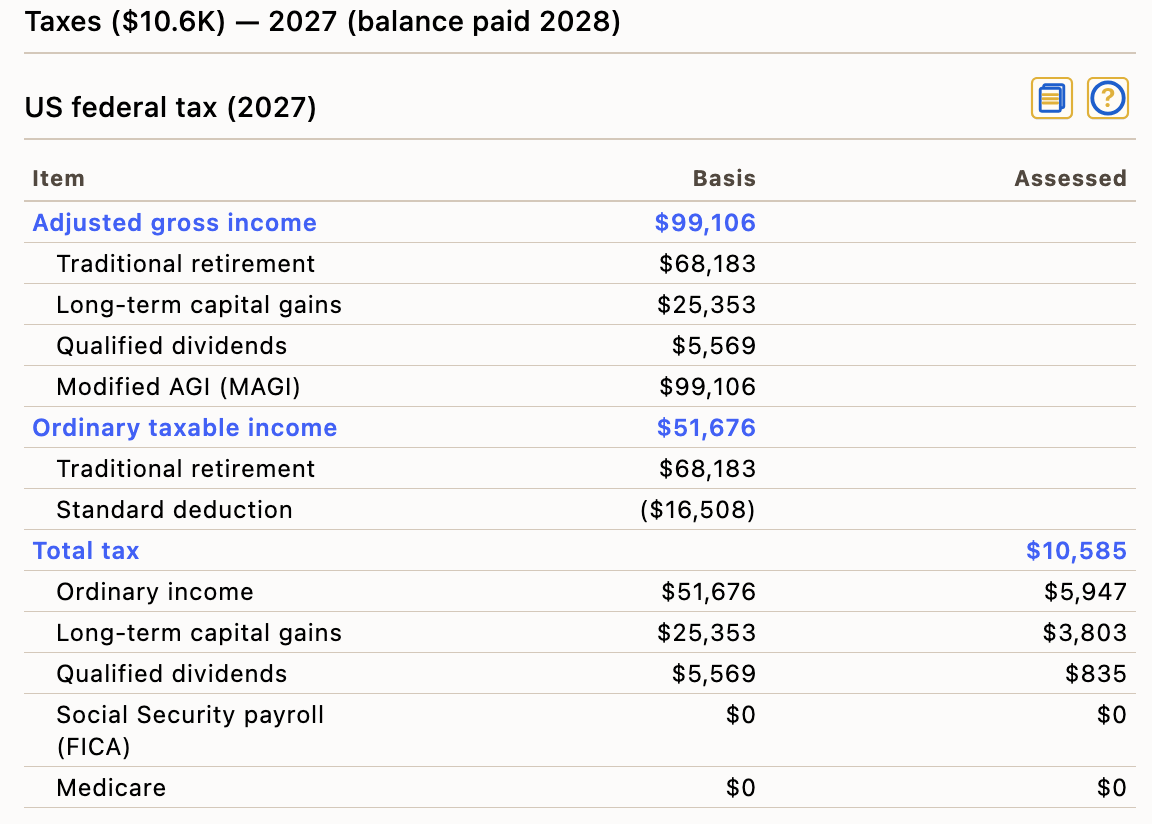
Taxes for the same conversion year. Traditional retirement of about $68,000 appears under Adjusted gross income and again under Ordinary taxable incomeWhat the rates are finally applied to — income after adjustments and deductions, not what you earned. It sits at the bottom of the page: gross income, then AGI, then this. Most people's taxable income is meaningfully smaller than their pay, which is why a bracket alone never tells you the tax.Full entry →, where the standard deductionAn amount subtracted from income before the tax is computed, so it saves tax at your marginal rate rather than dollar for dollar. That is the difference from a credit, which comes off the tax itself: a $1,000 deduction is worth a few hundred dollars, a $1,000 credit is worth $1,000.Full entry → of about $16,500 brings it down to the top of the 12% bracket. MAGI tracks AGI here and is the input for later cliffs. Notice one cost of a full bracket. Alex's long-term capital gains, about $25,000 this year, now sit above the 0% gains threshold and are taxed at 15%. A planner weighs that against the 22% the converted dollars would pay later. There is no early-withdrawal penalty line, because Alex is past 59½.
4. Look ahead to IRMAA (and the Cliffs strip)
IRMAA is a Medicare premium surchargeAn extra amount added on top of a normal charge once income passes a line — in planning, almost always the Medicare premium surcharge. It is not a tax rate, so it does not show up in a bracket; it arrives as a higher premium, in tiers, based on a tax return from two years earlier.Full entry → driven by MAGI from two years earlier — a healthcare cash outflow, not a federal tax-statement line. The honest version is simple: a conversion that lifts MAGI in year t can raise premiums in year t+2 once someone is on Medicare (planning anchor: age 65). Example: convert at 63 → IRMAA risk at 65.
On this sample the surcharge appears, and then it shrinks. Alex turns 65 in 2031. The conversions of 2029 to 2032 lift MAGI over the first IRMAA threshold, so the cash-flow table shows an IRMAA surcharge in 2031 to 2034. Over the whole plan, though, conversions lower the IRMAA Alex pays. Without them, the larger RMDs keep MAGI high for the rest of Alex's life, and the plan pays about twice as much in surcharges. Paying a small surcharge for four years buys a smaller one for thirteen.
Still open ForecasterA main-rail area with two jobs: (1) run the plan year by year and inspect Forecast Detail, and (2) Simulation Summary — many paths summarized into something like a probability of success. → cliff radar (CliffsA Forecast Detail tax-lens chip. MAGI / IRMAA / NIIT-style cliff radar — threshold lanes by year. view on by default; toggle under Custom
if needed) on a conversion year and on a later Medicare-age year:
| What you should see | What you should not see |
|---|---|
| Note that Roth conversion is active in a conversion year (MAGI moves now) | An invented IRMAA surcharge when cash flow has none |
| On later years with an IRMAA radar row whose lookback year was a conversion year: a lookback conversion note (t → t+2) | Optimum conversion markers or cliff “scores” |
| Not modeled · ACA subsidy honesty row, because this plan's marketplace phase is not marked as a marketplace plan | Silent omission of known gaps |
Full strip vocabulary (in play / nearby / honest empty): Cliff radar in the Forecaster.
To see IRMAA cash and statement depth on a path that lights the surcharge: open
MAGI cliffs (sample already on Medicare with higher MAGI).
There, CF TableA Forecast Detail chip. CF = cash flows for the selected year — incomes, expenses, taxes, and invest / sell / borrow totals. /  CF ChartA Forecast Detail chip. CF = cash flows. Money in above the line, money out below, by category over the years. The net line, drawn in thick black, is net cash flow — often the thing you came for. shows IRMAA (Medicare surcharge) under healthcare — still not
Taxes — and the same year’s cliff radar should agree when surcharge > 0.
Conversion is not free tax arbitrage, because MAGI cliffs can bite in the conversion years. This sample teaches the cause chain (conversion → ordinary income → MAGI) and the trade it creates. Cliff radar keeps the scan on your path; MAGI cliffs teaches the cash line and statement audit.
You already met forced RMDRequired Minimum Distribution — once you reach an age set by statute, the law makes you withdraw a minimum amount each year from traditional retirement accounts, whether or not you need the money. The withdrawal is taxable income, so RMDs can push a household into a higher bracket or over a surcharge threshold. Roth accounts are generally not subject to them.Full entry → with the RMD lesson. Conversions add a policy lane:
| Layer | Who decides | Example Why / marker |
|---|---|---|
| Forced / statutory | RMD rules | RMD · Traditional IRA (⚖️ on forced sales) |
| Conversion policy | Roth conversion settings | Roth conversion · Roth IRA ( on conversion sales / invest) |
| Residual strategy | Pro-rata / tax-account order / glide | Pro-rata residual, Tax-account order · taxable, … |
A single year can show more than one layer on the same holding. Do not read every traditional sale as “living expenses” or “the residual strategy alone.”
| Check | Pass looks like |
|---|---|
| Policy on | AssumptionsA main-rail area. The rules the forecast runs under — growth, taxes, movements, success definition, locality, currency. Read and write. → Movements → Roth conversion enabled with amount + years (see screenshot above) |
| Chip view | CF TableA Forecast Detail chip. CF = cash flows for the selected year — incomes, expenses, taxes, and invest / sell / borrow totals. + Moves TableA Forecast Detail chip. Mov = Movements. Holding-level trades for the selected year — sold or invested, after, %, and Why. (and optional Moves ChartA Forecast Detail chip. Mov = Movements. Chart of sales, invest, and borrow over the years — how the operating net is closed.) so conversion lines are visible |
| CF marker | Conversion traditional sale carries (and the tax icon) — distinct from residual of the same name |
| Movements Why | Roth conversion on traditional sell and Roth invest; residual Why (if any) is separate |
| Toggle foil | With policy off, conversion sales/invest and Why lines disappear |
| Tax | Conversion year ordinary / traditional retirement includes conversion, landing at the top of the 12% bracket |
| MAGI | Conversion year MAGI higher than the no-conversion what-if |
| Does it pay | Simulator taxes paid lower with the policy on than with it off; success and median net worth about the same |
| Cliff radar | ForecasterA main-rail area with two jobs: (1) run the plan year by year and inspect Forecast Detail, and (2) Simulation Summary — many paths summarized into something like a probability of success. cliff radar notes conversion this year; no invented IRMAA surcharge |
| Conversion tax | At 2028 the brokerage Why shows Roth conversion tax · from taxable; at 2034 the traditional row shows Roth conversion tax · taxable ran short |
| IRMAA (later) | A surcharge in 2031–2034 from conversion-year MAGI; less IRMAA over the whole plan than with the policy off |
- A multi-year optimal conversion schedule (dynamic program / “max wealth” solver)
- Full Roth 5-year seasoning / ordering rules for every distribution type
- Withholding a conversion's tax from the converted dollars. The engine always moves the full amount into the Roth and pays the tax the next year, from taxable holdings first. The tax on the sales that pay it is not counted as the conversion's.
- The ACAAffordable Care Act — the law behind the individual health-insurance marketplace and its income-based subsidies. It matters to a plan mostly before Medicare age: retiring early means buying coverage here, and the subsidy is tested against income you partly control.Full entry → subsidy response when MAGI moves in a marketplace year. Tutilis prices the premium tax creditThe ACA subsidy that pays part of a marketplace health premium, sized by income. It is the reason a dollar of extra income can cost far more than its tax: crossing the wrong line trims or ends the subsidy for the whole year.Full entry → for a phase marked as a marketplace plan, but this plan's phase is deliberately left unmarked, so its conversion years show the warning only.
- That fill-to-bracket is a closed-form fixed point with every cliff re-solved
Those are honesty boundaries, not missing polish for this lesson.
| Lesson | Why go there |
|---|---|
| Filling the cheap buckets | See the bracket being filled — forced RMDs vs chosen conversion competing for one bucket |
| Cliff radar in the Forecaster | Year-reactive strip: cliffs in play / nearby / not modeled |
| MAGI cliffs — IRMAA, NIIT, and friends | IRMAA lookback, NIIT, MAGI audit rows in depth |
| Forced traditional RMD vs residual tax order | Another “Why” layer that is not residual strategy |
| Social Security treatment | Ordinary income and AGI ingredients that share the bracket with conversions |
| Getting around the app | Forecaster chips and Assumptions map |
When you change conversion aggressiveness, re-read success, taxes paid, and terminal direction together — one lever, many surfaces.
Rebuild this plan by hand
The cards on the canvas show the accounts and cash flows. These are the settings that live outside any card, read from the plan itself, with the label each control carries in the app. A value marked default is one to leave alone.
| Setting | Roth Conversion Window |
|---|---|
| Household | |
| Planning region | United States (default) |
| Alex (Primary) | |
| birth year | 1966 |
| retirement age | 60 |
| death age | 92 |
| Taxes | |
| Tax regime | United States |
| Filing status | Single |
| State of residence | None |
| First-year federal estimate | — |
| First-year state estimate | — |
| Strategy | |
| Residual withdrawal strategy | Tax-account order |
| Roth conversions | Fill ordinary bracket, to the top of 12% |
| Roth conversions active | 2026 → 2036 (exclusive) |
| Definition of success | Liquidity crises allowed (default) |
| Glide path target | None (default) |
| Advanced | |
| Reporting inflation | Assumption set's rate (default) |
| Cost of capital | Assumption set's rate (default) |
| Growth assumptions | Growth overrides (default) |
| Currencies | Multiple currencies (default) |
| Default currency | USD (default) |
| Display currency | USD (default) |

Educational content — not advice. These lessons teach how Tutilis models a plan and how to read what it shows. The households, balances, and outcomes in them are invented for teaching. Nothing here is financial, investment, tax, or legal advice, or a recommendation to buy, sell, or hold anything. A model cannot know your circumstances — check anything you take from a lesson against your own situation, and against a qualified professional where it matters.