
 Meet the Banks household (HNW)

How this page works
New to the Learning Center, or want a map of the panels? Start with a tour: Reading Lesson (Getting Around) or Screencast Lesson (Getting Around) — both walk through Tutilis next to a live planThe running Tutilis product next to this lesson — navigation, Bird's Eye, Forecaster, tools, and more — loaded with a teaching sample. A dossier is the plan data; the live plan is the full product surface with a sample dossier already open so you can explore. On the web, teaching samples are not editable the way your own dossier will be in the full app.Full entry → (to the right on a desktop-width screen, or below when stacked on a tablet).
This page — Meet the Banks household (HNW) — includes a live sample planThe running Tutilis product next to this lesson — navigation, Bird's Eye, Forecaster, tools, and more — loaded with a teaching sample. A dossier is the plan data; the live plan is the full product surface with a sample dossier already open so you can explore. On the web, teaching samples are not editable the way your own dossier will be in the full app.Full entry → next to the text. On a wide screen it usually sits to the right of the text; on a tablet it usually sits below. Use the text for the walk-through, then try the same ideas in the live plan.
The live planThe running Tutilis product next to this lesson — navigation, Bird's Eye, Forecaster, tools, and more — loaded with a teaching sample. A dossier is the plan data; the live plan is the full product surface with a sample dossier already open so you can explore. On the web, teaching samples are not editable the way your own dossier will be in the full app.Full entry → next to this page — usually to the right on a wide screen, or below on a tablet — is Tutilis running a teaching sample: the same financial planning product available as a desktop application (early preview). A dossierYour full plan in Tutilis: the people in the household, what they own and owe, cash flows in and out, tax setting, and planning assumptions. One dossier is one complete situation as the product models it.Full entry → is the plan data; the live plan is the full product (navigation, Bird's Eye, Forecaster, tools) with a sample dossier already open so you can try the panels. See planned pricing. On the web, Learning Center samples are not editable the way your own dossier will be in the full app. Your own household goes in the Tutilis desktop app — the Learning Center front page has a short clip of that.
This lesson introduces a high-net-worth dual-earner sample for exploring concentration risk, fat right tails, and Banks-family follow-ons (forced RMDRequired Minimum Distribution — once you reach an age set by statute, the law makes you withdraw a minimum amount each year from traditional retirement accounts, whether or not you need the money. The withdrawal is taxable income, so RMDs can push a household into a higher bracket or over a surcharge threshold. Roth accounts are generally not subject to them.Full entry →, Reveal). The same cast, Philip and Vivian, appears in each of those lessons. Their story is not the Springfield dual-earner story, because the wealth scale and the portfolio shape are different. It is a high net worth retirement plan example, worked on a live sample.
| Tag | Role |
|---|---|
| hnw | Home + multi-bucket portfolio in the multi‑million range |
| family-banks | Sibling of Forced traditional RMD |
| baseline | Full household plan (work → retirement → LTC) |
The live plan on the right is Banks Baseline (banks_baseline).
The household has two earners, Philip and Vivian.
| Person | Role (illustrative) |
|---|---|
| Philip | Primary earner; SS; healthcare / LTC generators |
| Vivian | Secondary earner |
Home: Bel-Air Residence (paid-off real asset — no mortgage running through the plan the way Springfield has one).
Work → retirement: dual earned incomeMoney you were paid for working — wages, salary, self-employment profit. The distinction is not fussiness: earned income carries payroll tax and builds Social Security credit, while investment income does not. It is also what contribution limits and some credits are measured against.Full entry →, lifestyle phases, Social Security, healthcare handoff, late-life care. Same kinds of generators as Springfield, higher absolute levels.
Taxable brokerageAn ordinary taxable investment account — no special retirement wrapper, no contribution limit, and no withdrawal age rules. The trade-off is that dividends and realized gains are taxed as they happen rather than deferred. Often called the taxable bucket next to traditional and Roth.Full entry → includes Bel-Air Tech — a large single holding with elevated volatilityHow much an investment's returns bounce around from year to year, not whether it goes up or down overall. Written σ (sigma) in the product. Two holdings can have the same average return and feel completely different to live through — and high volatility drags the growth you actually compound below that average.Full entry → (authoring uses a high-vol equity growth assumption) on top of diversified equity and bond holdings, traditional, both Roth 401(k)A retirement account where you pay income tax on the money going in, and qualified withdrawals later come out tax-free — the mirror image of traditional. Named after the senator behind the law, so the word tells you nothing on its own. Plans care because Roth dollars do not add to taxable income later, which keeps them clear of income-driven cliffs.Full entry → and Roth IRAIndividual Retirement Account — a retirement wrapper you open yourself rather than through an employer. It comes in traditional (pre-tax going in) and Roth (taxed going in) flavors, so naming the flavor matters more than the acronym does.Full entry →, and cash.
| Look for | Where |
|---|---|
| Bel-Air Tech |  Bird's EyeWhen you are not on Dossier, this control sits in the top toolbar. Opens a household overview as a modal — people, assets and liabilities, cash flow — without leaving the area you are in. Hidden on Dossier, because that same overview already sits at the top of that area. → Assets / holdings;  BS TableA Forecast Detail chip. BS = balance sheet for the selected year — real assets, accounts, liabilities, net worth. Copyable companion to BS Chart. selected year |
| Multi-bucket mix | Taxable equities + bonds, traditional 401(k), Roth 401(k), Roth IRA, cash |
| High absolute wealth | NW Distribution / Key Forecasts (order of magnitude) |
| Tax-bucket map | Sheltering money — same plan, rules focus |
Teaching claim: concentration + vol widens the Monte CarloThe method behind a multi-path run: draw many randomized return paths, run the plan down each one, and read the spread of what happened. Named after the casino, because the engine is repeated random sampling rather than a formula — which is why two runs of one plan differ a little, and why a success rate is a proportion of sampled futures rather than a promise.Full entry → cloud. Mean terminal NW often sits well above the medianThe middle outcome — half above, half below — as against the average, which a few enormous results can drag upward. Over long horizons the two come apart badly, and the median is the one that answers "what does a typical path look like?"Full entry → (fat right tail). Key Forecasts → Max can sit far from GMF — that is when Reveal becomes a reading tool, not decoration.
The shape below is illustrative rather than a target. On a few-hundred-path run, the Banks median terminal net worth lands in the high single-digit to low double-digit $MM range while the p90 and the mean run much higher, which is the same pattern the Reveal lesson shows.
The plan’s inputs sit in the definitional views, and the results across paths sit in the Forecaster and the Simulation Summary.
Definitional
- Bird's EyeWhen you are not on Dossier, this control sits in the top toolbar. Opens a household overview as a modal — people, assets and liabilities, cash flow — without leaving the area you are in. Hidden on Dossier, because that same overview already sits at the top of that area. → People — Philip and Vivian; retire / longevity assumptions.
- Assets — Bel-Air Residence, multi-bucket accounts, Bel-Air Tech.
- Cash Flow mode — living phases, SSSocial Security — the US government retirement and disability benefit, funded by payroll tax while you work and paid as a monthly check once you claim. How much you get depends on your earnings history (your PIA) and the age you claim relative to full retirement age.Full entry →, healthcare, LTCLong-term care — help with everyday living (in-home aide, assisted living, nursing care) rather than medical treatment for an illness. It is modeled separately because ordinary health coverage largely does not pay for it, and because it tends to arrive late in a plan as a large, multi-year expense.Full entry →.
Projected
Select  BS ChartA Forecast Detail chip. BS = balance sheet. Assets above the line, liabilities below, over the forecast years. The net line, drawn in thick black, is net worth — often the thing you came for. Click a year to load the tables., BS TableA Forecast Detail chip. BS = balance sheet for the selected year — real assets, accounts, liabilities, net worth. Copyable companion to BS Chart.,
 CF ChartA Forecast Detail chip. CF = cash flows. Money in above the line, money out below, by category over the years. The net line, drawn in thick black, is net cash flow — often the thing you came for.,
 CF TableA Forecast Detail chip. CF = cash flows for the selected year — incomes, expenses, taxes, and invest / sell / borrow totals.. Open Simulation Summary.
| Preview | View | Role here |
|---|---|---|
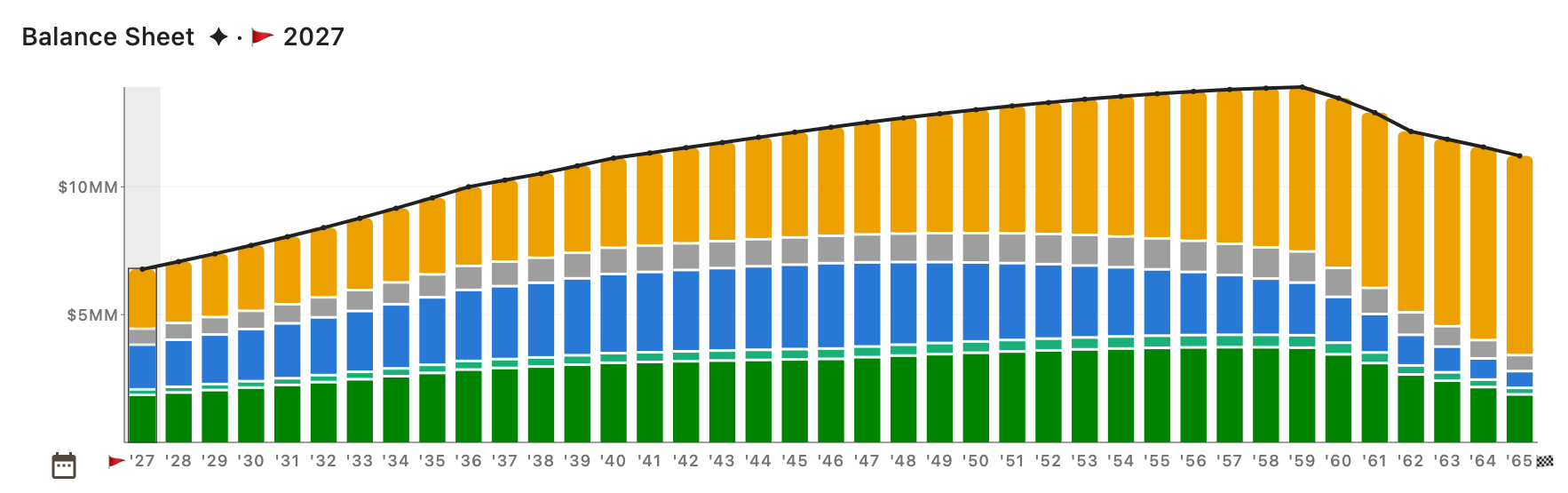 | BS ChartA Forecast Detail chip. BS = balance sheet. Assets above the line, liabilities below, over the forecast years. The net line, drawn in thick black, is net worth — often the thing you came for. Click a year to load the tables. | Wealth scale over the horizon; house + accounts. |
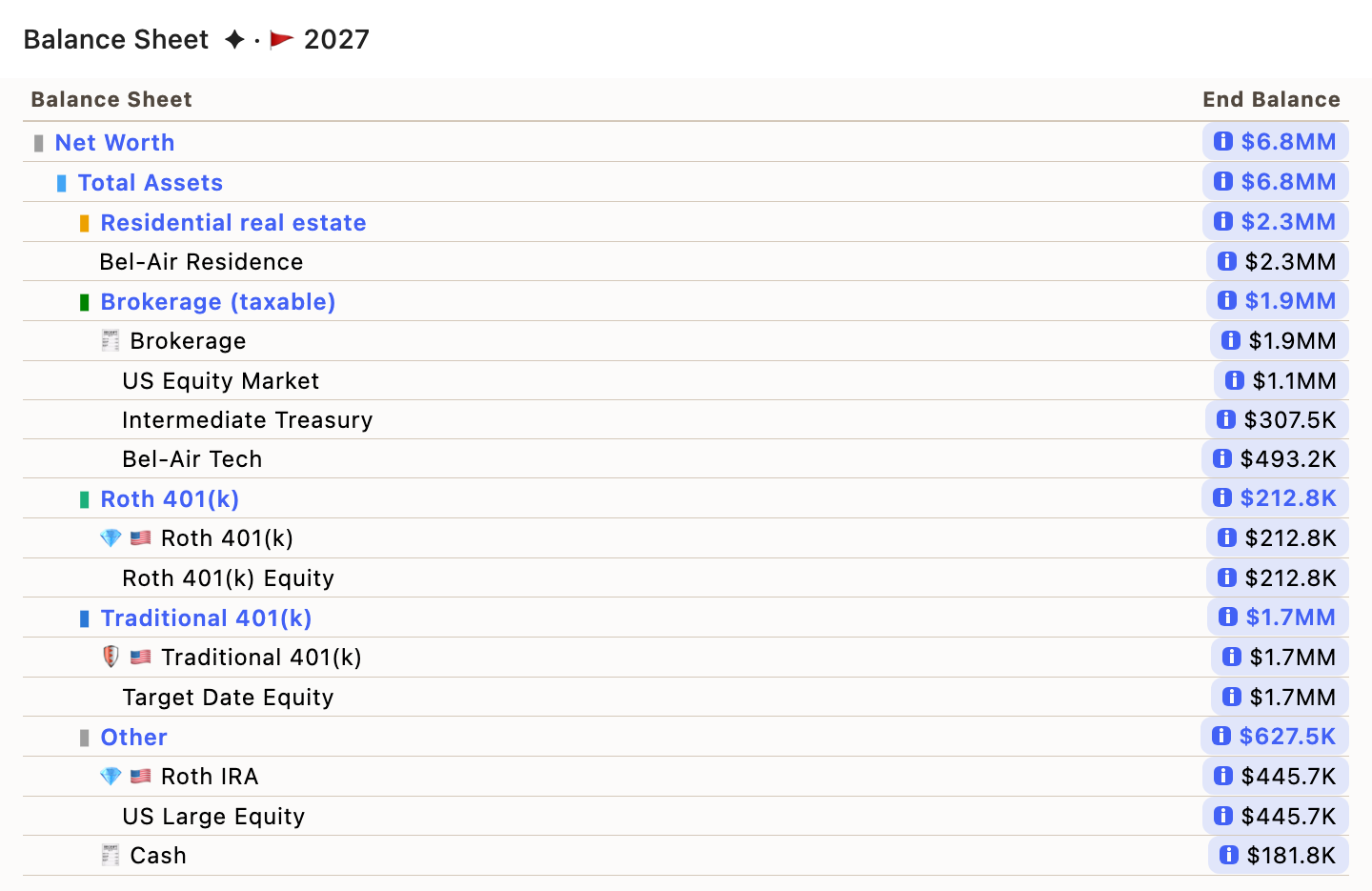 | BS TableA Forecast Detail chip. BS = balance sheet for the selected year — real assets, accounts, liabilities, net worth. Copyable companion to BS Chart. | Find Bel-Air Tech and bucket totals. |
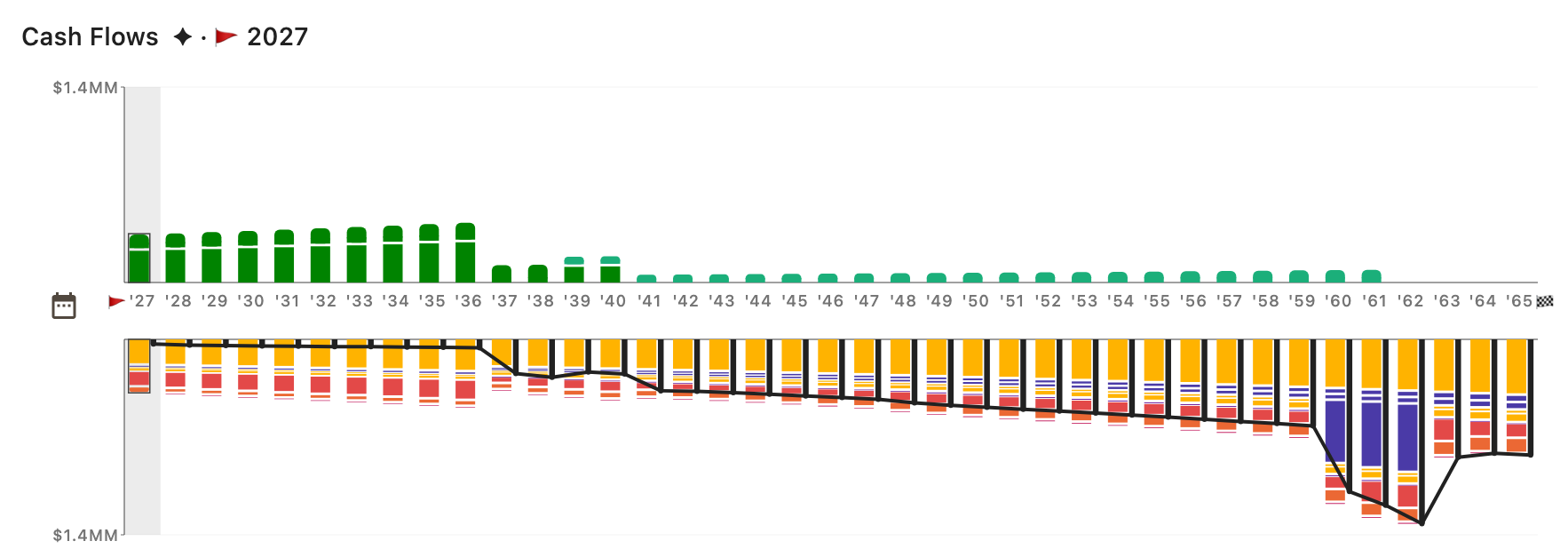 | CF ChartA Forecast Detail chip. CF = cash flows. Money in above the line, money out below, by category over the years. The net line, drawn in thick black, is net cash flow — often the thing you came for. | Dual earn → retirement handoff; LTC late. |
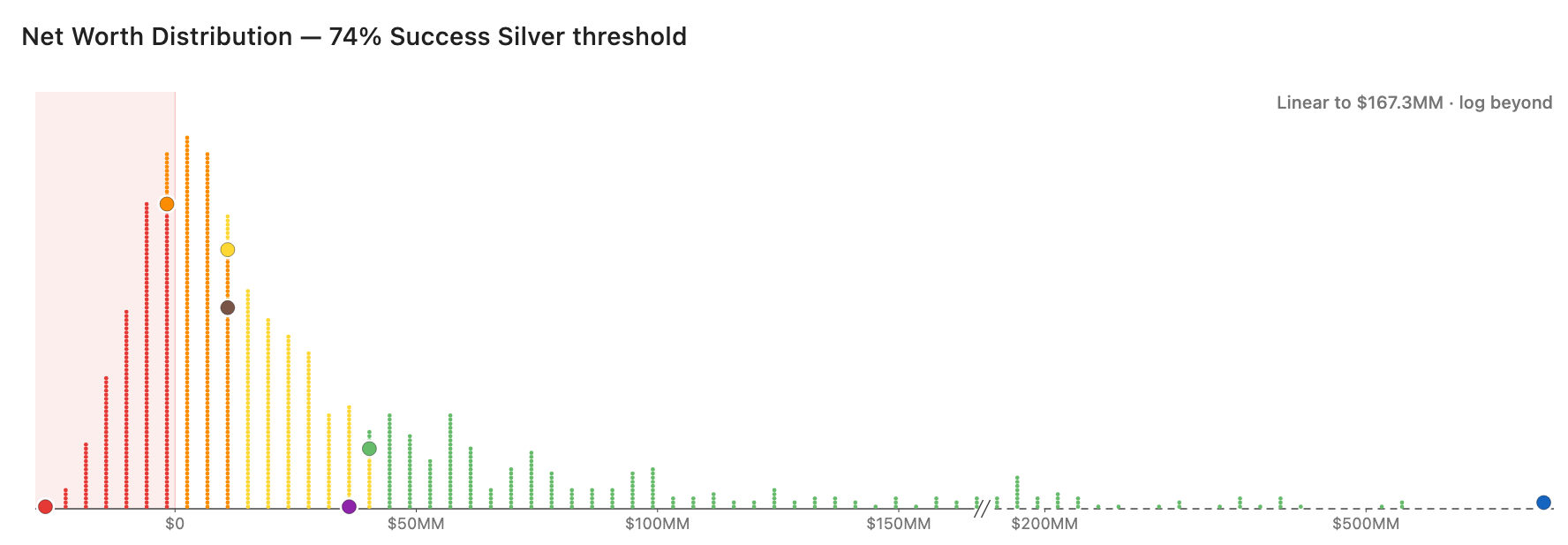 | NW Distribution | Right tail; try Reveal. |
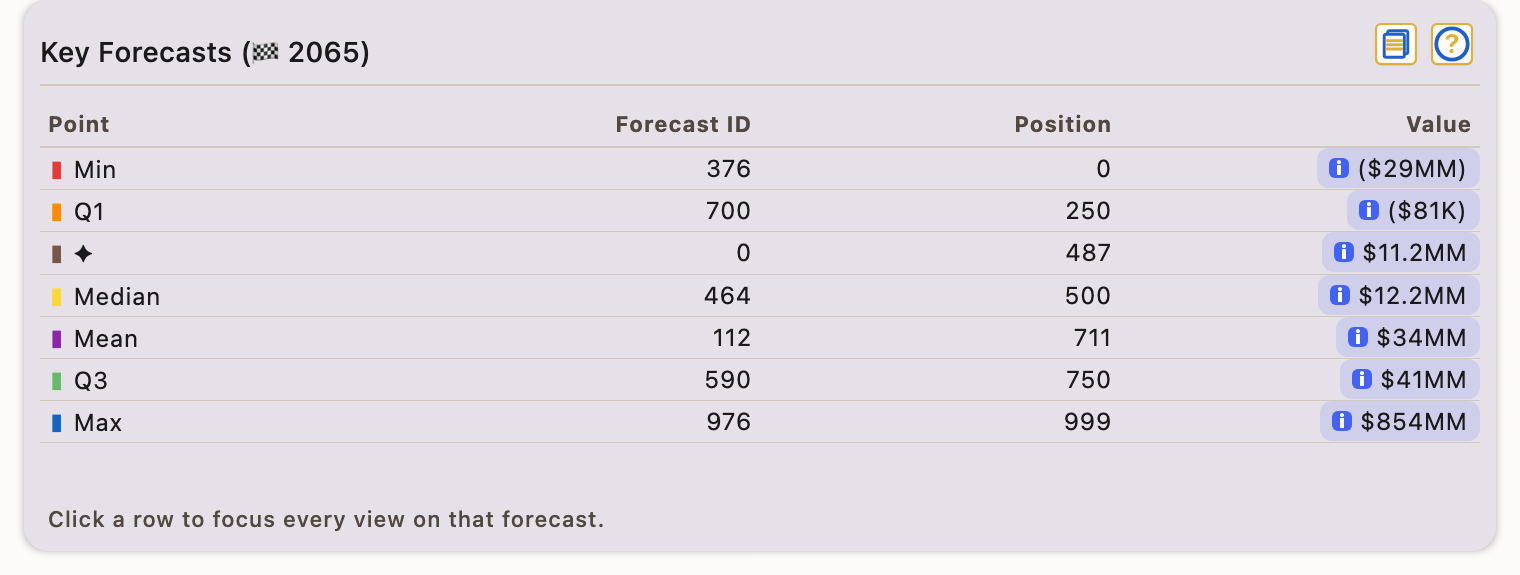 | Key Forecasts | Min / GMF / Max — Max far out is the concentration cue. |
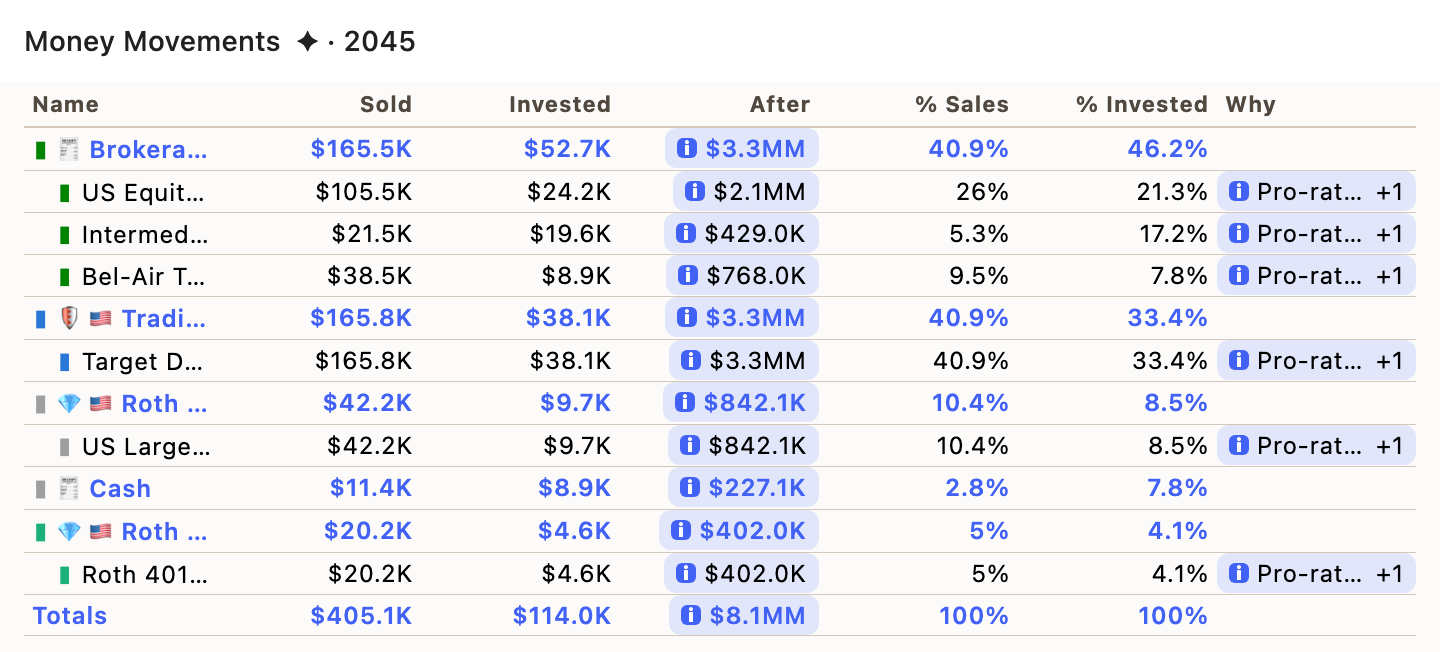 |  Moves TableA Forecast Detail chip. Mov = Movements. Holding-level trades for the selected year — sold or invested, after, %, and Why. | Drawdown years: residual sells (pro-rata default). |
Prefer FID 0 / GMFHow the north star is labeled in the FID control: FID 0 is the deterministic GMF ✦ path, and every other FID is a randomized draw from the simulation. Choose it when you want the year-by-year read to hold still while you change something else about the plan.Full entry →. Chart controls: Close up / zoom / Reveal.
Work these steps on the plan on the right.
- Orient on Bel-Air Residence and Bel-Air Tech (Bird's EyeWhen you are not on Dossier, this control sits in the top toolbar. Opens a household overview as a modal — people, assets and liabilities, cash flow — without leaving the area you are in. Hidden on Dossier, because that same overview already sits at the top of that area. / BS TableA Forecast Detail chip. BS = balance sheet for the selected year — real assets, accounts, liabilities, net worth. Copyable companion to BS Chart.).
- Simulation Summary — note success under Silver (often comfortable on this sample) and the spread between GMF-ish outcomes and Max.
- Reveal the distribution if the bulk is crushed left — see When the outcome cloud needs Reveal.
- Optional: Key Forecasts → Max, then open BS ChartA Forecast Detail chip. BS = balance sheet. Assets above the line, liabilities below, over the forecast years. The net line, drawn in thick black, is net worth — often the thing you came for. Click a year to load the tables. / CF ChartA Forecast Detail chip. CF = cash flows. Money in above the line, money out below, by category over the years. The net line, drawn in thick black, is net cash flow — often the thing you came for. on that FIDForecast ID — which of the simulated paths you are currently looking at. A simulation runs many paths; the FID control picks one so the year-by-year charts and tables have a single story to tell. FID 0 is the deterministic GMF ✦ north-star path rather than a random draw.Full entry → for a year deep
in the plan — a “lucky path” story, not the plan you underwrite.
- Optional contrast: open Springfield Baseline — same mechanisms, lower absolute scale and no Bel-Air-style concentrated position.
Prefer “concentration widens tails” over locking any percentage or dollar figure.
| Topic | Lesson |
|---|---|
| Taxable / traditional / Roth rules | Sheltering money |
| Forced RMD vs residual tax order | Forced traditional RMD |
| Reading fat right tails | When the outcome cloud needs Reveal |
| Mass-affluent dual-earner tour | Meet the Springfield household |
| Residual strategies | Tax-account order · Glide |
Illustrative quantities. Teaching claim: HNW + concentrated high-vol equity widens terminal NW spread; Max is a tail story — use Reveal and GMF for the bulk.
Rebuild this plan by hand
The cards on the canvas show the accounts and cash flows. These are the settings that live outside any card, read from the plan itself, with the label each control carries in the app. A value marked default is one to leave alone.
| Setting | Banks Baseline |
|---|---|
| Household | |
| Planning region | United States (default) |
| Philip (Primary) | |
| birth year | 1972 |
| retirement age | 65 |
| death age | 90 |
| Vivian (Secondary) | |
| birth year | 1974 |
| retirement age | 67 |
| death age | 92 |
| Taxes | |
| Tax regime | United States |
| Filing status | Married, filing jointly |
| State of residence | Ohio |
| First-year federal estimate | — |
| First-year state estimate | — |
| Strategy | |
| Residual withdrawal strategy | Pro-rata (default) |
| Roth conversions | Off |
| Definition of success | Liquidity crises allowed (default) |
| Glide path target | None (default) |
| Advanced | |
| Reporting inflation | Assumption set's rate (default) |
| Cost of capital | Assumption set's rate (default) |
| Growth assumptions | Growth overrides (default) |
| Currencies | Multiple currencies (default) |
| Default currency | USD (default) |
| Display currency | USD (default) |

Educational content — not advice. These lessons teach how Tutilis models a plan and how to read what it shows. The households, balances, and outcomes in them are invented for teaching. Nothing here is financial, investment, tax, or legal advice, or a recommendation to buy, sell, or hold anything. A model cannot know your circumstances — check anything you take from a lesson against your own situation, and against a qualified professional where it matters.