
 Tax-account order vs pro-rata
The situation A household drawing down savings in retirement with money in taxable, traditional, and Roth accounts — which should they spend first?
How to use this case study
New to the Learning Center, or want a map of the panels? Start with a tour: Reading Lesson (Getting Around) or Screencast Lesson (Getting Around) — both walk through Tutilis next to a live planThe running Tutilis product next to this lesson — navigation, Bird's Eye, Forecaster, tools, and more — loaded with a teaching sample. A dossier is the plan data; the live plan is the full product surface with a sample dossier already open so you can explore. On the web, teaching samples are not editable the way your own dossier will be in the full app.Full entry → (to the right on a desktop-width screen, or below when stacked on a tablet).
This page — Tax-account order vs pro-rata — includes a live sample planThe running Tutilis product next to this lesson — navigation, Bird's Eye, Forecaster, tools, and more — loaded with a teaching sample. A dossier is the plan data; the live plan is the full product surface with a sample dossier already open so you can explore. On the web, teaching samples are not editable the way your own dossier will be in the full app.Full entry → next to the text. On a wide screen it usually sits to the right of the text; on a tablet it usually sits below. Use the text for the walk-through, then try the same ideas in the live plan.
The live planThe running Tutilis product next to this lesson — navigation, Bird's Eye, Forecaster, tools, and more — loaded with a teaching sample. A dossier is the plan data; the live plan is the full product surface with a sample dossier already open so you can explore. On the web, teaching samples are not editable the way your own dossier will be in the full app.Full entry → next to this page — usually to the right on a wide screen, or below on a tablet — is Tutilis running a teaching sample: the same financial planning product available as a desktop application (early preview). A dossierYour full plan in Tutilis: the people in the household, what they own and owe, cash flows in and out, tax setting, and planning assumptions. One dossier is one complete situation as the product models it.Full entry → is the plan data; the live plan is the full product (navigation, Bird's Eye, Forecaster, tools) with a sample dossier already open so you can try the panels. See planned pricing. On the web, Learning Center samples are not editable the way your own dossier will be in the full app. Your own household goes in the Tutilis desktop app — the Learning Center front page has a short clip of that.
In pure drawdownThe spending-down phase — living off the portfolio rather than adding to it. Watch out: in market commentary the same word means a peak-to-trough decline. In planning prose here it is the withdrawal phase of life, the counterpart to the accumulation years.Full entry →, something has to fund living spend when cash flow is short. After any linked funding rules fire, the plan’s residual capital strategy decides which accounts supply the rest — and that choice can change terminal wealthEnding net worth (or a close cousin) at the horizon of the forecast — often the flag year on Key Forecasts (Min / GMF / Max and percentiles) and the spread of endings on Net Worth Distribution. Use it to see whether a what-if left the household richer or poorer at the end of the plan, not as a single dollar target.Full entry → a lot even when returns and spend are fixed. That choice is the retirement withdrawal order.
This lesson uses a lean solo retired Homer sample sized so two strategies diverge:
| Strategy | Plain idea |
|---|---|
| Pro-rata (this sample’s default) | Sell residual need market-value pro-rata across holdings. Honest baseline; does not prefer tax buckets. |
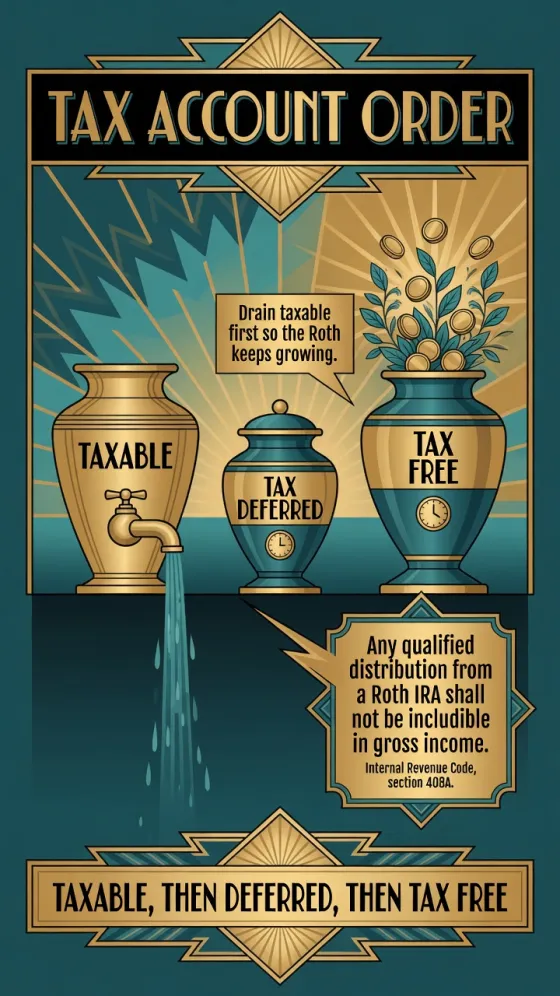
| Tax-account order | Drain taxable first, then tax-deferred (e.g. traditional IRA), then tax-free (Roth / 529). Protects high-growth tax-free accounts longer. |
The sample is built so that, with large taxable cash and a large high-growth RothA retirement account where you pay income tax on the money going in, and qualified withdrawals later come out tax-free — the mirror image of traditional. Named after the senator behind the law, so the word tells you nothing on its own. Plans care because Roth dollars do not add to taxable income later, which keeps them clear of income-driven cliffs.Full entry →, tax-account order should beat pro-rata on terminal net worth when you flip the strategy and re-simulate.
This is not the full dual-earner Springfield Baseline. The cast name carries over for continuity.
The live plan on the right is Springfield Tax Order (springfield_tax_order).
If I keep the same household, same spend, and same Monte CarloThe method behind a multi-path run: draw many randomized return paths, run the plan down each one, and read the spread of what happened. Named after the casino, because the engine is repeated random sampling rather than a formula — which is why two runs of one plan differ a little, and why a success rate is a proportion of sampled futures rather than a promise.Full entry → draws, but switch residual sell policy from pro-rata to tax-account order, does ending wealth improve — and can I see why in Movements (which account was sold)?
| Piece | Authoring (order of magnitude) |
|---|---|
| Person | Homer, born 1960, retired 65, death 90 — already in drawdown |
| Brokerage Cash (taxable) | Large money-market holding (~high basis cash) |
| Traditional IRA | Smaller bond holding |
| Roth IRA | Large US equity holding (high expected growth) |
| Spend | Retirement Living growing modestly through death |
| Residual strategy (default) | Pro-rata |
| Taxes | US single filer |
The teaching contrast is deliberate: cash-like taxable vs high-growth Roth. Pro-rata keeps nibbling the Roth; tax-account order tries to empty taxable first and leave the Roth compoundingGrowth on top of previous growth — this year's return is earned on last year's gains as well as the original money. It is why a plan curve bends upward instead of climbing in a straight line, and why the early years matter more than their size suggests.Full entry →.
Definitional
 Bird's EyeWhen you are not on Dossier, this control sits in the top toolbar. Opens a household overview as a modal — people, assets and liabilities, cash flow — without leaving the area you are in. Hidden on Dossier, because that same overview already sits at the top of that area. → Assets — BrokerageAn ordinary taxable investment account — no special retirement wrapper, no contribution limit, and no withdrawal age rules. The trade-off is that dividends and realized gains are taxed as they happen rather than deferred. Often called the taxable bucket next to traditional and Roth.Full entry → Cash, Traditional IRAIndividual Retirement Account — a retirement wrapper you open yourself rather than through an employer. It comes in traditional (pre-tax going in) and Roth (taxed going in) flavors, so naming the flavor matters more than the acronym does.Full entry →, Roth IRA.
 AssumptionsA main-rail area. The rules the forecast runs under — growth, taxes, movements, success definition, locality, currency. Read and write. → Movements — residual strategy selector (Pro-rata / Tax-account order
/ Glide rebalanceSelling some of what grew and buying what lagged, to bring the mix back to the target you chose. Without it a portfolio quietly drifts toward whatever has been winning, and gets riskier than intended precisely when it feels safest.Full entry →). This sample starts on Pro-rata.
- Bird's EyeWhen you are not on Dossier, this control sits in the top toolbar. Opens a household overview as a modal — people, assets and liabilities, cash flow — without leaving the area you are in. Hidden on Dossier, because that same overview already sits at the top of that area.
 A Bird's Eye / Assets & Liabilities mode. Weaves recurring cash flows into the sheet — inflows with assets, outflows with liabilities. The Σ badge (when on) rolls a series into a present-value-style total. Not a CPA balance sheet on purpose. — Retirement Living outflow.
Projected —  ForecasterA main-rail area with two jobs: (1) run the plan year by year and inspect Forecast Detail, and (2) Simulation Summary — many paths summarized into something like a probability of success. (already populated)
Select  BS ChartA Forecast Detail chip. BS = balance sheet. Assets above the line, liabilities below, over the forecast years. The net line, drawn in thick black, is net worth — often the thing you came for. Click a year to load the tables.,
 BS TableA Forecast Detail chip. BS = balance sheet for the selected year — real assets, accounts, liabilities, net worth. Copyable companion to BS Chart.,
 CF ChartA Forecast Detail chip. CF = cash flows. Money in above the line, money out below, by category over the years. The net line, drawn in thick black, is net cash flow — often the thing you came for.,
 CF TableA Forecast Detail chip. CF = cash flows for the selected year — incomes, expenses, taxes, and invest / sell / borrow totals., and turn on
 Moves TableA Forecast Detail chip. Mov = Movements. Holding-level trades for the selected year — sold or invested, after, %, and Why. for the
reason codes. Simulation Summary is already run under Silver.
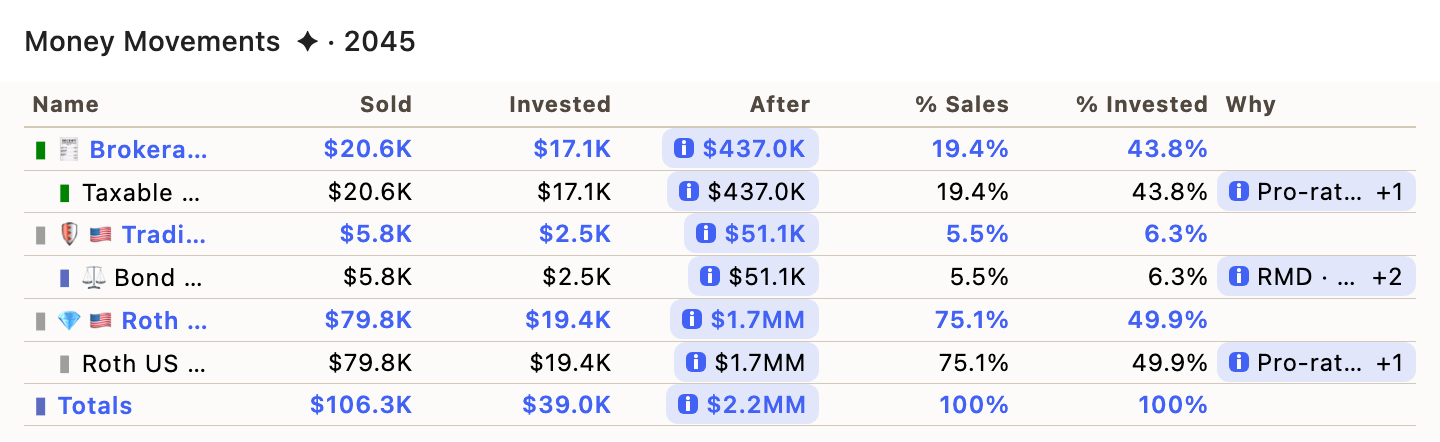
Canonical Movements chrome (values blurred). This lesson lives in the Why column — Pro-rata residual vs Tax-account order · …. HoverOn a desktop or laptop, rest the pointer on a row, chip, or control to open a detail card — attributes, amounts, and often a small path chart. We put a lot of teaching detail in those cards on purpose. Hover needs a pointer, so it does not work on tablets or phones (tap may show a simpler view or nothing). Hold Alt if the tips become a nuisance — many product hovers stay closed while Alt is down so you can move the pointer freely.Full entry → Name for Prior and full detail.
| Preview | View | Role here |
|---|---|---|
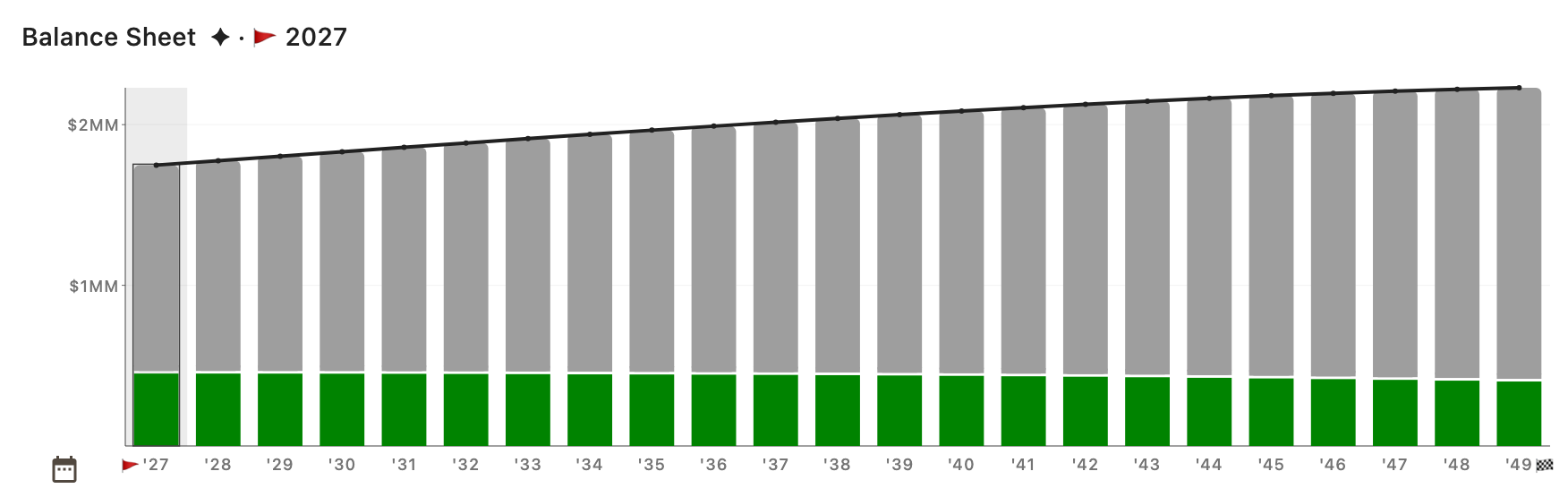 | BS ChartA Forecast Detail chip. BS = balance sheet. Assets above the line, liabilities below, over the forecast years. The net line, drawn in thick black, is net worth — often the thing you came for. Click a year to load the tables. | How balances shrink over the horizon under each residual policy. |
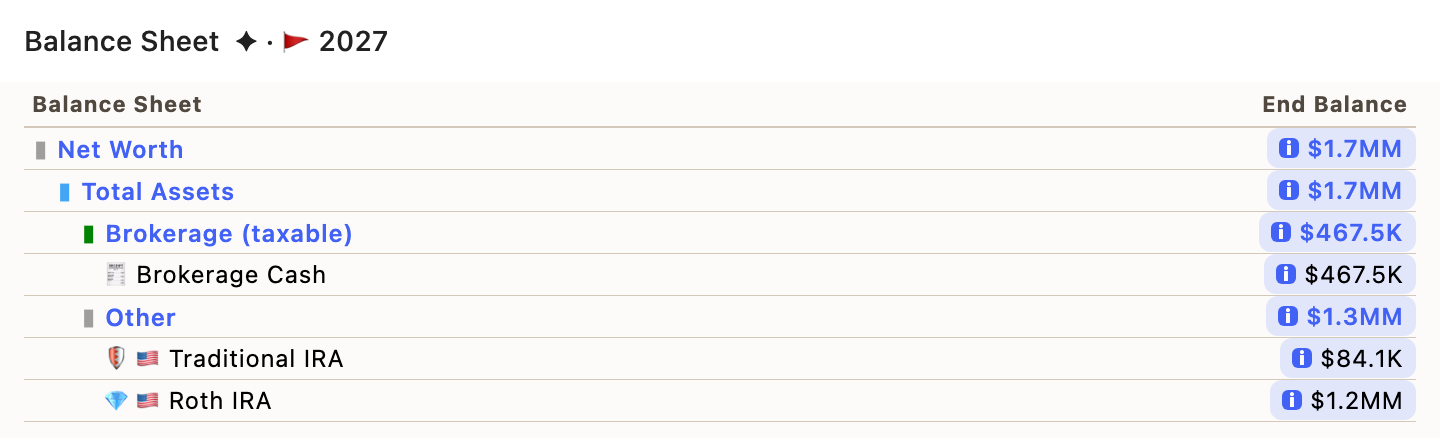 | BS TableA Forecast Detail chip. BS = balance sheet for the selected year — real assets, accounts, liabilities, net worth. Copyable companion to BS Chart. | Selected year: which accounts still hold value. |
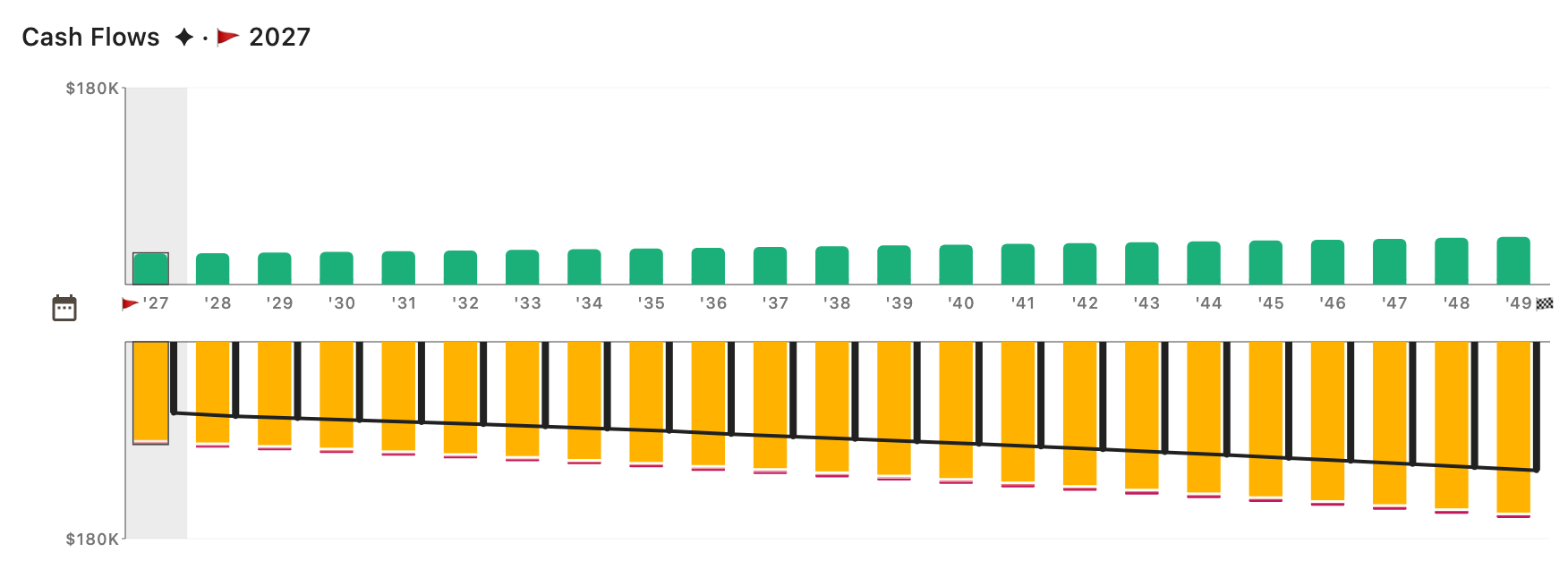 | CF ChartA Forecast Detail chip. CF = cash flows. Money in above the line, money out below, by category over the years. The net line, drawn in thick black, is net cash flow — often the thing you came for. | Living spend vs inflows; sales show up in disposition. |
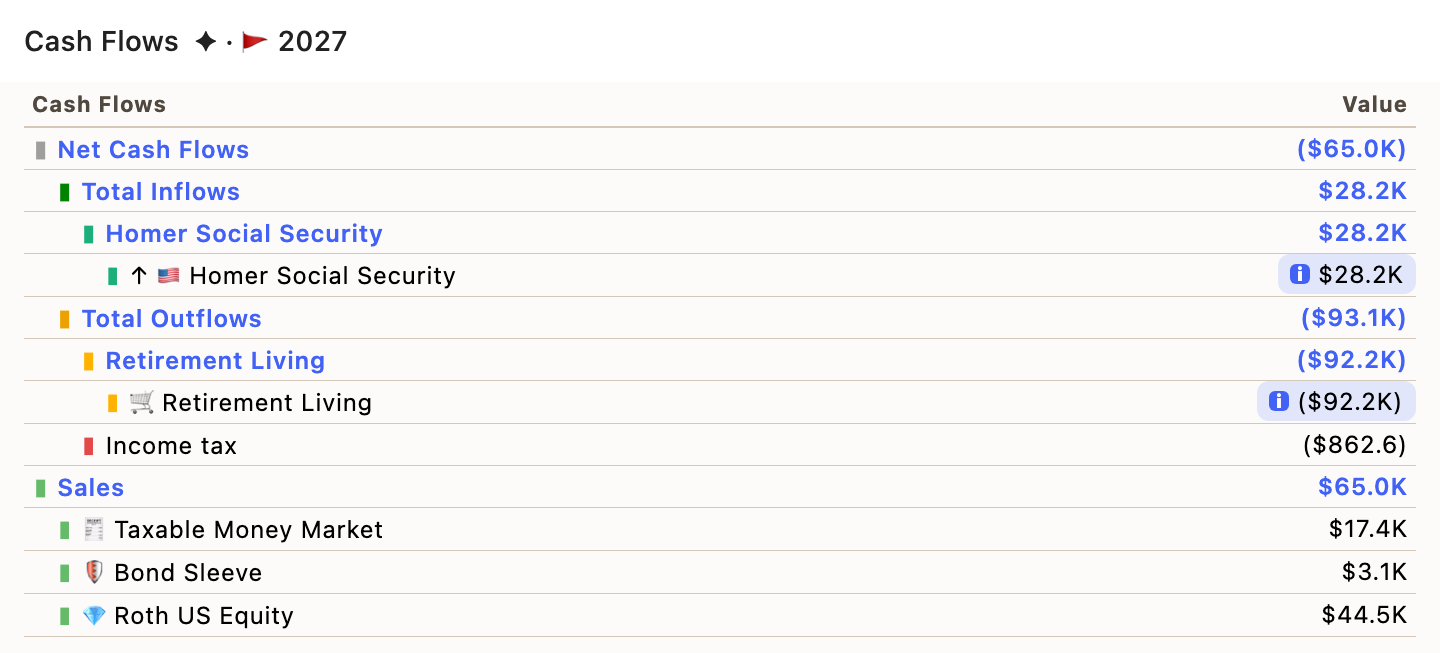 | CF TableA Forecast Detail chip. CF = cash flows for the selected year — incomes, expenses, taxes, and invest / sell / borrow totals. | Selected year: net sell / invest totals. |
| Moves TableA Forecast Detail chip. Mov = Movements. Holding-level trades for the selected year — sold or invested, after, %, and Why. | Which holdings sold and why — look for Pro-rata residual vs Tax-account order · … reasons. |
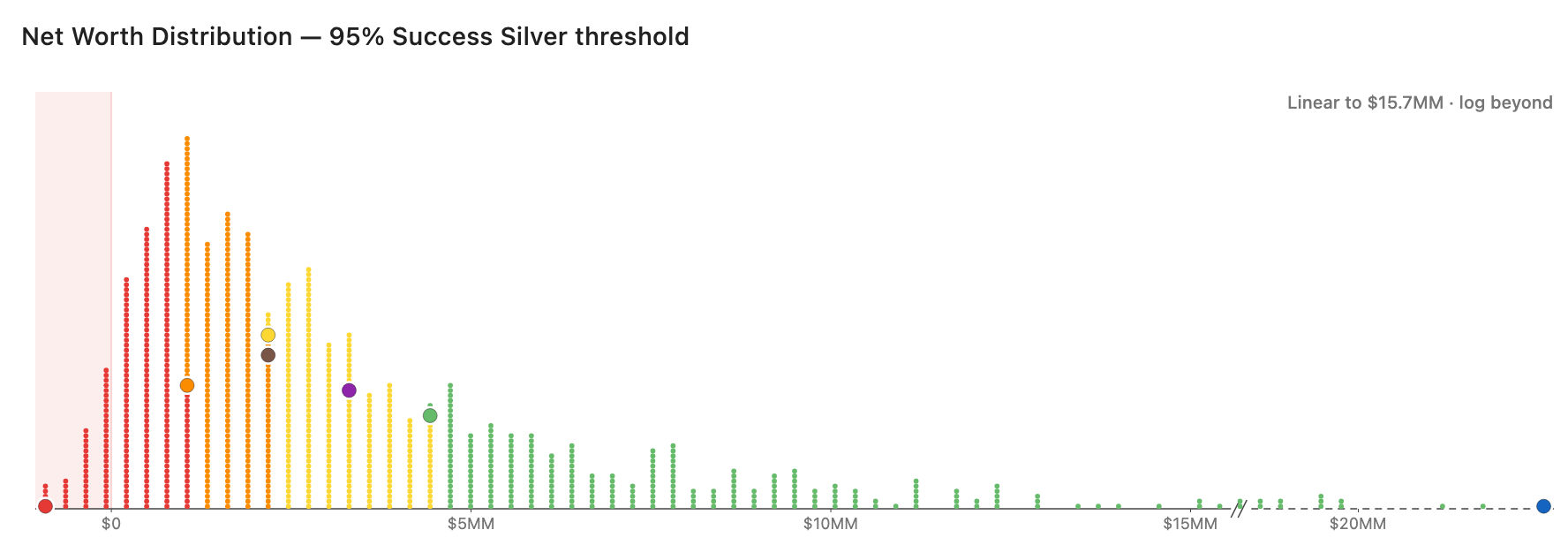 | NW Distribution | Terminal cloud + success at Silver after a strategy flip. |
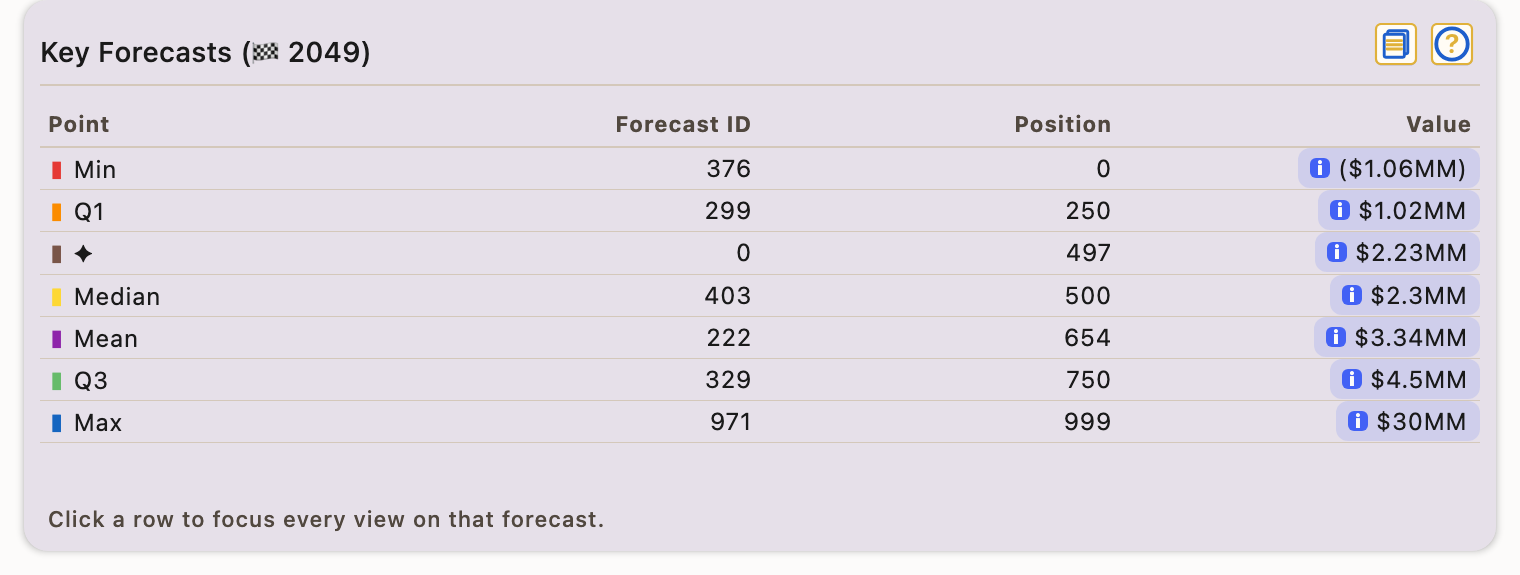 | Key Forecasts | Min / GMF / Max — compare GMF terminal NW before vs after. |
Prefer FID 0 / GMFHow the north star is labeled in the FID control: FID 0 is the deterministic GMF ✦ path, and every other FID is a randomized draw from the simulation. Choose it when you want the year-by-year read to hold still while you change something else about the plan.Full entry →. Snapshot dollars are not targets — read direction. Chart controls: Close up / zoom / Reveal.
The residual policy can be set in two equivalent places, from the same control family as the success criteria:
| Place | Use when |
|---|---|
| AssumptionsA main-rail area. The rules the forecast runs under — growth, taxes, movements, success definition, locality, currency. Read and write. → Movements | Durable policy on the dossier |
 TransformsA main-rail area. The name is Transforms because you transform a copy of the plan — a what-if — without rewriting the original dossier. Compare original vs modified side by side. → Modifiables → residual / sell-invest row (product label Money movements) | What-if without treating the edit as permanent; then Re-simulate |
Flip Pro-rata → Tax-account order. Do not change spend or accounts for the first experiment.
Linked funding (if any) always applies before residual policy — this lean sample is mostly residual drawdown.
- Stay on Springfield Tax Order. Confirm default residual is Pro-rata (Assumptions → Sell & invest).
- ForecasterA main-rail area with two jobs: (1) run the plan year by year and inspect Forecast Detail, and (2) Simulation Summary — many paths summarized into something like a probability of success. → Movements on a mid-plan year with spending. Note sales reasons —
Pro-rata residual (or similar) on both cash and Roth slices is the baseline story.
- Note GMF terminal wealth and success at Silver (order of magnitude only).
- TransformsA main-rail area. The name is Transforms because you transform a copy of the plan — a what-if — without rewriting the original dossier. Compare original vs modified side by side. (or Assumptions): switch residual to Tax-account order. Re-simulate.
- Expect terminal net worth up vs pro-rata on this sample (Roth equity left to compound longer; taxable cash drained first).
- Open Movements again — reasons should mention Tax-account order (and a tier such as taxable / deferred / tax-freeNo income tax due when the money comes out — the Roth promise, and the reason Roth dollars keep a withdrawal clear of income-driven thresholds. The word hides a condition: the withdrawal has to be qualified, which turns on age and how long the account has been open. It also hides a scope: municipal-bond interest is tax-free on the federal return yet still counts toward whether Social Security is taxed.Full entry →) more than pure pro-rata across everything.
- Optional: BS ChartA Forecast Detail chip. BS = balance sheet. Assets above the line, liabilities below, over the forecast years. The net line, drawn in thick black, is net worth — often the thing you came for. Click a year to load the tables. side-by-side in Transforms original vs modified — Roth balance should stay
higher longer under tax-account order.
Prefer “tax-aware residual helps terminal wealth on this account mix” over locking a percentage.
| Not this lesson | Where that lives |
|---|---|
| Full household with dual earn / mortgage | Springfield baseline |
| Glide rebalance vs pro-rata (bond-heavy taxable) | springfield_glide sample |
| RMD-forced sales on traditional IRAs | Banks / RMD family samples |
| Success definition alone | What does success mean? |
Glide is a third residual mode — useful later; do not conflate it with tax-account order here.
| If you only… | You can miss… |
|---|---|
| Maximize portfolio return assumptions | Which account pays living spend year by year |
| Treat all accounts as one undifferentiated pot | Tax buckets change after-tax compounding |
| Read one success % | Same cloud of returns, different residual policy → different endings |
Living spend and retirement timing still dominate many plans; this lever is about order of sacrifice once you are already spending.
| Topic | Lesson / sample |
|---|---|
| Full dual-earner household | Meet the Springfield household |
| Living spend lever | Bend the plan with living spend |
| Claim timing × longevity | Claim early vs live long |
| What “success” means | What does success mean? |
| Glide residual | Glide rebalance vs pro-rata |
| Forced RMD vs residual | Forced traditional RMD vs residual tax order |
| App map | Getting around the app |
Illustrative quantities. Teaching claim: on this taxable-cash + high-growth Roth mix, tax-account order residual tends to beat pro-rata on terminal NW. Directions over dollars.
Rebuild this plan by hand
The cards on the canvas show the accounts and cash flows. These are the settings that live outside any card, read from the plan itself, with the label each control carries in the app. A value marked default is one to leave alone.
| Setting | Springfield Tax Order |
|---|---|
| Household | |
| Planning region | United States (default) |
| Homer (Primary) | |
| birth year | 1960 |
| retirement age | 65 |
| death age | 90 |
| Taxes | |
| Tax regime | United States |
| Filing status | Single |
| State of residence | Ohio |
| First-year federal estimate | — |
| First-year state estimate | — |
| Strategy | |
| Residual withdrawal strategy | Pro-rata (default) |
| Roth conversions | Off |
| Definition of success | Liquidity crises allowed (default) |
| Glide path target | None (default) |
| Advanced | |
| Reporting inflation | Assumption set's rate (default) |
| Cost of capital | Assumption set's rate (default) |
| Growth assumptions | Growth overrides (default) |
| Currencies | Multiple currencies (default) |
| Default currency | USD (default) |
| Display currency | USD (default) |

Educational content — not advice. These lessons teach how Tutilis models a plan and how to read what it shows. The households, balances, and outcomes in them are invented for teaching. Nothing here is financial, investment, tax, or legal advice, or a recommendation to buy, sell, or hold anything. A model cannot know your circumstances — check anything you take from a lesson against your own situation, and against a qualified professional where it matters.