
 Forced traditional RMD vs residual tax order
The situation A retiree past RMD age with a large traditional IRA — the required withdrawals are bigger than they want to spend, so where does the money go and what does it cost?
How to use this case study
New to the Learning Center, or want a map of the panels? Start with a tour: Reading Lesson (Getting Around) or Screencast Lesson (Getting Around) — both walk through Tutilis next to a live planThe running Tutilis product next to this lesson — navigation, Bird's Eye, Forecaster, tools, and more — loaded with a teaching sample. A dossier is the plan data; the live plan is the full product surface with a sample dossier already open so you can explore. On the web, teaching samples are not editable the way your own dossier will be in the full app.Full entry → (to the right on a desktop-width screen, or below when stacked on a tablet).
This page — Forced traditional RMD vs residual tax order — includes a live sample planThe running Tutilis product next to this lesson — navigation, Bird's Eye, Forecaster, tools, and more — loaded with a teaching sample. A dossier is the plan data; the live plan is the full product surface with a sample dossier already open so you can explore. On the web, teaching samples are not editable the way your own dossier will be in the full app.Full entry → next to the text. On a wide screen it usually sits to the right of the text; on a tablet it usually sits below. Use the text for the walk-through, then try the same ideas in the live plan.
The live planThe running Tutilis product next to this lesson — navigation, Bird's Eye, Forecaster, tools, and more — loaded with a teaching sample. A dossier is the plan data; the live plan is the full product surface with a sample dossier already open so you can explore. On the web, teaching samples are not editable the way your own dossier will be in the full app.Full entry → next to this page — usually to the right on a wide screen, or below on a tablet — is Tutilis running a teaching sample: the same financial planning product available as a desktop application (early preview). A dossierYour full plan in Tutilis: the people in the household, what they own and owe, cash flows in and out, tax setting, and planning assumptions. One dossier is one complete situation as the product models it.Full entry → is the plan data; the live plan is the full product (navigation, Bird's Eye, Forecaster, tools) with a sample dossier already open so you can try the panels. See planned pricing. On the web, Learning Center samples are not editable the way your own dossier will be in the full app. Your own household goes in the Tutilis desktop app — the Learning Center front page has a short clip of that.
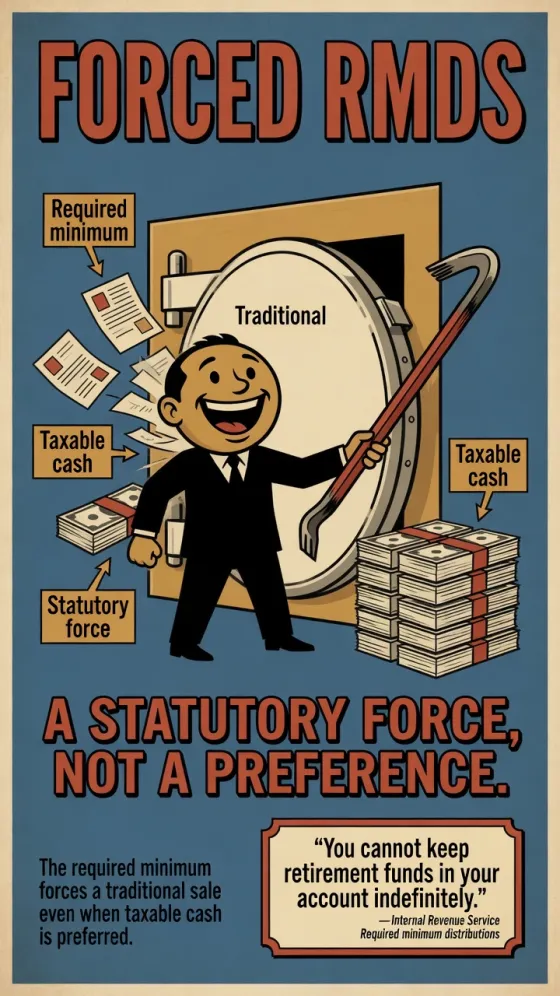
Required minimum distributions (RMDs) are not a residual preference — they are a statutory force. Once the owner is past RMDRequired Minimum Distribution — once you reach an age set by statute, the law makes you withdraw a minimum amount each year from traditional retirement accounts, whether or not you need the money. The withdrawal is taxable income, so RMDs can push a household into a higher bracket or over a surcharge threshold. Roth accounts are generally not subject to them.Full entry → age and holds a traditionalA retirement account where the tax is paid on the way out — not a description of an old-fashioned account. Money went in before income tax, grew untaxed, and is taxed as ordinary income when you take it out — traditional 401(k)s and IRAs work this way. The contrast is Roth (taxed going in, tax-free coming out) and taxable (brokerage, taxed as you go).Full entry → (pre-taxMoney that went in before income tax was taken — the traditional bucket. Not the same as untaxed: the tax was deferred, not forgiven, and it comes due as ordinary income on the way out. A pre-tax balance is worth less to spend than the same number in a Roth.Full entry →) retirement account, the plan must sell enough from that account each year (or pay a penalty) whether or not your residual strategy would rather spend taxable cash first. Required minimum distributions on a large IRA can push income into higher brackets for years.
This lesson uses a Banks-family lean sample (HNWHigh net worth — shorthand for a household wealthy enough that different planning problems dominate. Surcharge tiers, the investment surtax, and estate questions bind earlier, while running out of money is rarely the binding risk. There is no single official dollar line.Full entry → cast continuity — Philip, not Springfield):
| Piece | Why it is here |
|---|---|
| Philip born 1950 | In 2026 he is about 76 — past typical RMD start |
| Large Traditional IRA (~equity) | Source of forced annual RMD sales |
| Large Brokerage Cash (taxable MM) | What tax-account order would prefer to drain first for living spend |
| Smaller Roth IRA | Tax-free account residual may leave alone longer |
| Residual default | Tax-account order (taxable → deferred → tax-free) |
| Spend | Modest Retirement Living through death |
Teaching claim: even with residual set to tax-account order, Movements still shows RMD · Traditional IRAIndividual Retirement Account — a retirement wrapper you open yourself rather than through an employer. It comes in traditional (pre-tax going in) and Roth (taxed going in) flavors, so naming the flavor matters more than the acronym does.Full entry → (or similar) forced sales. Residual policy does not waive the RMD.
For background on the account types, read Sheltering money. For background on residual tax order, read Tax-account order vs pro-rata. Success is judged under Silver unless you change it.
The live plan on the right is Banks Forced Traditional RMD (banks_forced_rmd).
If my residual strategy says “spend taxable cash before the traditional IRA,” will the engine still force traditional RMD sales every year after RMD age — and can I see the reason code separately from residual sells?
Every sale on Movements is decided by one of two layers, and the Why column says which.
| Layer | Who decides | Example Why on Movements |
|---|---|---|
| Forced / statutory | RMD rules (and similar) | RMD · Traditional IRA |
| Residual strategy | Pro-rata / tax-account order / glide | Tax-account order · taxable, Pro-rata residual, … |
The product can split a year into both (e.g. RMD amount from traditional + residual from cash). Do not read every sell as “the residual strategy alone.”
When RMD rules are active, a forced-sales / RMD detail control (often a small balance / scale icon on Movements) opens statutory context: owner age, RMD start age, required amount, sold for RMD. Use it when the Why column is dense.
Definitional
 Bird's EyeWhen you are not on Dossier, this control sits in the top toolbar. Opens a household overview as a modal — people, assets and liabilities, cash flow — without leaving the area you are in. Hidden on Dossier, because that same overview already sits at the top of that area. → People — Philip; birth 1950 → age 76 in a 2026 valuation year.
- Assets — Traditional IRA, BrokerageAn ordinary taxable investment account — no special retirement wrapper, no contribution limit, and no withdrawal age rules. The trade-off is that dividends and realized gains are taxed as they happen rather than deferred. Often called the taxable bucket next to traditional and Roth.Full entry → Cash, RothA retirement account where you pay income tax on the money going in, and qualified withdrawals later come out tax-free — the mirror image of traditional. Named after the senator behind the law, so the word tells you nothing on its own. Plans care because Roth dollars do not add to taxable income later, which keeps them clear of income-driven cliffs.Full entry → IRA.
 AssumptionsA main-rail area. The rules the forecast runs under — growth, taxes, movements, success definition, locality, currency. Read and write. → Movements — residual is already Tax-account order (not the experiment
to flip first; it is the foil that would prefer cash).
Projected —  ForecasterA main-rail area with two jobs: (1) run the plan year by year and inspect Forecast Detail, and (2) Simulation Summary — many paths summarized into something like a probability of success. (already populated)
Turn on Movements plus the usual BS/CF chips. Simulation Summary is under Silver.
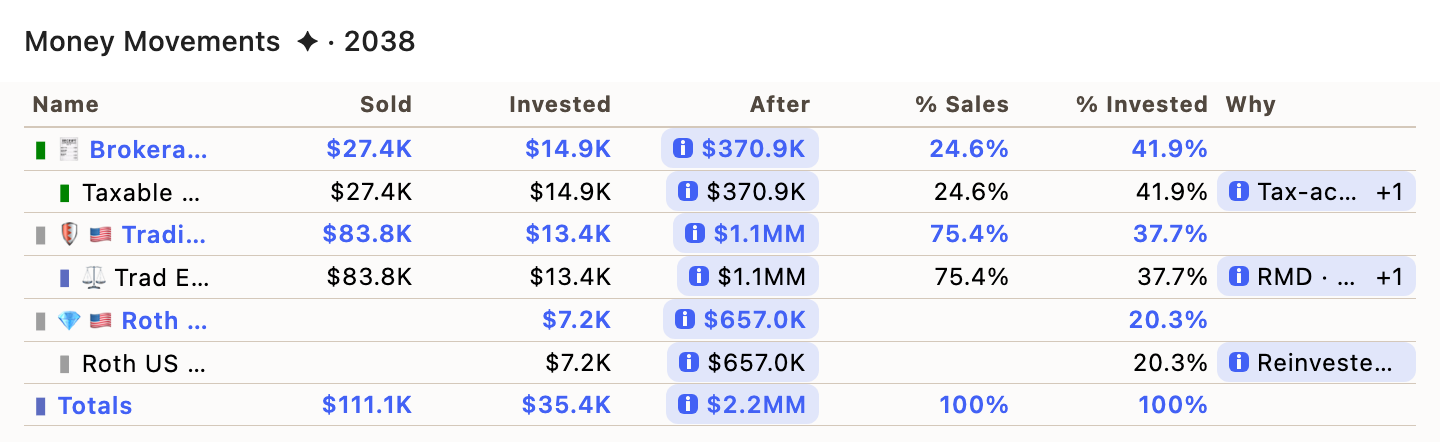
Canonical Movements chrome (values blurred). Hunt the Why column for RMD · … on traditional vs residual reasons on other accounts — same table shape as every other Movements surface.
| Preview | View | Role here |
|---|---|---|
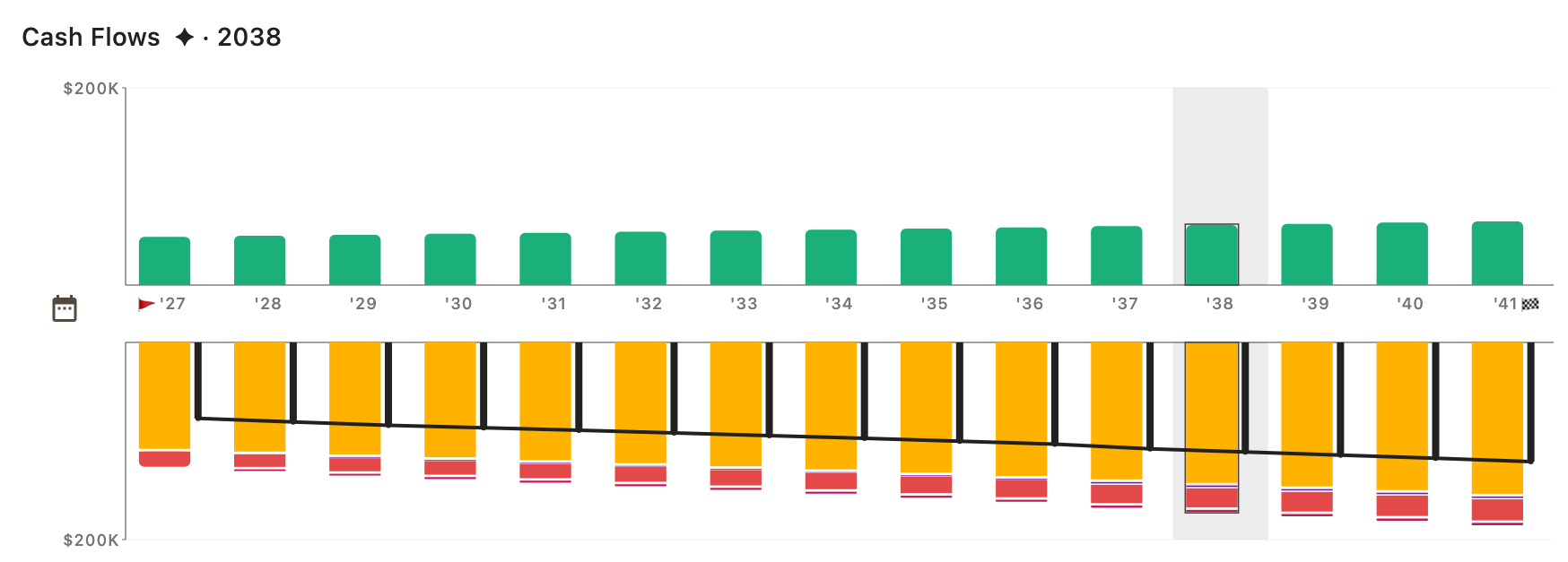 |  CF ChartA Forecast Detail chip. CF = cash flows. Money in above the line, money out below, by category over the years. The net line, drawn in thick black, is net cash flow — often the thing you came for. | Living spend; taxes may rise when RMD ordinary income hits. |
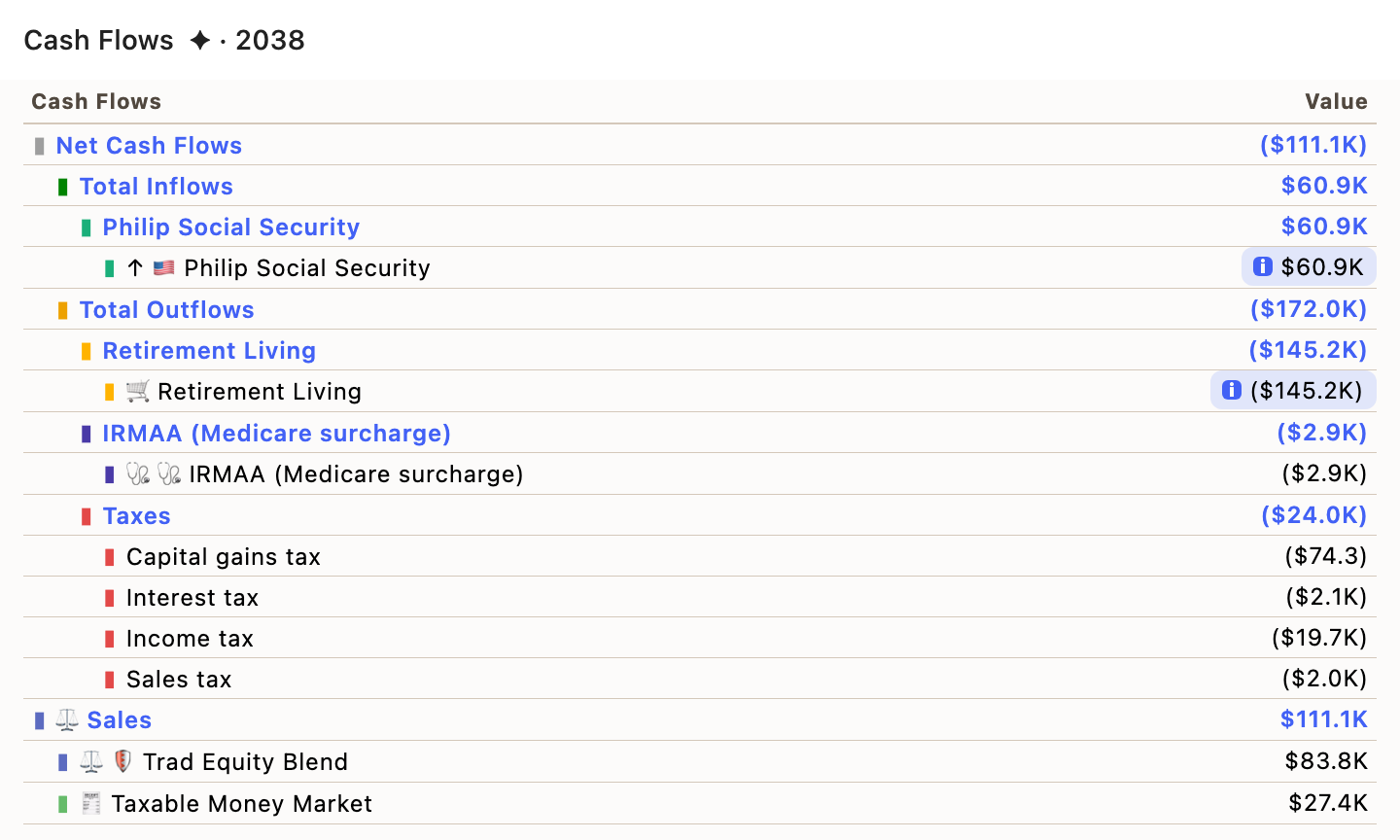 |  CF TableA Forecast Detail chip. CF = cash flows for the selected year — incomes, expenses, taxes, and invest / sell / borrow totals. | Selected year: disposition / tax lines. |
|  Moves TableA Forecast Detail chip. Mov = Movements. Holding-level trades for the selected year — sold or invested, after, %, and Why. | RMD · … reasons on traditional; residual reasons on other accounts. |
 BracketsA Forecast Detail tax-lens chip. Ordinary-income tax ladder for the selected year — how full the brackets are and who filled them. | Each year's ordinary income by source. The RMD segment sits against an outline of what the rules required that year. | |
| Taxes (optional) | RMD often shows as ordinary income character. | |
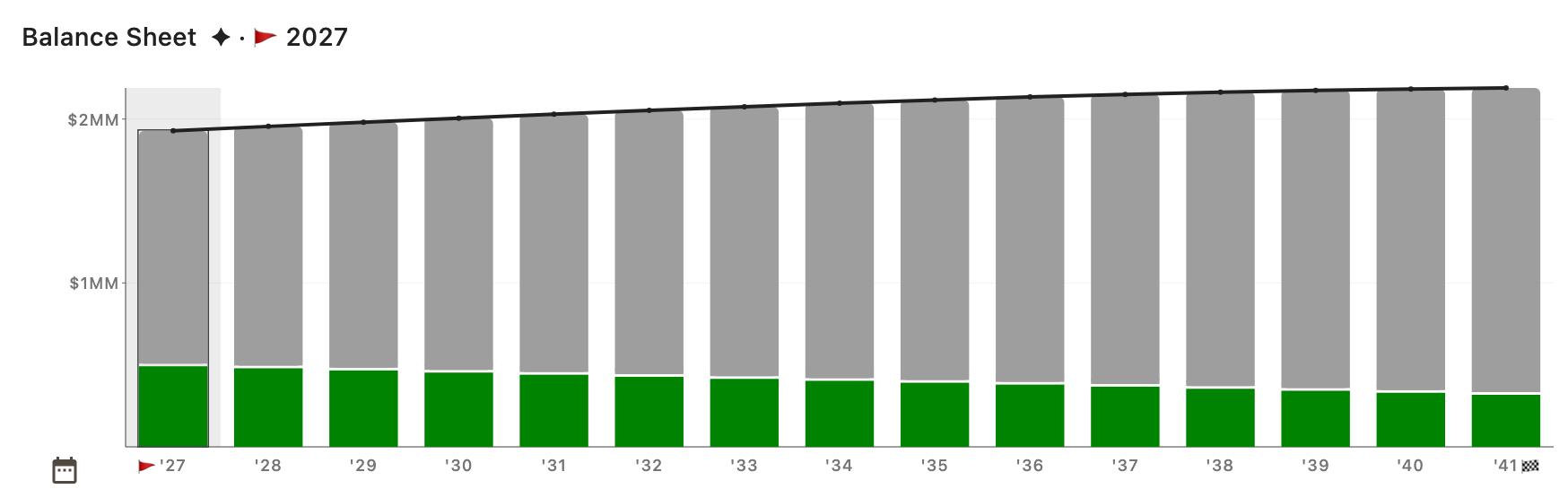 |  BS ChartA Forecast Detail chip. BS = balance sheet. Assets above the line, liabilities below, over the forecast years. The net line, drawn in thick black, is net worth — often the thing you came for. Click a year to load the tables. | Traditional IRA declining under forced distributions. |
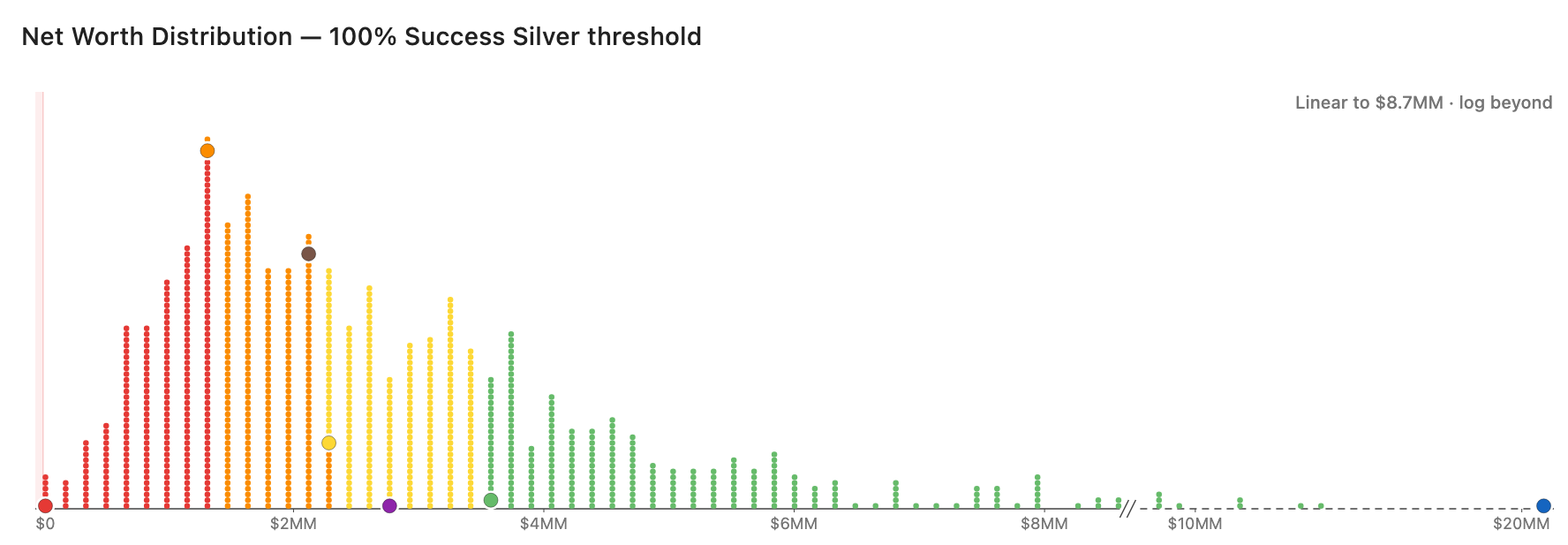 | NW Distribution | Terminal cloud (direction only). |
Prefer FID 0 / GMFHow the north star is labeled in the FID control: FID 0 is the deterministic GMF ✦ path, and every other FID is a randomized draw from the simulation. Choose it when you want the year-by-year read to hold still while you change something else about the plan.Full entry →. Scrub Year through several post-2026 years — RMD should repeat.
The required path across years
Movements answers “what sold this year and why.” The BracketsA Forecast Detail tax-lens chip. Ordinary-income tax ladder for the selected year — how full the brackets are and who filled them. chip answers a different
question. It shows what required minimum is coming year by year. That is the statutory path that
keeps forcing ordinary incomeIncome taxed at the regular graduated rates — wages, interest, pension payments, and withdrawals from traditional retirement accounts. The point of the label is the contrast: long-term capital gains and qualified dividends get their own, usually lower, rate schedule.Full entry → whether spending needs the cash or not.
| View | Question |
|---|---|
 Moves ChartA Forecast Detail chip. Mov = Movements. Chart of sales, invest, and borrow over the years — how the operating net is closed. / Moves TableA Forecast Detail chip. Mov = Movements. Holding-level trades for the selected year — sold or invested, after, %, and Why. | Forced sales this year (Why RMD · …); ⚖️ model popup for divisor math |
| BracketsA Forecast Detail tax-lens chip. Ordinary-income tax ladder for the selected year — how full the brackets are and who filled them. | Each year's taxable ordinary income by source, with the required RMD outlined |
Turn on Brackets in the tax lens. Each year's bar carries an indigo RMD segment, and the outline above it marks what the rules required. While Philip’s traditional IRA is large, that required amount rises year after year. It runs well into five figures a year, whether or not he needs the money.
Chart controls: Close up / zoom / Reveal.
- Confirm Philip’s age is past RMD (People / life-events context; ~76 in 2026).
- Confirm that the Money movement strategy under AssumptionsA main-rail area. The rules the forecast runs under — growth, taxes, movements, success definition, locality, currency. Read and write. is Tax-account order.
- ForecasterA main-rail area with two jobs: (1) run the plan year by year and inspect Forecast Detail, and (2) Simulation Summary — many paths summarized into something like a probability of success. → Movements for an early plan year (e.g. 2026 or 2027).
- Find at least one line with Why RMD · Traditional IRA (or the traditional account name). That sale is not “because residual preferred traditional.”
- Look for separate residual activity on Brokerage Cash when living spend still needs funding after / beside the RMD — tax-account order may show on those residual slices.
- Optional: open the forced sales / RMD detail (⚖️-style control when present) — required RMD vs sold for RMD for that year.
- Turn on the Brackets chip and scan the indigo RMD segments across years. The outline shows the required minimum for each year, which is a series over the whole horizon rather than a single year's trade list.
- Optional contrast: switch residual to Pro-rata and re-sim — RMD forced sales should still appear; residual extra sells change, the statutory RMD does not go away.
Prefer “RMD overrides residual preference on traditional balances” over memorizing a divisor table.
| Not this lesson | Where that lives |
|---|---|
| Choosing pro-rata vs tax-order for pure drawdown | Tax-account order vs pro-rata |
| Glide path residual | Glide rebalance vs pro-rata |
| Full Banks dual-household story | Meet the Banks household |
| Springfield dual-earner tour | Meet the Springfield household |
| SS statement paste vs early retirement | Social Security treatment |
| Pre-65 / Medicare phase validation | Healthcare expense phases (employer → Medicare) |
| If you only… | You can miss… |
|---|---|
| Set residual to “taxable first” | Traditional RMD still forces pre-tax sales and ordinary income |
| Read total sells as one bucket | Forced RMD vs residual are different Why codes |
| Ignore age | RMD is age-triggered on traditional balances |
Living spend, taxes, and success definition still shape the plan; this sample isolates the forced-RMD seam.
The other half: what the forced dollars cost you
This lesson shows that RMDs happen regardless of strategy. It does not show what they do to your tax bracketA band of income taxed at a given rate. The common misreading is that entering a higher bracket taxes all your income at that rate — it does not. Only the dollars inside that band pay the higher rate, so a raise never leaves you with less after tax.Full entry → — and that is where the money is. Forced distributions consume cheap-bracket room that a Roth conversionDeliberately moving money from a traditional account into a Roth one and paying the income tax on it now, so it grows and comes out tax-free later. The usual reason is a low-income year — between retiring and claiming benefits, say — where the conversion is taxed at a lower rate than the future withdrawal would be. It also shrinks later RMDs.Full entry → could otherwise have used, and they consume it first.
Filling the cheap buckets draws that competition directly: one stacked column per year, forced RMD below discretionary conversion, with the unfilled bracket room hatched on top. It is also where the statutory required amount is separated from the taxable band — the two diverge once base income stops covering the standard deductionThe flat amount most households subtract instead of itemizing individual deductions. You take the larger of the two, so it acts as a floor: below it, an extra deductible expense saves nothing at all, which surprises people who gave to charity expecting a break.Full entry →, and the gap is the deductionAn amount subtracted from income before the tax is computed, so it saves tax at your marginal rate rather than dollar for dollar. That is the difference from a credit, which comes off the tax itself: a $1,000 deduction is worth a few hundred dollars, a $1,000 credit is worth $1,000.Full entry → sheltering income the rules compelled.
| Topic | Lesson / sample |
|---|---|
| What RMDs do to your bracket | Filling the cheap buckets |
| Residual tax-account order | Tax-account order vs pro-rata |
| Glide residual | Glide rebalance vs pro-rata |
| What “success” means | What does success mean? |
| App map | Getting around the app |
Illustrative quantities. Teaching claim: past RMD age, traditional IRA sales carry an RMD reason even when residual tax-account order would prefer taxable cash. Directions over dollars.
Rebuild this plan by hand
The cards on the canvas show the accounts and cash flows. These are the settings that live outside any card, read from the plan itself, with the label each control carries in the app. A value marked default is one to leave alone.
| Setting | Banks Forced Traditional RMD |
|---|---|
| Household | |
| Planning region | United States (default) |
| Philip (Primary) | |
| birth year | 1950 |
| retirement age | 65 |
| death age | 92 |
| Taxes | |
| Tax regime | United States |
| Filing status | Single |
| State of residence | Ohio |
| First-year federal estimate | — |
| First-year state estimate | — |
| Strategy | |
| Residual withdrawal strategy | Tax-account order |
| Roth conversions | Off |
| Definition of success | Liquidity crises allowed (default) |
| Glide path target | None (default) |
| Advanced | |
| Reporting inflation | Assumption set's rate (default) |
| Cost of capital | Assumption set's rate (default) |
| Growth assumptions | Growth overrides (default) |
| Currencies | Multiple currencies (default) |
| Default currency | USD (default) |
| Display currency | USD (default) |

Educational content — not advice. These lessons teach how Tutilis models a plan and how to read what it shows. The households, balances, and outcomes in them are invented for teaching. Nothing here is financial, investment, tax, or legal advice, or a recommendation to buy, sell, or hold anything. A model cannot know your circumstances — check anything you take from a lesson against your own situation, and against a qualified professional where it matters.