This lesson uses 3 sample plans — switch anytime; color matches the bar between the columns.
On the right now: National muni

 When tax-exempt interest still shows up on the bill
The situation A California filer holding a chunk of bonds in a taxable account — does “tax-exempt” municipal interest actually keep money off the bill, and which bill?

How to use this case study
New to the Learning Center, or want a map of the panels? Start with a tour: Reading Lesson (Getting Around) or Screencast Lesson (Getting Around) — both walk through Tutilis next to a live planThe running Tutilis product next to this lesson — navigation, Bird's Eye, Forecaster, tools, and more — loaded with a teaching sample. A dossier is the plan data; the live plan is the full product surface with a sample dossier already open so you can explore. On the web, teaching samples are not editable the way your own dossier will be in the full app.Full entry → (to the right on a desktop-width screen, or below when stacked on a tablet).
This page — When tax-exempt interest still shows up on the bill — can open more than one live sample planThe running Tutilis product next to this lesson — navigation, Bird's Eye, Forecaster, tools, and more — loaded with a teaching sample. A dossier is the plan data; the live plan is the full product surface with a sample dossier already open so you can explore. On the web, teaching samples are not editable the way your own dossier will be in the full app.Full entry → next to the text (to the right on a wide screen, or below on a tablet). Use the Live plans chips (and matching colored links in the prose) to switch without leaving this page; the colored bar near the plans shows which one is loaded. The walk-through stays in the text.
The live planThe running Tutilis product next to this lesson — navigation, Bird's Eye, Forecaster, tools, and more — loaded with a teaching sample. A dossier is the plan data; the live plan is the full product surface with a sample dossier already open so you can explore. On the web, teaching samples are not editable the way your own dossier will be in the full app.Full entry → next to this page — usually to the right on a wide screen, or below on a tablet — is Tutilis running a teaching sample: the same financial planning product available as a desktop application (early preview). A dossierYour full plan in Tutilis: the people in the household, what they own and owe, cash flows in and out, tax setting, and planning assumptions. One dossier is one complete situation as the product models it.Full entry → is the plan data; the live plan is the full product (navigation, Bird's Eye, Forecaster, tools) with a sample dossier already open so you can try the panels. See planned pricing. On the web, Learning Center samples are not editable the way your own dossier will be in the full app. Your own household goes in the Tutilis desktop app — the Learning Center front page has a short clip of that.
Brokers, fund names, and 1099s call municipal-bondDebt issued by a state or local government. Its interest is normally excluded from federal AGI — which is what the industry label *tax-exempt* means, and all it means. The same dollars still count in MAGI, and most states add back interest from other states' issuers on their own return.Full entry → interest tax-exempt. That label is a federal AGIAdjusted Gross Income — total income minus a specific set of adjustments, and the number many other tax rules build on. It is a midpoint, not your taxable income: deductions still come off after it.Full entry → fact: the interest does not go on Form 1040 as ordinary incomeIncome taxed at the regular graduated rates — wages, interest, pension payments, and withdrawals from traditional retirement accounts. The point of the label is the contrast: long-term capital gains and qualified dividends get their own, usually lower, rate schedule.Full entry →. It is not a complete tax picture. So are municipal bonds tax-freeNo income tax due when the money comes out — the Roth promise, and the reason Roth dollars keep a withdrawal clear of income-driven thresholds. The word hides a condition: the withdrawal has to be qualified, which turns on age and how long the account has been open. It also hides a scope: municipal-bond interest is tax-free on the federal return yet still counts toward whether Social Security is taxed.Full entry →? Mostly, for federal income tax, but muni interest is MAGI income, and MAGI drives several costs.
The same dollars still count in modified AGIModified Adjusted Gross Income — AGI with certain deductions added back. It matters far out of proportion to the small adjustment, because MAGI is the figure that triggers cliffs: Medicare surcharges, the investment surtax, and health-subsidy eligibility all test against a MAGI, and each rule uses a slightly different one.Full entry → — the figure that drives IRMAAIncome-Related Monthly Adjustment Amount — a surcharge on Medicare premiums for higher-income households. It works in tiers, so one dollar of extra income can raise the premium for a whole year. It looks back at a tax return from a couple of years earlier, which is why a one-off spike (a big conversion, a property sale) shows up as a bill much later.Full entry → Medicare premiums, the 3.8% net investment income taxNet Investment Income Tax — an extra tax (commonly cited at 3.8%) on investment income once income passes a threshold. It applies on top of ordinary income tax rather than instead of it, which is why a plan can show the same dollar taxed on more than one line.Full entry →, and how much of a Social Security check is taxable. And most states that levy an income tax add out-of-state municipal interest back onto their own return. California, used on these live plans, is one of them.
US TreasuriesDebt issued by the US federal government. The mirror image of a municipal bond: the interest is federally taxable, and states are barred from taxing it — so it is subtracted on a state return rather than added back.Full entry → are the inverse special case: federally taxable, state-exempt, because federal law bars states from taxing that interest.
Stay on this page. Switch the live plan with the chips above (or the links below). The household and the $200k taxable holding stay put; only the character of the interest changes.
| Live plan | What the holding pays | Federal income tax | MAGI | California |
|---|---|---|---|---|
| National muni (default) | Tax-exempt (municipal) yield | Out of AGI | AGI + the munis | Added back |
| Treasury | Taxable Treasury interest | In AGI | Equals AGI | Subtracted |
| Corporate | Ordinary corporate interest | In AGI | Equals AGI | Taxed like other interest |
Shared setup:
| Setup | Value |
|---|---|
| Person | Alex, single, California |
| Wages | $120k |
| Taxable bond holding | $200k, 3% yield (~$6k of interest) |
| Living spend | $80k |
| Holding return | Pinned at μThe Greek letter the product uses for an assumed average return — in plain speech, about what something earns in a typical year. It is an input to the projection rather than a result of it, and it never travels alone: μ paired with σ is the whole growth assumption, because an average return says nothing about how rough the ride is.Full entry → 3.5% / σThe Greek letter the product uses for volatility — how widely returns scatter around their average. A bare σ on a chart axis is measuring risk, not return: two holdings can sit at the same height (same μ) and be completely different things to live through. Higher σ also drags the growth you actually compound below the average you were quoted.Full entry → 5% on all three plans |
Watch labels and which lines appear, not the exact cents. Schedule growth and the selected year will move the dollars; they should not change those labels.
The return is pinned deliberately. The three holdings carry different instrument categories — intermediate Treasury, long-term corporate, other — and each plan overrides that category with the same expected return and volatilityHow much an investment's returns bounce around from year to year, not whether it goes up or down overall. Written σ (sigma) in the product. Two holdings can have the same average return and feel completely different to live through — and high volatility drags the growth you actually compound below that average.Full entry →, so switching chips cannot move net worth for any reason except the tax. This is a comparison of character, not of return.
On a taxable bond holding of the same size, can I open the tax statement and see:
- National muni — federal MAGI above AGI, and a California line Municipal bond interest added back?
- Treasury — MAGI equals AGI, federal still taxes the interest, and California subtracts it?
- Corporate — neither special line; interest is ordinary at both levels?
“Tax-exempt” on a muni is answering one question: does this interest enter federal AGI? For a normal municipal bond, no.
Three other questions still have answers, and they are not “no”:
| Question | Municipal interest | Treasury interest | Corporate interest |
|---|---|---|---|
| On federal AGI? | No | Yes | Yes |
| In MAGI (IRMAA, NIIT, taxable Social Security)? | Yes — added to AGI | Yes (already in AGI) | Yes |
| On a typical state return? | Usually yes if the issuer is another state; usually no if it is yours | No (federal law) | Yes |
A national fund holds bonds from many states, so most of its interest is out-of-state wherever you live, and Tutilis adds all of it back. A single-state fund is entered with its issuing state set on the fund's yields, beside the tax-exempt yield. A California fund held by a California resident stays off the California return. The same fund held by a New York resident is added back there, because Tutilis compares the issuing state with the state the plan lives in. Tutilis does not split a fund CUSIPThe nine-character id that names one specific security. It matters here because tax character is a property of the issuer, so questions like "how much of this fund is in-state?" are answered issue by issue rather than by the fund's name.Full entry → by CUSIP, so a fund that is mostly but not entirely in-state is best entered as national.
Illinois, Iowa, Oklahoma and Wisconsin tax most of their own munis as well, and Tutilis adds those back even in-state. North Dakota does not add other states’ munis back. States with no income tax (Texas, Florida, …) only care about the MAGI half.
Start on the canvasWhat we call the right side of this page (or the bottom on a narrow screen) where the Tutilis application is drawn in this web Learning Center setting. It is the same product surface as the live plan — navigation, Bird's Eye, Forecaster, and so on — not a separate product.Full entry → beside this lesson — no install, and it is the same data the desktop app edits.
First, switch the beam to Holding. Open  Bird's EyeWhen you are not on Dossier, this control sits in the top toolbar. Opens a household overview as a modal — people, assets and liabilities, cash flow — without leaving the area you are in. Hidden on Dossier, because that same overview already sits at the top of that area. and pick Holding from the
Account / Holding / Cash Flow selector. On Account the brokerageAn ordinary taxable investment account — no special retirement wrapper, no contribution limit, and no withdrawal age rules. The trade-off is that dividends and realized gains are taxed as they happen rather than deferred. Often called the taxable bucket next to traditional and Roth.Full entry → is one rolled-up row and
the fund inside it is not drawn at all — and the fund is the thing this lesson is about. Holding
opens accounts into the individual securities they contain.
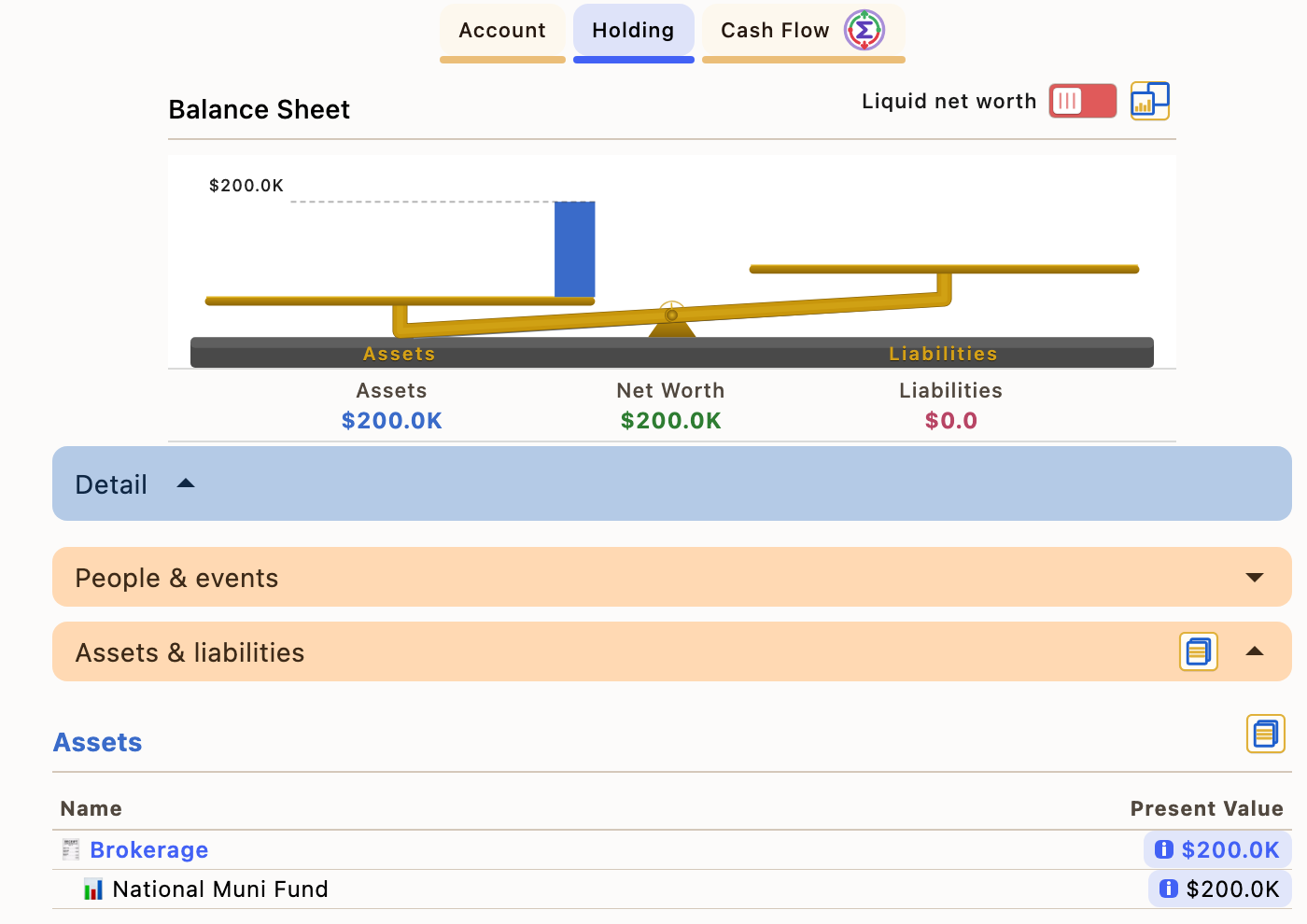
Bird's Eye with Holding picked. Under Assets, the Brokerage account has opened into the fund it holds — on Account that second row is not drawn, and the hoverOn a desktop or laptop, rest the pointer on a row, chip, or control to open a detail card — attributes, amounts, and often a small path chart. We put a lot of teaching detail in those cards on purpose. Hover needs a pointer, so it does not work on tablets or phones (tap may show a simpler view or nothing). Hold Alt if the tips become a nuisance — many product hovers stay closed while Alt is down so you can move the pointer freely.Full entry → below is impossible.
Now hover the bond holding under Brokerage. The card that comes up is the plan's own description of that instrument, and the yieldThe income an investment pays out — interest or dividends — as a percentage of its price. It is not total return: a holding can yield 4% and still lose value over the year. Chasing yield alone is how a portfolio quietly takes on risk it was not paid for.Full entry → rows are where the character lives:
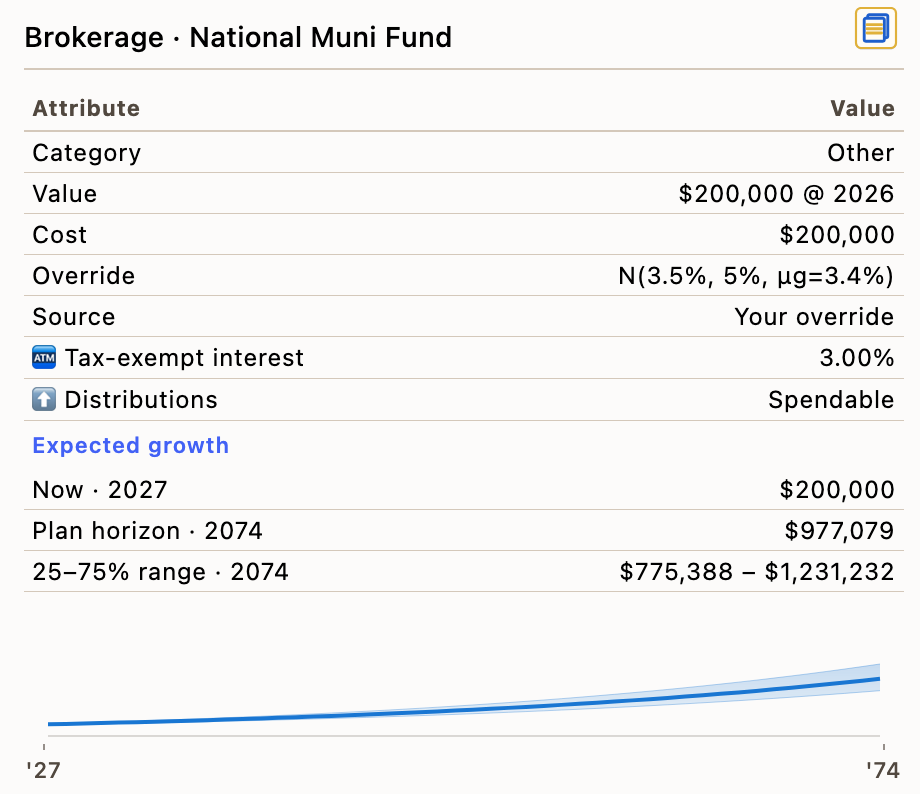
The National Muni Fund's canonical card. Tax-exempt interest 3% is the whole of what makes this plan a muni plan — the fund's name is just a name.
Now switch to the Treasury chip and hover the same row:
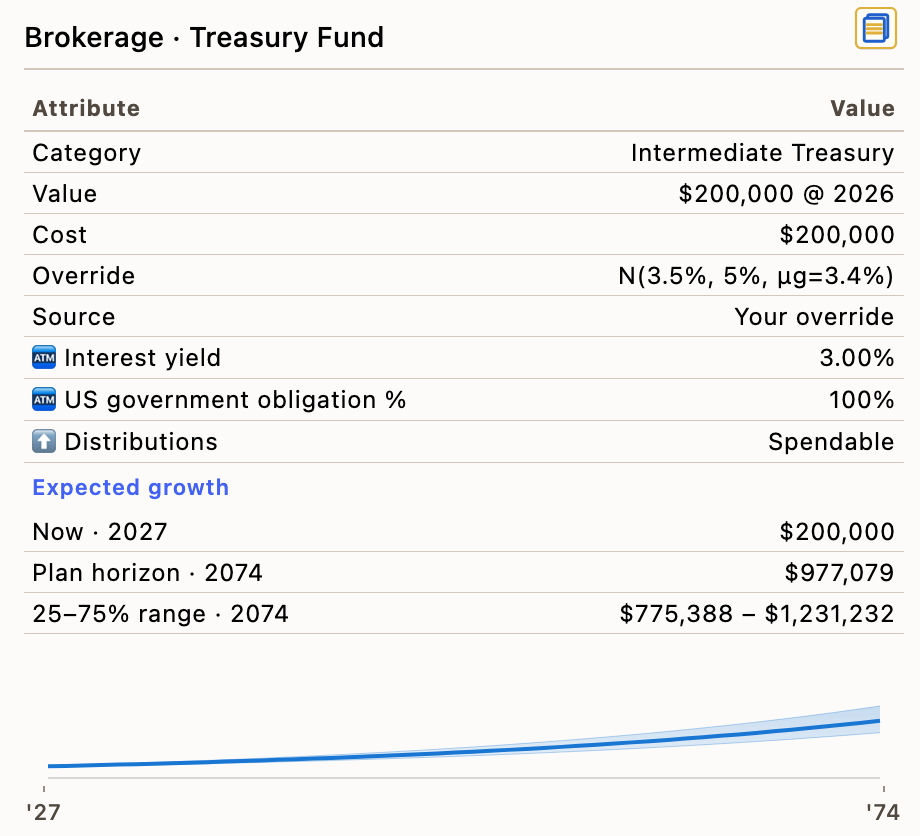
The Treasury holding. Same $200K, same pinned N(3.5%, 5%) — and a completely different pair of yield rows.
Tax-exempt interest is gone. Interest yield is 3%, and US government obligation % is 100% —
which no line in the plan file states. It comes from the instrument's growth category
(Intermediate Treasury), and it is the entire mechanism behind the state subtraction you are about to read
on the tax statement.
The Corporate chip is the third case, and it is defined by what is missing. Its card carries
Long-term corporate bonds, the same Interest yield 3% — and no US government obligation row at all. A
corporate bond has no federal-obligation slice, so the card does not offer one: nothing here is
subtracted by any state.
Read the three side by side and the whole lesson is four rows:
| Card row | National muni | Treasury | Corporate |
|---|---|---|---|
| Category | Other | Intermediate Treasury | Long-term corporate bonds |
| Tax-exempt interest | 3% | — | — |
| Interest yield | — | 3% | 3% |
| US government obligation % | — | 100% | (no such row) |
Every other row on all three cards — Value, Cost, Override, Source, and the whole Expected
growth block down to $613K – $973K at 2074 — is identical. That is the controlled comparison:
the only things that move are the two yield rows.
Desktop app only
On the dossier, open the holding and the fund or stock yields section. Two fields do the work:
- Tax-exempt interest — municipal yield. Federally excluded; California adds it back.
- Interest yield plus US government obligation % — taxable interest, of which that percentage is Treasuries (subtracted on the state return). Treasury and TIPSTreasury Inflation-Protected Securities — government bonds whose principal rises with inflation, so the return is stated in real terms. Like other Treasuries, the interest is exempt from state income tax.Full entry → growth categories default to 100%. A total-bond fund is some other percentage; you set it.
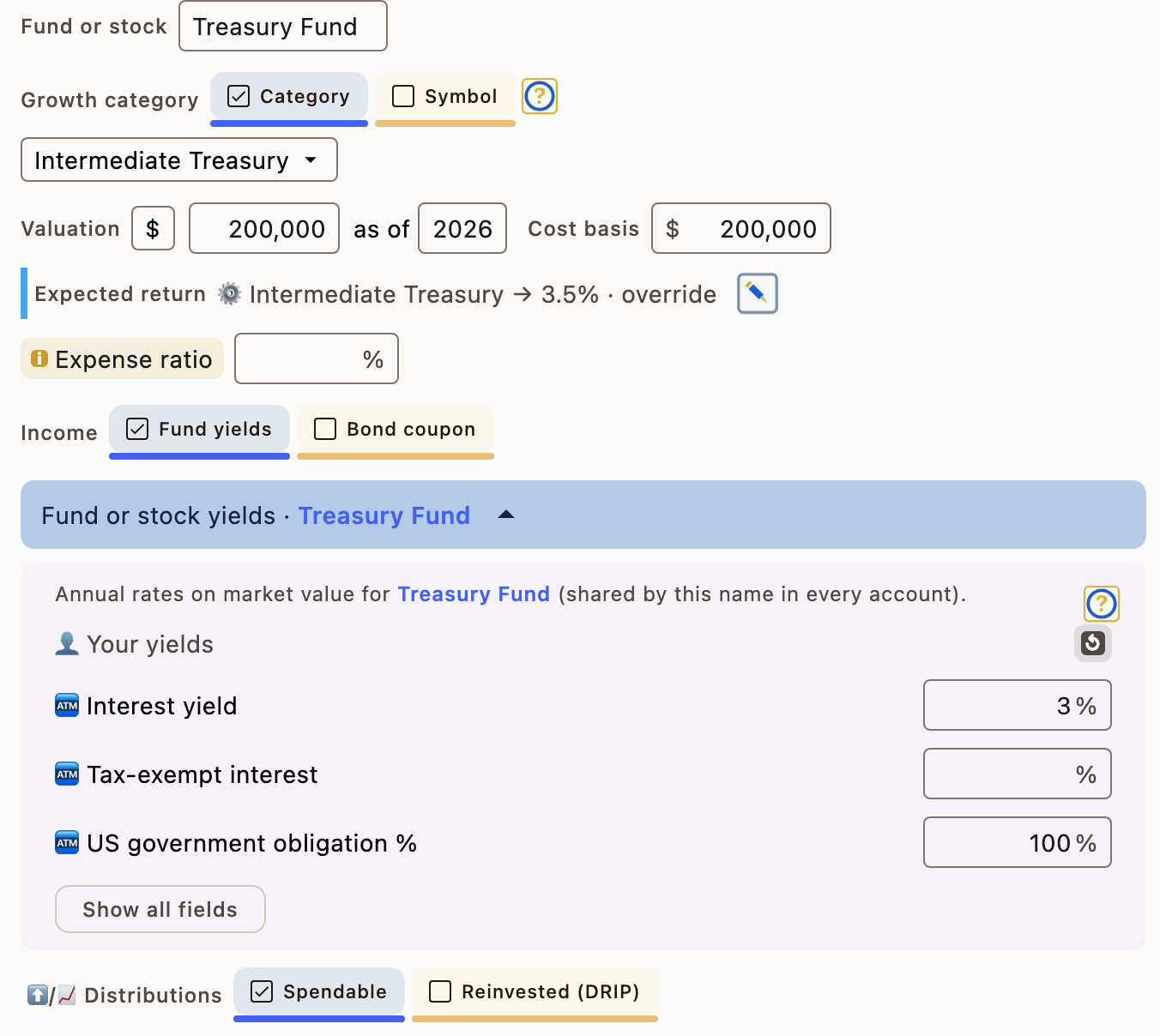
The Treasury Fund editor on Treasury, with yields open. Interest yield is 3%, and US government obligation % is 100% because the growth category is intermediate Treasury.
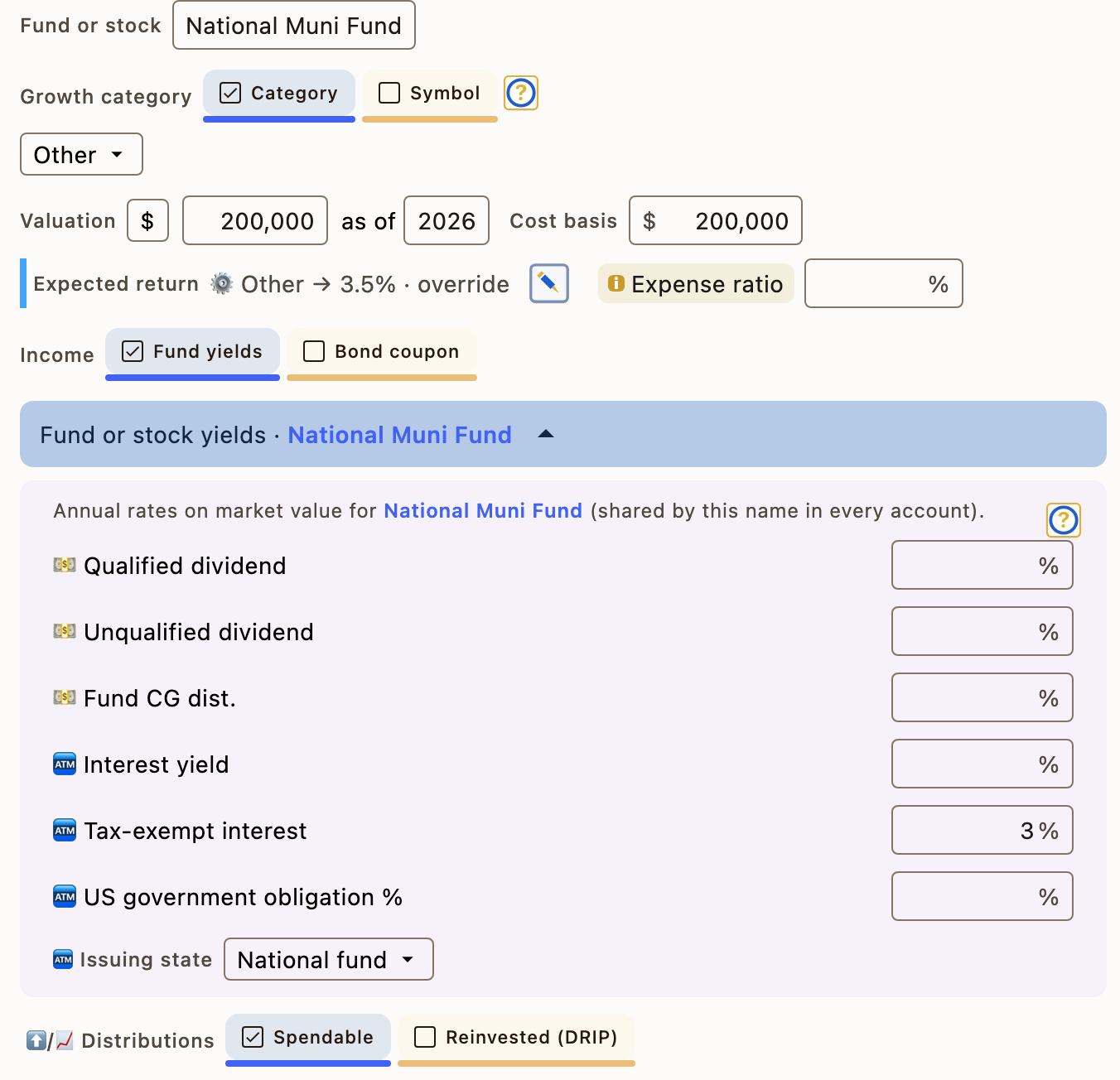
The National Muni Fund editor on National muni. Tax-exempt interest is 3%, and the taxable interest fields are empty.
Note the panel header: shared by this name in every account. Yields hang off the instrument name, so two accounts holding the same fund cannot disagree about what it pays.
The National muni plan has a 3% tax-exempt yield and no taxable interest. Treasury has a 3% taxable yield on an intermediate-Treasury growth category. Corporate has the same 3% taxable yield on a corporate-bondDebt issued by a company. The plain case against which the other two are special: its interest is ordinary income federally and in the state base — no exclusion, no subtraction.Full entry → category, so none of it is subtracted.
Authoring is desktop-only because the canvas beside this lesson is read-only for structure. What the fields do you can read on the canvas card above.
 ForecasterA main-rail area with two jobs: (1) run the plan year by year and inspect Forecast Detail, and (2) Simulation Summary — many paths summarized into something like a probability of success. → tax statement (Taxes chip). Pick a year with wages running — 2027 on
these plans is enough (the first forecast year).
National muni
Live plan: National muni
On the federal statement, Modified AGI (MAGI) sits above Adjusted gross income by the muni interest (~$6k). AGI itself does not include it. That is the MAGI add-back the IRMAA and NIIT lessons assume is usually zero.
On the California statement, Municipal bond interest added back is a positive adjustment.
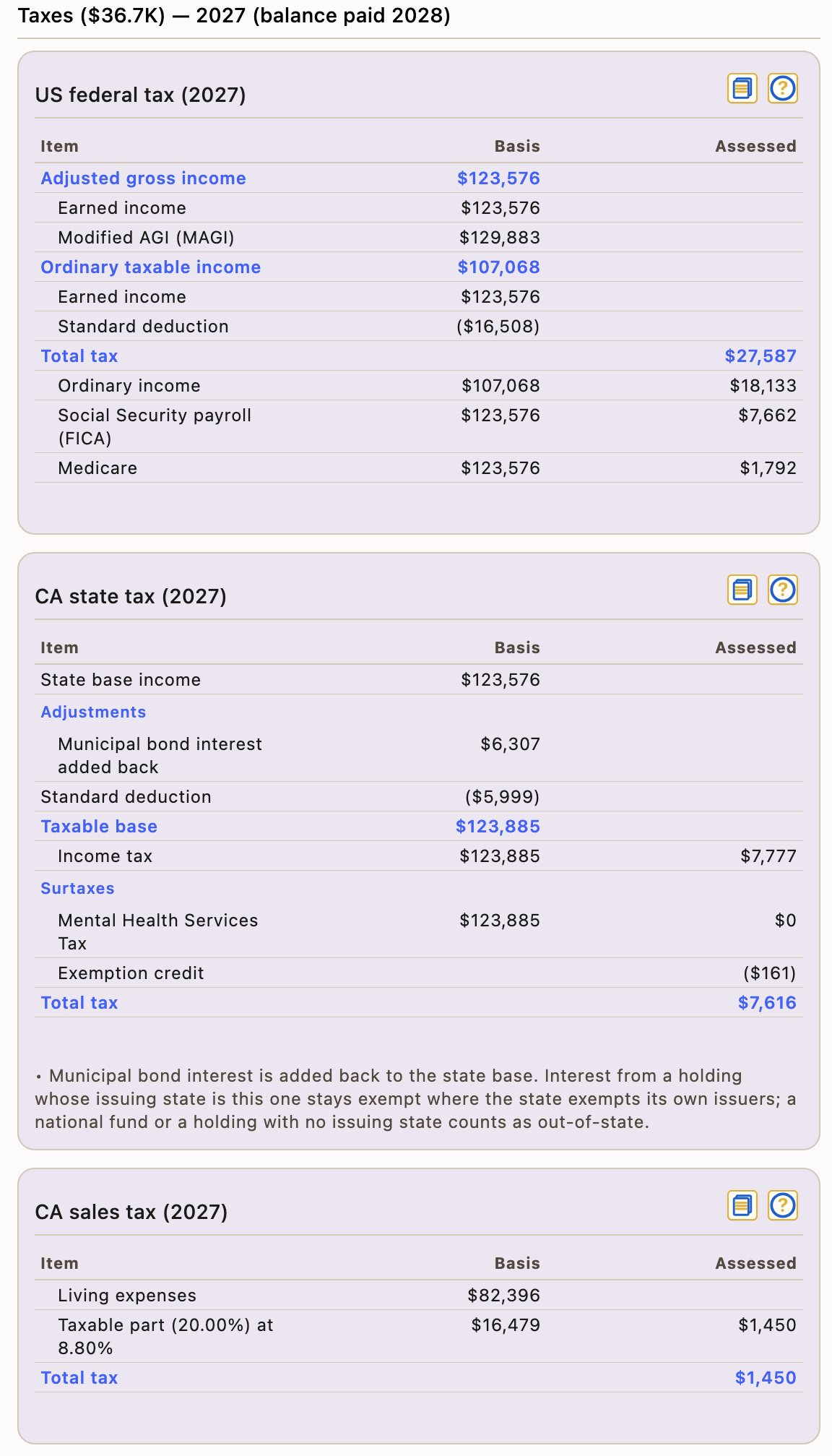
Tax statements, 2027, National muni plan. Federal MAGI is above AGI; California adds the muni interest back. Match the row labels, not the exact dollars.
Treasury
Live plan: Treasury
Federal AGI includes the interest — Treasuries are not a federal exclusion. MAGI equals AGI. California shows US Treasury interest subtracted. The federal bill is higher than on the muni plan; the state bill is not.
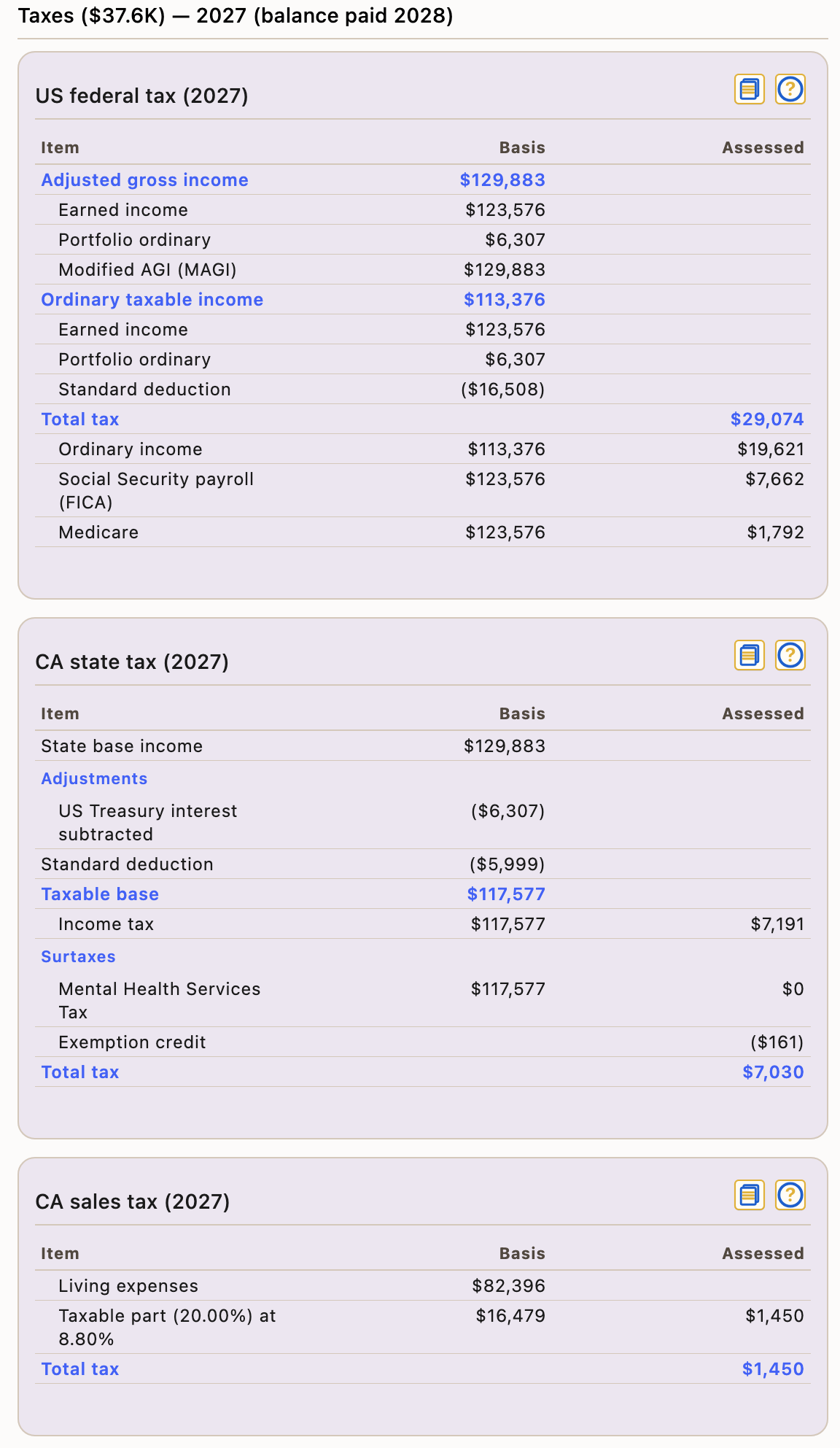
The same household holding the Treasury instead. MAGI equals AGI, and California subtracts the Treasury interest.
Corporate (the control)
Live plan: Corporate
Ordinary taxable interest: in federal AGI, in MAGI, and in the California base. No add-back, no subtraction. This is what a corporate bond fund — and the taxable slice of a total-bond fund — looks like.
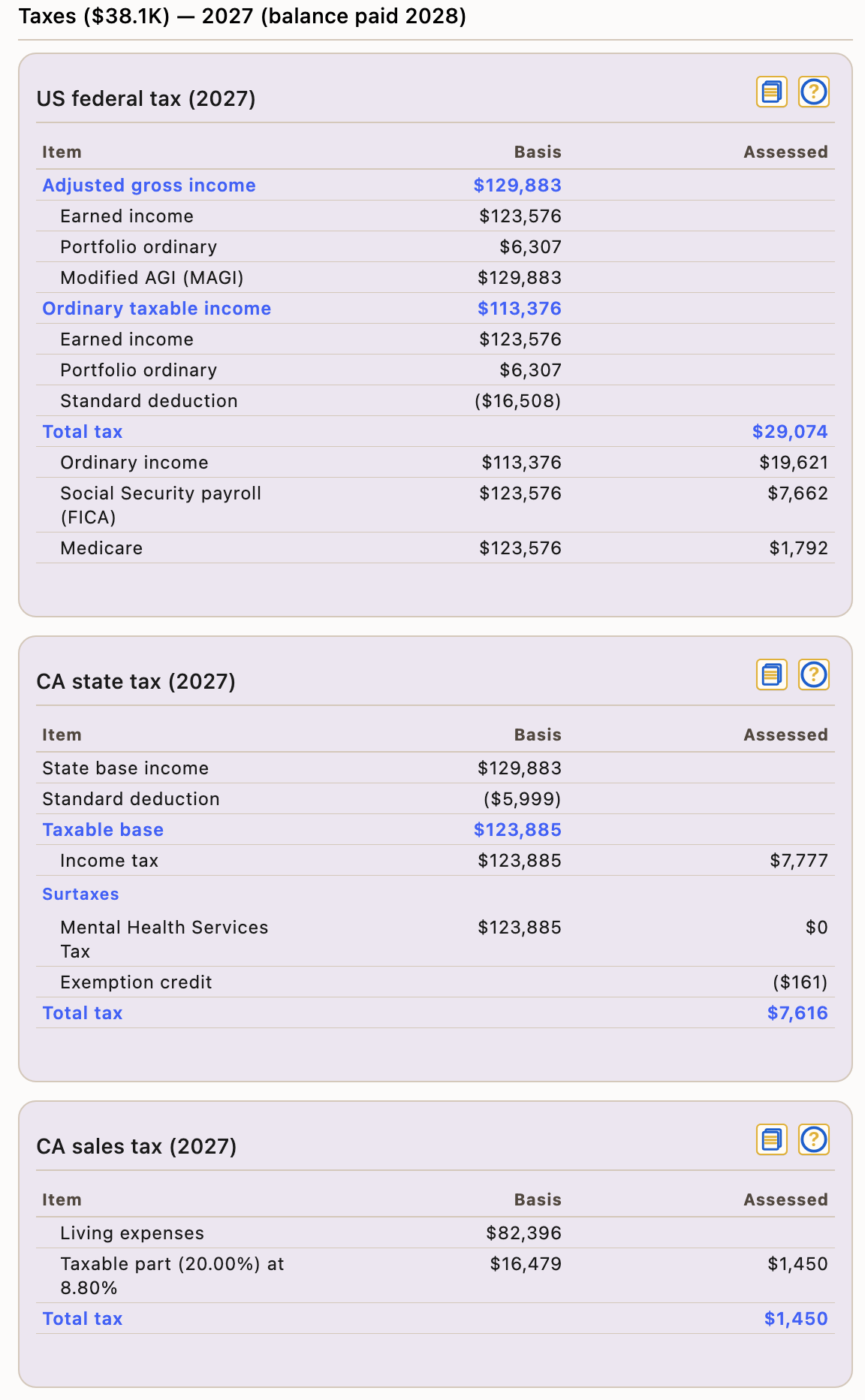
Corporate holding: neither special line. Interest is ordinary at both levels.
Municipal interest’s federal exclusion is account-sensitive. In a taxable brokerage it does what this lesson shows. Inside a traditional IRAIndividual Retirement Account — a retirement wrapper you open yourself rather than through an employer. It comes in traditional (pre-tax going in) and Roth (taxed going in) flavors, so naming the flavor matters more than the acronym does.Full entry → or 401(k) the exclusion never happens: withdrawals are ordinary income regardless of what the fund held. Putting munis in tax-deferredTax postponed, not avoided. Growth compounds without a yearly tax drag, and the bill arrives when the money comes out — which is why a large tax-deferred balance and a required withdrawal age are the same conversation.Full entry → accounts throws away the one exclusion the industry name is pointing at.
Treasuries in taxable get the state subtraction. In a 401(k) that subtraction never comes up — the state is taxing the withdrawal, not the coupon.
The live plans keep the holding in taxable on purpose. For the account-type contrast see Sheltering money.
The same municipal dollars that skip Form 1040 still feed:
- IRMAA (Medicare premiumWhat you pay for coverage — a monthly insurance or Medicare cost — and not a bonus or a prize. Confusingly, the same word means "above face value" when applied to a bond. In a plan it is nearly always the insurance sense: a recurring outflow that rises with age and, past a threshold, with income.Full entry → steps, from MAGI two years prior)
- NIIT (3.8% on net investment income above a MAGI threshold)
- Taxable Social Security (provisional incomeThe test income that decides how much of a Social Security benefit is taxed: adjusted gross income, plus tax-exempt interest, plus half of the benefit itself. It is not AGI and not MAGI, and the tax-exempt line is the trap — municipal-bond interest that owes nothing on its own can still pull more of a benefit into taxable income.Full entry → includes tax-exempt interest)
This page is the character of the interest. MAGI cliffs — IRMAA, NIIT, and friends is where those later costs show up as their own lines. On that sample MAGI usually equals AGI because there is no tax-exempt interest. Switch back here when you want MAGI to move without AGI.
- Private-activity municipal bonds that can appear on the federal AMT.
- Automatic federal-obligation percentages for a total-bond index — that percentage is an input (the 1099 / annual report figure), not a look-up.
| Lesson | Why |
|---|---|
| MAGI cliffs — IRMAA, NIIT, and friends | The later costs MAGI drives, once you have seen MAGI diverge from AGI |
| Sheltering money | Which account the holding sits in — taxable vs traditional vs Roth |
| Filling the cheap buckets | Ordinary brackets the Treasury and corporate coupons compete for |
Rebuild this plan by hand
The cards on the canvas show the accounts and cash flows. These are the settings that live outside any card, read from each plan this lesson opens, with the label each control carries in the app. A value marked default is one to leave alone.
| Setting | National muni | Treasury | Corporate |
|---|---|---|---|
| Household | |||
| Planning region | United States (default) | United States (default) | United States (default) |
| Alex (Primary) | |||
| birth year | 1985 | 1985 | 1985 |
| retirement age | 65 | 65 | 65 |
| death age | 90 | 90 | 90 |
| Taxes | |||
| Tax regime | United States | United States | United States |
| Filing status | Single | Single | Single |
| State of residence | California | California | California |
| First-year federal estimate | $28,000 | $28,000 | $28,000 |
| First-year state estimate | $10,000 | $10,000 | $10,000 |
| Strategy | |||
| Residual withdrawal strategy | Pro-rata (default) | Pro-rata (default) | Pro-rata (default) |
| Roth conversions | Off | Off | Off |
| Definition of success | Liquidity crises allowed (default) | Liquidity crises allowed (default) | Liquidity crises allowed (default) |
| Glide path target | None (default) | None (default) | None (default) |
| Advanced | |||
| Reporting inflation | Assumption set's rate (default) | Assumption set's rate (default) | Assumption set's rate (default) |
| Cost of capital | Assumption set's rate (default) | Assumption set's rate (default) | Assumption set's rate (default) |
| Growth assumptions | Growth overrides (default) | Growth overrides (default) | Growth overrides (default) |
| Currencies | Multiple currencies (default) | Multiple currencies (default) | Multiple currencies (default) |
| Default currency | USD (default) | USD (default) | USD (default) |
| Display currency | USD (default) | USD (default) | USD (default) |

Educational content — not advice. These lessons teach how Tutilis models a plan and how to read what it shows. The households, balances, and outcomes in them are invented for teaching. Nothing here is financial, investment, tax, or legal advice, or a recommendation to buy, sell, or hold anything. A model cannot know your circumstances — check anything you take from a lesson against your own situation, and against a qualified professional where it matters.