This lesson uses 3 sample plans — switch anytime; color matches the bar between the columns.
On the right now: Minimum required

▶ Watch Cogilis answer Jordan Whitfield (answered by Claude)
 Inheriting an IRA: the 10-year rule
The situation Jordan is 51, still working, and has just inherited a $500,000 traditional IRA from a father who was already taking required distributions. What does Jordan have to take out each year, what happens if the money waits until the deadline, and would it be different if the account were a Roth?
How to use this case study
New to the Learning Center, or want a map of the panels? Start with a tour: Reading Lesson (Getting Around) or Screencast Lesson (Getting Around) — both walk through Tutilis next to a live planThe running Tutilis product next to this lesson — navigation, Bird's Eye, Forecaster, tools, and more — loaded with a teaching sample. A dossier is the plan data; the live plan is the full product surface with a sample dossier already open so you can explore. On the web, teaching samples are not editable the way your own dossier will be in the full app.Full entry → (to the right on a desktop-width screen, or below when stacked on a tablet).
This page — Inheriting an IRA: the 10-year rule — can open more than one live sample planThe running Tutilis product next to this lesson — navigation, Bird's Eye, Forecaster, tools, and more — loaded with a teaching sample. A dossier is the plan data; the live plan is the full product surface with a sample dossier already open so you can explore. On the web, teaching samples are not editable the way your own dossier will be in the full app.Full entry → next to the text (to the right on a wide screen, or below on a tablet). Use the Live plans chips (and matching colored links in the prose) to switch without leaving this page; the colored bar near the plans shows which one is loaded. The walk-through stays in the text.
The live planThe running Tutilis product next to this lesson — navigation, Bird's Eye, Forecaster, tools, and more — loaded with a teaching sample. A dossier is the plan data; the live plan is the full product surface with a sample dossier already open so you can explore. On the web, teaching samples are not editable the way your own dossier will be in the full app.Full entry → next to this page — usually to the right on a wide screen, or below on a tablet — is Tutilis running a teaching sample: the same financial planning product available as a desktop application (early preview). A dossierYour full plan in Tutilis: the people in the household, what they own and owe, cash flows in and out, tax setting, and planning assumptions. One dossier is one complete situation as the product models it.Full entry → is the plan data; the live plan is the full product (navigation, Bird's Eye, Forecaster, tools) with a sample dossier already open so you can try the panels. See planned pricing. On the web, Learning Center samples are not editable the way your own dossier will be in the full app. Your own household goes in the Tutilis desktop app — the Learning Center front page has a short clip of that.
An IRAIndividual Retirement Account — a retirement wrapper you open yourself rather than through an employer. It comes in traditional (pre-tax going in) and Roth (taxed going in) flavors, so naming the flavor matters more than the acronym does.Full entry → you inherit is not the same account it was for the person who left it to you. It keeps its tax character, so a traditionalA retirement account where the tax is paid on the way out — not a description of an old-fashioned account. Money went in before income tax, grew untaxed, and is taxed as ordinary income when you take it out — traditional 401(k)s and IRAs work this way. The contrast is Roth (taxed going in, tax-free coming out) and taxable (brokerage, taxed as you go).Full entry → IRA still pays out ordinary incomeIncome taxed at the regular graduated rates — wages, interest, pension payments, and withdrawals from traditional retirement accounts. The point of the label is the contrast: long-term capital gains and qualified dividends get their own, usually lower, rate schedule.Full entry → and a RothA retirement account where you pay income tax on the money going in, and qualified withdrawals later come out tax-free — the mirror image of traditional. Named after the senator behind the law, so the word tells you nothing on its own. Plans care because Roth dollars do not add to taxable income later, which keeps them clear of income-driven cliffs.Full entry → still pays out tax-freeNo income tax due when the money comes out — the Roth promise, and the reason Roth dollars keep a withdrawal clear of income-driven thresholds. The word hides a condition: the withdrawal has to be qualified, which turns on age and how long the account has been open. It also hides a scope: municipal-bond interest is tax-free on the federal return yet still counts toward whether Social Security is taxed.Full entry → money. But the rules for when the money has to come out change completely at the owner's death. Most heirs must empty the account within ten years under the inherited IRA 10-year rule, some must also take a distribution every year along the way, and a few can stretch it over their whole life. This lesson follows one working heir through three versions of the same inheritance to show which rule applies, what waiting until the last year costs, and how an inherited Roth differs.
Jordan is 51, single, and still working, with wages of about $95,000 a year and spending of about $70,000. Jordan lives in Texas, which has no state income tax, so every tax figure in this lesson is federal. Jordan has a 401(k)An employer-sponsored retirement account, named after the section of tax law that created it — so the name says nothing about what it does. Contributions are usually payroll-deducted, often matched by the employer, and come in traditional (pre-tax) and Roth flavors. A 403(b) is the same idea for schools and nonprofits, a 457 for government workers.Full entry → of $250,000 and a brokerageAn ordinary taxable investment account — no special retirement wrapper, no contribution limit, and no withdrawal age rules. The trade-off is that dividends and realized gains are taxed as they happen rather than deferred. Often called the taxable bucket next to traditional and Roth.Full entry → account of $60,000, and plans to retire at 65.
Jordan's father died in 2025 at 79 and left Jordan his traditional IRA, worth $500,000. He had been taking his own required minimum distributionsRequired Minimum Distribution — once you reach an age set by statute, the law makes you withdraw a minimum amount each year from traditional retirement accounts, whether or not you need the money. The withdrawal is taxable income, so RMDs can push a household into a higher bracket or over a surcharge threshold. Roth accounts are generally not subject to them.Full entry → for years. Jordan is thirty years younger than his father and is neither disabled nor chronically ill, which turns out to matter a great deal.
The lesson opens three plans. Each one changes a single thing about the inherited account, so the difference between any two is caused by that one thing.
- Minimum required takes only what the rules require each year and leaves the rest until the deadline.
- Even over ten years is the same household and the same account. Each year it takes the balance divided by the years left before the deadline, so the account empties in roughly equal pieces.
- Inherited Roth is the same household with the same $500,000 inherited as a Roth IRA, left alone until the deadline.
Every number below is read from the forecast's most likely path, with the plan starting in 2027.
In the Learning Center there is no need to enter the IRA or mark it as inherited, because the three plans in this lesson already have it set up for you. If you are in Jordan's situation yourself and plan with the desktop app, enter the account as follows.
Desktop app only
Add an account and choose Inherited Traditional IRA or Inherited Roth IRA as its type, and set the account's owner to the person who inherited it. The account editor then asks for three facts: the year the original owner died, the year they were born, and how you inherited, such as "Other individual" for an adult child. A line under those fields names the rule that applies, for example "10-year rule with annual RMDs: a required distribution every year, and the rest by the end of 2035." When the account has a deadline, the editor also offers Withdrawals, with a choice of Minimum required or Even to deadline. An eligible beneficiary whose owner had not started RMDs also sees Distribute by, with a choice of Life expectancy or 10-year rule.
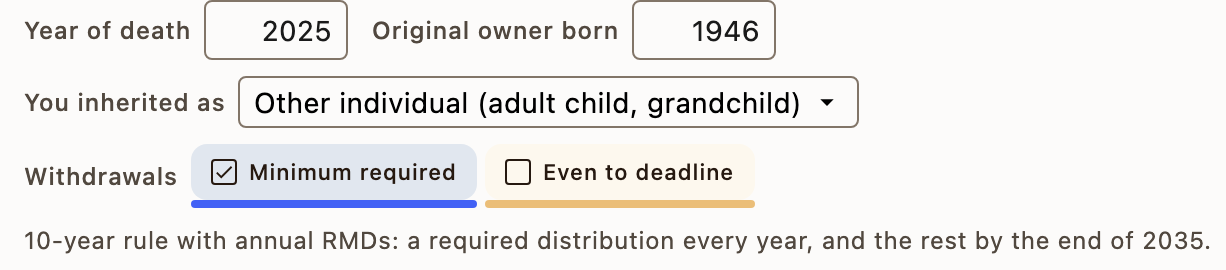
These are the fields on Jordan's inherited account in Minimum required.
Once the account is entered, each year's required distribution appears as a forced sale under Money Movements, and the detail panel for that sale shows the rule, the divisor and the deadline the forecast used. An inherited account never takes contributions, because the law does not allow them.
The rules sort heirs into three groups, and the group decides almost everything that follows. The IRS spells them out in Publication 590-B.
An eligible designated beneficiaryAn heir the law lets stretch an inherited retirement account over their own life expectancy instead of the 10-year rule: the owner's surviving spouse, the owner's child under 21, someone disabled or chronically ill, or anyone not more than ten years younger than the owner. Every other individual heir is a designated beneficiary under the 10-year rule.Full entry → is the owner's surviving spouse, the owner's own child under 21, someone who is disabled or chronically ill, or anyone who is not more than ten years younger than the owner. These heirs may stretch distributions over their own life expectancy, taking a modest amount every year for as long as they live.
A designated beneficiary who is not eligible is any other person. That is usually an adult child or a grandchild, and it is Jordan. Since the SECUREThe law (and its sequel) that moved several retirement-account rules: the age RMDs start, catch-up contributions, and how quickly an inherited account must be emptied. Its practical effect on a plan is that dates you may remember from a decade ago are no longer the dates.Full entry → Act, which took effect for deaths after 2019, these heirs must empty the account by December 31 of the tenth year after the death. That requirement is the 10-year ruleThe SECURE Act rule for most people who inherit a retirement account after 2019: the account must be empty by December 31 of the tenth year after the owner's death. When the owner had already started RMDs, the heir must also take a distribution every year along the way. An estate gets a 5-year version when the owner had not started RMDs.Full entry →. Jordan's father died in 2025, so Jordan's deadline is the end of 2035.
An estate or a trust that does not qualify is not a designated beneficiary at all. It gets the shortest schedule.
Which rule applies to an inherited IRA (deaths after 2019)
| Who inherited | Owner had not started RMDs, and every inherited Roth | Owner had started RMDs |
|---|---|---|
| Adult child or other individual | Empty by the end of year 10, nothing due before | A distribution every year, and the rest by the end of year 10 |
| Spouse, minor child, disabled or chronically ill, or not more than 10 years younger | Life-expectancy payments every year, or choose the 10-year rule | Life-expectancy payments every year |
| Estate or non-qualifying trust | Empty by the end of year 5 | Payments over the owner's remaining life expectancy |
A minor child takes life-expectancy payments until age 21 and then has ten more years to empty the account. A surviving spouse can also treat the IRA as their own, and most do; it then follows the ordinary rules for the spouse's own IRA.
The second fact that decides the rule is whether the owner had reached their required beginning dateApril 1 of the year after a retirement-account owner reaches RMD age, the deadline for their first required distribution. It matters most at death: an owner who died on or after it had started RMDs, so their heirs must keep taking a distribution every year; one who died before it had not.Full entry →. That date is April 1 of the year after the owner reached RMD age, which is 70½, 72, 73 or 75 depending on when they were born. An owner who died before that date had never been required to take anything. An owner who died after it was already drawing the account down every year.
Jordan's father was 79 and well past it. In that case the final regulations, which apply from 2025, require Jordan to keep the withdrawals going: a distribution every year in years one through nine, and everything that is left in year ten. Tutilis works this out from the father's birth year and year of death, so you never have to answer the question yourself.
The yearly amount uses the IRS Single Life Expectancy table. Jordan looks up his own life expectancy at his age in the year after the death, and then subtracts one each year instead of looking it up again. In 2027 the divisor is 35.2, and on Minimum required the required distribution is $15,087. That is about 3% of the account, so the annual requirement barely dents it. It rises slowly each year and is $23,315 in 2034.
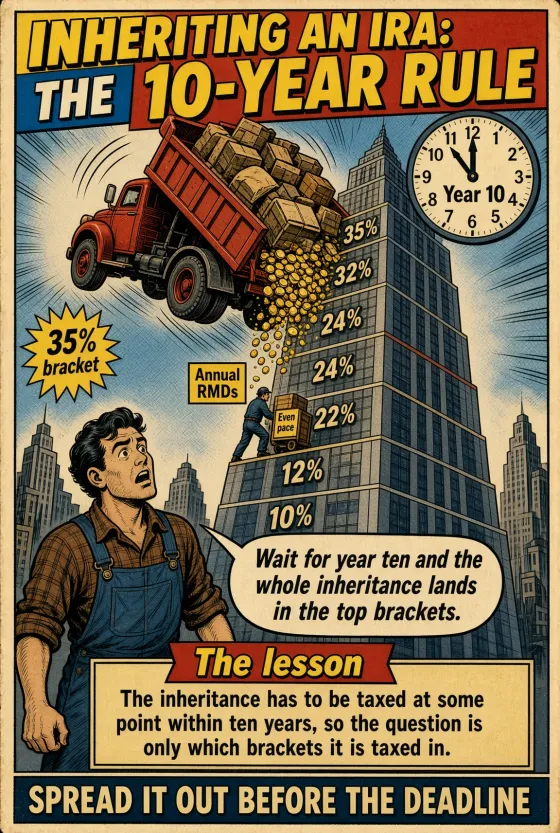
Taking only the minimum feels like the careful choice, because each year's distribution is small and the account keeps growing tax-deferredTax postponed, not avoided. Growth compounds without a yearly tax drag, and the bill arrives when the money comes out — which is why a large tax-deferred balance and a required withdrawal age are the same conversation.Full entry →. The cost arrives all at once. On Minimum required, the 2035 column of the Brackets chart carries the entire remaining balance. Jordan takes out $716,985 that year on top of his wages, and every dollar of it is ordinary income.
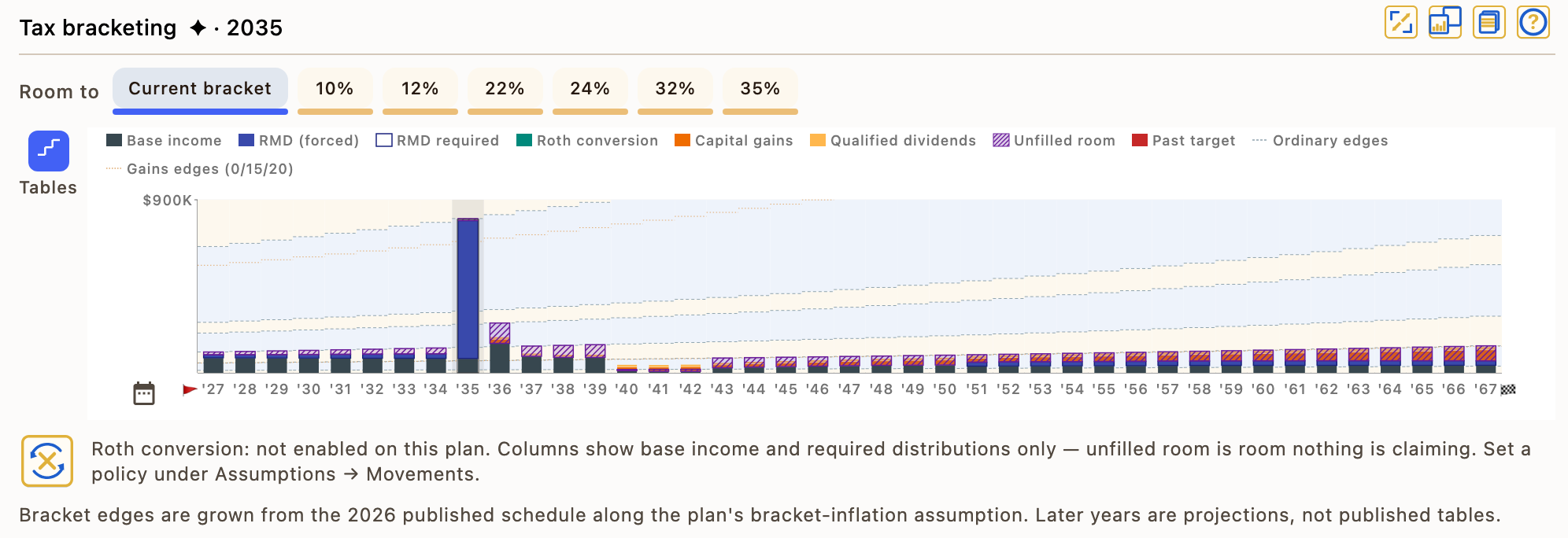
Jordan's top rate that year is 35%, against 22% in every year before it. The tax on that distribution is paid the following spring, so the forecast shows $247,076 of taxes paid in 2036, more than ten times a normal year. Most of the inheritance that came out in 2035 was taxed in the two highest bracketsA band of income taxed at a given rate. The common misreading is that entering a higher bracket taxes all your income at that rate — it does not. Only the dollars inside that band pay the higher rate, so a raise never leaves you with less after tax.Full entry → Jordan will ever see.
The rules set a floor and a deadline, but nothing stops Jordan from taking more than the floor in any year. Even over ten years takes the balance divided by the years left, which means $62,676 in 2027 and similar amounts after that. The required distribution is still part of each year's draw, so the floor is always met.
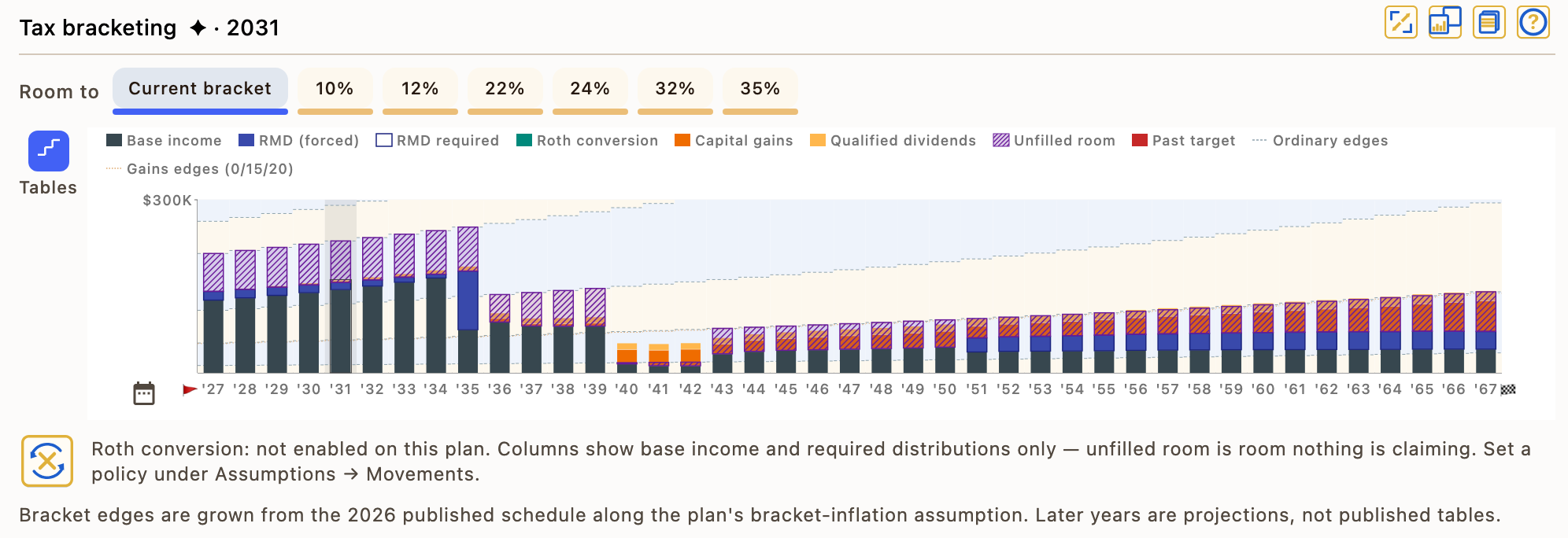
Each year now carries a slice of the inheritance instead of one year carrying all of it. Jordan's top rate is 24% in every year from 2027 through 2035 and never reaches the 32% or 35% brackets. Spreading the withdrawals costs more tax in the early years, because Jordan pays 24% on money that would otherwise have waited. But it saves far more at the end. The tax on each year's withdrawal is paid the following year, so those bills fall from 2028 through 2036. Over those years, Jordan pays about $92,000 less on Even over ten years than on Minimum required.
This is the same idea as filling the cheap brackets, which the lesson Filling the cheap buckets covers in depth. The inheritance has to be taxed at some point within ten years, so the question is only which brackets it is taxed in. An even pace is a simple rule rather than an optimized one. A year with unusually low income, such as a sabbatical or the first year of retirement, is a good year to take more.
Going deeper — what the Brackets chart counts as an RMD
On Even over ten years, the blue required-distribution layer of each column is only the amount the rules require. What the even pace takes above the requirement is shown as ordinary income alongside the wages, because it is a choice rather than an obligation. The total height of the column is the same either way. In 2035 the whole remaining balance is required, so that year's layer is all blue.
The third plan changes only the account type. Inherited Roth starts with the same $500,000, but as an inherited Roth IRAA Roth IRA held by someone who inherited it. Qualified withdrawals stay tax-free, but unlike the original owner's Roth it must be emptied on the beneficiary schedule. Because a Roth owner is always treated as dying before the required beginning date, most heirs owe nothing until the tenth year, which lets the money grow untouched until the deadline.Full entry →. Because a Roth owner always counts as having died before the required beginning date, Jordan owes no distribution from 2027 through 2034. The whole balance comes due in 2035.
That changes the best strategy completely. Distributions from an inherited Roth are generally tax-free, so there is no bracket to manage and no reason to spread them out. Leaving the account alone lets it grow tax-free for the full ten years. By 2035 it has grown to $892,269, and Jordan moves nearly all of it into the brokerage account without adding a dollar to taxable incomeWhat the rates are finally applied to — income after adjustments and deductions, not what you earned. It sits at the bottom of the page: gross income, then AGI, then this. Most people's taxable income is meaningfully smaller than their pay, which is why a bracket alone never tells you the tax.Full entry →. His top rate stays at 22% throughout.
The tax-free treatment depends on the Roth having been open for five years, counted from the original owner's first contribution rather than from the death. Nearly every inherited Roth clears that bar. If it does not, only the earnings are taxable until the five years are up, and contributions still come out tax-free first.
When the SECURE Act passed, most people read the 10-year rule as a deadline and nothing more. In February 2022 the IRS proposed that heirs like Jordan, whose parent had already started RMDs, must also take a distribution every year inside the ten. Many heirs had already skipped those distributions. The IRS responded by waiving the 25% penalty on them, one year at a time, for 2021, 2022, 2023 and 2024.
The final regulations made the annual distributions mandatory from 2025. Two details matter for anyone who inherited in those years. The waived years never have to be made up. And the waiver did not move the deadline, so an heir whose parent died in 2020 still has to empty the account by the end of 2030, with annual distributions in the years before it.
One more group keeps the old rules entirely. An heir whose owner died before 2020 can still stretch distributions over their own life expectancy, even as an adult child. That includes inherited Roth IRAs, which then do have a required distribution every year. It is tax-free, but it is required, and a planning tool that ignores it will overstate how long the money can stay sheltered.
The forecast models the rules for the years it covers. A few things it does not model are worth knowing.
- The year-of-death distribution. If the owner died after starting RMDs and had not yet taken that year's distribution, the heir must take it. The forecast starts after the year of death, so it does not include this one payment.
- Deaths early in the year after RMD age. Tutilis decides whether the owner had reached the required beginning date from birth and death years. An owner who died between January 1 and March 31 of the year after reaching RMD age had not reached it, but is counted as if they had.
- Trusts named as beneficiaries. A trust that qualifies as "see-through" can pass its beneficiaries' rules through. That analysis is not modeled.
- Inherited 401(k) and other workplace plans. The same rules apply to them, but the account types here are IRAs. Most heirs roll a workplace plan into an inherited IRA anyway.
- The best possible schedule. An even pace is one sensible rule. The cheapest schedule for a real household depends on every other income in those years, and Tutilis does not search for it.
An inherited IRA comes with a deadline, and for most adult children that deadline is ten years. Whether there is also a distribution every year depends on whether the owner had started RMDs. Tutilis works that out from two years you already know. For an inherited traditional IRAA traditional IRA held by someone who inherited it. It keeps its tax character, so every withdrawal is ordinary income, but the owner's lifetime RMD rules stop at the death and the beneficiary rules take over: for most adult children, the account must be empty by the end of the tenth year after the death. No one may contribute to it, and withdrawals carry no 10% early-withdrawal tax at any age.Full entry →, the deadline is a tax decision in disguise. Waiting until the last year piles the whole balance into the highest brackets, and spreading it out keeps every year in the same bracket. For an inherited Roth the opposite holds, and waiting is usually best because the money grows tax-free and comes out tax-free.
Works cited — the publications behind the rules
- Internal Revenue Service, Publication 590-B: Distributions from Individual Retirement Arrangements (IRAs), for use in preparing 2025 returns. Chapter 1, "IRA Beneficiaries"; chapter 2, "Distributions After Owner's Death"; Appendix B, Table I. https://www.irs.gov/publications/p590b
- Internal Revenue Service, Notice 2024-35: Certain Required Minimum Distributions for 2024. https://www.irs.gov/pub/irs-drop/n-24-35.pdf
- Treasury Decision 10001, Required Minimum Distributions, final regulations under section 401(a)(9), Internal Revenue Bulletin 2024-33. https://www.irs.gov/irb/2024-33_IRB
Rebuild this plan by hand
The cards on the canvas show the accounts and cash flows. These are the settings that live outside any card, read from each plan this lesson opens, with the label each control carries in the app. A value marked default is one to leave alone.
| Setting | Minimum required | Even over ten years | Inherited Roth |
|---|---|---|---|
| Household | |||
| Planning region | United States (default) | United States (default) | United States (default) |
| Jordan (Primary) | |||
| birth year | 1976 | 1976 | 1976 |
| retirement age | 65 | 65 | 65 |
| death age | 92 | 92 | 92 |
| Taxes | |||
| Tax regime | United States | United States | United States |
| Filing status | Single | Single | Single |
| State of residence | Texas | Texas | Texas |
| First-year federal estimate | — | — | — |
| First-year state estimate | — | — | — |
| Strategy | |||
| Residual withdrawal strategy | Pro-rata (default) | Pro-rata (default) | Pro-rata (default) |
| Roth conversions | Off | Off | Off |
| Definition of success | Liquidity crises allowed (default) | Liquidity crises allowed (default) | Liquidity crises allowed (default) |
| Glide path target | None (default) | None (default) | None (default) |
| Advanced | |||
| Reporting inflation | Assumption set's rate (default) | Assumption set's rate (default) | Assumption set's rate (default) |
| Cost of capital | Assumption set's rate (default) | Assumption set's rate (default) | Assumption set's rate (default) |
| Growth assumptions | Growth overrides (default) | Growth overrides (default) | Growth overrides (default) |
| Currencies | Multiple currencies (default) | Multiple currencies (default) | Multiple currencies (default) |
| Default currency | USD (default) | USD (default) | USD (default) |
| Display currency | USD (default) | USD (default) | USD (default) |

Educational content — not advice. These lessons teach how Tutilis models a plan and how to read what it shows. The households, balances, and outcomes in them are invented for teaching. Nothing here is financial, investment, tax, or legal advice, or a recommendation to buy, sell, or hold anything. A model cannot know your circumstances — check anything you take from a lesson against your own situation, and against a qualified professional where it matters.