This lesson uses 2 sample plans — switch anytime; color matches the bar between the columns.
On the right now: The Vances, $27 million

▶ Watch Cogilis answer Helen and Arturo Vance (answered by Claude)
 Where to retire on $27 million
The situation Helen and Arturo Vance live in Massachusetts with about $27 million and are weighing a move to Florida, New Hampshire, Washington or Pennsylvania. Their neighbors, Joan and Ray, have about $1.5 million and are asking the same question. Should both couples make the same move?
How to use this case study
New to the Learning Center, or want a map of the panels? Start with a tour: Reading Lesson (Getting Around) or Screencast Lesson (Getting Around) — both walk through Tutilis next to a live planThe running Tutilis product next to this lesson — navigation, Bird's Eye, Forecaster, tools, and more — loaded with a teaching sample. A dossier is the plan data; the live plan is the full product surface with a sample dossier already open so you can explore. On the web, teaching samples are not editable the way your own dossier will be in the full app.Full entry → (to the right on a desktop-width screen, or below when stacked on a tablet).
This page — Where to retire on $27 million — can open more than one live sample planThe running Tutilis product next to this lesson — navigation, Bird's Eye, Forecaster, tools, and more — loaded with a teaching sample. A dossier is the plan data; the live plan is the full product surface with a sample dossier already open so you can explore. On the web, teaching samples are not editable the way your own dossier will be in the full app.Full entry → next to the text (to the right on a wide screen, or below on a tablet). Use the Live plans chips (and matching colored links in the prose) to switch without leaving this page; the colored bar near the plans shows which one is loaded. The walk-through stays in the text.
The live planThe running Tutilis product next to this lesson — navigation, Bird's Eye, Forecaster, tools, and more — loaded with a teaching sample. A dossier is the plan data; the live plan is the full product surface with a sample dossier already open so you can explore. On the web, teaching samples are not editable the way your own dossier will be in the full app.Full entry → next to this page — usually to the right on a wide screen, or below on a tablet — is Tutilis running a teaching sample: the same financial planning product available as a desktop application (early preview). A dossierYour full plan in Tutilis: the people in the household, what they own and owe, cash flows in and out, tax setting, and planning assumptions. One dossier is one complete situation as the product models it.Full entry → is the plan data; the live plan is the full product (navigation, Bird's Eye, Forecaster, tools) with a sample dossier already open so you can try the panels. See planned pricing. On the web, Learning Center samples are not editable the way your own dossier will be in the full app. Your own household goes in the Tutilis desktop app — the Learning Center front page has a short clip of that.
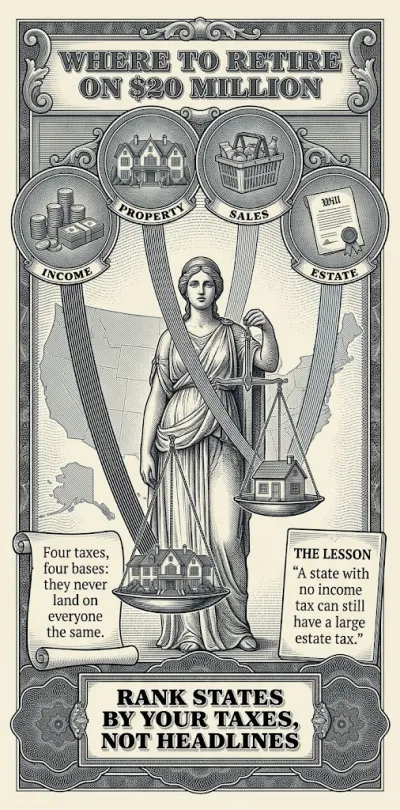
Lists of the best states to retire in usually rank states by one number, most often the income tax rate. A state's taxes are not one number. An income tax grows with what you earn, a property taxA yearly tax on what real estate is worth, set by the state and the local governments where it sits. It is owed whether or not the property earns anything, and rates differ several times over from one state to the next, so it is one of the larger costs a move can change. In Tutilis a home or other real asset takes its rate from its state and locality, or from a rate you set.Full entry → with the house, a sales tax with what you spend, and an estate taxA tax on what a person owns at death, paid by the estate before heirs receive it. The federal tax applies only above a large exemption ($15 million per person in 2026) at a top rate of 40%. About a dozen states and the District of Columbia have their own estate tax, most with far lower exemptions.Full entry → with what you leave behind. Two households in the same town can pay those four taxes in very different proportions, so the same move can be a good idea for one of them and a costly one for the other. This lesson runs a $27 million couple and their $1.5 million neighbors through Region and finds that the state ranking flips between them.
The Vances are the couple from When bracket-filling stops working, now with their home state set. Helen is 66 and Arturo is 64, they live in Massachusetts in a $3.5 million house, and they have about $27 million in all, most of it in a taxable brokerageAn ordinary taxable investment account — no special retirement wrapper, no contribution limit, and no withdrawal age rules. The trade-off is that dividends and realized gains are taxed as they happen rather than deferred. Often called the taxable bucket next to traditional and Roth.Full entry → account that holds stock index funds and $10 million of TreasuriesDebt issued by the US federal government. The mirror image of a municipal bond: the interest is federally taxable, and states are barred from taxing it — so it is subtracted on a state return rather than added back.Full entry →. They spend about $420,000 a year.
The neighbors, Joan and Ray, are the same ages and live in the same town in an $850,000 house. They have about $1.5 million, most of it in a traditionalA retirement account where the tax is paid on the way out — not a description of an old-fashioned account. Money went in before income tax, grew untaxed, and is taxed as ordinary income when you take it out — traditional 401(k)s and IRAs work this way. The contrast is Roth (taxed going in, tax-free coming out) and taxable (brokerage, taxed as you go).Full entry → IRAIndividual Retirement Account — a retirement wrapper you open yourself rather than through an employer. It comes in traditional (pre-tax going in) and Roth (taxed going in) flavors, so naming the flavor matters more than the acronym does.Full entry →, they spend about $92,000 a year, and Social SecuritySocial Security — the US government retirement and disability benefit, funded by payroll tax while you work and paid as a monthly check once you claim. How much you get depends on your earnings history (your PIA) and the age you claim relative to full retirement age.Full entry → pays a large share of it.
Both couples are thinking about Florida, New Hampshire, Pennsylvania and Washington. Each plan leaves its estate to two children.
Each state tax is charged on something different, and that is why one ranking cannot fit everyone.
| Tax | Charged on | Who it hits hardest |
|---|---|---|
| Income tax | What comes in each year: wages, IRA withdrawals, interest, dividends, gains | Households with large taxable income. Many states exempt Social Security and some exempt retirement-plan withdrawals, but few exempt a portfolio's income. |
| Property tax | The value of the house, every year | Households whose house is a large share of what they own. |
| Sales tax | What is bought | Households that spend a large share of their income. |
| Estate or inheritance tax | What is left at death | Households with large estates. Most state estate taxes start far below the federal exemption. |
A couple whose wealth is mostly a house and an IRA meets the first three. A couple whose wealth is mostly an investment portfolio meets the first and the last, and the last can be the largest by far.
Open the tax statements for 2027 on the Vances and scroll to the Massachusetts section.
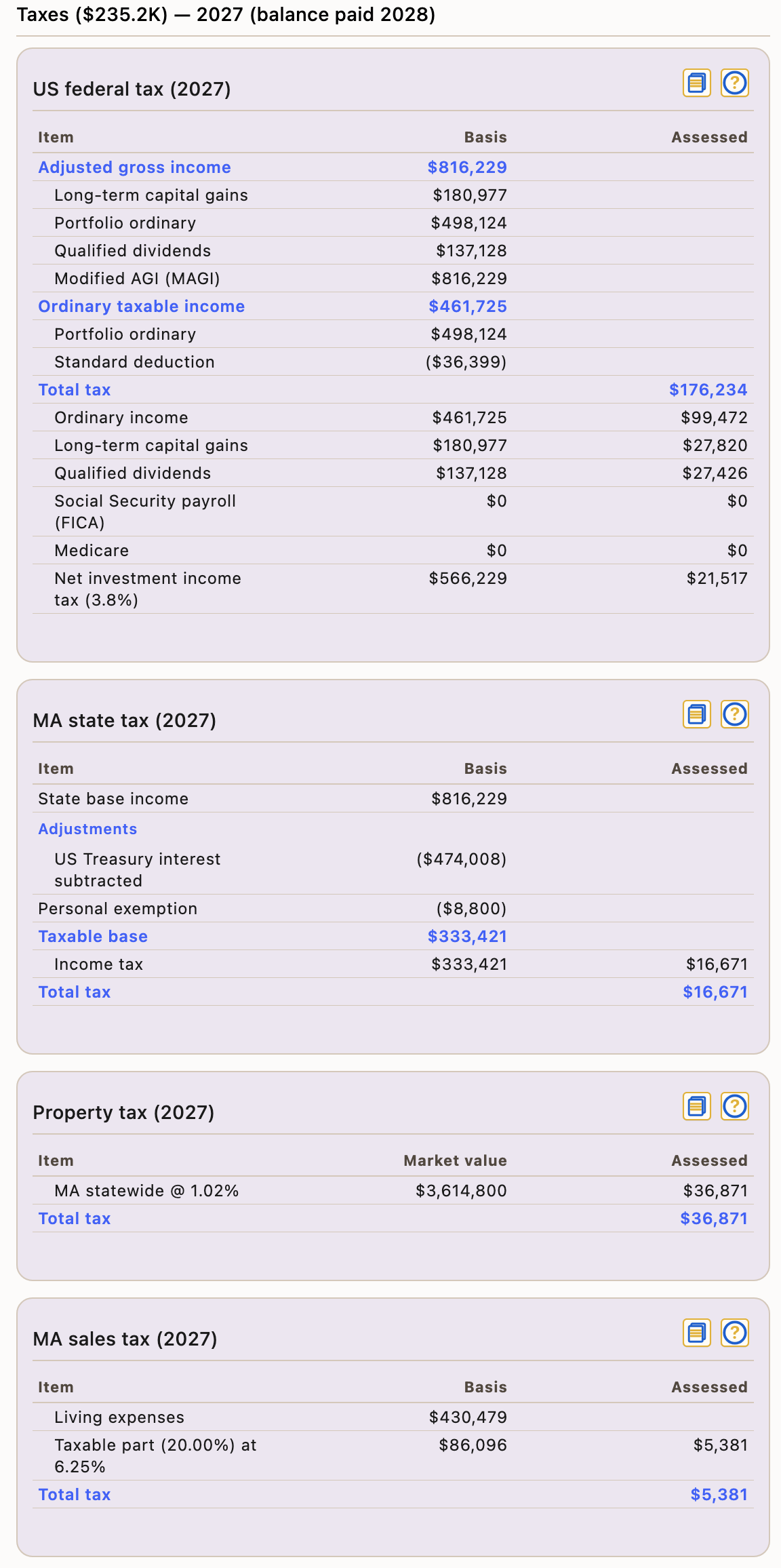
The Vances' 2027 tax statements. Massachusetts starts from about $816,000 of income, subtracts about $474,000 of Treasury interest, and taxes the rest at 5%, about $16,700.
Two things stand out. Their dividends and capital gains are taxed in full, at Massachusetts's flat 5%. Their Treasury interest is not taxed at all, because federal law bars states from taxing interest on federal bonds, so the state return subtracts it. A household whose bonds are Treasuries pays far less state income tax than its income suggests. Massachusetts also adds a 4% surtaxAn extra tax charged on top of the regular one, usually on income above a high threshold, such as Massachusetts' 4% on income over about $1 million. Unlike a Medicare premium surcharge, it is a tax rate and is computed on the return. Each one shows by name under Surtaxes on the state statement.Full entry → on income above about $1 million, which the Vances stay under because so much of their income is Treasury interest.
Now open the same section for the neighbors.
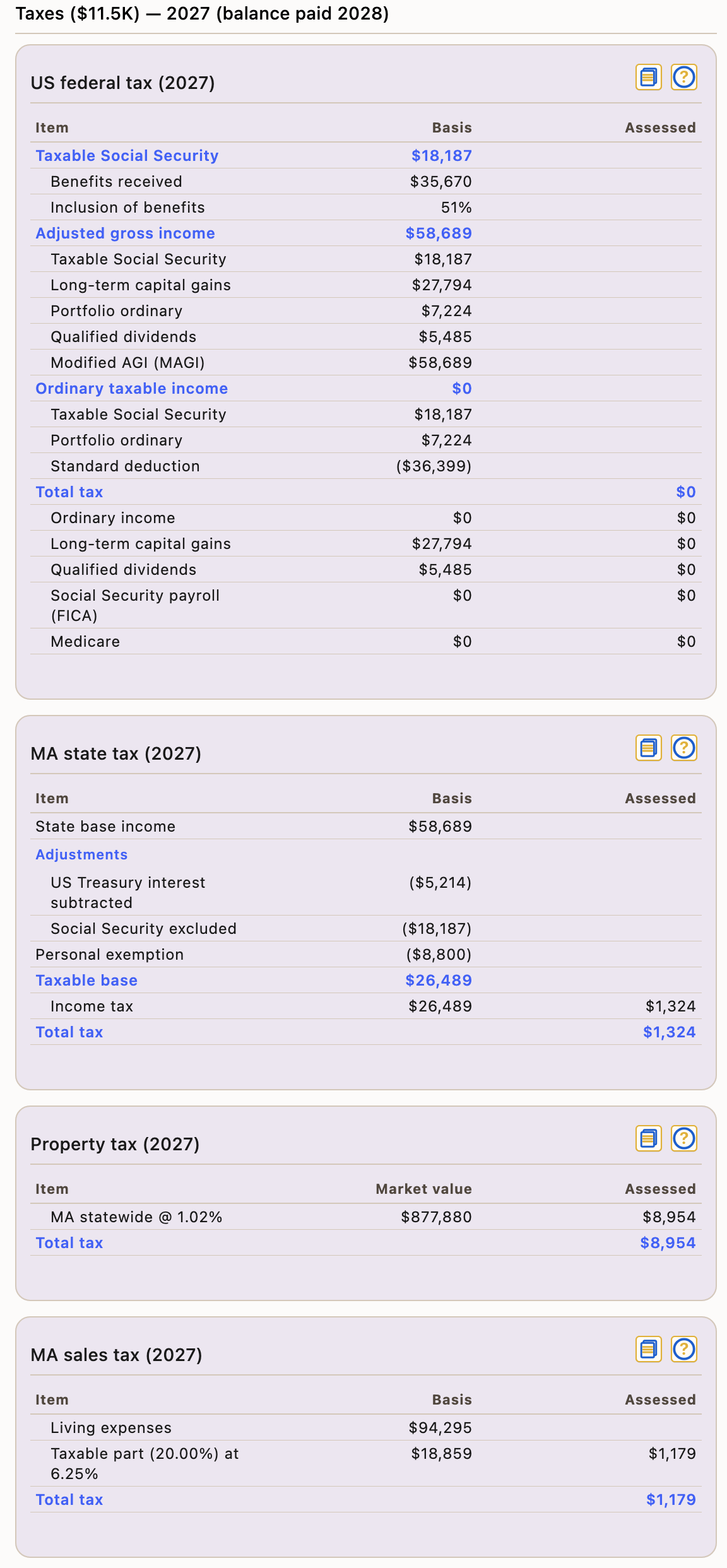
The neighbors' 2027 tax statements. Massachusetts excludes their Social Security, and after the exemption their state income tax is about $1,300. Their property tax is several times as large.
For the neighbors, the state income tax is a small bill. Their property tax, about $9,000, is about seven times larger.
Property tax follows the house wherever the household goes. Region's comparison table shows each state's average property tax rate beside its income tax. A move from Massachusetts, at about 1.0%, to New Hampshire, at about 1.6%, raises the property tax on the same house by more than half. Property tax, the silent killer follows that bill through a whole retirement.
Sales taxA tax on what is bought, charged at the register as a share of the price. Each state sets its own rate, most localities add their own, and many states exempt groceries; five states levy no statewide sales tax. In Tutilis it is charged on living expenses at the state rate plus the average local rate, on the fifth of spending a sales tax typically reaches, plus groceries where the state taxes them. A plan can set its own share and rate under Assumptions, Taxes.Full entry → is the third tax. Tutilis charges it on living expenses: the state rate plus the average local rate, on the fifth of spending a sales tax typically reaches, and on groceries too where the state taxes them. It appears on the tax statement as its own card and in the cash flow as its own line, and Region's comparison counts it. Region's state profile card shows each state's rate and whether groceries are exempt, and the map's Sales lens shades the states that levy one. Washington's combined rate is about 9.4%, New Hampshire has none, and Massachusetts, Florida and Pennsylvania sit between 6% and 7%. Sales tax falls on what is bought, so it weighs more on a household that spends most of its income than on one that spends a small share of it. For both couples here it is real money each year, and small beside the other taxes in this lesson.
Open Region on the Vances and select Florida, New Hampshire, Pennsylvania and Washington. Switch off the cost-of-living and wage adjustments, so each row differs from Massachusetts only in its taxes.
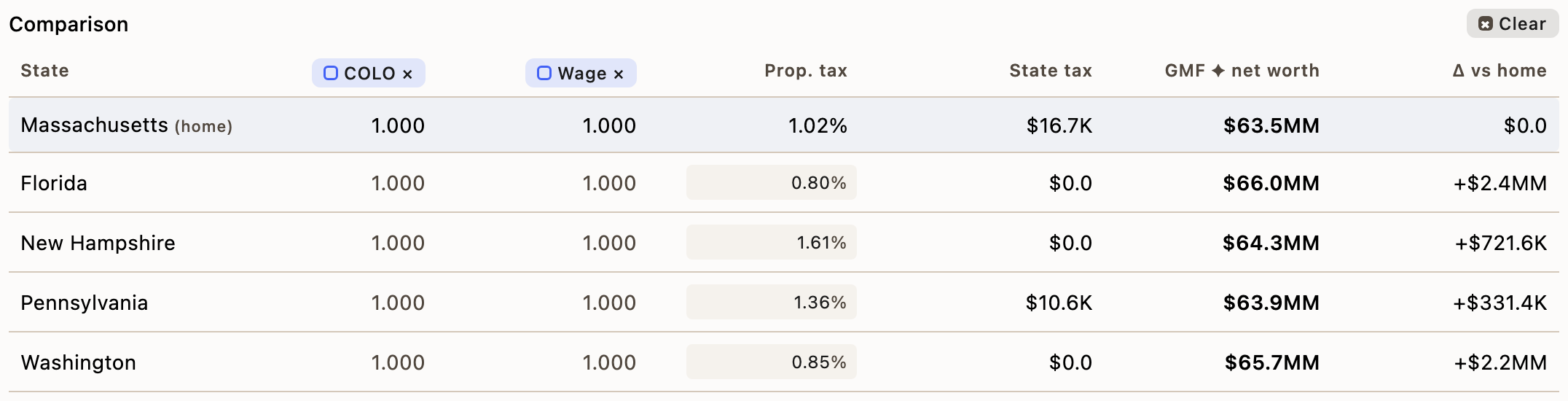
Region's comparison for the Vances with the adjustments off. Before any estate tax, Florida finishes about $2.4 million ahead of Massachusetts and Washington about $2.2 million ahead. New Hampshire finishes about $720,000 ahead and Pennsylvania about $330,000 ahead.
Read this way, Washington looks almost as good as Florida. It has no income tax on the Vances' income, since its only income tax is on capital gains above a high threshold, and its property tax is lower than Massachusetts's. Now turn on the Estate lens. The comparison gains a column, To heirs: each row's ending net worthEverything owned minus everything owed — the bottom line of the balance sheet. Worth remembering that it counts dollars, not spendable dollars: a traditional account and a Roth account of the same size are not the same net worth to live on, because one still owes tax.Full entry → after the federal estate tax and that state's own estate or inheritance taxA tax on what an heir receives, paid by the heir, at a rate that depends on how closely the heir was related to the person who died. There is no federal inheritance tax. A handful of states levy one, and most exempt a spouse; some also exempt children.Full entry →.
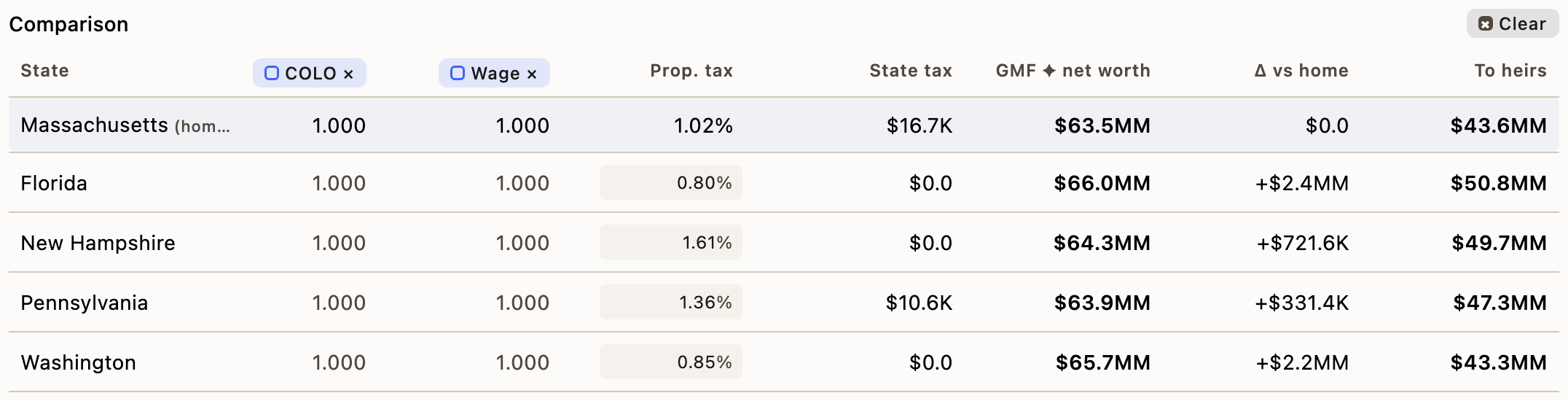
The same comparison with the Estate lens on. Florida leaves the heirs about $50.8 million, New Hampshire about $49.7 million, Pennsylvania about $47.3 million and Massachusetts about $43.6 million. Washington, second before the estate tax, falls to last at about $43.3 million, just behind Massachusetts.
The ranking changes completely.
- Florida and New Hampshire have no estate tax. The heirs lose only the federal tax, which applies above an exemption the couple shares through portabilityA surviving spouse's right to use the federal estate-tax exemption the first spouse to die did not use. It must be claimed on a timely federal estate-tax return, even when no tax is due. Most states with their own estate tax do not allow it.Full entry →.
- Pennsylvania has no estate tax, but it taxes what the children inherit at 4.5%.
- Massachusetts taxes estates above $2 million, less than a seventh of the federal exemption, and the heirs receive about $7 million less than they would in Florida.
- Washington taxes estates above $3 million at rates from 10% to 20%, a top rate only Hawaii matches. The state with no income tax on their income costs their heirs about $7.5 million more than Florida does, slightly more than staying in Massachusetts.
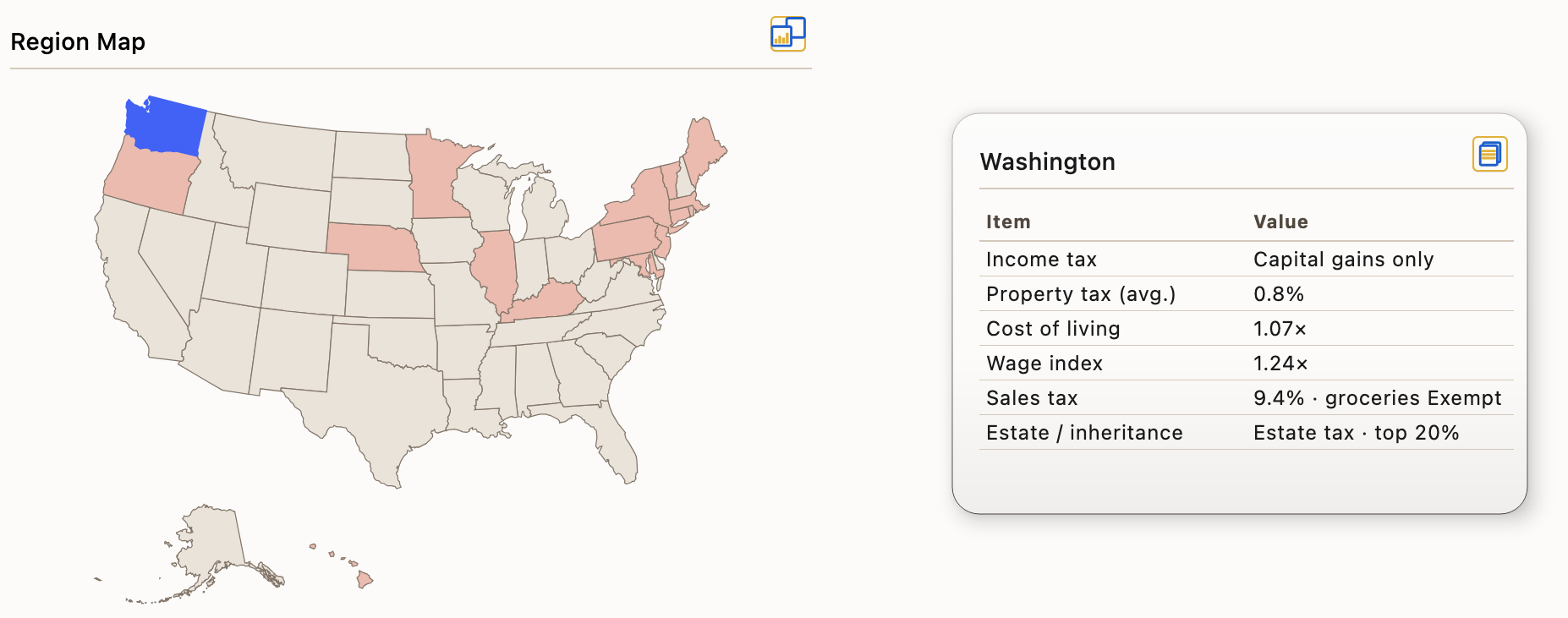
Region's map with the Estate lens on: the states that levy an estate or inheritance tax are shaded, and Washington's profile card shows an estate tax with a top rate of 20%.
A state's headline income tax can hide its largest tax. For a household at this level, the state's estate tax is often the deciding number, and it is the number least likely to appear in a ranking of places to retire.
Run the same comparison on the neighbors, with the Estate lens on.
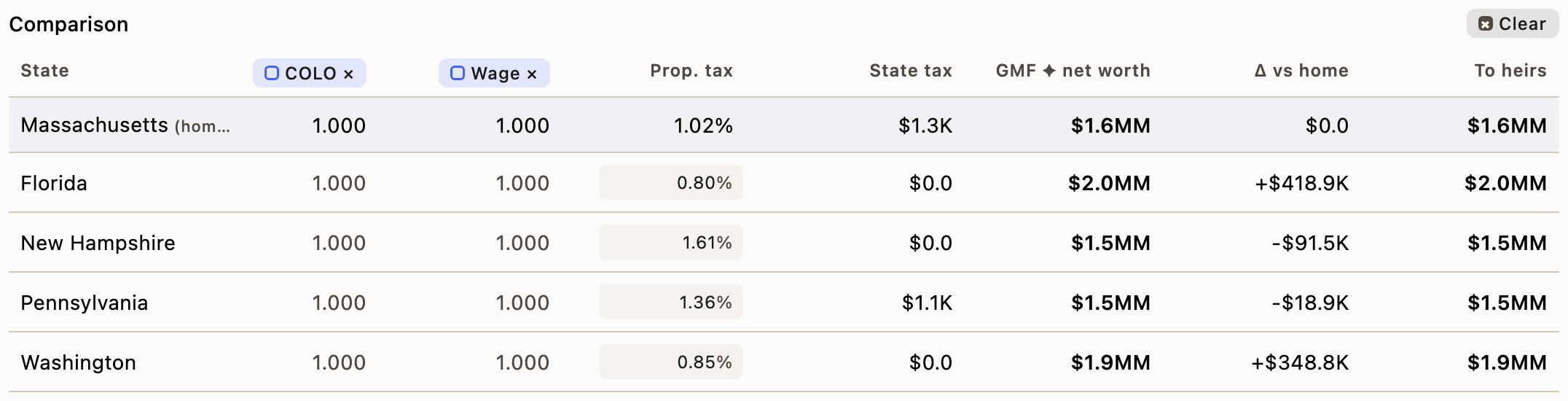
Region's comparison for the neighbors with the Estate lens on. Florida finishes about $419,000 ahead of Massachusetts and Washington about $349,000 ahead. Pennsylvania finishes slightly behind and New Hampshire about $92,000 behind. The To heirs column matches net worth in every row but Pennsylvania's.
The neighbors' estate is far below every estate tax exemption, so the To heirs column changes only one row. Pennsylvania's inheritance tax has no exemption, and it charges their children 4.5% of everything they inherit, about $70,000. That takes Pennsylvania from slightly behind Massachusetts to about $88,000 behind it, level with New Hampshire. Their ranking is set by property tax and the small income tax. Washington, the worst state for the Vances, is the second best for the neighbors. New Hampshire, a good choice for the Vances, is the worst for the neighbors, because its high property tax on a house that is half of what they own outweighs having no income tax.
Same town, same four states, and the order is nearly reversed. That is the reason to run your own plan through Region rather than read a ranking.
A household in a high-tax state often buys municipal bondsDebt issued by a state or local government. Its interest is normally excluded from federal AGI — which is what the industry label *tax-exempt* means, and all it means. The same dollars still count in MAGI, and most states add back interest from other states' issuers on their own return.Full entry → issued in its own state, because most states exempt their own issuers' interest from state tax as well as federal. That doubles the tax benefit, and it also concentrates the household's bonds in one state's finances. If that state, or the projects its bonds fund, runs into trouble, the household's bond sleeve and its home state are hit together. That is credit riskThe chance that a borrower pays late, pays less than promised, or stops paying. Every bond carries some except US Treasuries, which are treated as free of it. A municipal bond is only as sound as the state, city, or project behind it, and a higher yield is usually the price a borrower pays for more of this risk.Full entry → with no diversificationSpreading money across investments that do not all move together, so a bad year for one is not a bad year for everything. Owning many holdings is not the same thing — if they are highly correlated they behave like one large position wearing several names.Full entry → behind it. When bracket-filling stops working covers credit risk in more detail.
Tutilis tells them apart by the fund's issuing state, set on its yields beside the tax-exempt yield. Interest from the state the plan lives in stays off the state return, and interest from any other state is added back where the state taxes it. A national fund has no issuing state and is treated as out-of-state everywhere. Because Region swaps the state a plan lives in, it also shows the cost of a move for a household with in-state bonds: the same fund that was exempt at home is added back in the new state.
A new address does not change a household's tax home. States tax residents by domicile, the place a person intends as their permanent home, and a high-tax state may audit a former resident who claims to have left. The evidence is ordinary life: where the household spends most of its days, where its home, cars, doctors and voter registration are, and where it files. A move made for tax reasons at this level of wealth is usually planned with an estate attorney and a tax professional, and it often comes with changes to wills and trusts.
- Sales tax uses an average spending mix. It is charged on a fixed share of living expenses, not on what this household actually buys, so a household that spends mostly on services pays less than shown and one that buys mostly goods pays more.
- Pennsylvania's rate for young children is not modeled. Pennsylvania charges nothing when a child 21 or younger inherits from a parent; the model taxes all children at 4.5%.
- A move is modeled from the first year. Region compares living in each state for the whole plan. A move partway through retirement is a second plan with the state changed from that year.
A state's taxes are four different taxes on four different things, and households meet them in different proportions. For most retirees, property tax and income tax set the ranking. For a household with a large estate, a state's estate or inheritance tax can outweigh everything else, and it can turn a state with no income tax into the most expensive place to die. Run your own plan through Region with the Estate lens on before believing anyone's list.
Rebuild this plan by hand
The cards on the canvas show the accounts and cash flows. These are the settings that live outside any card, read from each plan this lesson opens, with the label each control carries in the app. A value marked default is one to leave alone.
| Setting | The Vances, $27 million | The neighbors, $1.5 million |
|---|---|---|
| Household | ||
| Planning region | United States (default) | United States (default) |
| Helen (Primary) | ||
| birth year | 1960 | — |
| retirement age | 64 | — |
| death age | 93 | — |
| Arturo (Secondary) | ||
| birth year | 1962 | — |
| retirement age | 62 | — |
| death age | 90 | — |
| Joan (Primary) | ||
| birth year | — | 1960 |
| retirement age | — | 64 |
| death age | — | 93 |
| Ray (Secondary) | ||
| birth year | — | 1962 |
| retirement age | — | 62 |
| death age | — | 90 |
| Taxes | ||
| Tax regime | United States | United States |
| Filing status | Married, filing jointly | Married, filing jointly |
| State of residence | Massachusetts | Massachusetts |
| First-year federal estimate | — | — |
| First-year state estimate | — | — |
| Strategy | ||
| Residual withdrawal strategy | Tax-account order | Tax-account order |
| Roth conversions | Off | Off |
| Definition of success | Liquidity crises allowed (default) | Liquidity crises allowed (default) |
| Glide path target | None (default) | None (default) |
| Advanced | ||
| Reporting inflation | Assumption set's rate (default) | Assumption set's rate (default) |
| Cost of capital | Assumption set's rate (default) | Assumption set's rate (default) |
| Growth assumptions | Growth overrides (default) | Growth overrides (default) |
| Currencies | Multiple currencies (default) | Multiple currencies (default) |
| Default currency | USD (default) | USD (default) |
| Display currency | USD (default) | USD (default) |

Educational content — not advice. These lessons teach how Tutilis models a plan and how to read what it shows. The households, balances, and outcomes in them are invented for teaching. Nothing here is financial, investment, tax, or legal advice, or a recommendation to buy, sell, or hold anything. A model cannot know your circumstances — check anything you take from a lesson against your own situation, and against a qualified professional where it matters.