This lesson uses 3 sample plans — switch anytime; color matches the bar between the columns.
On the right now: Taxable account first

 Capital gains, dividends and interest in retirement
The situation A retired couple with $1.4 million spread across an IRA, a Roth IRA and a brokerage account needs about $96,000 a year. Which money should they spend first, what does each source cost in tax, and does it matter which account holds the bonds?
How to use this case study
New to the Learning Center, or want a map of the panels? Start with a tour: Reading Lesson (Getting Around) or Screencast Lesson (Getting Around) — both walk through Tutilis next to a live planThe running Tutilis product next to this lesson — navigation, Bird's Eye, Forecaster, tools, and more — loaded with a teaching sample. A dossier is the plan data; the live plan is the full product surface with a sample dossier already open so you can explore. On the web, teaching samples are not editable the way your own dossier will be in the full app.Full entry → (to the right on a desktop-width screen, or below when stacked on a tablet).
This page — Capital gains, dividends and interest in retirement — can open more than one live sample planThe running Tutilis product next to this lesson — navigation, Bird's Eye, Forecaster, tools, and more — loaded with a teaching sample. A dossier is the plan data; the live plan is the full product surface with a sample dossier already open so you can explore. On the web, teaching samples are not editable the way your own dossier will be in the full app.Full entry → next to the text (to the right on a wide screen, or below on a tablet). Use the Live plans chips (and matching colored links in the prose) to switch without leaving this page; the colored bar near the plans shows which one is loaded. The walk-through stays in the text.
The live planThe running Tutilis product next to this lesson — navigation, Bird's Eye, Forecaster, tools, and more — loaded with a teaching sample. A dossier is the plan data; the live plan is the full product surface with a sample dossier already open so you can explore. On the web, teaching samples are not editable the way your own dossier will be in the full app.Full entry → next to this page — usually to the right on a wide screen, or below on a tablet — is Tutilis running a teaching sample: the same financial planning product available as a desktop application (early preview). A dossierYour full plan in Tutilis: the people in the household, what they own and owe, cash flows in and out, tax setting, and planning assumptions. One dossier is one complete situation as the product models it.Full entry → is the plan data; the live plan is the full product (navigation, Bird's Eye, Forecaster, tools) with a sample dossier already open so you can try the panels. See planned pricing. On the web, Learning Center samples are not editable the way your own dossier will be in the full app. Your own household goes in the Tutilis desktop app — the Learning Center front page has a short clip of that.
A retired household lives on cash, and the portfolio produces cash in several different ways. A bond fund pays interest. A stock fund pays dividends. Selling shares turns part of the account into money in the bank. An IRAIndividual Retirement Account — a retirement wrapper you open yourself rather than through an employer. It comes in traditional (pre-tax going in) and Roth (taxed going in) flavors, so naming the flavor matters more than the acronym does.Full entry → withdrawal does the same thing from a different kind of account. Every one of these is cash you can spend, and the tax code treats nearly every one of them differently, so retirement income taxes depend on the mix. The capital gains tax in retirement is often the smallest part of the bill. This lesson follows one retired couple through three versions of the same plan to show what each kind of income costs, which ones you get to time, why a sale of long-held shares is often the cheapest cash a retiree has, and which account each kind of income belongs in.
Ruth is 65 and Victor is 64, and both have stopped working. They live in Florida, which has no state income tax, so every tax figure in this lesson is federal. They spend about $96,000 a year. Ruth will claim Social Security at her full retirement age in 2028 and Victor at his in 2029, and until then the portfolio pays for everything.
They have about $1.4 million, which is comfortable without being rich. It sits in four places.
| Account | Balance | Tax character |
|---|---|---|
| Ruth's traditional IRA | $700,000 | Tax-deferredTax postponed, not avoided. Growth compounds without a yearly tax drag, and the bill arrives when the money comes out — which is why a large tax-deferred balance and a required withdrawal age are the same conversation.Full entry →. Every dollar withdrawn is ordinary income. |
| Victor's RothA retirement account where you pay income tax on the money going in, and qualified withdrawals later come out tax-free — the mirror image of traditional. Named after the senator behind the law, so the word tells you nothing on its own. Plans care because Roth dollars do not add to taxable income later, which keeps them clear of income-driven cliffs.Full entry → IRA | $150,000 | Tax-freeNo income tax due when the money comes out — the Roth promise, and the reason Roth dollars keep a withdrawal clear of income-driven thresholds. The word hides a condition: the withdrawal has to be qualified, which turns on age and how long the account has been open. It also hides a scope: municipal-bond interest is tax-free on the federal return yet still counts toward whether Social Security is taxed.Full entry → when withdrawn. |
| Joint brokerageAn ordinary taxable investment account — no special retirement wrapper, no contribution limit, and no withdrawal age rules. The trade-off is that dividends and realized gains are taxed as they happen rather than deferred. Often called the taxable bucket next to traditional and Roth.Full entry → | $500,000 | Taxable. Interest and dividends are taxed as they arrive, and a sale is taxed only on its gain. |
| Savings | $50,000 | Taxable. A money market fund paying interest. |
The brokerage account has been building for decades, so most of its stock fund is gain. The fund is worth $322,000 and the couple paid $150,000 for it. That $150,000 is the cost basisWhat you paid for an investment — the starting point tax measures your gain against. Sell for more than basis and the difference is a taxable gain; the money you originally put in is not taxed again. It is the reason two accounts with identical balances can cost very different amounts to spend from.Full entry →, and it will matter a great deal.
The lesson opens three plans. Each one changes a single thing, so the difference between any two is caused by that one thing.
- Taxable account first holds the same balanced mix of stocks and bonds, about 64/36, in every account, the way a target-date fund would. When spending runs short it sells from the taxable accounts first, then the IRA, and the Roth last.
- Every account at once is the same household with the same accounts. It sells from every account in proportion to its size.
- Bonds in the IRA keeps the same dollars in each account and the same overall mix, but moves the bonds into the IRA and the stocks into the brokerage and the Roth. It sells from every account in proportion, like the second plan.
Every number below is read from the forecast with the year set to 2027 unless the text names another year.
The portfolio can hand Ruth and Victor cash in five ways, and a withdrawal from a retirement account is a sixth. The reference table below is the whole map. The rest of the lesson shows each row on the plans.
How each kind of cash is taxed (US federal)
| Kind of cash | Where it comes from | How it is taxed | Who decides when |
|---|---|---|---|
| Interest | Bonds, bond funds, CDs, money market funds | Ordinary incomeIncome taxed at the regular graduated rates — wages, interest, pension payments, and withdrawals from traditional retirement accounts. The point of the label is the contrast: long-term capital gains and qualified dividends get their own, usually lower, rate schedule.Full entry →, at the same rates as a salary | The issuer |
| Non-qualified dividends | REITs, some foreign funds, money held too briefly | Ordinary income | The fund |
| Qualified dividendsA dividend that meets the holding-period and issuer conditions, so it is taxed on the lower long-term capital-gain schedule rather than at ordinary rates. Same cash as an unqualified one; a materially smaller tax bill.Full entry → | Most US and many foreign stock funds | The long-term capital gains rates of 0%, 15% or 20% | The fund |
| Fund capital-gain distributions | A fund selling winners inside itself | Long-term capital gains rates | The fund |
| A sale held more than a year | Selling shares you own | Only the gain is taxed, at 0%, 15% or 20%. The basis comes back untaxed. | You |
| A sale held a year or less | Selling shares you bought recently | Only the gain is taxed, as ordinary income | You |
| A traditional IRA or 401(k) withdrawal | Tax-deferred accounts | The whole withdrawal is ordinary income | You, until required minimum distributions begin |
| A qualified Roth withdrawal | Roth accounts | Not taxed | You |
For a married couple filing jointly in 2026, long-term gains and qualified dividends are taxed at 0% while taxable incomeWhat the rates are finally applied to — income after adjustments and deductions, not what you earned. It sits at the bottom of the page: gross income, then AGI, then this. Most people's taxable income is meaningfully smaller than their pay, which is why a bracket alone never tells you the tax.Full entry → stays under $98,900, at 15% above that, and at 20% above $613,700. Those gains sit on top of ordinary income, so ordinary income fills the 0% band first.
Two columns in that table do most of the work in retirement. The tax column says that a dollar of interest and a dollar of long-term gain are taxed very differently. The last column says that some of these arrive on someone else's schedule. The next two sections take those columns one at a time.
Interest and dividends arrive whether the household needs them or not. A bond fund pays its interest every month, and a stock fund pays its dividends every quarter. Once paid, they are taxed in that year, and reinvesting them does not change that, as The dividend you never see shows.
Open the tax statement on Taxable account first for 2027. The line Portfolio ordinary is $10,447. That is the interest from the bond fund in the brokerage and from the money market fund in savings. Ruth and Victor did nothing to cause it. It would have arrived in a year of high income just the same, stacked on top of whatever else they had.
A sale is different. The couple decides whether to sell, when, and how much. In the same year they sold $76,925 from the brokerage, and the statement shows exactly how much of that became taxable gain. They could have sold more in a year with room to spare and less in a year that was already full.
The IRA sits between the two. Withdrawals are voluntary until required minimum distributions, or RMDsRequired Minimum Distribution — once you reach an age set by statute, the law makes you withdraw a minimum amount each year from traditional retirement accounts, whether or not you need the money. The withdrawal is taxable income, so RMDs can push a household into a higher bracket or over a surcharge threshold. Roth accounts are generally not subject to them.Full entry →, begin. For Ruth that is 2036, and after that the law decides a minimum every year. On this plan Ruth's RMD is $49,134 in its first year and $107,501 by 2053, and the household has to take it whether they need it or not.
The uncontrolled income is not bad income. It still pays bills, and the usual advice is to spend it before selling anything. The point is that it uses up room on the tax return before you have made any decision, so it should be counted first when you plan the rest of the year.
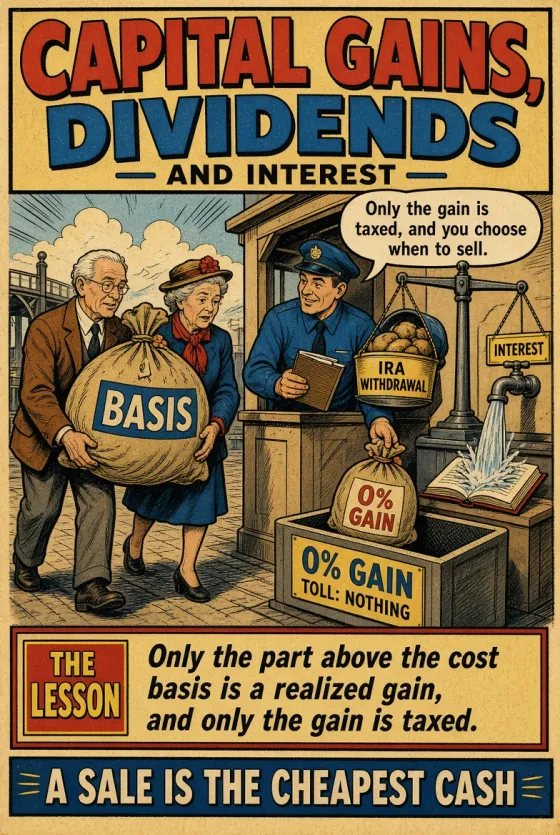
When you sell shares in a taxable account, most of what comes back is often your own money returning to you. Only the part above the cost basis is a realized gainA gain that has been locked in by selling — and, in a taxable account, the moment it becomes taxable. Until then it is unrealized: the holding is worth more than you paid, but nothing has happened yet and no tax is due. The same word cuts the other way: a loss is only realized once you sell, which is why a downturn you ride through costs nothing you did not sell.Full entry →, and only the gain is taxed. When the shares were held more than a year, that gain is a long-term capital gain, taxed at the lowest rates in the code.
Stay on Taxable account first in 2027. Ruth and Victor need about $84,000 of cash beyond the interest and dividends, and the plan raises nearly all of it by selling from the brokerage.
| What came in | Amount |
|---|---|
| Sold from the brokerage | $76,925 |
| Of which basis, returned untaxed | about $45,600 |
| Of which long-term capital gainLong-Term Capital Gain — profit on something held longer than a year, taxed on its own lower schedule instead of at ordinary rates. The holding period is the whole trick: the same sale a day earlier is taxed as ordinary income.Full entry → | $31,316 |
| Federal tax on the gain | $0 |
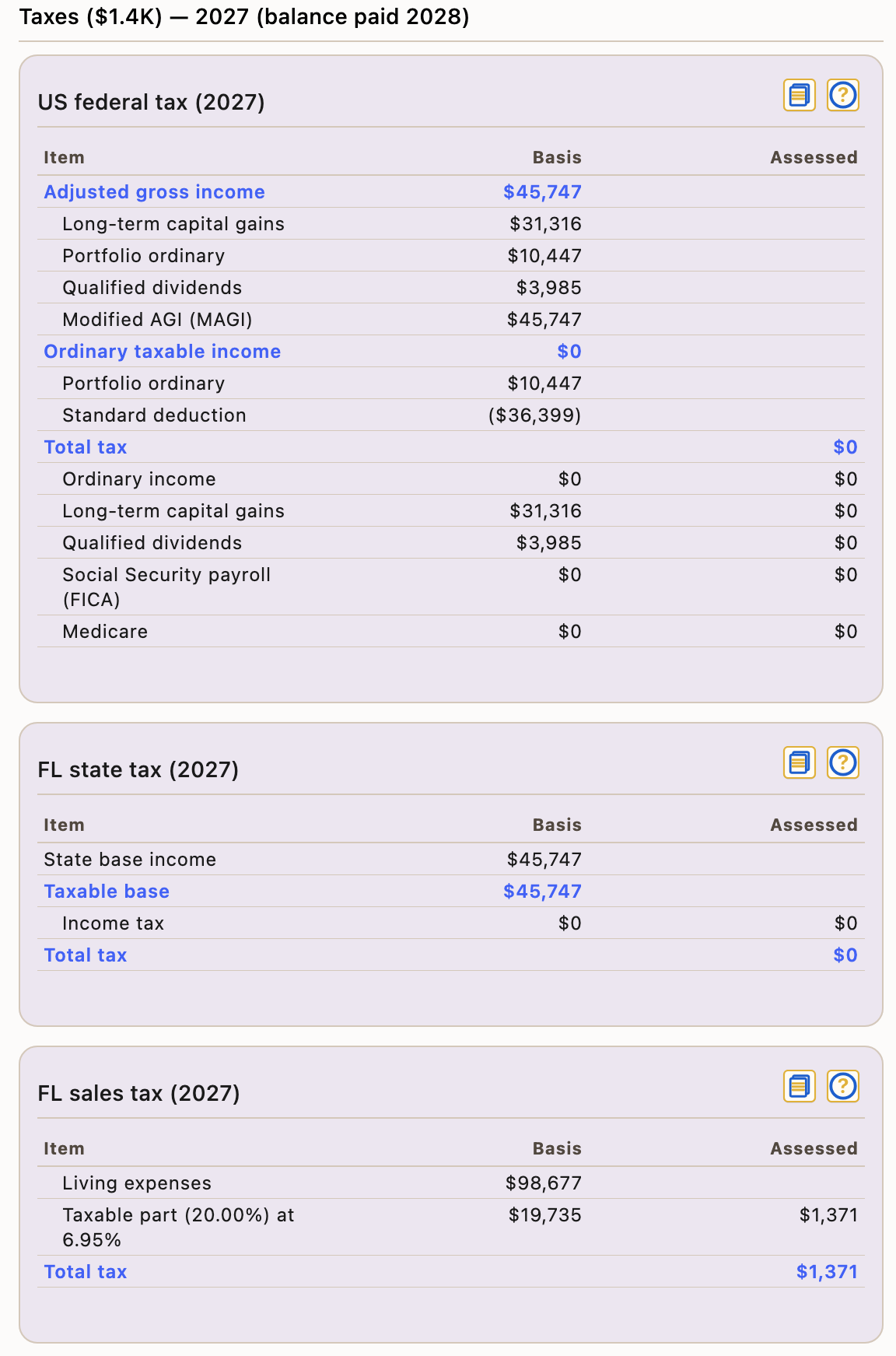
The 2027 federal statement on Taxable account first. The gain, the interest and the dividends together come to $45,747 of income, the standard deductionThe flat amount most households subtract instead of itemizing individual deductions. You take the larger of the two, so it acts as a floor: below it, an extra deductible expense saves nothing at all, which surprises people who gave to charity expecting a break.Full entry → covers all of the interest, and the gains and dividends fall inside the 0% band.
Now switch to Every account at once. The household spends the same amount, but about half of the cash now comes out of the IRA.
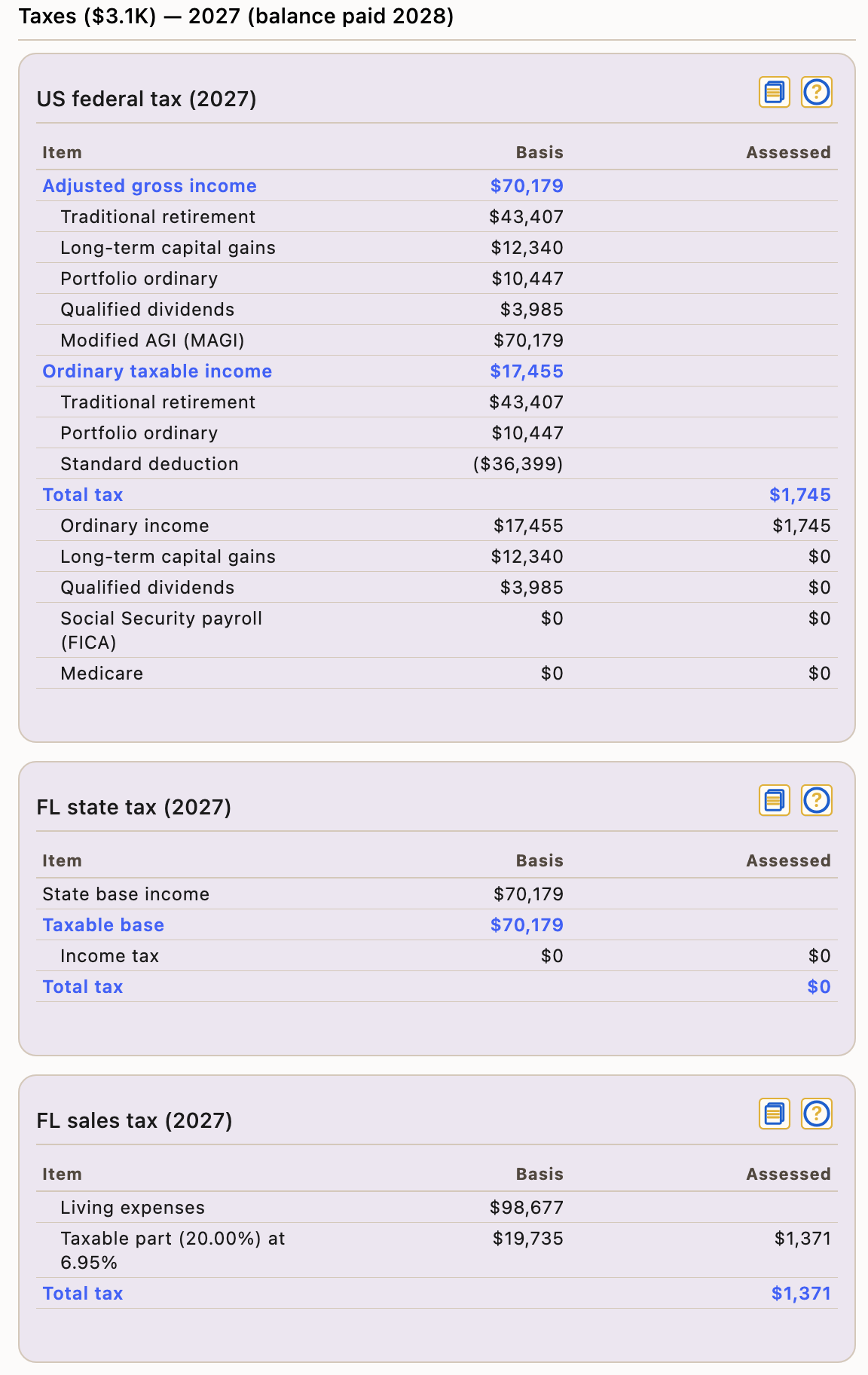
The 2027 federal statement on Every account at once. The $43,407 IRA withdrawal arrives as traditional retirement income, every dollar of it ordinary, and pushes $17,455 of ordinary income past the standard deduction.
The IRA withdrawal of $43,407 puts all $43,407 on the return. The brokerage sale of $76,925 put only $31,316 there, and none of that was taxed. This is the sense in which a sale of long-held shares is the cheapest cash a retiree has. Part of each dollar is basis, which is never taxed again, and the rest is taxed at rates that start at zero.
For the math lovers — what a sale puts on the return
Write the sale proceeds as \(S\), the shares' value as \(V\) and their cost basis as \(B\). With average-cost basis, each dollar sold carries the same share of basis as the whole holding, so the gain realized is
\[ G = S \times \left(1 - \frac{B}{V}\right) \]
The brokerage stock fund started at \(V = \$322{,}000\) and \(B = \$150{,}000\), so a little more than half of every dollar sold is gain. An IRA withdrawal is the case \(B = 0\) taxed at ordinary rates: the whole of \(S\) is income. A money market fund is the opposite case, \(B = V\), so selling it realizes nothing at all.
Most retirement guides, and the large fund companies, give the same rule of thumb for which money to spend first.
- Spend what arrives on its own. Interest, dividends, Social Security, a pension and, later, RMDs come whether you want them or not and are taxed either way, so they should pay the bills before anything is sold.
- Then sell from the taxable account. Much of each dollar is basis, and the gain is taxed at preferential rates.
- Then withdraw from tax-deferred accounts. Every dollar is ordinary income, so these are drawn after the cheaper sources.
- Leave the Roth for last. It grows tax-free, it has no required withdrawals for the original owner, and it passes to heirs tax-free.
Taxable account first follows this order. Every account at once ignores it and takes the same share from everything. Tutilis calls these two choices Tax-account order and Pro-rata.
Desktop app only
The order is the Money movement strategy under  AssumptionsA main-rail area. The rules the forecast runs under — growth, taxes, movements, success definition, locality, currency. Read and write.. Change it on your own plan and compare the Brackets view before and after.
The conventional order does exactly what it promises in the early years. On Taxable account first, Ruth and Victor owe no federal tax at all from 2027 through 2035. Every one of those years, they live on interest, dividends, Social Security and brokerage sales, and the sales land in the 0% band. In 2036 Ruth's first RMD arrives and the bill is $5,718.
The cost shows up later. Because the IRA is never touched, it keeps growing, and when RMDs begin they are larger. By 2045 the RMD on Taxable account first is $77,891, against $52,635 on Every account at once, and by 2053 it is $107,501 against $64,794. The Brackets view shows the shape.
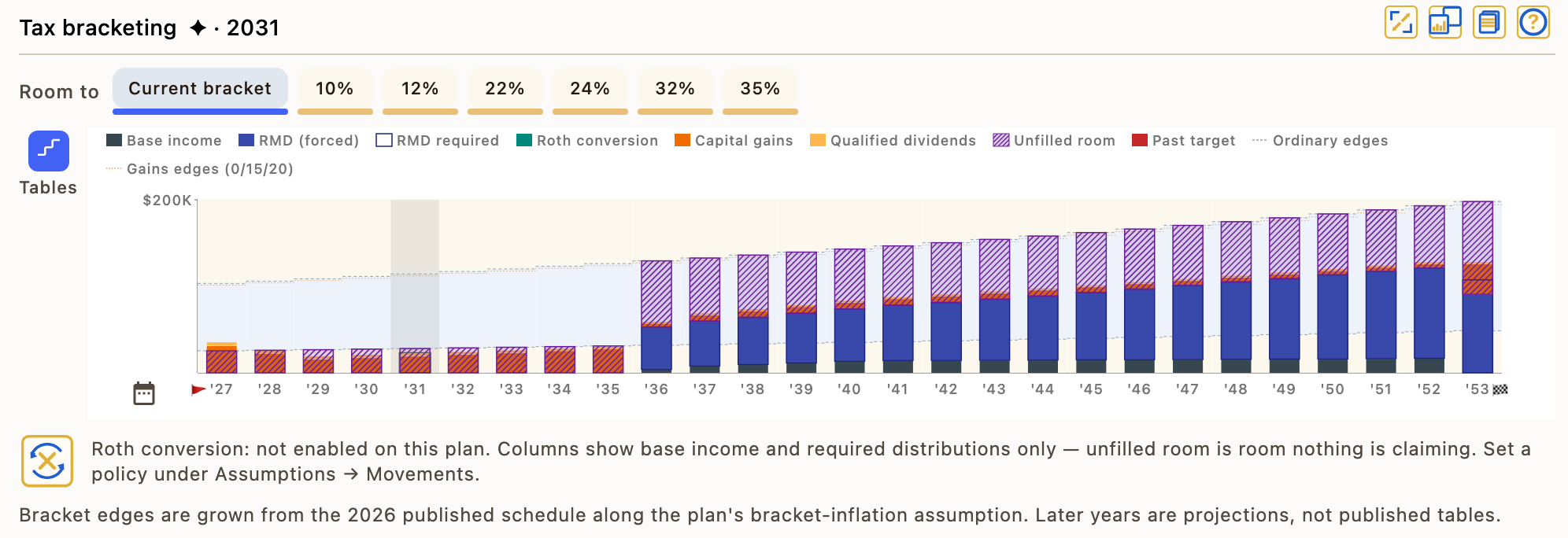
The Brackets view for Taxable account first. From 2027 through 2035 each column is a thin layer of capital gains with no ordinary income under it, so the 10% and 12% brackets go unused. From 2036 the RMD fills the column, and it grows every year.
Over the whole plan, the two orders pay similar amounts. Taxable account first pays about $178,000 of federal tax and Every account at once pays about $179,000, a difference of less than 1% that can turn the other way with a different horizon or market. What differs reliably is when the tax is paid. The conventional order pays nothing for a decade and then pays all of it, mostly at a time when the household can no longer choose.
This is the main criticism researchers make of the rule of thumb. Cook, Meyer and Reichenstein showed in 2015 that a retiree can usually do better than either plan here. The improved approach still lives mostly on the taxable account in the early years, but it also takes just enough from the IRA, or converts just enough to a Roth, to fill the empty 10% and 12% bracketsA band of income taxed at a given rate. The common misreading is that entering a higher bracket taxes all your income at that rate — it does not. Only the dollars inside that band pay the higher rate, so a raise never leaves you with less after tax.Full entry → each year. Filling the cheap buckets shows that technique on its own plan, and Roth conversion in the window shows how to set it up.
The ending balances also need care. In 2053 Taxable account first shows a net worth of about $1.99 million and Every account at once about $1.94 million, but $1.12 million of the first figure sits in the traditional IRA, and every dollar of that is still owed tax. Comparing the totals without noticing which accounts they are in flatters the plan that deferred the most.
The order you draw accounts in is a yearly decision. Which account holds which investment is a decision made once, and it lasts for decades. Planners call it asset location, and the usual guidance follows directly from the tax table.
| Holding | Main income it produces | Best home | Why |
|---|---|---|---|
| Taxable bonds and bond funds | Interest | Traditional IRA or 401(k) | Interest is ordinary income every year in a taxable account. Sheltered, it is taxed only when withdrawn, which would have been ordinary anyway. |
| REITs and high-yield bonds | Ordinary dividends, interest | Traditional IRA or 401(k) | The same reasoning, with even more of the return paid out each year. |
| Broad stock index funds | Qualified dividends, long-term gains | Taxable brokerage | Dividends are small and lightly taxed, the gains wait until you choose to sell, and the cost basis steps up for heirs at death. |
| The highest-growth holdings | Mostly price growth | Roth IRA | Growth that is never taxed is worth most where there is the most growth. |
| Municipal bondsDebt issued by a state or local government. Its interest is normally excluded from federal AGI — which is what the industry label *tax-exempt* means, and all it means. The same dollars still count in MAGI, and most states add back interest from other states' issuers on their own return.Full entry → | Tax-exempt interest | Taxable brokerage only | The exemption is wasted inside an account that is already sheltered. When tax-exempt interest still shows up on the bill covers the catches. |
Switch from Every account at once to Bonds in the IRA. The household, the spending, the dollars in each account and the overall mix are all the same. Only the location changed.
In 2027 the Portfolio ordinary line falls from $10,447 to $2,010, because the bond fund's interest now lands inside the IRA where it is not taxed in the year. What remains is the interest from the savings account. Qualified dividends rise from $3,985 to $6,188, because there is more stock in the brokerage, but those are taxed at 0% here. The 2027 tax falls from $1,745 to $1,117.
The yearly saving is small, and it compounds. Over the whole plan, Bonds in the IRA pays about $142,000 of federal tax against about $179,000 for Every account at once. There is a second effect as well. Bonds grow more slowly than stocks, so an IRA full of bonds grows more slowly too, and that makes every later RMD smaller. In 2053 the RMD is $50,213 on Bonds in the IRA and $64,794 on Every account at once.
The ending balances show where the money ends up. Bonds in the IRA and Taxable account first finish 2053 with almost the same net worth, about $2.00 million and $1.99 million, but in very different accounts.
| 2053 balance | Taxable account first | Bonds in the IRA |
|---|---|---|
| Traditional IRA (tax still owed) | $1,120,320 | $498,066 |
| Roth IRA (tax-free) | $703,660 | $423,718 |
| Brokerage (taxed only on gains) | $157,435 | $1,048,622 |
| Savings | $5,435 | $26,575 |
The same total in Bonds in the IRA carries far less tax still owed. Vanguard's research puts the value of good asset location at up to about 0.3% a year of after-tax return, for a household like this one with a balanced mix and meaningful money in both taxable and sheltered accounts.
Going deeper — why this comparison draws from every account at once
You might expect the location plan to use the conventional order, since a household that places its bonds carefully usually spends the taxable account first as well. The trouble is that Tutilis's Tax-account order sells each holding in the taxable accounts in proportion to its size, and it does not rebalance inside the IRA afterward. With all the stocks in the brokerage, selling the brokerage first sells the stocks first, and year after year the household drifts from about 64% stocks toward bonds. Its ending net worth then falls because of the drift, which has nothing to do with taxes.
A real household would avoid that by selling bonds and buying stocks inside the IRA, which costs no tax. Because the forecast does not rebalanceSelling some of what grew and buying what lagged, to bring the mix back to the target you chose. Without it a portfolio quietly drifts toward whatever has been winning, and gets riskier than intended precisely when it feels safest.Full entry → that way, this lesson compares location under Pro-rata, which keeps every holding's share of the portfolio steady, so the only difference between the two plans is where the bonds sit.
A forecast is a model, and this one simplifies a few things that matter for capital gains.
- Every sale is long-term. Tutilis does not track how long each lot has been held, so it never produces a short-term gain. For a retiree selling shares bought years ago, that is accurate.
- Basis is averaged. Tutilis uses one average cost for each holding. A real brokerage lets you pick which lots to sell, and choosing the highest-cost lots first can make each sale cheaper than the average shows.
- There is no gain-harvesting setting. The forecast does not sell and rebuy shares to use up the 0% band on purpose, so the gain harvesting described above is not in these numbers.
- Preferential income is stacked one kind at a time. When a year has both qualified dividends and long-term gains reaching past the 0% band, Tutilis measures each against ordinary income on its own, which can understate the tax a little. Ruth and Victor stay inside the band in the years this lesson reads.
- State tax depends on the state. Florida has no income tax. Most states tax capital gains as ordinary income, so in another state the sale would still be cheap federally but not free.
- The comparison is one path. Every figure is the forecast's middle path. In a bad market the totals change, though the differences in tax character do not.
- Interest, dividends, capital gains and IRA withdrawals are all cash, and each is taxed differently. Interest and IRA withdrawals are ordinary income. Qualified dividends and long-term gains get rates that start at 0%.
- Interest, dividends and RMDs arrive on someone else's schedule. Sales and voluntary IRA withdrawals arrive on yours, so plan them around what has already arrived.
- A sale from a long-held taxable account returns basis untaxed and taxes only the gain at preferential rates. For many retirees it is the cheapest cash available.
- The conventional order is to spend what arrives first, then sell from taxable accounts, then draw tax-deferred accounts, and leave the Roth for last. It makes the early years cheap, but it can leave low brackets empty and RMDs large, so fill those brackets on purpose.
- Put interest-paying bonds in tax-deferred accounts, broad stock funds in the taxable account, and the fastest-growing holdings in the Roth. When you compare plans, count the tax still owed inside each account as well as the total.
Works cited — the publications behind the figures
- Kirsten A. Cook, William Meyer and William Reichenstein, "Tax-Efficient Withdrawal Strategies", Financial Analysts Journal 71, no. 2, March/April 2015, for the conventional withdrawal order and the improvement on it.
- Vanguard, When and how asset location matters, research note, June 2026, for placing taxable bonds in tax-advantaged accounts first and the value of location of up to about 0.3% a year.
- Internal Revenue Service, Topic no. 409, Capital gains and losses, for long- and short-term gains and the 0%, 15% and 20% rates.
- Internal Revenue Service, Publication 550, Investment Income and Expenses, for the tax treatment of interest, ordinary and qualified dividends, and capital-gain distributions.
Rebuild this plan by hand
The cards on the canvas show the accounts and cash flows. These are the settings that live outside any card, read from each plan this lesson opens, with the label each control carries in the app. A value marked default is one to leave alone.
| Setting | Taxable account first | Every account at once | Bonds in the IRA |
|---|---|---|---|
| Household | |||
| Planning region | United States (default) | United States (default) | United States (default) |
| Ruth (Primary) | |||
| birth year | 1961 | 1961 | 1961 |
| retirement age | 64 | 64 | 64 |
| death age | 92 | 92 | 92 |
| Victor (Secondary) | |||
| birth year | 1962 | 1962 | 1962 |
| retirement age | 63 | 63 | 63 |
| death age | 92 | 92 | 92 |
| Taxes | |||
| Tax regime | United States | United States | United States |
| Filing status | Married, filing jointly | Married, filing jointly | Married, filing jointly |
| State of residence | Florida | Florida | Florida |
| First-year federal estimate | — | — | — |
| First-year state estimate | — | — | — |
| Strategy | |||
| Residual withdrawal strategy | Tax-account order | Pro-rata (default) | Pro-rata (default) |
| Roth conversions | Off | Off | Off |
| Definition of success | Liquidity crises allowed (default) | Liquidity crises allowed (default) | Liquidity crises allowed (default) |
| Glide path target | None (default) | None (default) | None (default) |
| Advanced | |||
| Reporting inflation | Assumption set's rate (default) | Assumption set's rate (default) | Assumption set's rate (default) |
| Cost of capital | Assumption set's rate (default) | Assumption set's rate (default) | Assumption set's rate (default) |
| Growth assumptions | Growth overrides (default) | Growth overrides (default) | Growth overrides (default) |
| Currencies | Multiple currencies (default) | Multiple currencies (default) | Multiple currencies (default) |
| Default currency | USD (default) | USD (default) | USD (default) |
| Display currency | USD (default) | USD (default) | USD (default) |

Educational content — not advice. These lessons teach how Tutilis models a plan and how to read what it shows. The households, balances, and outcomes in them are invented for teaching. Nothing here is financial, investment, tax, or legal advice, or a recommendation to buy, sell, or hold anything. A model cannot know your circumstances — check anything you take from a lesson against your own situation, and against a qualified professional where it matters.