This lesson uses 3 sample plans — switch anytime; color matches the bar between the columns.
On the right now: Dividend as cash

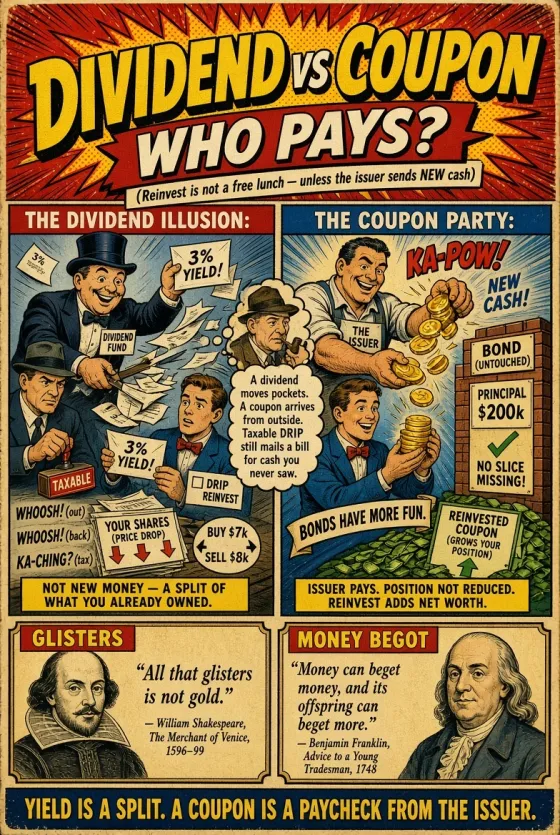
 The dividend you never see
The situation Someone with $200,000 in a dividend fund and a reinvest checkbox they ticked years ago — where does that money go, and why is it taxed when it never reached their account?
How to use this case study
New to the Learning Center, or want a map of the panels? Start with a tour: Reading Lesson (Getting Around) or Screencast Lesson (Getting Around) — both walk through Tutilis next to a live planThe running Tutilis product next to this lesson — navigation, Bird's Eye, Forecaster, tools, and more — loaded with a teaching sample. A dossier is the plan data; the live plan is the full product surface with a sample dossier already open so you can explore. On the web, teaching samples are not editable the way your own dossier will be in the full app.Full entry → (to the right on a desktop-width screen, or below when stacked on a tablet).
This page — The dividend you never see — can open more than one live sample planThe running Tutilis product next to this lesson — navigation, Bird's Eye, Forecaster, tools, and more — loaded with a teaching sample. A dossier is the plan data; the live plan is the full product surface with a sample dossier already open so you can explore. On the web, teaching samples are not editable the way your own dossier will be in the full app.Full entry → next to the text (to the right on a wide screen, or below on a tablet). Use the Live plans chips (and matching colored links in the prose) to switch without leaving this page; the colored bar near the plans shows which one is loaded. The walk-through stays in the text.
The live planThe running Tutilis product next to this lesson — navigation, Bird's Eye, Forecaster, tools, and more — loaded with a teaching sample. A dossier is the plan data; the live plan is the full product surface with a sample dossier already open so you can explore. On the web, teaching samples are not editable the way your own dossier will be in the full app.Full entry → next to this page — usually to the right on a wide screen, or below on a tablet — is Tutilis running a teaching sample: the same financial planning product available as a desktop application (early preview). A dossierYour full plan in Tutilis: the people in the household, what they own and owe, cash flows in and out, tax setting, and planning assumptions. One dossier is one complete situation as the product models it.Full entry → is the plan data; the live plan is the full product (navigation, Bird's Eye, Forecaster, tools) with a sample dossier already open so you can try the panels. See planned pricing. On the web, Learning Center samples are not editable the way your own dossier will be in the full app. Your own household goes in the Tutilis desktop app — the Learning Center front page has a short clip of that.
Alex holds $200,000 in a dividend fund. The fund yields 3%, so it distributes about $6,000 in the first year and more as the fund grows. Alex has two choices, and most brokerages present them as a single checkbox: take the dividend as cash, or reinvest it. Either way, the dividend is taxable in a taxable account in the year it is paid.
The checkbox looks like it is about convenience. It is not. It changes what shows up on the cash flow statement, what the reconciliation has to account for, and — in the case of a bond — whether the household ends the year better off at all.
Switch between the first two plans on the canvasWhat we call the right side of this page (or the bottom on a narrow screen) where the Tutilis application is drawn in this web Learning Center setting. It is the same product surface as the live plan — navigation, Bird's Eye, Forecaster, and so on — not a separate product.Full entry →. They are the same household, the same fund, the same yieldThe income an investment pays out — interest or dividends — as a percentage of its price. It is not total return: a holding can yield 4% and still lose value over the year. Chasing yield alone is how a portfolio quietly takes on risk it was not paid for.Full entry →. Only the checkbox moves.
Desktop app only
The checkbox is the holding's Distributions choice, under fund or stock yields.
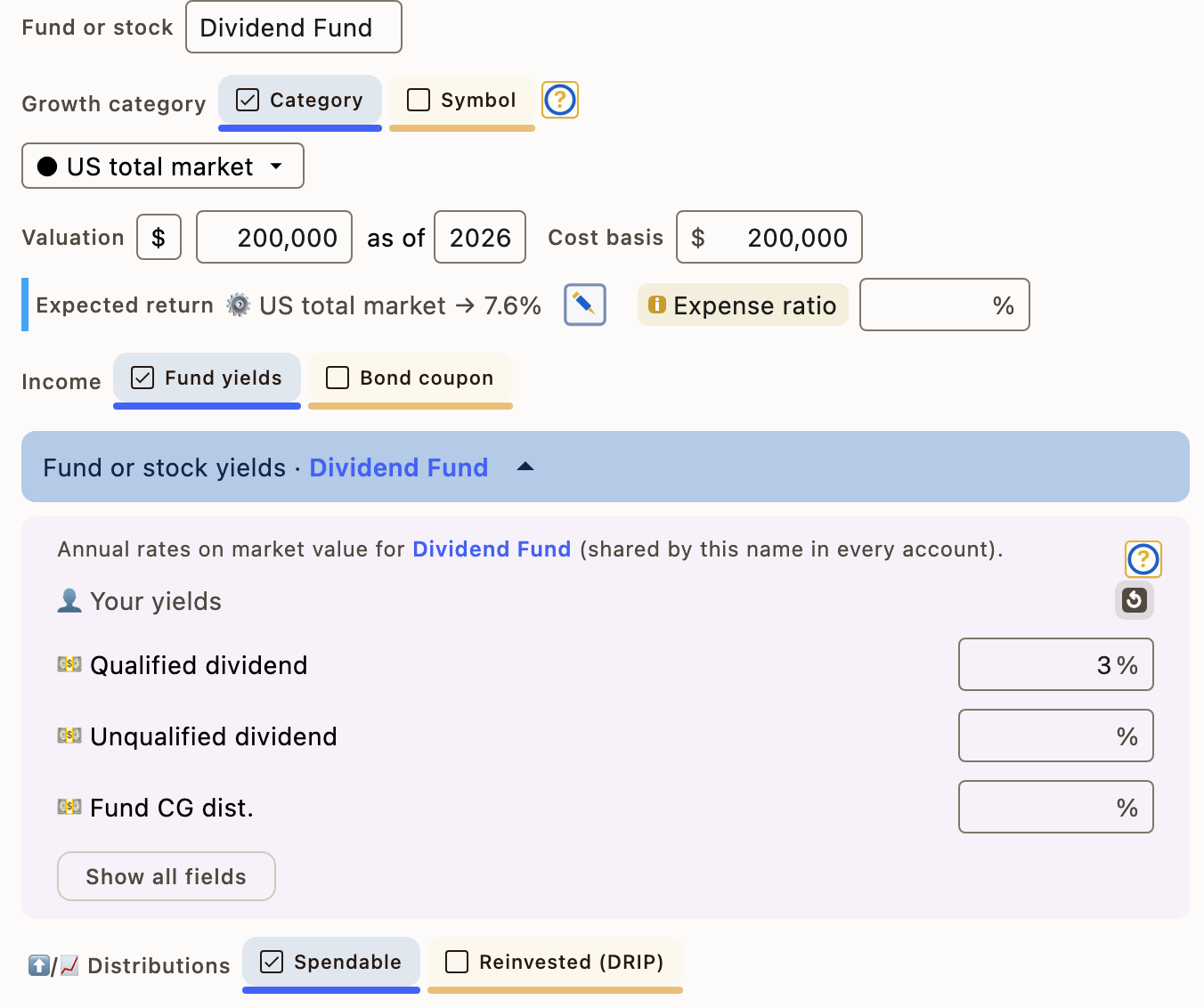
The Dividend Fund on Dividend as cash. Distributions is Spendable, so the dividend arrives as cash the household can spend.
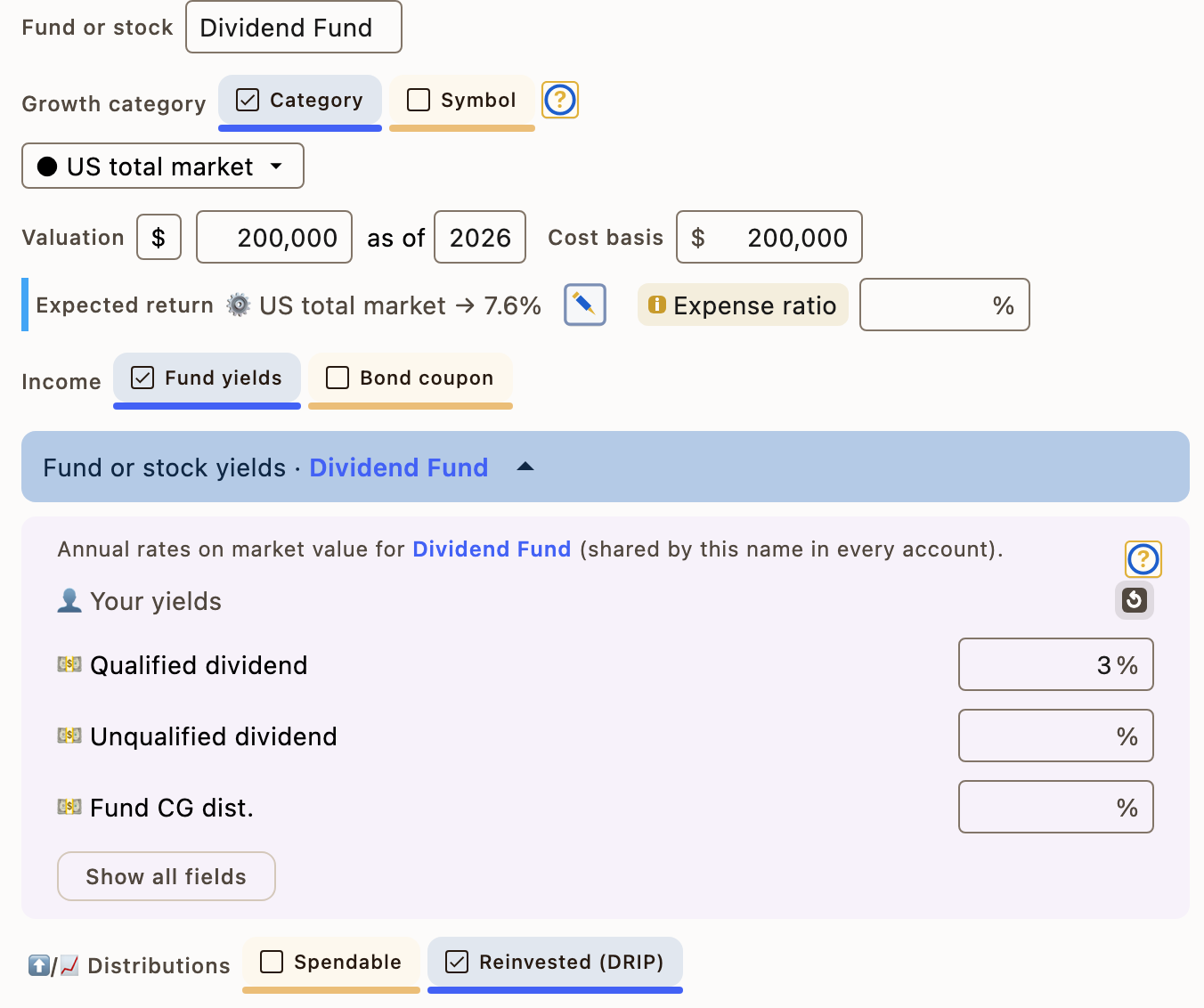
The same fund on Dividend reinvested. Distributions is Reinvested, so the dividend buys more of the fund and never becomes cash.
With Dividend as cash, the dividend arrives. It shows up in the year's income beside the salary, and the household can spend it, save it, or let the plan reinvest it as ordinary surplus.
What is easy to miss is where the money came from. A fund's published return is a total return — the price appreciation and the yield together. When the fund pays a dividend, the share price drops by what was paid. The fund handed over value it was already holding on Alex's behalf. Nothing was created.
That is why a plan built on chasing yield is not a plan. A 6% yielding fund and a 3% yielding fund with the same total return leave the household in exactly the same place; the first one just hands back more of itself each year.
For the math lovers — why yield is a split of the return
Write the share price at the start of the year as \(P_0\), at the end as \(P_1\), and the dividend per share as \(D\). The total return is
\[ R = \frac{P_1 + D - P_0}{P_0} = \frac{P_1 - P_0}{P_0} + \frac{D}{P_0} \]
The first term is the price return and the second is the yield. The price falls by \(D\) when the dividend is paid, so for the same \(R\), every point of extra yield is a point less of price return.
Switch to Dividend reinvested. The salary is unchanged. Living expenses are unchanged. But the year's income falls by the whole dividend, because no dividend arrived.
Look at the reconciliation — the panel that proves the year's money adds up. Set the forecaster to 2030, which is the year every table below is read from. It grows a new source:
| Side | Segment | Amount |
|---|---|---|
| source | Incomes | $134,956 |
| source | Reinvested Distributions | $7,086 |
| source | Sales | $9,046 |
| use | Expenses | $112,529 |
| use | Taxes | $31,474 |
| use | Investments | $7,086 |
The dividend and the shares it bought are the same $7,086, entered on both sides. It is a source because something had to pay for those shares. It is not income — it never reached the household, so the cash flow statement is right not to list it. The reconciliation is where the two facts are allowed to coexist.
And notice the third line. Alex's spending did not change, but the salary alone no longer covers it, so the plan sells $9,046 of the fund to make up the difference — after buying $7,086 of the same fund with the dividend. Reinvesting a distribution you were going to need anyway is a round trip with a tax bill attached.
Open the tax statements on the Dividend reinvested plan and stay on 2030:
| Basis | Assessed | |
|---|---|---|
| Qualified dividends | $7,086 | $1,063 |
The dividend Alex never saw is taxed exactly like the dividend Alex did see. Reinvestment is a decision about where the money goes, not about whether it counts. In a taxable accountAn ordinary taxable investment account — no special retirement wrapper, no contribution limit, and no withdrawal age rules. The trade-off is that dividends and realized gains are taxed as they happen rather than deferred. Often called the taxable bucket next to traditional and Roth.Full entry →, the DRIPDividend reinvestment plan — dividends buy more shares automatically instead of landing as cash. It changes where the money goes, not whether it is taxed: in a taxable account a reinvested dividend is income in the year it is paid, exactly as if it had been taken in cash.Full entry → checkbox creates a bill that has to be paid out of something else.
This is the single most useful thing to know about reinvestment, and it is invisible on a brokerage statement that only shows the share count going up.
Now switch to Coupon reinvested. Alex holds a $200,000 corporate bond at a 5% coupon instead of the fund, and the coupon is reinvested. The reconciliation for 2030 reads:
| Side | Segment | Amount |
|---|---|---|
| source | Reinvested Distributions | $10,000 |
| use | Investments | $10,000 |
The shape is the same as the dividend, and the meaning is completely different. A bond coupon is paid by the issuer, out of the issuer's pocket, on top of the principalThe amount itself — the money lent, borrowed, or invested, as against the interest or growth on top of it. On a mortgage payment it is the part that actually reduces the debt; early on, most of the payment is not principal. (Not *principle*, and not a person.)Full entry →. The bond's price is not reduced by it, the way a fund's share price is. So when the coupon is reinvested, the position grows by $10,000 that did not previously exist anywhere in Alex's plan. That is real new net worth.
For a dividend, "reinvest" moves money from one pocket to the same pocket. For a coupon, "reinvest" is the only combination in the whole grid where the reinvestment itself adds something.
The tax statement is different too:
| Basis | Assessed | |
|---|---|---|
| Portfolio ordinary (interest) | $10,000 | — |
The coupon is ordinary incomeIncome taxed at the regular graduated rates — wages, interest, pension payments, and withdrawals from traditional retirement accounts. The point of the label is the contrast: long-term capital gains and qualified dividends get their own, usually lower, rate schedule.Full entry →. Alex's qualified dividendA dividend that meets the holding-period and issuer conditions, so it is taxed on the lower long-term capital-gain schedule rather than at ordinary rates. Same cash as an unqualified one; a materially smaller tax bill.Full entry → was taxed at the preferential 15% rate; the coupon is taxed at the marginal ordinary rate, which for this household is higher. Same $10,000-ish of "income from the portfolio", meaningfully different bills.
- A dividend is not free money. The fund's price falls by what it pays. Yield is a split of the total return, not an addition to it.
- Reinvesting does not make it disappear. In a taxable account you owe tax on a distribution you never received.
- A bond coupon is the exception, and it is the exception because of who pays it. The issuer pays; the position is untouched; reinvesting it genuinely compounds.
- If you are going to need the cash anyway, reinvesting it just means selling something else later.
Rebuild this plan by hand
The cards on the canvas show the accounts and cash flows. These are the settings that live outside any card, read from each plan this lesson opens, with the label each control carries in the app. A value marked default is one to leave alone.
| Setting | Dividend as cash | Dividend reinvested | Coupon reinvested |
|---|---|---|---|
| Household | |||
| Planning region | United States (default) | United States (default) | United States (default) |
| Alex (Primary) | |||
| birth year | 1985 | 1985 | 1985 |
| retirement age | 65 | 65 | 65 |
| death age | 90 | 90 | 90 |
| Taxes | |||
| Tax regime | United States | United States | United States |
| Filing status | Single | Single | Single |
| State of residence | None | None | None |
| First-year federal estimate | $22,000 | $22,000 | $22,000 |
| First-year state estimate | — | — | — |
| Strategy | |||
| Residual withdrawal strategy | Pro-rata (default) | Pro-rata (default) | Pro-rata (default) |
| Roth conversions | Off | Off | Off |
| Definition of success | Liquidity crises allowed (default) | Liquidity crises allowed (default) | Liquidity crises allowed (default) |
| Glide path target | None (default) | None (default) | None (default) |
| Advanced | |||
| Reporting inflation | Assumption set's rate (default) | Assumption set's rate (default) | Assumption set's rate (default) |
| Cost of capital | Assumption set's rate (default) | Assumption set's rate (default) | Assumption set's rate (default) |
| Growth assumptions | Growth overrides (default) | Growth overrides (default) | Growth overrides (default) |
| Currencies | Multiple currencies (default) | Multiple currencies (default) | Multiple currencies (default) |
| Default currency | USD (default) | USD (default) | USD (default) |
| Display currency | USD (default) | USD (default) | USD (default) |

Educational content — not advice. These lessons teach how Tutilis models a plan and how to read what it shows. The households, balances, and outcomes in them are invented for teaching. Nothing here is financial, investment, tax, or legal advice, or a recommendation to buy, sell, or hold anything. A model cannot know your circumstances — check anything you take from a lesson against your own situation, and against a qualified professional where it matters.