This lesson uses 2 sample plans — switch anytime; color matches the bar between the columns.
On the right now: On schedule

 The years that change the rules
The situation Homer is 50 and Marge is 48. Bart and Lisa are 12 and 10. Over the next thirty years the family will cross almost every age the tax code and the benefit programs care about. When does each one arrive, and when should they start thinking about it?
How to use this case study
New to the Learning Center, or want a map of the panels? Start with a tour: Reading Lesson (Getting Around) or Screencast Lesson (Getting Around) — both walk through Tutilis next to a live planThe running Tutilis product next to this lesson — navigation, Bird's Eye, Forecaster, tools, and more — loaded with a teaching sample. A dossier is the plan data; the live plan is the full product surface with a sample dossier already open so you can explore. On the web, teaching samples are not editable the way your own dossier will be in the full app.Full entry → (to the right on a desktop-width screen, or below when stacked on a tablet).
This page — The years that change the rules — can open more than one live sample planThe running Tutilis product next to this lesson — navigation, Bird's Eye, Forecaster, tools, and more — loaded with a teaching sample. A dossier is the plan data; the live plan is the full product surface with a sample dossier already open so you can explore. On the web, teaching samples are not editable the way your own dossier will be in the full app.Full entry → next to the text (to the right on a wide screen, or below on a tablet). Use the Live plans chips (and matching colored links in the prose) to switch without leaving this page; the colored bar near the plans shows which one is loaded. The walk-through stays in the text.
The live planThe running Tutilis product next to this lesson — navigation, Bird's Eye, Forecaster, tools, and more — loaded with a teaching sample. A dossier is the plan data; the live plan is the full product surface with a sample dossier already open so you can explore. On the web, teaching samples are not editable the way your own dossier will be in the full app.Full entry → next to this page — usually to the right on a wide screen, or below on a tablet — is Tutilis running a teaching sample: the same financial planning product available as a desktop application (early preview). A dossierYour full plan in Tutilis: the people in the household, what they own and owe, cash flows in and out, tax setting, and planning assumptions. One dossier is one complete situation as the product models it.Full entry → is the plan data; the live plan is the full product (navigation, Bird's Eye, Forecaster, tools) with a sample dossier already open so you can try the panels. See planned pricing. On the web, Learning Center samples are not editable the way your own dossier will be in the full app. Your own household goes in the Tutilis desktop app — the Learning Center front page has a short clip of that.
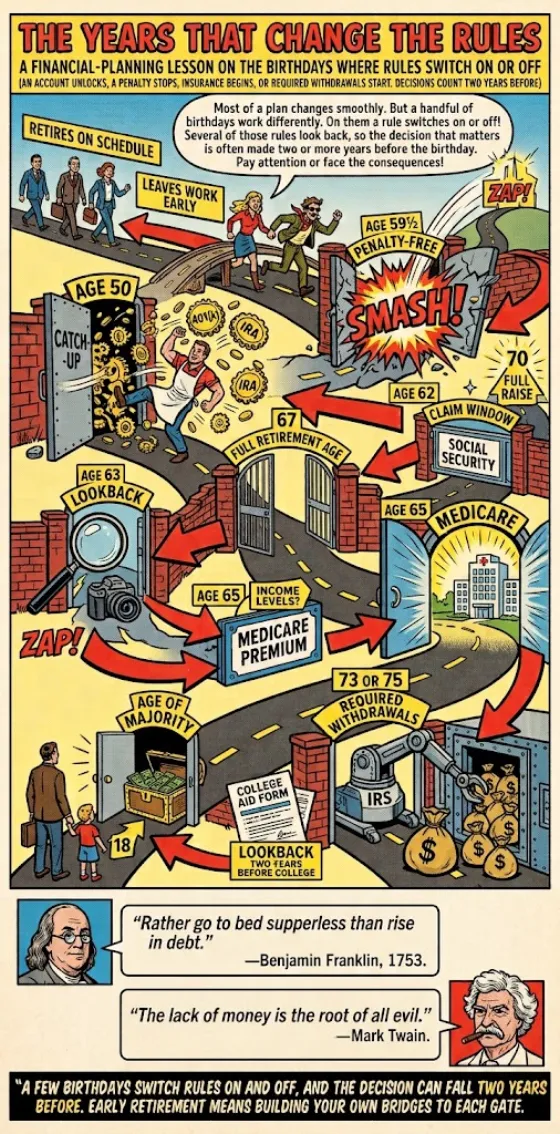
Most of a financial plan changes smoothly. Wages rise a little each year, spending drifts, and markets go up and down. A handful of birthdays work differently. On them, a rule switches on or off: an account unlocks, a penalty stops, an insurance program begins, or the government starts requiring withdrawals. Several of those rules also look back at earlier years, so the decision that matters is often made two or more years before the birthday itself. Those birthdays are the key retirement ages, and this lesson lists each one.
This lesson follows one family across every one of those dates. Homer is 50 in 2026 and Marge is 48. Their children, Bart and Lisa, are 12 and 10. It is the same household as Saving for college with a 529, with two changes: Marge now has a Social SecuritySocial Security — the US government retirement and disability benefit, funded by payroll tax while you work and paid as a monthly check once you claim. How much you get depends on your earnings history (your PIA) and the age you claim relative to full retirement age.Full entry → benefit of her own, and Homer plans to claim his at 70. Between 2026 and the end of the plan the family crosses nearly every age the tax code and the benefit programs care about.
Two plans are open on the canvasWhat we call the right side of this page (or the bottom on a narrow screen) where the Tutilis application is drawn in this web Learning Center setting. It is the same product surface as the live plan — navigation, Bird's Eye, Forecaster, and so on — not a separate product.Full entry →. On schedule has Homer working to 65 and Marge to 67. Both stop in 2030 has the same family, but both paychecks end in 2030, when Homer is 54 and Marge is 52. The second plan shows what happens when a household reaches the milestones in the wrong order. Both plans draw from savings in tax-account order: the brokerage accountAn ordinary taxable investment account — no special retirement wrapper, no contribution limit, and no withdrawal age rules. The trade-off is that dividends and realized gains are taxed as they happen rather than deferred. Often called the taxable bucket next to traditional and Roth.Full entry → first, then the traditionalA retirement account where the tax is paid on the way out — not a description of an old-fashioned account. Money went in before income tax, grew untaxed, and is taxed as ordinary income when you take it out — traditional 401(k)s and IRAs work this way. The contrast is Roth (taxed going in, tax-free coming out) and taxable (brokerage, taxed as you go).Full entry → 401(k)An employer-sponsored retirement account, named after the section of tax law that created it — so the name says nothing about what it does. Contributions are usually payroll-deducted, often matched by the employer, and come in traditional (pre-tax) and Roth flavors. A 403(b) is the same idea for schools and nonprofits, a 457 for government workers.Full entry →, then the RothA retirement account where you pay income tax on the money going in, and qualified withdrawals later come out tax-free — the mirror image of traditional. Named after the senator behind the law, so the word tells you nothing on its own. Plans care because Roth dollars do not add to taxable income later, which keeps them clear of income-driven cliffs.Full entry →.
Tutilis works out every milestone year from two facts about each person: a birth year and the ages you give for retirement and death. You never type "Medicare starts in 2041". The app derives that year, and it moves on its own when you change a birth year or a retirement age.
The dates appear in three places.
- The life-event timeline. Open
 Bird's EyeWhen you are not on Dossier, this control sits in the top toolbar. Opens a household overview as a modal — people, assets and liabilities, cash flow — without leaving the area you are in. Hidden on Dossier, because that same overview already sits at the top of that area. and look at People & events. Each person has a lane with retirement
 , full retirement age 🎖, the Social Security claim 🧓, Medicare
 , college years, and death
 laid out along the calendar.
- The Year events card. In the
 ForecasterA main-rail area with two jobs: (1) run the plan year by year and inspect Forecast Detail, and (2) Simulation Summary — many paths summarized into something like a probability of success., turn on the Year events chip under Forecast Detail. It lists everything that happens in the selected year: life events, cash flows that start or stop, and each person's catch-up contribution limit. Drag the year slider and the card follows it.
- The chart axes. Rest the pointer on any year along the bottom of a chart and the same events appear in a tip. The calendar icon at the lower left of a chart (
 Year axis
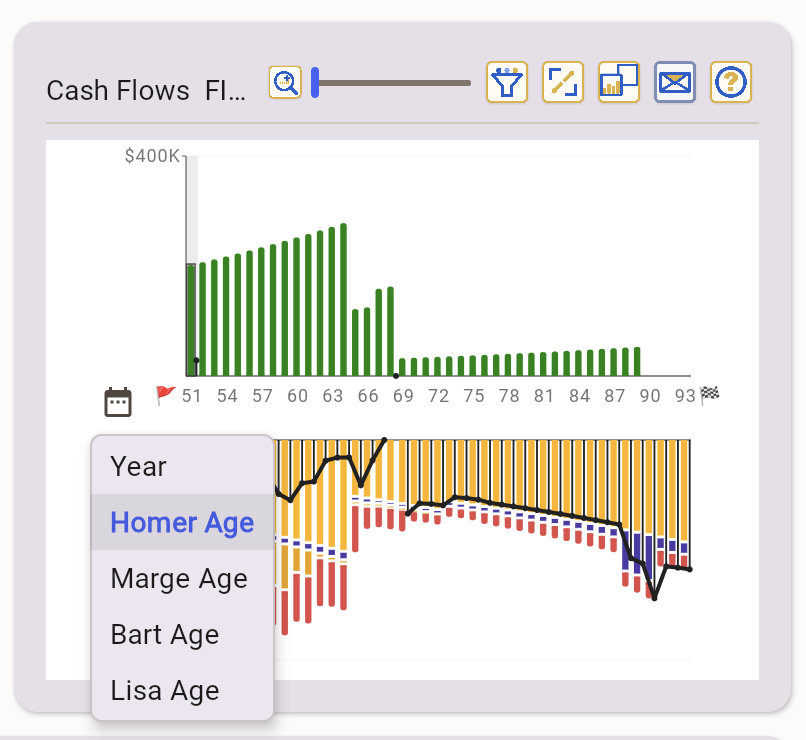 A calendar icon on year-axis charts (lower left of BS Chart, CF Chart, and peers). Opens Year (calendar years, the default) or {Name} Age. Relabels the year line only — it does not change which year the header Year slider has selected. Same control on every year-axis chart.) relabels the axis with a person's age, which is often the easier way to read a life plan.
Desktop app only
Those dates come from the person editor. Homer's birth year and retirement age are what produce 2041 for Medicare and 2051 for required withdrawals. Birth month is empty, which is why the year he turns 59 is treated as a penalty year all the way through.
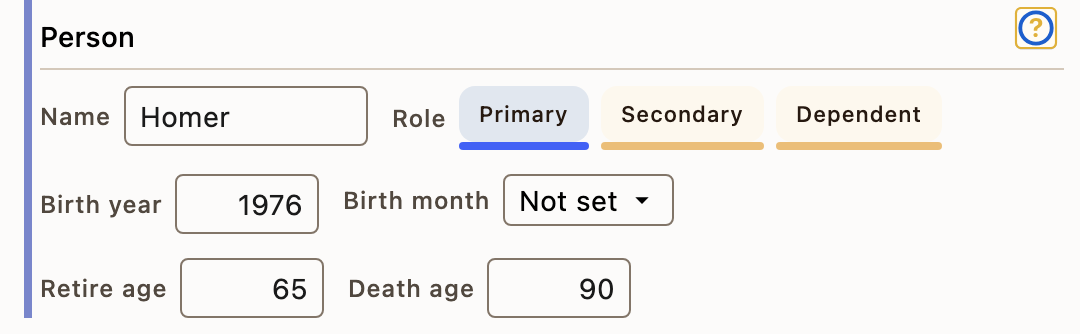
Homer on On schedule. Born in 1976, retires at 65, and birth month is not set.
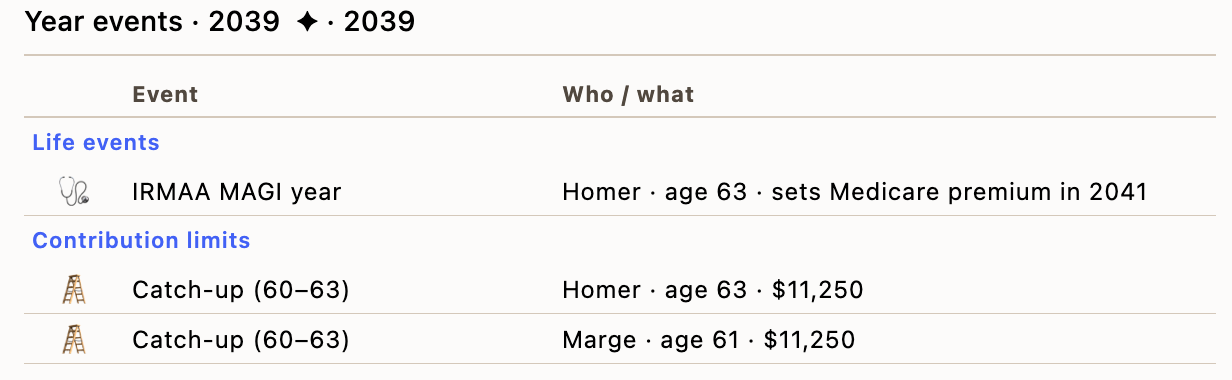
Every table in this lesson is the Year events card for one year of the On schedule plan, drawn by the app itself.
Eighteen is the age of majority in most states, and several things change on the same birthday. A child can open a brokerage account in their own name. A custodial (UTMA or UGMACustodial accounts — Uniform Gifts / Transfers to Minors Act — that hold money in a child's name with an adult managing it until the child comes of age. Simple to open, but the money is the child's outright, and for financial aid it counts as a student asset, which is assessed far more heavily than a parent's.Full entry →) account passes to the child at an age the state sets, most often 21 and in some states 18, and after that the parents have no say in how it is spent. A Trump Account unlocks, and it becomes an ordinary traditional IRAIndividual Retirement Account — a retirement wrapper you open yourself rather than through an employer. It comes in traditional (pre-tax going in) and Roth (taxed going in) flavors, so naming the flavor matters more than the acronym does.Full entry → in the child's name. The lesson A Trump Account for a newborn covers that account in detail.
In the Springfield plan, 18 is also the year college starts. The Year events card shows Bart college starting in 2032 and Lisa college in 2034. The two 529 accounts carry their contributions up to those years and then fund the tuition.
The planning for college starts earlier than 18. The federal aid form, the FAFSAFree Application for Federal Student Aid — the form that decides what a family is expected to contribute toward college. It reads income and assets, and treats them differently by whose name they are in, which is why college years show up in a plan as more than an expense.Full entry →, uses the family's income from two years before the school year. Bart's first year of college is 2032, so the income that counts for his aid is the family's 2030 income, when he is 16. A family hoping for aid should look at that year's income, including any capital gains they choose to take, two years before the first tuition bill. Tutilis does not model financial aid, but it does show you which calendar year is two years before college.
One later date belongs here too. A child can stay on a parent's health plan until 26. For a family whose insurance comes through work, that birthday is a real cost change for the child.
At 50, the limit on what you can put into a 401(k) or a similar workplace plan goes up. This extra room is called a catch-up contributionExtra room to contribute to a retirement account once you reach a set age — the ordinary limit plus an additional amount, with a still-higher amount in a narrow age band. The name is aspirational: nothing has to be caught up on to use it.Full entry →. Homer turns 50 in 2026 and Marge in 2028, and from those years the Year events card lists a Catch-up (50+) row for each of them with the extra amount: $8,000 in 2026 dollars.
A second, larger tier covers only four birthdays. In the years you turn 60, 61, 62 and 63, the catch-up rises to $11,250. At 64 it drops back to the ordinary amount. Homer's enhanced window is 2036 to 2039 and Marge's is 2038 to 2041. The card marks the first year of each tier with begins, so the window is easy to find:
Two points about lead time apply here. First, a workplace plan changes deferrals through payroll, so the decision to use the higher limit belongs in the year before, when the new elections are set. Second, starting in 2026, anyone whose wages were above about $150,000 in the prior year must make catch-up contributions as Roth contributions. That changes the tax math for a high earner, and it is worth checking the year before turning 50.
Tutilis lists these limits for reference. The forecast does not cap contributions against them, so a plan that contributes more than the limit will not be corrected for you.
Money in a traditional 401(k) or IRA can be withdrawn at any age, but a withdrawal before 59½ usually carries a 10% additional tax on top of ordinary incomeIncome taxed at the regular graduated rates — wages, interest, pension payments, and withdrawals from traditional retirement accounts. The point of the label is the contrast: long-term capital gains and qualified dividends get their own, usually lower, rate schedule.Full entry → tax. After 59½ the extra tax is gone. The Year events card marks the year each person turns 59 with  Penalty-free withdrawals begin (mid-year): 2035 for Homer and 2037 for Marge.
The words "mid-year" matter. Someone born in March reaches 59½ in September of the year they turn 59. Someone born in October does not reach it until April of the following year. Tutilis only knows the birth month if you enter it on the person. Without it, the engine takes the careful reading and charges the penalty for the whole of the year the person turns 59.
A few exceptions exist, and one of them is a milestone of its own. Under the "rule of 55," someone who leaves an employer in or after the year they turn 55 can take withdrawals from that employer's 401(k) without the penalty. Tutilis does not model the rule of 55 or the other exceptions yet. It charges the plain 10% and says so on the tax statement.
For the On schedule family, 59½ passes quietly. Both are still working, the brokerage account covers the gaps, and the plan never pays the penalty. The section Leaving before the gates shows the same birthday in a plan where it is not quiet at all.
Social Security retirement benefits can start at any age from 62 to 70. The amount depends on when you claim, measured against your full retirement age (FRAFull retirement age — the Social Security age at which you can claim your full Primary Insurance Amount (PIA) with neither an early-claim reduction nor a delayed-claim increase. For many people born in the 1960s it is 67; the calendar year of FRA depends on birth date.Full entry →), which is 67 for anyone born in 1960 or later. Claiming at 62 pays about 70% of the full benefit for life. Waiting past 67 adds 8% for each year of delay, so a claim at 70 pays about 124%. After 70 there is no further increase.
For the math lovers — where 70% and 124% come from
Social Security measures a claim in months from full retirement age. A claim before FRA loses 5/9 of 1% for each of the first 36 months early and 5/12 of 1% for each month beyond that. Claiming at 62 with an FRA of 67 is 60 months early:
\[ 36 \times \tfrac{5}{9}\% + 24 \times \tfrac{5}{12}\% = 20\% + 10\% = 30\% \]
so the benefit is 70% of the full amount. A claim after FRA earns 2/3 of 1% a month, which is 8% a year, and 67 to 70 is 36 months:
\[ 36 \times \tfrac{2}{3}\% = 24\% \]
so the benefit is 124%.
In the On schedule plan, the two spouses use different ends of the window. Marge claims at her full retirement age in 2045, the same year she retires. Homer retires at 65 in 2041 and does not claim until 70, in 2046. The Year events card shows FRA and SS claim as separate rows, and in 2046 it shows Homer's claim at age 70 alone. The cash-flow chart shows the shape: two paychecks, then one, then Social Security arriving in two steps.
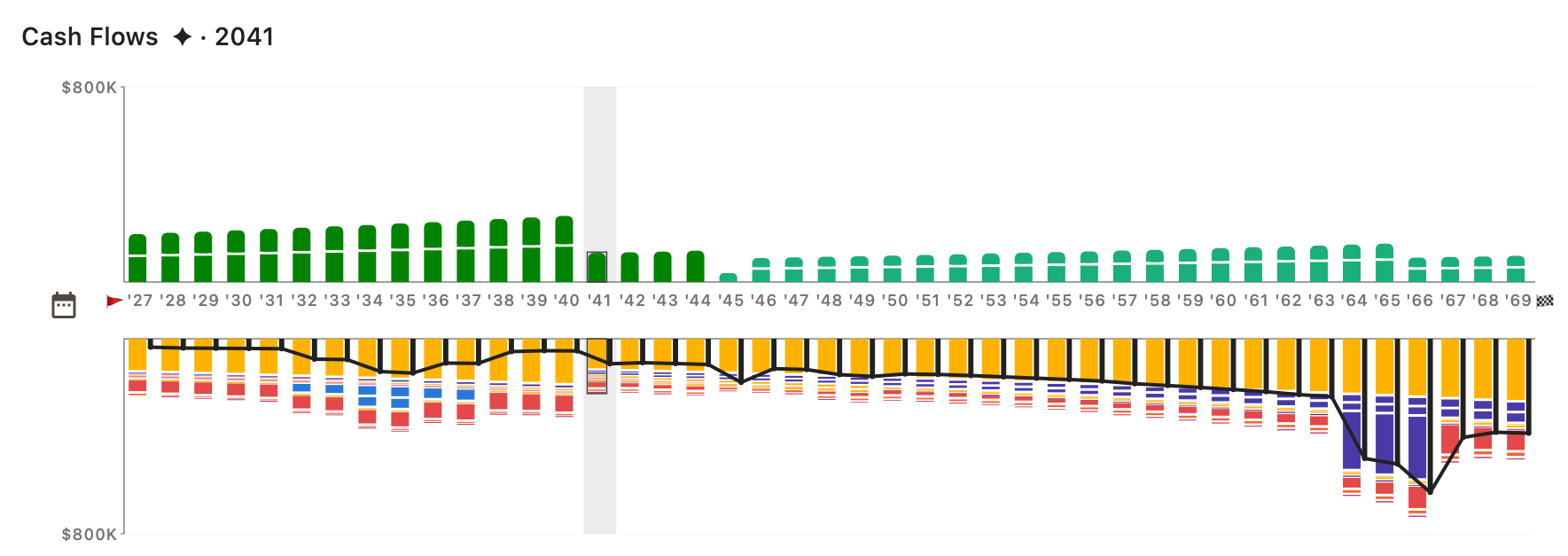
Delaying is a bet on a long life, and for a married couple it is also a bet on the survivor. When one spouse dies, the survivor keeps the larger of the two benefits. That is a common reason for the higher earner to wait. Tutilis models each person's own benefit, but not spousal or survivor benefits, so this part of the reasoning stays in your head rather than in the plan. The lesson Claim early vs live long runs the claim-age question against a short life and a long one.
The decision deserves about a year of lead time. You can apply up to four months before the month you want benefits to begin, and the years between retirement and the claim have to be paid for from savings. Homer's five-year gap between 2041 and 2046 is paid from the brokerage account, which is nearly empty by the time his benefit starts.
Medicare eligibility begins at 65 for almost everyone. The initial enrollment period is seven months long: the three months before your birthday month, the month itself, and the three months after. Someone who misses it without other qualifying coverage, such as an employer plan, pays a late-enrollment penalty on Part B of 10% for each full year of delay, and pays it for life. A health savings accountHealth Savings Account — paired with a high-deductible health plan, and the only common account that is untaxed at all three points: going in, growing, and coming out for medical costs. That is why plans treat it as a retirement account that happens to pay doctors.Full entry → cannot receive contributions once Medicare coverage starts, so an HSA saver's last contribution year is also tied to 65.
The less obvious date is 63. Medicare's Part B and Part D premiumsWhat you pay for coverage — a monthly insurance or Medicare cost — and not a bonus or a prize. Confusingly, the same word means "above face value" when applied to a bond. In a plan it is nearly always the insurance sense: a recurring outflow that rises with age and, past a threshold, with income.Full entry → rise for higher-income households through a surchargeAn extra amount added on top of a normal charge once income passes a line — in planning, almost always the Medicare premium surcharge. It is not a tax rate, so it does not show up in a bracket; it arrives as a higher premium, in tiers, based on a tax return from two years earlier.Full entry → called IRMAAIncome-Related Monthly Adjustment Amount — a surcharge on Medicare premiums for higher-income households. It works in tiers, so one dollar of extra income can raise the premium for a whole year. It looks back at a tax return from a couple of years earlier, which is why a one-off spike (a big conversion, a property sale) shows up as a bill much later.Full entry →, and the income it looks at is your MAGIModified Adjusted Gross Income — AGI with certain deductions added back. It matters far out of proportion to the small adjustment, because MAGI is the figure that triggers cliffs: Medicare surcharges, the investment surtax, and health-subsidy eligibility all test against a MAGI, and each rule uses a slightly different one.Full entry → from two years earlier. The income you earn at 63 sets the premium you pay at 65. The Year events card marks that year as the IRMAA MAGI year (see the 2039 table above), and in the Medicare year it names the year that sets the premium:
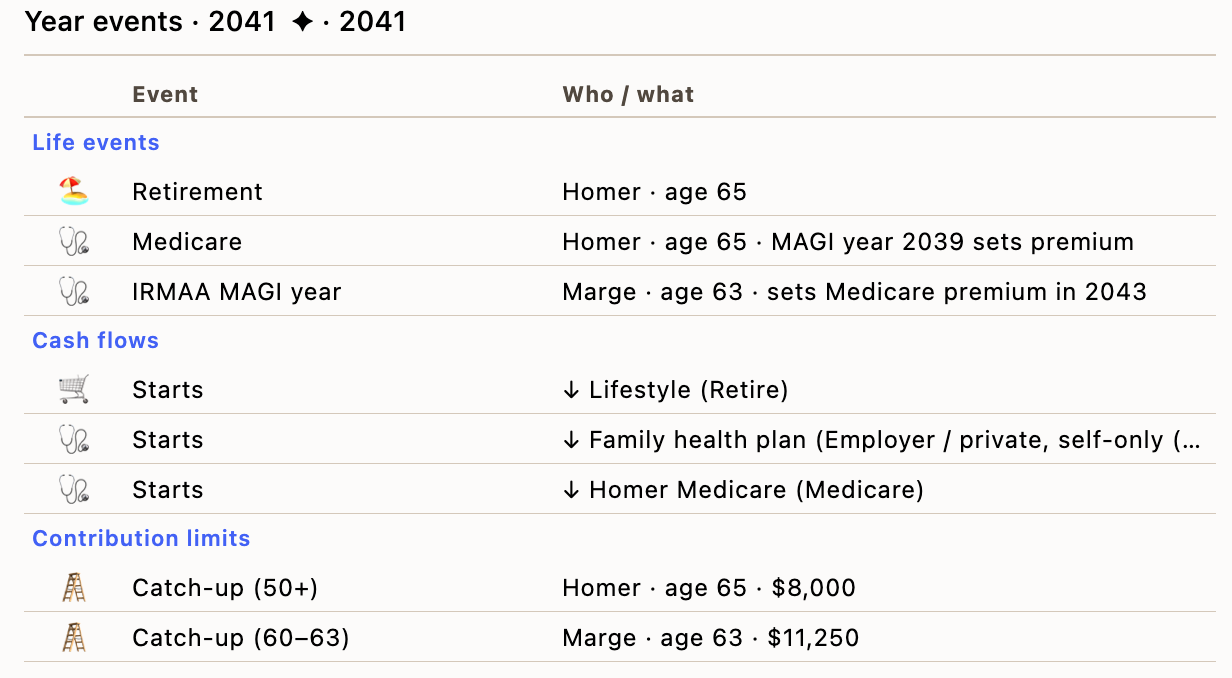
In the On schedule plan, Homer's last two full working years, 2039 and 2040, are high-income years with both paychecks running. They set his premiums for 2041 and 2042, and the forecast charges an IRMAA surcharge of about $2,900 in each of those years. In 2043 the lookback reaches 2041, after he retired, and the surcharge disappears.
A real household could appeal. Social Security accepts form SSA-44 after a "life-changing event," and stopping work is one of them. Tutilis charges IRMAA as the rule is written and does not model the appeal, but seeing the surcharge in 2041 and 2042 is exactly what should prompt one. The planning window for IRMAA opens at 63, two years before Medicare. A large capital gain, a Roth conversionDeliberately moving money from a traditional account into a Roth one and paying the income tax on it now, so it grows and comes out tax-free later. The usual reason is a low-income year — between retiring and claiming benefits, say — where the conversion is taxed at a lower rate than the future withdrawal would be. It also shrinks later RMDs.Full entry → or a bonus taken at 63 or 64 shows up on a Medicare bill two years later.
The government lets money grow tax-deferredTax postponed, not avoided. Growth compounds without a yearly tax drag, and the bill arrives when the money comes out — which is why a large tax-deferred balance and a required withdrawal age are the same conversation.Full entry → in a traditional account, but not forever. From a certain age you must take a required minimum distributionRequired Minimum Distribution — once you reach an age set by statute, the law makes you withdraw a minimum amount each year from traditional retirement accounts, whether or not you need the money. The withdrawal is taxable income, so RMDs can push a household into a higher bracket or over a surcharge threshold. Roth accounts are generally not subject to them.Full entry → each year, a fraction of the balance set by an IRS table, and pay ordinary income tax on it. That age is 73 for people born from 1951 through 1959 and 75 for people born in 1960 or later. Homer and Marge were both born after 1960, so the Year events card marks ⏳ RMDs begin in 2051 for Homer and 2053 for Marge.
Homer's 401(k) is large, and his first required distribution in 2051 is about $141,000. It shows up at once in the Brackets lens, where the RMD band appears in 2051 and fills a larger share of the brackets every year after:
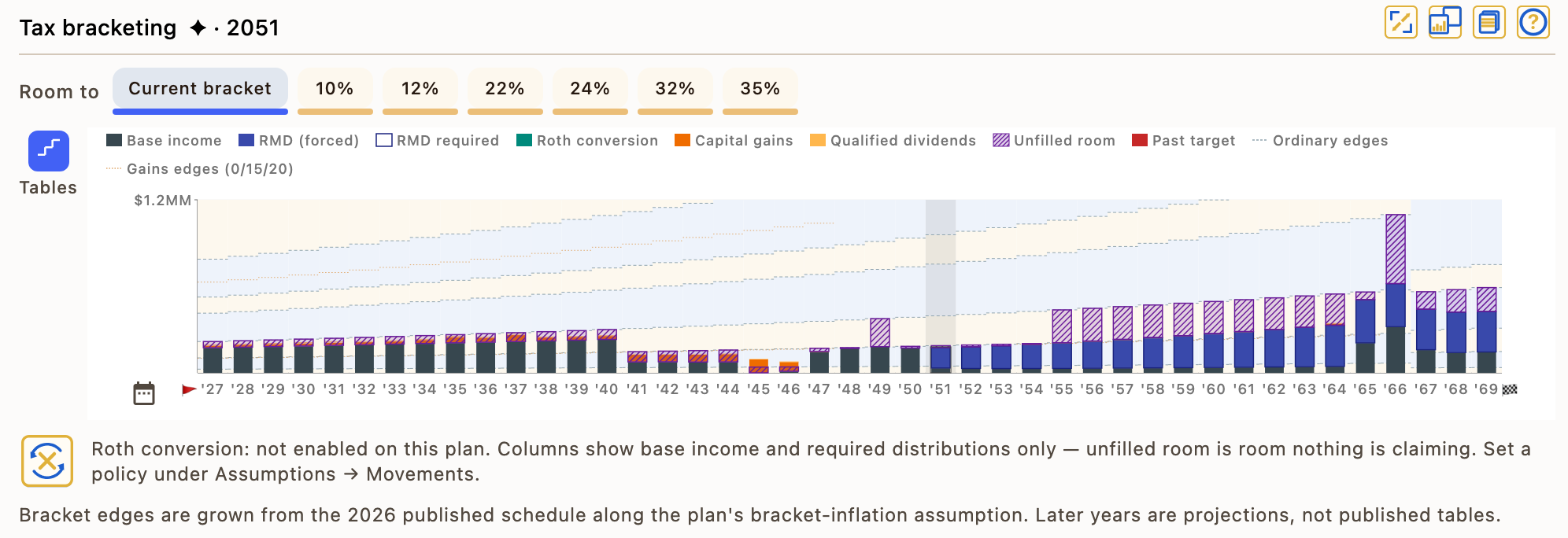
RMDs push up taxable incomeWhat the rates are finally applied to — income after adjustments and deductions, not what you earned. It sits at the bottom of the page: gross income, then AGI, then this. Most people's taxable income is meaningfully smaller than their pay, which is why a bracket alone never tells you the tax.Full entry →, and higher taxable income can bring back IRMAA. In this plan the surcharge returns in 2050, three years after the 401(k) withdrawals begin, and it steps up again in the late 2050s as the distributions grow.
The lead time for RMDs is the longest of any milestone, because the only way to shrink them is to move money out of the traditional account before they start. The years between retirement and the first RMD are often the lowest-income years of a person's life, which makes them a good time for Roth conversions. In the On schedule plan, 2045 has almost no ordinary income: Marge's paycheck has ended and Homer has not yet claimed. The lesson Roth conversion in the window explains how to use years like that. A couple planning to convert should start thinking about it in their early 60s, about a decade before the first required distribution.
Reference — the first RMD and the missed-RMD penalty
You may delay the first RMD until April 1 of the following year, but then two distributions land in the same tax year. The penalty for missing an RMD is 25% of the shortfall, reduced to 10% if you correct it promptly.
Switch to Both stop in 2030. Everything about the family is the same, except that Homer stops work at 54 and Marge at 52, both in 2030. The Year events card for 2030 shows both retirements, the retirement budget starting, and the family's health coverage moving to a private plan.
Leaving work early changes the order of the milestones. In the On schedule plan, a paycheck covered every year until the next source of money arrived. Here, the paychecks end first and every milestone comes afterward:
- Health insurance has to be bought privately until Medicare at 65. For Homer that is eleven years and for Marge thirteen. In this plan the private premiums add up to about $426,000 between 2030 and 2042.
- The 401(k) is locked behind the 10% penalty until Homer turns 59 in 2035.
- Social Security cannot start before 62, and the plan keeps the same claim ages, so no benefit arrives until 2045.
With no paychecks, the forecast pays for everything from savings, starting with the brokerage account. That account is the bridge to 59½, and it is not long enough. It lasts five years and runs out in 2035, the year Homer turns 59, so the forecast turns to the 401(k) before he can draw on it without the penalty:
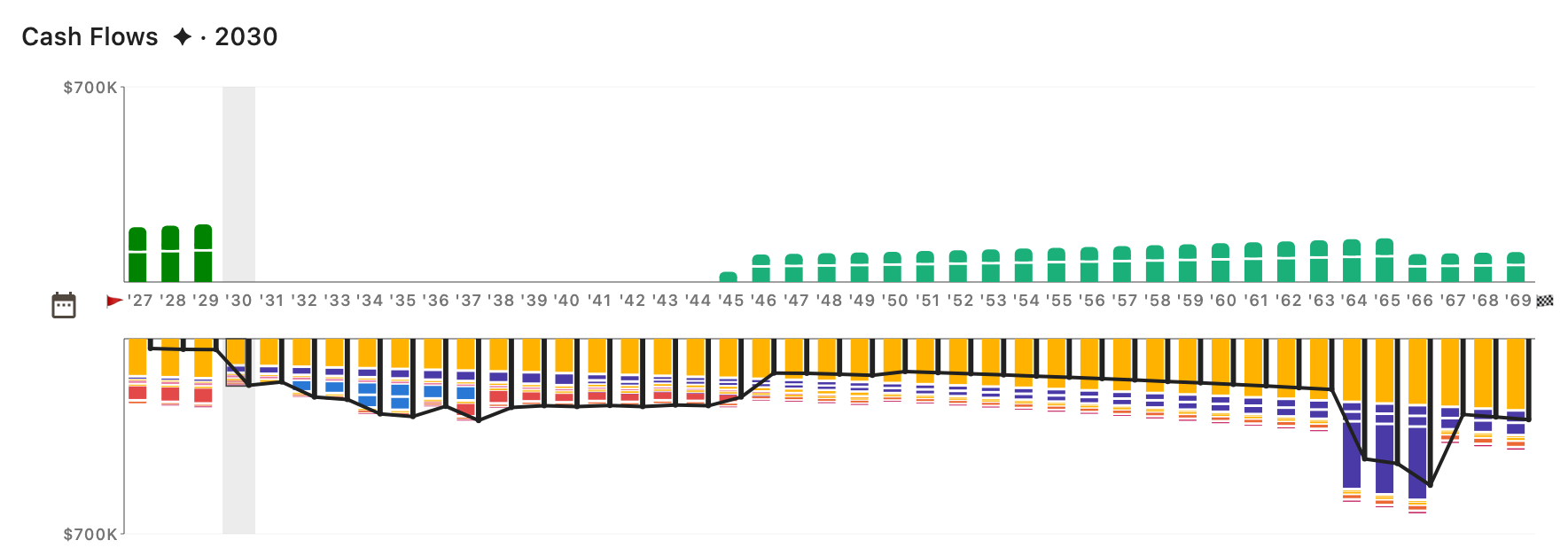
In 2035 the last of the brokerage account is spent, about $13,000 of the year's spending comes out of the 401(k), and the tax statement carries the penalty line:
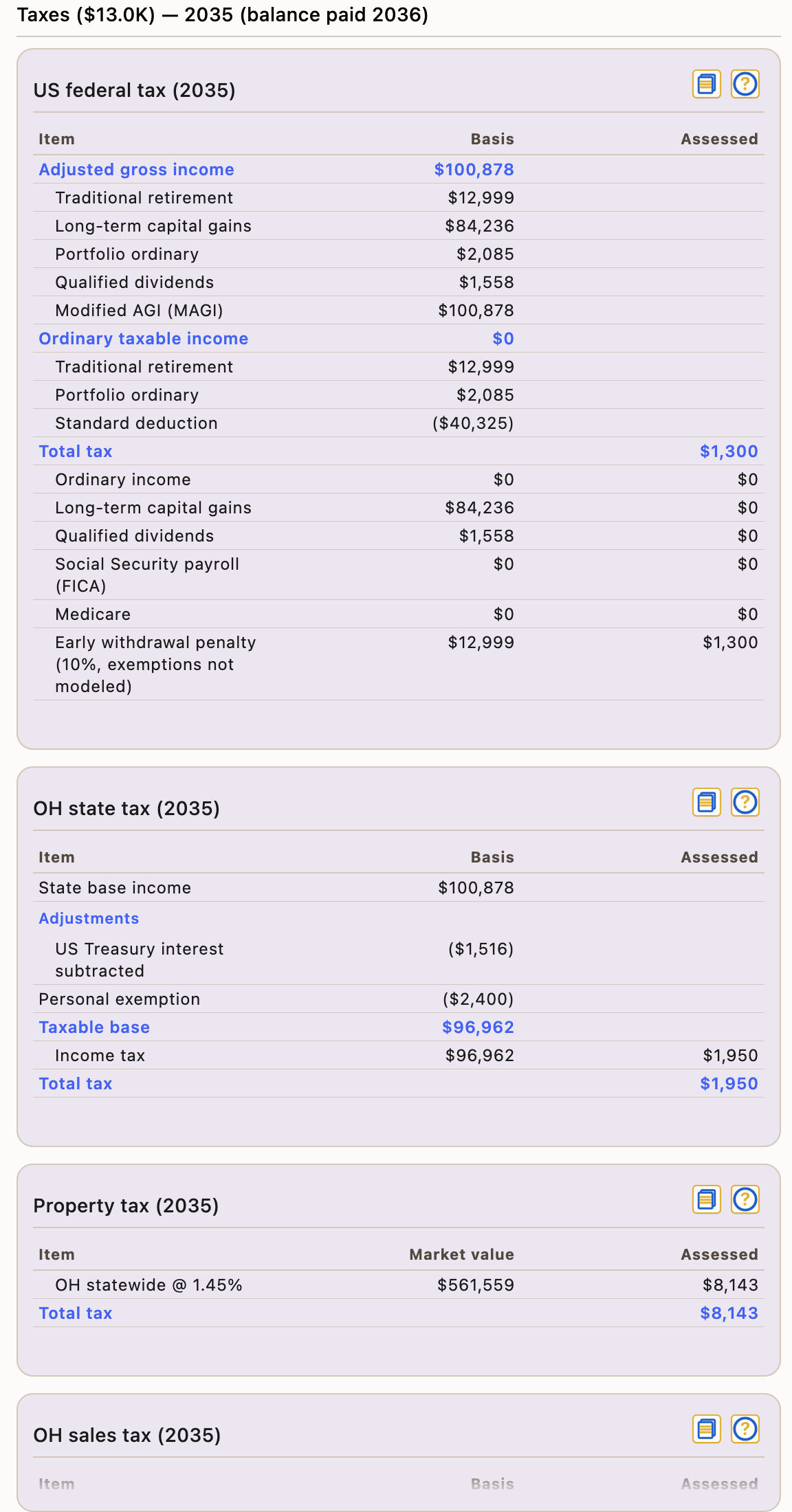
The penalty that year is about $1,300, because the brokerage account still paid for most of the year. This is also where the birth month matters. Homer turns 59 in 2035, and the Year events card says penalty-free withdrawals begin mid-year. The plan does not know his birth month, so it charges the penalty on all of 2035. If Homer was born in the first half of the year, entering his birth month removes the 2035 penalty entirely. The plan cannot know that unless you tell it.
Health insurance follows the same turn, one year later. While the brokerage account pays the bills, the family shows little income, about 180% to 240% of the poverty line, and the marketplace premium credit pays most of the premium, about $20,000 to $26,000 a year from 2030 to 2034. In 2035 the first 401(k) withdrawals lift their income to about 3.8 times the poverty line, which is close to the 400% line but still under it, and the credit that year is about $24,000. In 2036 the 401(k) pays for the whole year, and their income jumps to about 6.9 times the poverty line. Above 400% there is no credit at all, so the family repays the whole of 2036's advance credit, about $25,700, with the next year's tax, and pays the full premium every year after that until Medicare. The bridge account was doing two jobs: paying the bills, and keeping income low enough to earn the credit.
The penalty is not the main problem, though. The larger costs are thirteen years of private insurance, seven of them at the full premium, and fifteen years with no income except what the portfolio provides, and in this plan the family's savings run out in the late 2050s. The same plan also keeps both Social Security amounts as stated, even though leaving work eleven and fifteen years sooner would lower them in real life. The timing lesson is still clear: retiring early means building a bridge to each milestone, and each piece has to be sized and funded before the paycheck stops. That work starts five to ten years ahead.
The last date on the plan is death, and it is the one nobody knows. The averages are a reasonable place to start. According to the CDC, a baby born in the United States in 2024 could expect to live about 76.5 years if male and 81.4 years if female. People who have already reached 65 do better, because they have survived the risks of the earlier decades. A man of 65 in 2024 could expect about 18.4 more years and a woman about 20.8, which means an age of about 83 or 86.
An average is the middle of a range, and about half of people outlive it. A plan that runs out of money at the average age fails for roughly half the people who use it. For a married couple the relevant question is how long the longer-lived spouse survives, and that is usually several years past either average. This is why planners typically run plans to 90 or 95. The Springfield plans use 90 for Homer and 92 for Marge, and the forecast runs until Marge reaches hers.
In Tutilis, death age is a setting on each person, and the milestones depend on it: the long-term-care years, the last year of Social Security, and the plan horizon all move when you change it. Try the On schedule plan with Marge living to 97. The last five years are where a plan's margin, or lack of it, becomes visible.
The table gathers every milestone in the lesson with the years it falls in for this family and the point where it deserves attention. The Springfield years come from the Year events card. The lead times are general guidance rather than rules.
| Age | What changes | Homer | Marge | Start thinking |
|---|---|---|---|---|
| 16 (child) | FAFSA looks at this year's income | 2030 for Bart, 2032 for Lisa | Two years before college | |
| 18 (child) | Age of majority; custodial and Trump Accounts pass to the child | 2032 for Bart, 2034 for Lisa | A few years ahead, while you still choose the account | |
| 50 | Catch-up contributions begin | 2026 | 2028 | The year before, at open enrollment |
| 55 | Rule of 55 for a 401(k) after leaving that employer | 2031 | 2033 | Before choosing a retirement date |
| 59½ | 10% early-withdrawal penalty ends | 2035 | 2037 | Five to ten years ahead if retiring early |
| 60–63 | Enhanced catch-up | 2036–2039 | 2038–2041 | The year you turn 59 |
| 62 | Earliest Social Security claim | 2038 | 2040 | By 60, to plan the bridge |
| 63 | IRMAA lookback year for Medicare | 2039 | 2041 | Before any large income at 63 or 64 |
| 65 | Medicare; HSA contributions end | 2041 | 2043 | Six months ahead, for enrollment |
| 67 | Full retirement age | 2043 | 2045 | A year ahead |
| 70 | Last age that raises the benefit | 2046 | 2048 | A year ahead |
| 75 | Required minimum distributions | 2051 | 2053 | In your early 60s, for conversions |
| 83–86 | Average life expectancy at 65 | When setting the plan's death ages |
- A few birthdays switch rules on and off, and the most important are 50, 59½, 62, 63, 65, 67, 70 and 73 or 75. Children add 16, 18 and 26.
- Several of those rules look back. The FAFSA reads income from two years before college, and IRMAA reads income from two years before the premium. For these rules the decision falls before the birthday.
- Tutilis derives every date from birth years and a few ages. The life-event timeline, the Year events card and the chart-axis tips all show the same years, and they move when you change a person.
- Retiring early does not break any rule, but it means paying for the years before each milestone yourself. The bridge has to be sized before the paycheck stops.
- Plan for a long life. The average is the middle of the range, and a plan should last well past it.
Rebuild this plan by hand
The cards on the canvas show the accounts and cash flows. These are the settings that live outside any card, read from each plan this lesson opens, with the label each control carries in the app. A value marked default is one to leave alone.
| Setting | On schedule | Both stop in 2030 |
|---|---|---|
| Household | ||
| Planning region | United States (default) | United States (default) |
| Homer (Primary) | ||
| birth year | 1976 | 1976 |
| retirement age | 65 | 54 |
| death age | 90 | 90 |
| Marge (Secondary) | ||
| birth year | 1978 | 1978 |
| retirement age | 67 | 52 |
| death age | 92 | 92 |
| Bart (Dependent) | ||
| birth year | 2014 | 2014 |
| retirement age | — | — |
| death age | — | — |
| Lisa (Dependent) | ||
| birth year | 2016 | 2016 |
| retirement age | — | — |
| death age | — | — |
| Taxes | ||
| Tax regime | United States | United States |
| Filing status | Married, filing jointly | Married, filing jointly |
| State of residence | Ohio | Ohio |
| First-year federal estimate | — | — |
| First-year state estimate | — | — |
| Strategy | ||
| Residual withdrawal strategy | Tax-account order | Tax-account order |
| Roth conversions | Off | Off |
| Definition of success | Liquidity crises allowed (default) | Liquidity crises allowed (default) |
| Glide path target | None (default) | None (default) |
| Advanced | ||
| Reporting inflation | Assumption set's rate (default) | Assumption set's rate (default) |
| Cost of capital | Assumption set's rate (default) | Assumption set's rate (default) |
| Growth assumptions | Growth overrides (default) | Growth overrides (default) |
| Currencies | Multiple currencies (default) | Multiple currencies (default) |
| Default currency | USD (default) | USD (default) |
| Display currency | USD (default) | USD (default) |

Educational content — not advice. These lessons teach how Tutilis models a plan and how to read what it shows. The households, balances, and outcomes in them are invented for teaching. Nothing here is financial, investment, tax, or legal advice, or a recommendation to buy, sell, or hold anything. A model cannot know your circumstances — check anything you take from a lesson against your own situation, and against a qualified professional where it matters.