This lesson uses 2 sample plans — switch anytime; color matches the bar between the columns.
On the right now: Trump Account

 A Trump Account for a newborn
The situation Maya and Theo have a newborn, Ada, and want to set $5,000 a year aside for her. Does a Trump Account do anything a plain brokerage account earning the same return would not?
How to use this case study
New to the Learning Center, or want a map of the panels? Start with a tour: Reading Lesson (Getting Around) or Screencast Lesson (Getting Around) — both walk through Tutilis next to a live planThe running Tutilis product next to this lesson — navigation, Bird's Eye, Forecaster, tools, and more — loaded with a teaching sample. A dossier is the plan data; the live plan is the full product surface with a sample dossier already open so you can explore. On the web, teaching samples are not editable the way your own dossier will be in the full app.Full entry → (to the right on a desktop-width screen, or below when stacked on a tablet).
This page — A Trump Account for a newborn — can open more than one live sample planThe running Tutilis product next to this lesson — navigation, Bird's Eye, Forecaster, tools, and more — loaded with a teaching sample. A dossier is the plan data; the live plan is the full product surface with a sample dossier already open so you can explore. On the web, teaching samples are not editable the way your own dossier will be in the full app.Full entry → next to the text (to the right on a wide screen, or below on a tablet). Use the Live plans chips (and matching colored links in the prose) to switch without leaving this page; the colored bar near the plans shows which one is loaded. The walk-through stays in the text.
The live planThe running Tutilis product next to this lesson — navigation, Bird's Eye, Forecaster, tools, and more — loaded with a teaching sample. A dossier is the plan data; the live plan is the full product surface with a sample dossier already open so you can explore. On the web, teaching samples are not editable the way your own dossier will be in the full app.Full entry → next to this page — usually to the right on a wide screen, or below on a tablet — is Tutilis running a teaching sample: the same financial planning product available as a desktop application (early preview). A dossierYour full plan in Tutilis: the people in the household, what they own and owe, cash flows in and out, tax setting, and planning assumptions. One dossier is one complete situation as the product models it.Full entry → is the plan data; the live plan is the full product (navigation, Bird's Eye, Forecaster, tools) with a sample dossier already open so you can try the panels. See planned pricing. On the web, Learning Center samples are not editable the way your own dossier will be in the full app. Your own household goes in the Tutilis desktop app — the Learning Center front page has a short clip of that.
Maya and Theo had a daughter, Ada, in 2026. They earn a comfortable living, they have a modest brokerage account and a checking account, and they would like to put $5,000 a year aside for her. The question they are asking is a fair one: a Trump Account and an ordinary brokerage account can hold the same index fund and earn the same return, so what does the special account actually buy? This lesson weighs a Trump Account vs brokerage account for a newborn to find out.
This lesson opens two plans that are identical except for where Ada's $5,000 a year goes. Switch between them on the canvasWhat we call the right side of this page (or the bottom on a narrow screen) where the Tutilis application is drawn in this web Learning Center setting. It is the same product surface as the live plan — navigation, Bird's Eye, Forecaster, and so on — not a separate product.Full entry → as you read. The answer is not mainly about the return, and it is not mainly about tax. It is about a year in 2036 when the household needed money and one of the two accounts could not be touched.
A Trump Account is a retirement account that belongs to the child. Under the statute (IRC §530A) it works like this:
- Anyone may contribute, but the total is capped at $5,000 a year across every contributor, of which an employer may put in up to $2,500. The cap is indexed for inflationA rise in the price level. The same basket of goods costs more dollars than it did. A household plan carries a growth rate on each bill, because one published inflation number is one basket. The reporting rate that restates future dollars into today's dollars is a separate assumption.Full entry → from 2028. Contributions can begin in July 2026 and stop once the child turns 18.
- A child born from 2025 through 2028 receives a one-time $1,000 deposit from the Treasury when the account is opened.
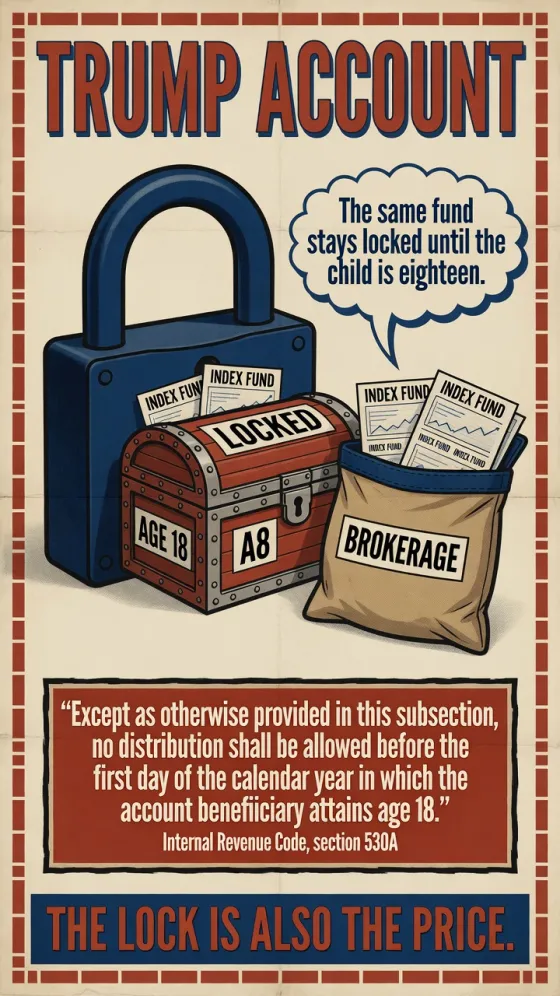
- Nothing can be withdrawn before the year the child turns 18. There is no hardship exception and no penalty to pay instead. The money is simply not available.
- From that year on it is an ordinary traditional IRA in the child's name. Withdrawals are taxed as ordinary incomeIncome taxed at the regular graduated rates — wages, interest, pension payments, and withdrawals from traditional retirement accounts. The point of the label is the contrast: long-term capital gains and qualified dividends get their own, usually lower, rate schedule.Full entry → on the earnings, the parents' contributions come back as basis, and the usual pre-59½ rules apply.
Tutilis models each of those. The editor flags a contribution over the ceiling, offers the $1,000 deposit when the child's birth year qualifies, refuses to sell from the account before the child is 18, and taxes the earnings as ordinary income after.
Desktop app only
Ada's birth year is on her person, and the $5,000 is a contribution on the account named For Ada.
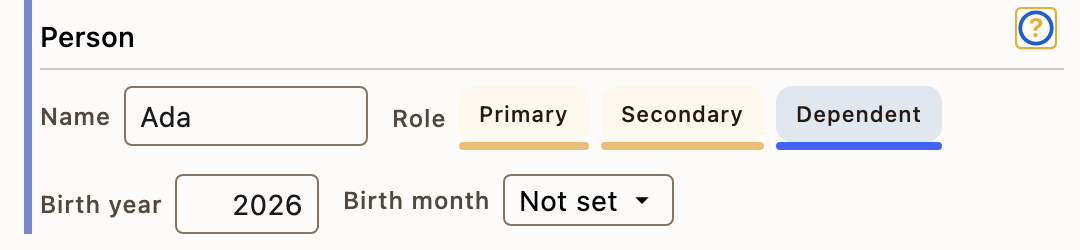
Ada's person editor on the Trump Account plan. Her birth year is 2026, which is what qualifies the $1,000 Treasury deposit.
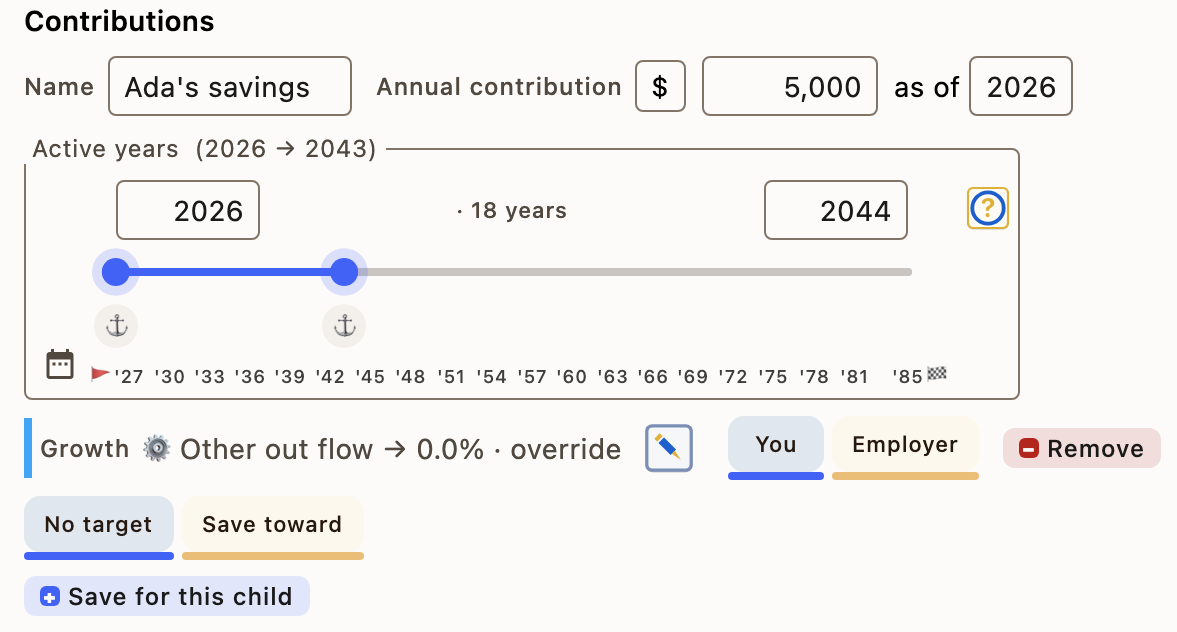
The contributions on For Ada: $5,000 a year from 2026 through 2043.
Both plans hold the same household. Maya and Theo earn about $150,000 between them, spend about $96,000 a year plus childcare while Ada is small, and keep $18,000 in checking and $40,000 in a brokerage account. In every year but one the household runs a surplus, which lands in the checking and brokerage accounts.
In the Trump Account plan, an account named For Ada opens with the $1,000 Treasury deposit and receives $5,000 a year from her parents until 2043. The deposit carries no cost basis, because the statute says it comes out as taxable earnings; the contributions do.
In the Brokerage instead plan, the same $5,000 a year goes into a brokerage account with the same name, earmarked for Ada and holding the same index fund. To keep the two plans comparable, her parents put in the first $1,000 themselves, so both accounts start at the same balance. The brokerage account carries a target balance the household will never reach; that is a modeling device, not a plan, and it exists so the household's ordinary surplus does not drift into Ada's account and muddy the comparison.
The two accounts earn the same return on the same dollars. Through 2035 their balances are identical to the dollar.
In 2036 the household has an expensive year. The roof, the furnace and a car all go at once, and the plan carries a one-year expense of $70,000 on top of ordinary living. Income does not cover it, so the forecast has to sell something.
Here is what it sells in each plan:
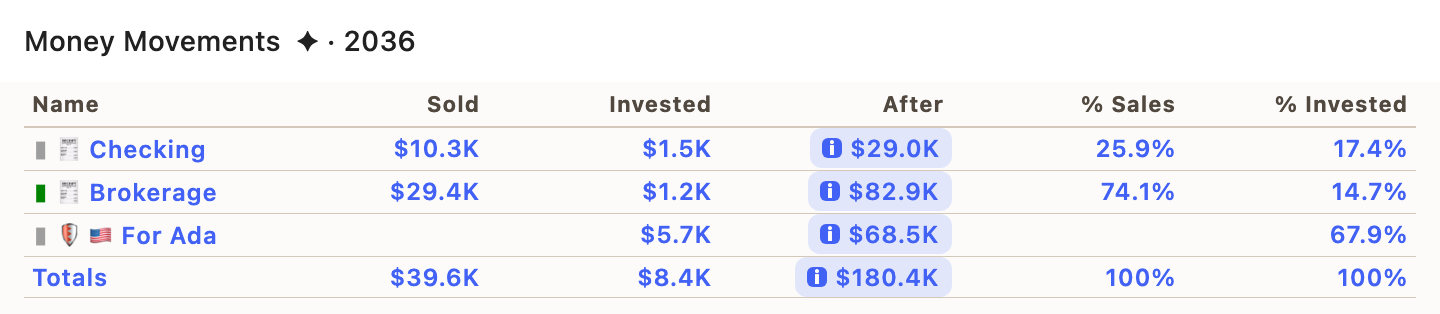
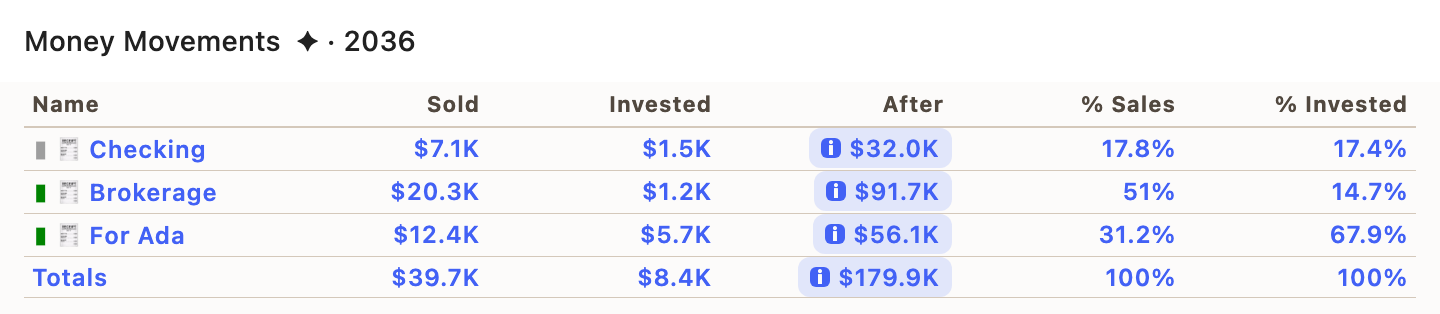
With the Trump Account, the shortfall comes out of checking and the parents' brokerage account, and For Ada does not appear in the Sold column at all. It is not that the plan chose to spare it. The account was not on the list of things that could be sold, because in 2036 Ada is ten.
With the brokerage instead, For Ada is one more taxable account, and the forecast's residual strategy sells from the taxable accounts in proportion to their size. Almost a third of the shortfall, about $12,400, comes out of the account her parents meant for her. Nobody decided that. It is what happens to money that is reachable in a year when money is needed.
By 2044 Ada is 18 and the contributions have stopped. Compare the two balance sheets:
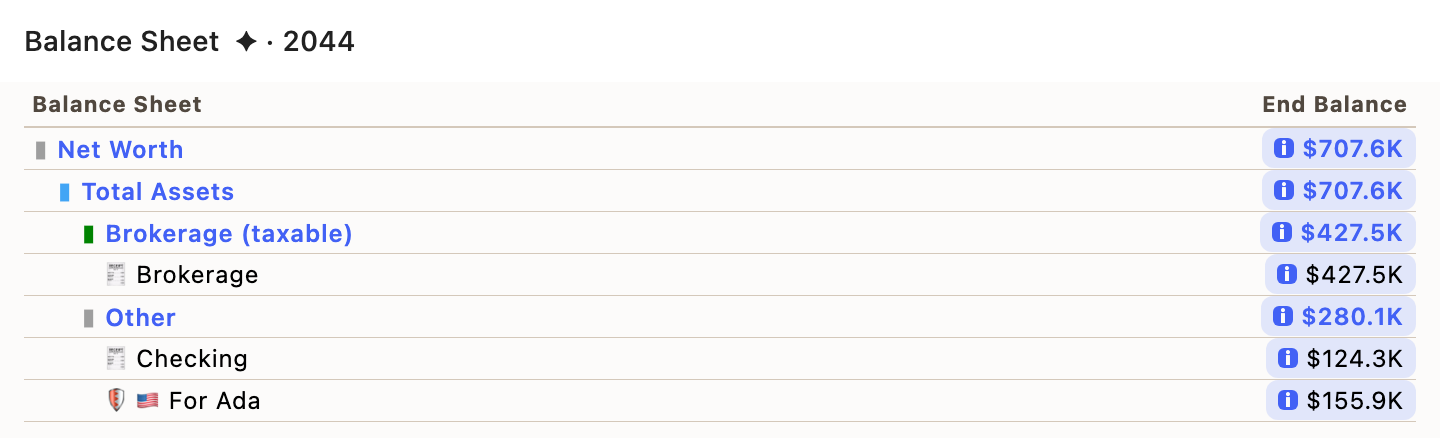
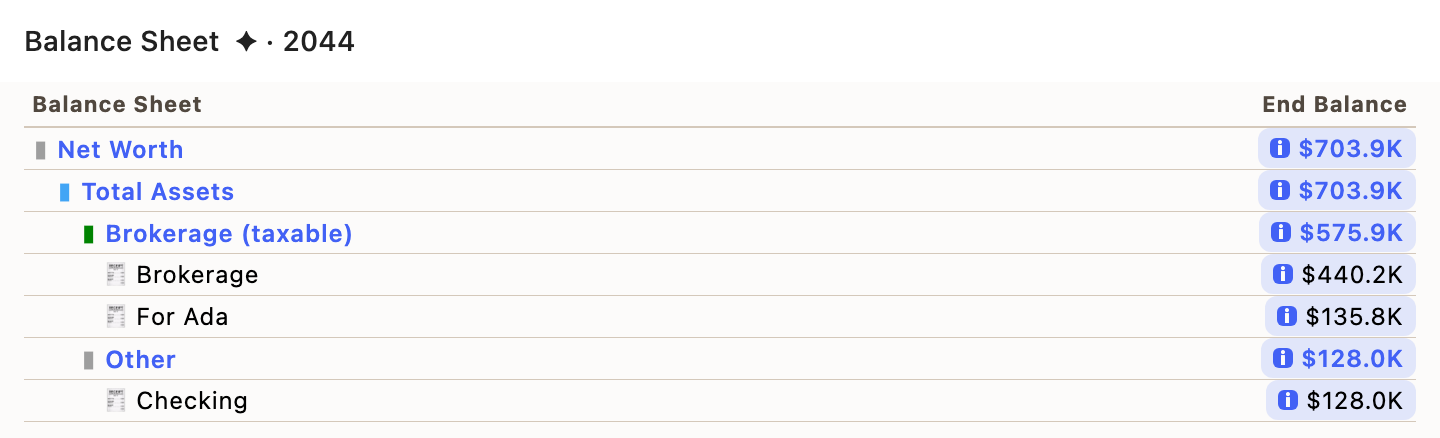
The Trump Account is about $20,000 ahead. Every dollar of that gap traces back to the 2036 sale: the $12,400 that left the brokerage account would have compounded for another eight years, and it did not. Five years later, at 2049, the gap has grown to about $27,000, and it keeps growing for as long as the money stays invested.
The household is not poorer for it. Total net worth is almost the same in both plans, because the 2036 shortfall was paid either way. What differs is whose money paid it. In one plan it came partly out of Ada's future; in the other, it could not.
From 2044 the plan treats Ada's account as her own traditional IRA. In life it would leave this plan with her. Here it simply keeps compounding so you can see the shape of what she was handed.
The lock is the point, and it is also the price. The same rule that kept the 2036 shortfall out of Ada's account would have kept a genuine emergency out of it too. A family that might need that money before the child is 18 should not put it there.
Two smaller points are worth knowing. First, the tax character is different rather than better. A brokerage account pays a little tax each year on its dividends and capital-gains tax on the way out; a Trump Account pays nothing along the way and ordinary income tax on the earnings when the child eventually withdraws, at the child's rate then. Which is cheaper depends on a rate nobody knows yet. Second, the modeled contributions are $5,000 in 2026 money, rising with inflation, which is how the statutory ceiling is indexed from 2028. Tutilis will flag a contribution above the ceiling for the year, and it will flag one made after the child turns 18.
- A Trump Account and a brokerage account can earn exactly the same return. The account does not make the money grow faster.
- What it does is take the money off the table. Before the child is 18 nothing can be sold from it, and in the year this household needed cash, that was the whole difference.
- The gap that opens in a bad year does not close. It compounds.
- The lock protects the child from the household's bad years, and it also means the household cannot count on that money. Both are true, and the second is the reason to think before opening one.
Rebuild this plan by hand
The cards on the canvas show the accounts and cash flows. These are the settings that live outside any card, read from each plan this lesson opens, with the label each control carries in the app. A value marked default is one to leave alone.
| Setting | Trump Account | Brokerage instead |
|---|---|---|
| Household | ||
| Planning region | United States (default) | United States (default) |
| Maya (Primary) | ||
| birth year | 1994 | 1994 |
| retirement age | 65 | 65 |
| death age | 90 | 90 |
| Theo (Secondary) | ||
| birth year | 1995 | 1995 |
| retirement age | 65 | 65 |
| death age | 90 | 90 |
| Ada (Dependent) | ||
| birth year | 2026 | 2026 |
| retirement age | — | — |
| death age | — | — |
| Taxes | ||
| Tax regime | United States | United States |
| Filing status | Married, filing jointly | Married, filing jointly |
| State of residence | Ohio | Ohio |
| First-year federal estimate | — | — |
| First-year state estimate | — | — |
| Strategy | ||
| Residual withdrawal strategy | Pro-rata (default) | Pro-rata (default) |
| Roth conversions | Off | Off |
| Definition of success | Liquidity crises allowed (default) | Liquidity crises allowed (default) |
| Glide path target | None (default) | None (default) |
| Advanced | ||
| Reporting inflation | Assumption set's rate (default) | Assumption set's rate (default) |
| Cost of capital | Assumption set's rate (default) | Assumption set's rate (default) |
| Growth assumptions | Growth overrides (default) | Growth overrides (default) |
| Currencies | Multiple currencies (default) | Multiple currencies (default) |
| Default currency | USD (default) | USD (default) |
| Display currency | USD (default) | USD (default) |

Educational content — not advice. These lessons teach how Tutilis models a plan and how to read what it shows. The households, balances, and outcomes in them are invented for teaching. Nothing here is financial, investment, tax, or legal advice, or a recommendation to buy, sell, or hold anything. A model cannot know your circumstances — check anything you take from a lesson against your own situation, and against a qualified professional where it matters.