This lesson uses 2 sample plans — switch anytime; color matches the bar between the columns.
On the right now: As it is

 A budget checklist for a first paycheck
The situation A 23-year-old on a first salary who has never written the expenses down, is not sure how much is being saved each month, and wants to know how much room the budget really has.
How this page works
New to the Learning Center, or want a map of the panels? Start with a tour: Reading Lesson (Getting Around) or Screencast Lesson (Getting Around) — both walk through Tutilis next to a live planThe running Tutilis product next to this lesson — navigation, Bird's Eye, Forecaster, tools, and more — loaded with a teaching sample. A dossier is the plan data; the live plan is the full product surface with a sample dossier already open so you can explore. On the web, teaching samples are not editable the way your own dossier will be in the full app.Full entry → (to the right on a desktop-width screen, or below when stacked on a tablet).
This page — A budget checklist for a first paycheck — can open more than one live sample planThe running Tutilis product next to this lesson — navigation, Bird's Eye, Forecaster, tools, and more — loaded with a teaching sample. A dossier is the plan data; the live plan is the full product surface with a sample dossier already open so you can explore. On the web, teaching samples are not editable the way your own dossier will be in the full app.Full entry → next to the text (to the right on a wide screen, or below on a tablet). Use the Live plans chips (and matching colored links in the prose) to switch without leaving this page; the colored bar near the plans shows which one is loaded. The walk-through stays in the text.
The live planThe running Tutilis product next to this lesson — navigation, Bird's Eye, Forecaster, tools, and more — loaded with a teaching sample. A dossier is the plan data; the live plan is the full product surface with a sample dossier already open so you can explore. On the web, teaching samples are not editable the way your own dossier will be in the full app.Full entry → next to this page — usually to the right on a wide screen, or below on a tablet — is Tutilis running a teaching sample: the same financial planning product available as a desktop application (early preview). A dossierYour full plan in Tutilis: the people in the household, what they own and owe, cash flows in and out, tax setting, and planning assumptions. One dossier is one complete situation as the product models it.Full entry → is the plan data; the live plan is the full product (navigation, Bird's Eye, Forecaster, tools) with a sample dossier already open so you can try the panels. See planned pricing. On the web, Learning Center samples are not editable the way your own dossier will be in the full app. Your own household goes in the Tutilis desktop app — the Learning Center front page has a short clip of that.
Riley is 23, a year out of college, and earning $65,000 at a first real job. Rent gets paid, the car gets paid, the 401(k)An employer-sponsored retirement account, named after the section of tax law that created it — so the name says nothing about what it does. Contributions are usually payroll-deducted, often matched by the employer, and come in traditional (pre-tax) and Roth flavors. A 403(b) is the same idea for schools and nonprofits, a 457 for government workers.Full entry → takes 3% because that was the box on the onboarding form, and whatever is left at the end of the month is gone by the next one. Riley has never written the expenses down, and so has no answer to the only budgeting question that matters: how much is being saved each month, and is it enough? A first paycheck budget, written down once, answers it.
This lesson is a checklist for answering that. It walks through every category a first paycheck goes to, asks the questions that find the amounts, and puts the totals on a plan so the tool can do the arithmetic. It then measures each section against a few rules of thumb, and shows what happens, this year and forty years from now, when the sections that are over their range are trimmed and the difference is given somewhere to go.
Two plans are open on the canvasWhat we call the right side of this page (or the bottom on a narrow screen) where the Tutilis application is drawn in this web Learning Center setting. It is the same product surface as the live plan — navigation, Bird's Eye, Forecaster, and so on — not a separate product.Full entry →: As it is, Riley's budget as it stands, and Trimmed to the ranges, the same budget after the trims. Every figure below says which plan it comes from. The first forecast year is 2027, so set the ForecasterWhere you run and inspect projections — simulation summary and year-by-year detail for the plan currently open.Full entry → there once and it carries across the switch.
Go section by section and write a monthly number beside every line, even when the number is zero. A zero you wrote is a decision. A line you skipped is a guess. Each section opens with the questions that find the amounts, and closes with what Riley wrote down and how each line sorts into Need, Want, Savings or Unexpected. Those four buckets come back later, when the budget is measured.
Housing
Where do you live, and what does it cost to keep the lights on and the fridge full? What do you pay to protect what is in the apartment? What does the phone cost, and the internet? How much goes to groceries in an ordinary week, and to the things that are not food but come from the same store? Did you buy a couch this year, and will you buy something like it next year?
| Line | Riley, per month | Sort |
|---|---|---|
| Rent or mortgage | $1,625 | Need |
| Renter's or homeowner's insurance | $15 | Need |
| Utilities (electricity, gas, water) | $110 | Need |
| Internet | $60 | Need |
| Phone bill | $65 | Need |
| Groceries | $380 | Need |
| Household supplies (cleaning products, toiletries) | $40 | Need |
| Furniture and home essentials | $30 | Want |
| Repairs and maintenance | $0 | Unexpected |
| Housing | $2,325 |
Rent at $1,625 is exactly 30% of Riley's gross pay, which is a number we will come back to.
Transportation
How do you get to work, and what does that cost per month rather than per tank? Is there a car payment, and for how many more years? What is the insurance, and when did you last shop it? What do you set aside for oil changes and tires, or do those arrive as surprises? Do you pay to park? Do you take rideshares, and how often is that a choice rather than a necessity?
| Line | Riley, per month | Sort |
|---|---|---|
| Car payment | $430 | Need |
| Car insurance | $150 | Need |
| Gas | $130 | Need |
| Maintenance (oil changes, tires, repairs) | $50 | Need |
| Parking | $45 | Need |
| Public transit passes | $0 | Need |
| Rideshare budget | $45 | Want |
| Transportation | $850 |
Personal and lifestyle
What do you spend on clothes and shoes across a year, divided by twelve? Haircuts? Is there a gym, and do you go? What do the hobbies cost? How many streaming services are you paying for, and could you name them all without checking? What did you spend eating out and going out last month, honestly? Do you set money aside for a trip, or does the trip go on a card? What do birthdays and the holidays cost?
| Line | Riley, per month | Sort |
|---|---|---|
| Clothing and shoes | $80 | Need |
| Haircuts and grooming | $40 | Need |
| Gym membership or fitness classes | $50 | Want |
| Hobbies | $50 | Want |
| Streaming services | $45 | Want |
| Dining out and entertainment | $430 | Want |
| Travel fund | $100 | Want |
| Gifts (holidays, birthdays) | $50 | Want |
| Personal and lifestyle | $845 |
Clothes and haircuts are sorted as needs, because a first job expects you to show up presentable and that costs something every month. The part above presentable is a want, and the line between them is yours to draw. The sort matters later, when the buckets are measured, so make it deliberately rather than by default.
Dining out and entertainment at $430 a month is $5,160 a year, which is just under 8% of Riley's gross pay. That is the other number we will come back to.
Work and professional
Does the commute cost something the transportation section did not already count? Does the job need clothes you would not otherwise buy? Are there courses or certifications you are paying for, or that the employer would pay for if you asked? Do you go to events that cost money to attend?
| Line | Riley, per month | Sort |
|---|---|---|
| Work-related commuting costs | $0 (counted under gas and parking) | Need |
| Professional clothing | $25 | Need |
| Courses and certifications | $0 | Want |
| Networking events | $15 | Want |
| Work and professional | $40 |
Savings and financial health
This is the section most people leave blank, and it is the one the lesson exists for. What goes into the 401(k) each month, and what does the employer add? Is there an emergency fund, and how many months of expenses would it cover? Is there a separate pot for the next big purchase, and for the long-term ones? Is anything invested outside the retirement account?
| Line | Riley, per month | Sort |
|---|---|---|
| Emergency fund (3 to 6 months of expenses) | $0, and about $2,000 in checking | Savings |
| Retirement contributions (401(k), IRAIndividual Retirement Account — a retirement wrapper you open yourself rather than through an employer. It comes in traditional (pre-tax going in) and Roth (taxed going in) flavors, so naming the flavor matters more than the acronym does.Full entry →) | $163, a 3% deferral, plus $81 from the employer | Savings |
| Short-term savings (vacations, big purchases) | $0 (the travel fund above is the only one) | Savings |
| Long-term savings (house, future goals) | $0 | Savings |
| Investing | $0 | Savings |
| Savings and financial health | $163, plus the match |
The emergency fund is thin, too. $2,000 in checking is about two weeks of Riley's expenses, and the usual target is three months.
Insurance and health
What comes out of the paycheck for the health plan, and what do you pay on top of that in an ordinary year for visits and prescriptions? Are dental and vision separate? Does anyone depend on your income, which is the question that decides whether life insurance belongs here? Does the employer provide disability coverage, and do you know?
| Line | Riley, per month | Sort |
|---|---|---|
| Health insurance premiums (employee share) | $120 | Need |
| Copays and prescriptions | $40 | Need |
| Dental and vision | $25 | Need |
| Life insurance | $0 (nobody depends on the income yet) | Need |
| Disability insurance | $0 (provided by the employer) | Need |
| Insurance and health | $185 |
Personal development
What do you spend on books? On courses that are yours rather than the job's? On a learning subscription you signed up for in January?
| Line | Riley, per month | Sort |
|---|---|---|
| Books | $15 | Want |
| Online courses | $20 | Want |
| Skill-building subscriptions | $0 | Want |
| Personal development | $35 |
Administrative and other
Is tax withheld from the paycheck, or will there be a bill in April? Is the bank charging you anything, and why? Is there a pet? And what did last year's parking ticket, cracked phone screen and flat tire add up to, because something like them will happen again this year?
| Line | Riley, per month | Sort |
|---|---|---|
| Taxes (if self-employed or under-withheld) | $0 (withheld; the plan computes the bill) | Need |
| Bank fees | $10 | Need |
| Pet expenses | $0 | Need |
| "Life happens" fund (tickets, repairs, surprises) | $100 | Unexpected |
| Administrative and other | $110 |
Riley's checklist comes to $4,390 a month before the 401(k), or $52,680 a year, which is 81% of gross pay. What is left after that has to cover the tax bill and the retirement contribution, and we are about to find out whether it does.
A plan does not want forty line items. It wants each section as one number a year, which is the monthly total times twelve, and it wants savings as contributions on the accounts they go into rather than as expenses. That is how both plans in this lesson were built:
- Each expense section is one living expense line named for the section, with its monthly total times twelve in 2026 money. Housing is $2,325 × 12 = $27,900, Transportation is $850 × 12 = $10,200, and so on.
- Insurance and health is a healthcare line rather than a living expense, so the tool can switch it to Medicare at 65 and so it shows up under its own heading.
- The 401(k) is an account with two contributions, Riley's deferral and the employer's match, and the match is marked as employer-funded so it counts as income rather than as something Riley paid.
- Salary is $65,000 until retirement at 67, Social Security is estimated from a statement and claimed at full retirement age, and there is no student loan. If you carry one, it goes on the plan as a loan and appears as its own line.
Open  Bird's EyeWhen you are not on Dossier, this control sits in the top toolbar. Opens a household overview as a modal — people, assets and liabilities, cash flow — without leaving the area you are in. Hidden on Dossier, because that same overview already sits at the top of that area. with the Cash Flow chip selected and the checklist is the liability side of the beam. Each bar is the present valueWhat a future amount is worth today, after discounting for the years between. A multi-year outflow shown as one present value is not a sum of its rows — a dollar due in twenty years counts for less than one due next year. The product's PV rollups and "amount mode" switches are this idea applied to a whole flow.Full entry → of a lifetime of that section, which is why Housing dwarfs everything else:
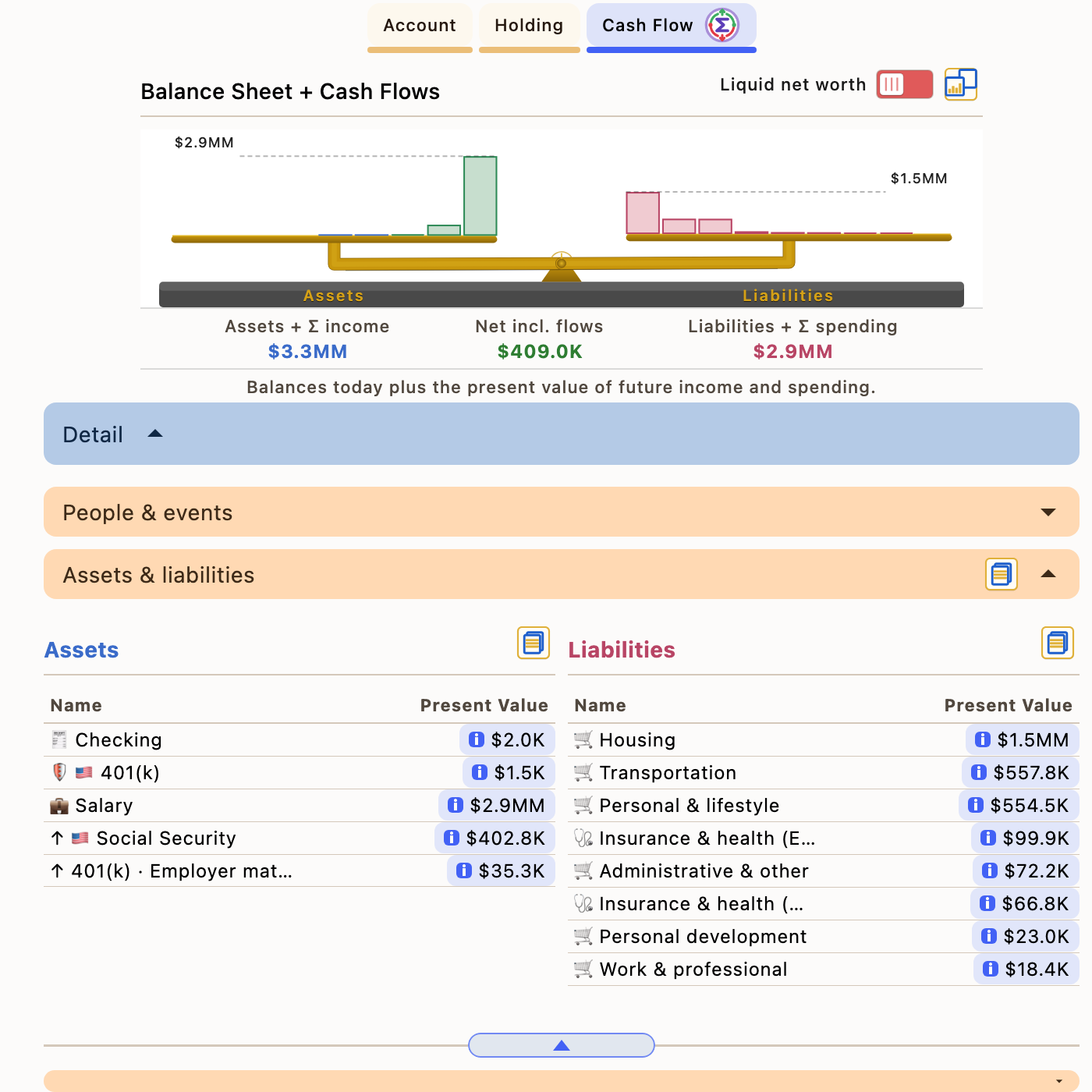
Bird's Eye in As it is: the sections as lifetime present values.
HoverOn a desktop or laptop, rest the pointer on a row, chip, or control to open a detail card — attributes, amounts, and often a small path chart. We put a lot of teaching detail in those cards on purpose. Hover needs a pointer, so it does not work on tablets or phones (tap may show a simpler view or nothing). Hold Alt if the tips become a nuisance — many product hovers stay closed while Alt is down so you can move the pointer freely.Full entry → a section and its card shows the one number the plan holds for it:
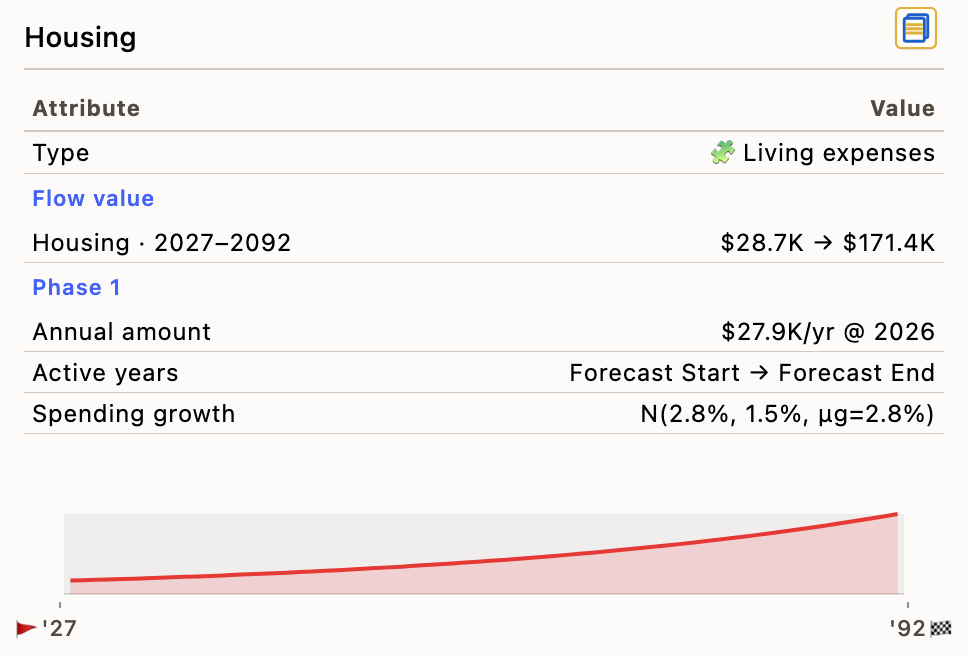
The Housing card in As it is: one phase, the monthly total times twelve.
The forecast's first year is 2027, and the tool grows every line from the 2026 amounts Riley typed before it pays them, so the tables below sit a few percent above the checklist. The proportions are what matter, and they carry. Here is the cash flowMoney moving over a period — wages and benefits in, spending and taxes out. The counterpart to the balance sheet's snapshot: a household can look wealthy on the balance sheet and still be short of cash in a given year, which is usually what forces a sale.Full entry → statement for 2027, which is the checklist totaled by the tool:
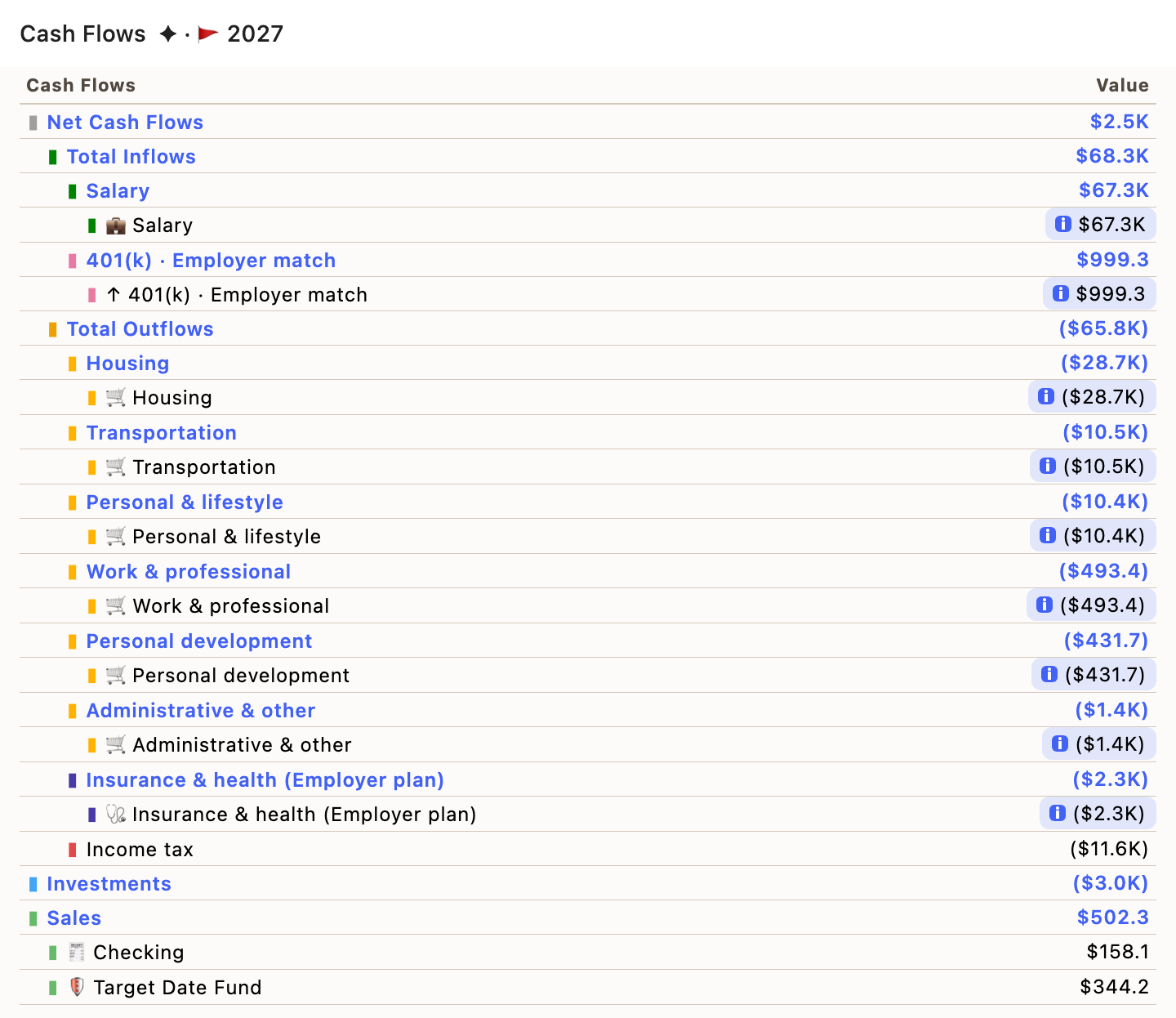
Cash flow for 2027 in As it is, on  CF TableA Forecast Detail chip. CF = cash flows for the selected year — incomes, expenses, taxes, and invest / sell / borrow totals..
Two lines on that statement are not on the checklist, and they are the reason to put a budget on a plan rather than on the back of an envelope. Income tax is about $11,600, which is about a sixth of Riley's pay and larger than any section except Housing. Riley never wrote it down because it never arrives as a bill; it leaves the paycheck before the paycheck arrives. And Investments, about $3,000, is the 401(k) deferral and the employer match, with nothing left over, which is the answer to the question the lesson opened with.
The reconciliation puts sources against uses for the year, and it is the cleanest picture of how much of Riley's pay is being used:
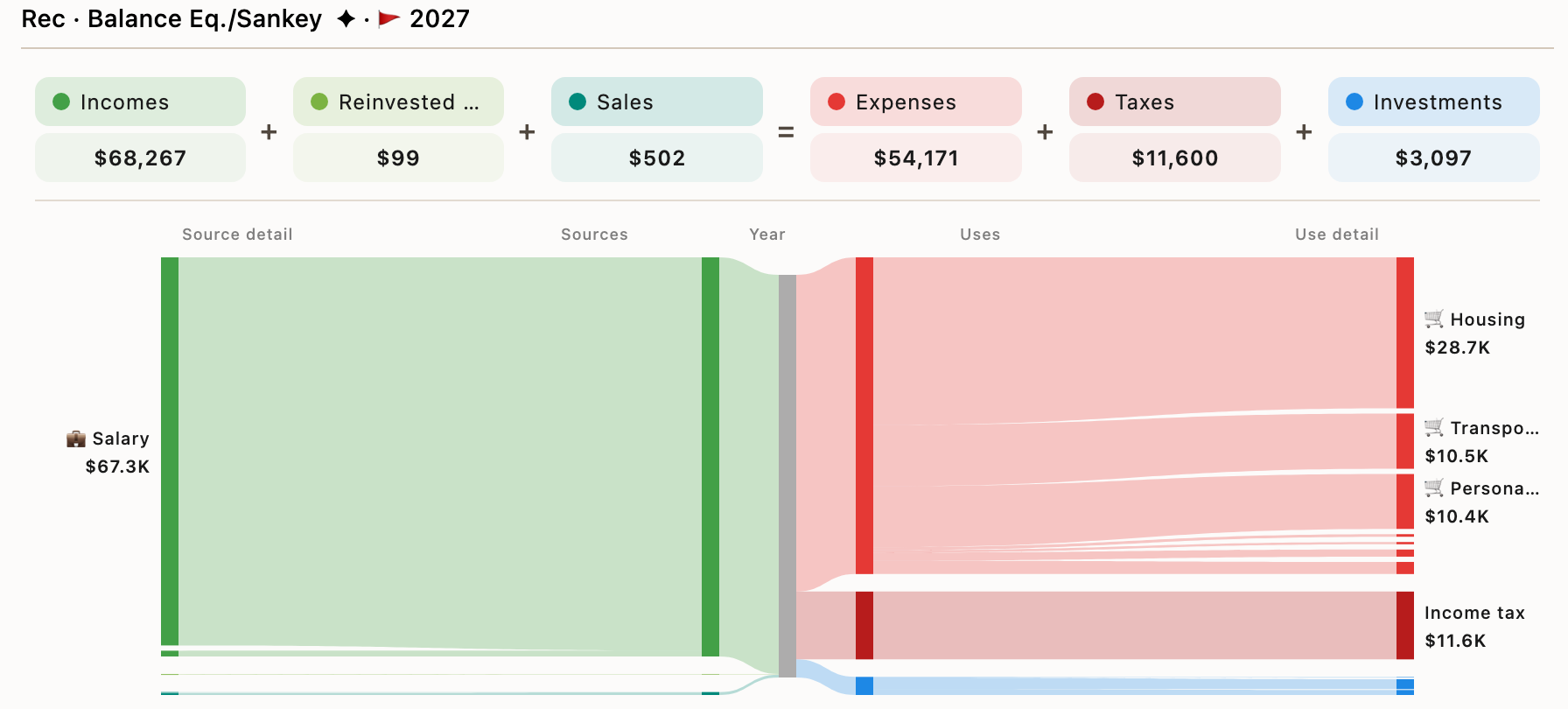
Reconciliation for 2027 in As it is, on  RecA Forecast Detail chip. Rec = Reconciliation. Ties the year's cash flows to the balance-sheet change so you can see why net worth moved..
Of about $68,900 that came in, about $54,200 went to expenses and $11,600 to tax. That is 96 cents of every dollar, before saving a cent. The blue bar, investments, is the 401(k) plus about $80 paid into Checking, and the Money Movements table says exactly where it went:
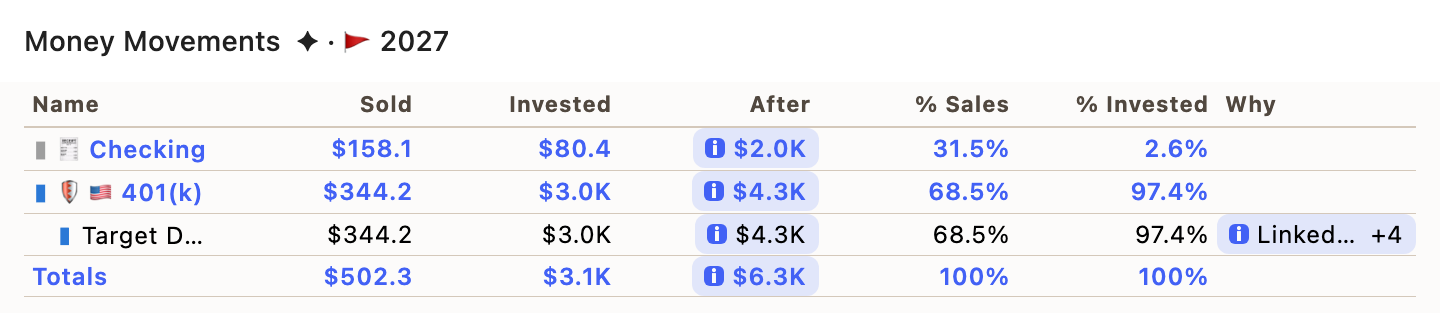
Sales and investments for 2027 in As it is, on  Moves TableA Forecast Detail chip. Mov = Movements. Holding-level trades for the selected year — sold or invested, after, %, and Why..
Riley's own deferral is about $2,000 and the match adds about $1,000, but the year runs about $500 short. The plan covers the gap by selling about $160 from Checking and about $340 from the 401(k), half of that as an early withdrawal. In real life the gap is more likely to land on a credit card. The plan is being generous.
Now sort the checklist into the four buckets. Riley's take-home pay, after tax and the 401(k) deferral, is about $4,300 a month.
| Bucket | Riley, per month | Share of take-home | The 50/30/20 target |
|---|---|---|---|
| Needs | $3,440 | 80% | 50% |
| Wants | $850 | 20% | 30% |
| Unexpected | $100 | 2% | (inside needs) |
| Savings | $163 | 4% | 20% |
The shares add to 106% because the checklist runs slightly above take-home pay, and the $163 of savings has already come out of it.
The 50/30/20 rule is a target, and it is one line long: half of take-home pay to needs, three-tenths to wants, a fifth to savings. Riley's wants are inside their range. Needs are four-fifths of take-home, which is normal on a first salary in a city with real rents. Savings are 4% against a target of 20%, and that gap is the shortfall the lesson is looking for. The buckets say where it can come from: a little from wants, and more from the one need that is bigger than all the others.
Rules of thumb are not laws, and every one of them has exceptions by city and by circumstance. They are useful because they say which sections deserve a hard look. Here are the ranges this lesson uses, measured against Riley's checklist as a share of gross pay. A section inside its range is fine. A section above it is where to look first.
| Section | Range | Riley, as it is | Verdict |
|---|---|---|---|
| Rent or mortgage | 25% to 30% of gross pay | 30.0% | At the line |
| Housing, all in | 35% to 40% of gross pay, counting utilities, phone, internet and groceries; this band varies most by city | 42.9% | Watch |
| Transportation | 10% to 15% of gross pay, car payment included | 15.7% | Over |
| Dining out and entertainment | 3% to 5% of gross pay | 7.9% | Over |
| Retirement saving | 15% of gross pay or more, counting the employer match | 4.5% | Under |
| Emergency fund | 3 to 6 months of expenses | About half a month | Under |
Each highlighted row comes with a reason, because the reason is what makes the number worth acting on.
Transportation is over by a little, and the car payment is why. A car payment is the one line in this section that a budget cannot trim; it ends when the loan ends. The lever this year is small, which is shopping the insurance and cutting the rideshares. The bigger lever is the next car, which should cost less.
Dining out and entertainment is over by three points of pay, which is about $2,000 a year. It is the most flexible line on the whole checklist, and the rule of thumb is 5% because that is roughly where a single person on one salary can eat out regularly without it being the thing the budget is built around.
Retirement saving is under by ten points of pay, and the first three of those are free. The employer matches half of the first 6%, so raising the deferral from 3% to 6% costs Riley about $160 a month before tax and collects about $80 a month that is currently left on the table. Nothing else on this page has that return.
The emergency fund is under, which is the reason the "life happens" line exists and the reason it is not enough. A hundred dollars a month covers the parking ticket. It does not cover a month without a paycheck, and three months of Riley's expenses is about $13,000.
Rent is at the line rather than over it, and the housing row is marked watch rather than over because the all-in band is the loosest of these and depends most on where you live. But housing is the section where the room is, if Riley wants it. A roommate does not change the rule; it changes the rent.
The Trimmed to the ranges plan is the same checklist with seven lines changed and the difference given three places to go. Nothing else moves: same salary, same car, same phone, same gym.
| Line | As it is | Trimmed | Why |
|---|---|---|---|
| Rent | $1,625 | $1,300 | A roommate; 24% of gross instead of 30% |
| Utilities | $110 | $70 | Split two ways |
| Internet | $60 | $30 | Split two ways |
| Car insurance | $150 | $130 | Shopped |
| Rideshare | $45 | $20 | Mostly the car |
| Streaming | $45 | $25 | Two services instead of four |
| Dining out and entertainment | $430 | $270 | 5% of gross pay |
| Freed | $620 a month |
And where it goes:
| Savings line | As it is | Trimmed | What it is |
|---|---|---|---|
| 401(k) deferral | 3%, $163 a month | 6%, $325 a month | Collects the full match, which doubles to $163 |
| Emergency fund | $0 | $300 a month | Into a savings account with a target balance of $12,000; the plan stops the top-up when it gets there |
| RothA retirement account where you pay income tax on the money going in, and qualified withdrawals later come out tax-free — the mirror image of traditional. Named after the senator behind the law, so the word tells you nothing on its own. Plans care because Roth dollars do not add to taxable income later, which keeps them clear of income-driven cliffs.Full entry → IRA | $0 | $100 a month | After-taxMoney that has already had income tax taken out of it. In an account it means you own that basis outright and will not be taxed on it again — only on the growth, and how *that* is taxed depends on the wrapper it grew in.Full entry → money that grows and comes out untaxed |
| Saved | $163 plus $81 match | $725 plus $163 match |
The savings add to $562 a month against $620 freed, and the extra 3% of deferral comes out before tax. From the second year that lowers the income tax, so the take-home falls by less than the deferral rises. The rest is slack, and slack is fine. Here is the same cash flow statement for 2027 in the trimmed plan:
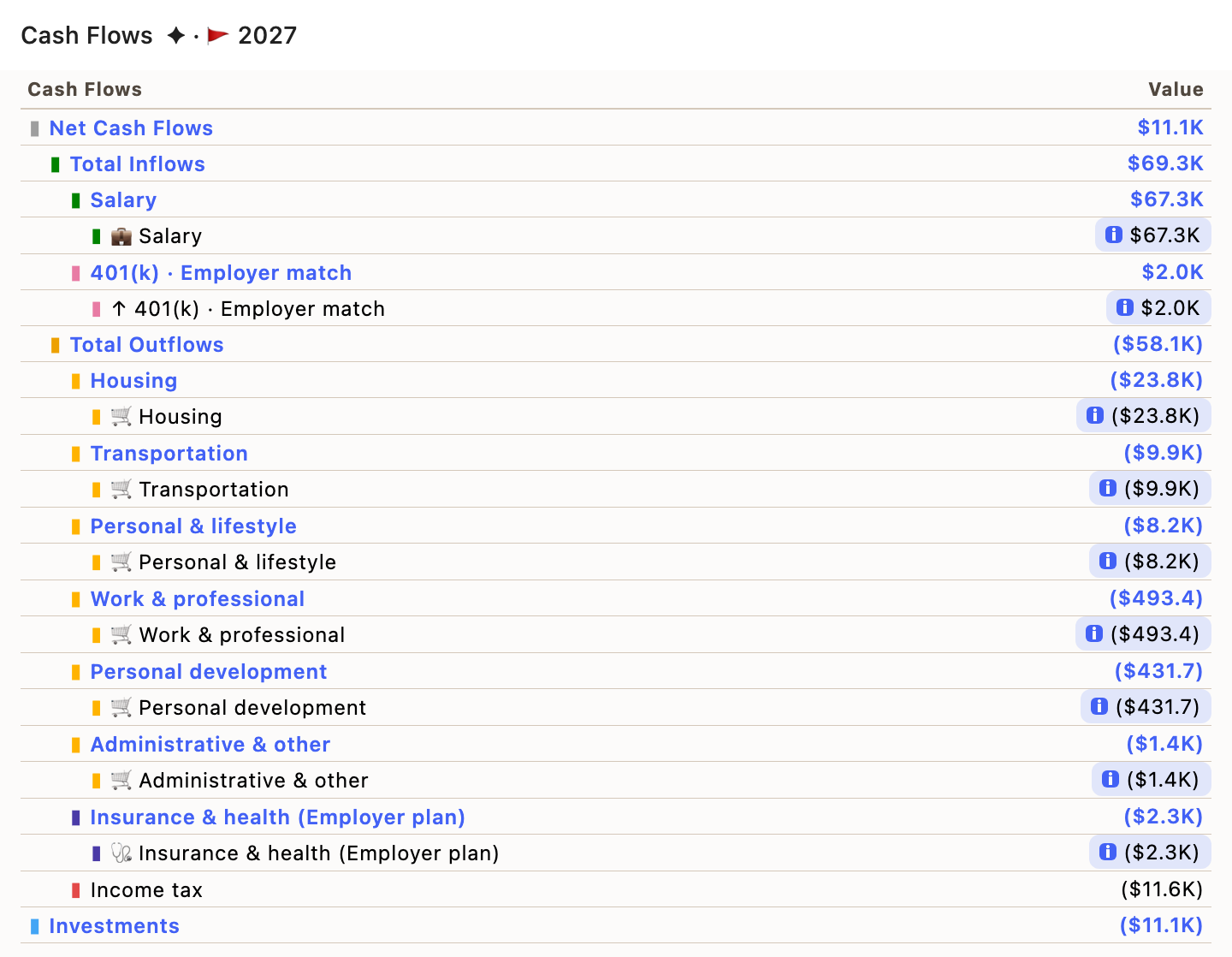
Cash flow for 2027 in Trimmed to the ranges, on CF TableA Forecast Detail chip. CF = cash flows for the selected year — incomes, expenses, taxes, and invest / sell / borrow totals..
Housing is about $4,900 lower, Personal and lifestyle about $2,200 lower, the match has doubled, tax is the same this first year because both plans pay the stated estimate, and Investments has gone from about $3,000 to about $11,100. From 2028 the larger pre-taxMoney that went in before income tax was taken — the traditional bucket. Not the same as untaxed: the tax was deferred, not forgiven, and it comes due as ordinary income on the way out. A pre-tax balance is worth less to spend than the same number in a Roth.Full entry → deferral trims the tax by a few hundred dollars a year. The Money Movements table shows the routing, which is the part a budget on paper cannot do:
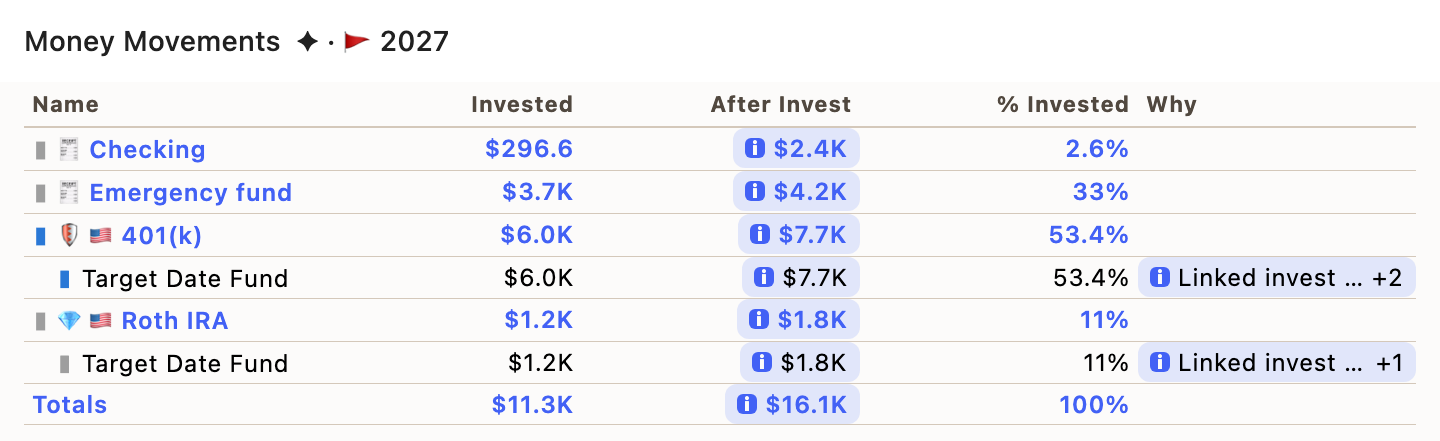
Sales and investments for 2027 in Trimmed to the ranges, on Moves TableA Forecast Detail chip. Mov = Movements. Holding-level trades for the selected year — sold or invested, after, %, and Why..
The emergency fund takes about $3,700, the 401(k) about $6,000 of which $2,000 is the match, the Roth about $1,200, and about $300 is left in Checking. In three years or so the emergency fund reaches its target balance and the top-up stops on its own; that $300 a month is then the next thing to give a name to. And the reconciliation, side by side with the one above:
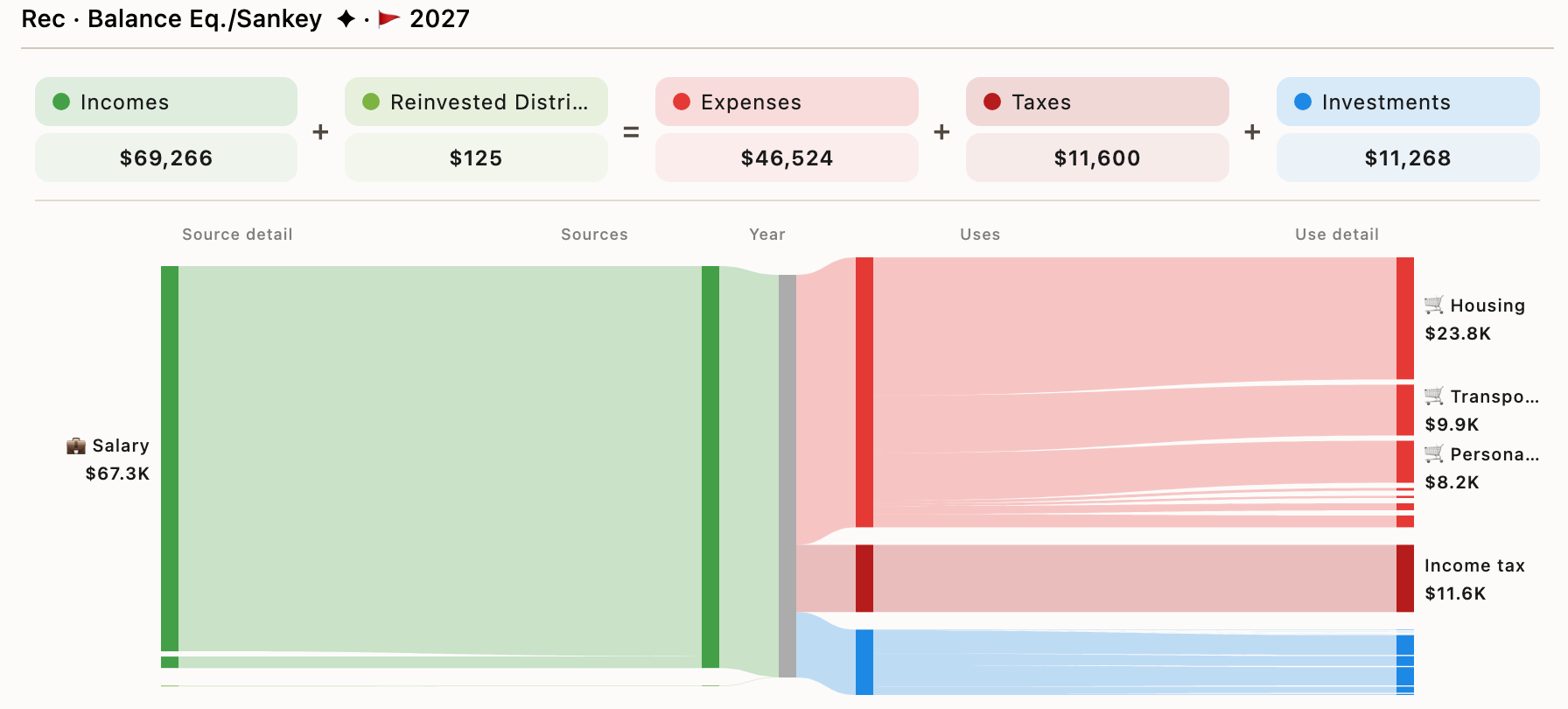
Reconciliation for 2027 in Trimmed to the ranges, on RecA Forecast Detail chip. Rec = Reconciliation. Ties the year's cash flows to the balance-sheet change so you can see why net worth moved..
Expenses and tax now take about 84 cents of every dollar rather than 96, and the blue bar is about 16% of pay counting the match. About 10% of pay goes to the 401(k) and the Roth IRA and the rest builds the emergency fund. When that fund is full, the $300 a month it frees brings the retirement rule of thumb within reach, from a budget that a year ago had never been written down.
The trims are worth about $620 a month now. What they are worth later is the reason to make them. Here is the balance sheetWhat the household owns and what it owes, at one moment. Assets on one side, liabilities on the other, and the difference is net worth. It is a snapshot rather than a story: it says nothing about money moving through the year, which is what the cash flow is for.Full entry → over the whole plan, first as it is and then trimmed, on  BS ChartA Forecast Detail chip. BS = balance sheet. Assets above the line, liabilities below, over the forecast years. The net line, drawn in thick black, is net worth — often the thing you came for. Click a year to load the tables.:
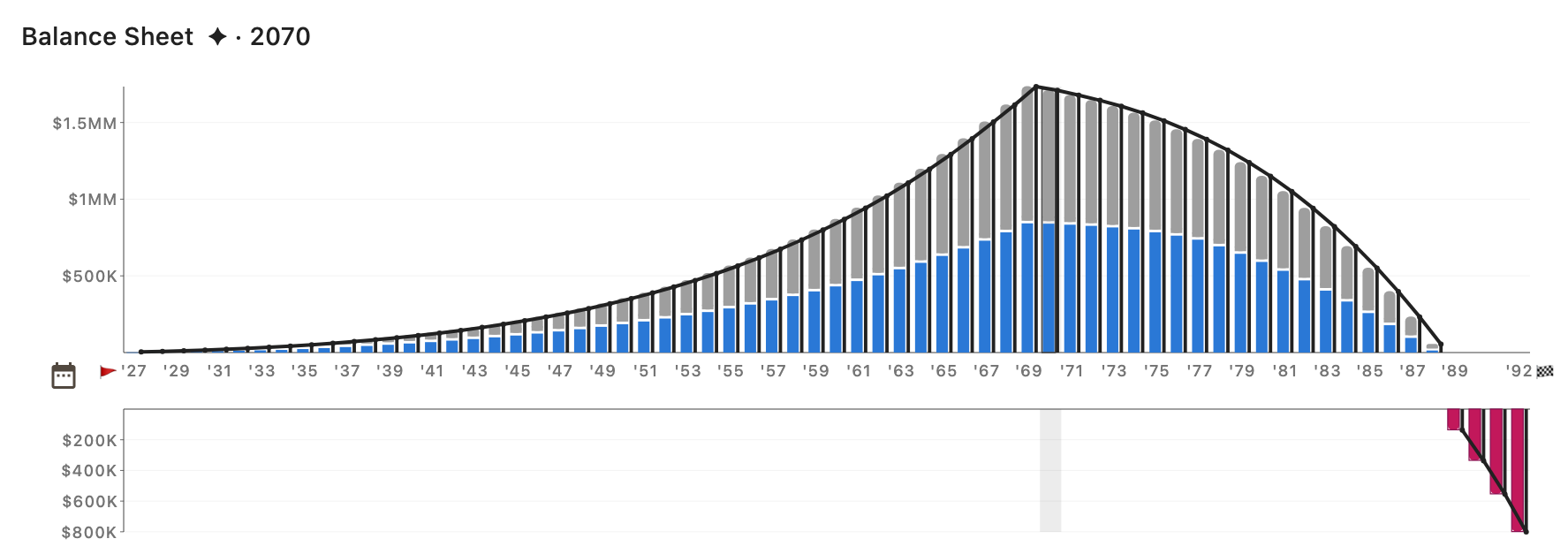
Balance sheet by year in As it is, with 2070, the retirement year, selected.
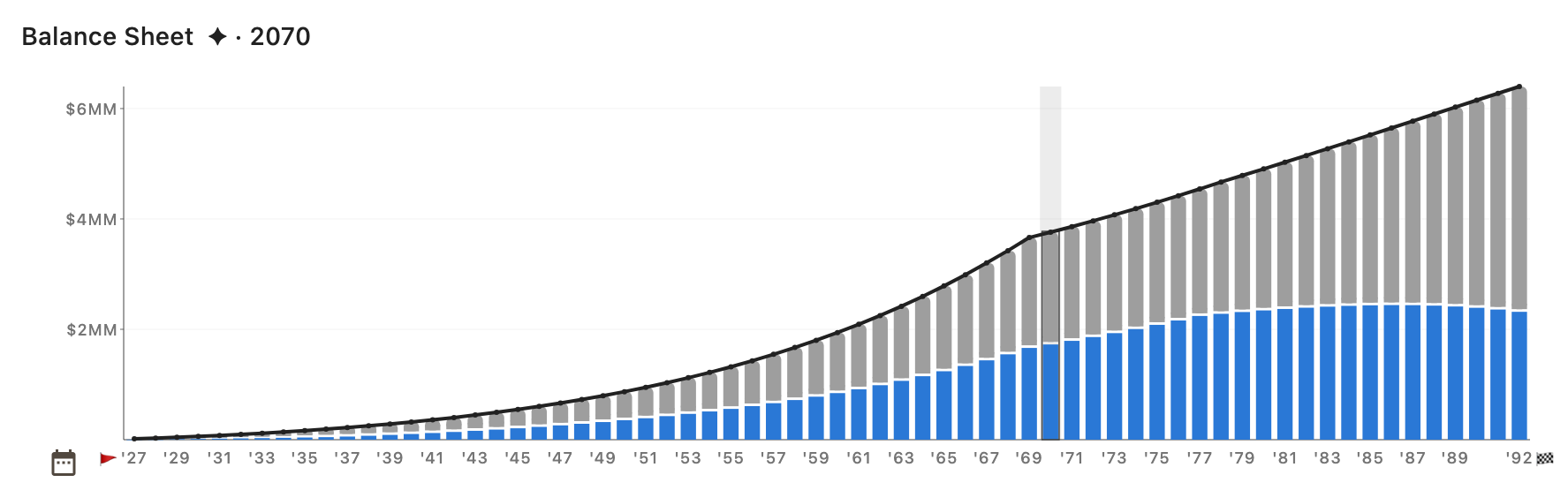
Balance sheet by year in Trimmed to the ranges, with the same year selected.
Both plans grow through the working years, because salary rises a little faster than expenses do and the plan invests the difference. But the trimmed plan reaches retirement with roughly twice the net worthEverything owned minus everything owed — the bottom line of the balance sheet. Worth remembering that it counts dollars, not spendable dollars: a traditional account and a Roth account of the same size are not the same net worth to live on, because one still owes tax.Full entry →, and the shape after 67 is different in kind. As it is, the balance peaks at retirement, is drawn down every year after, and runs out at about 86, which is the red at the right edge of the first chart. Trimmed, the balance never falls, because Social Security plus the growth on what was saved covers the spending. The whole difference is $620 a month, compoundingGrowth on top of previous growth — this year's return is earned on last year's gains as well as the original money. It is why a plan curve bends upward instead of climbing in a straight line, and why the early years matter more than their size suggests.Full entry → for forty years, with the employer's half of the match riding along for free.
The simulationA multi-path run of the plan — typically Monte Carlo — that samples many randomized market and growth paths and summarizes outcomes (success rate, net-worth cloud, key metrics). Distinct from a single-year or single-path forecast detail view.Full entry → says the same thing in the language of odds. Here is the net worth distribution for each plan:
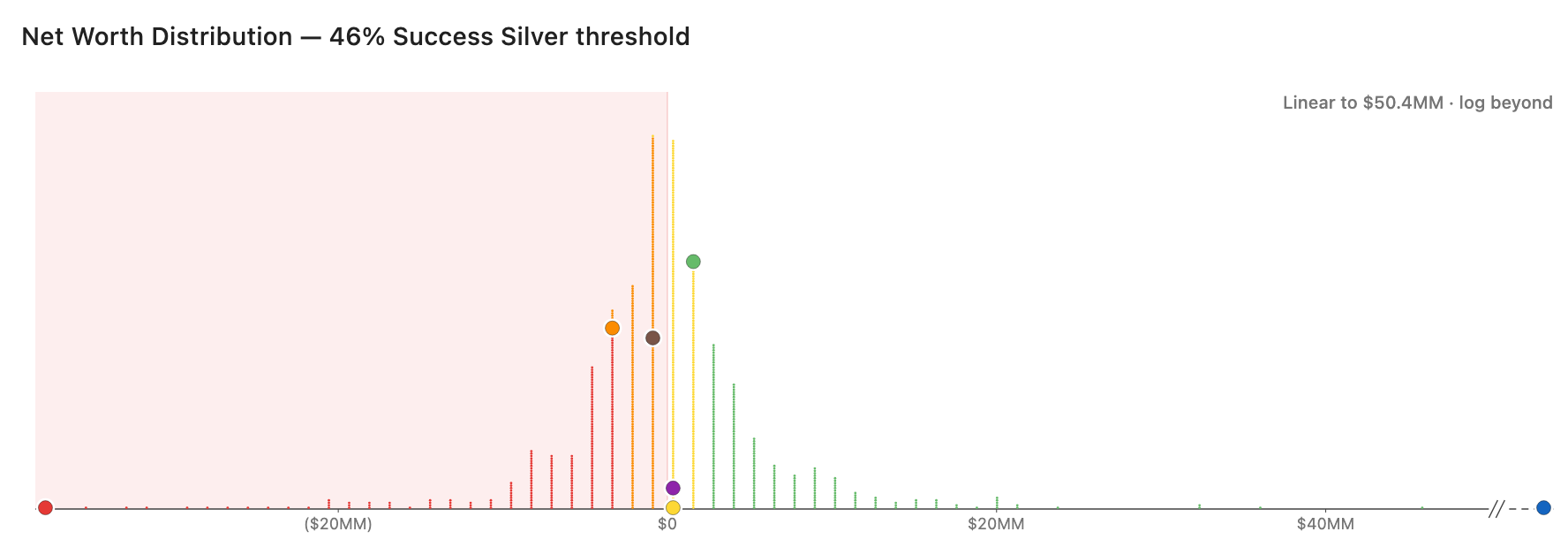
Net worth distribution in As it is: about half the paths end in failure.
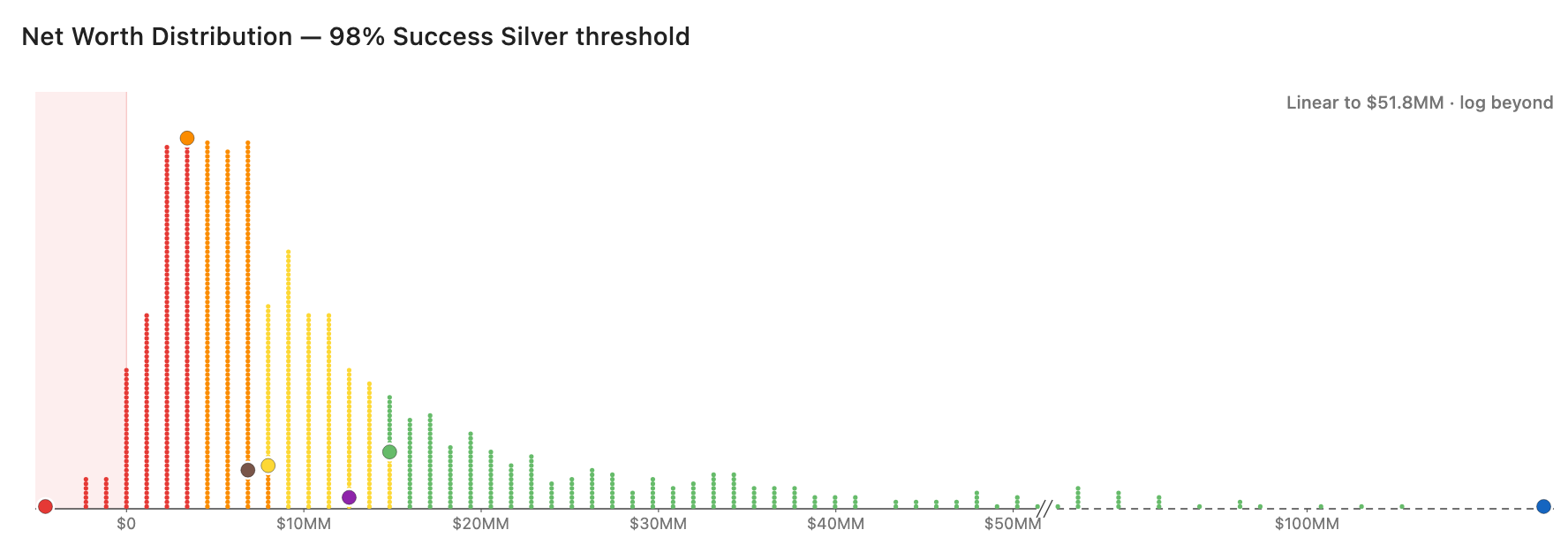
Net worth distribution in Trimmed to the ranges: more than nine in ten succeed.
As it is, Riley's plan succeeds about half the time. That is not a plan that fails; it is a plan that depends on which forty years the market happens to deliver, and on Social Security doing most of the work after 67. Trimmed, the success rateThe share of simulated paths that counted as a success — 85% means 85 of every 100 sampled futures cleared the bar. It is a proportion of sampled futures, not a probability the world owes you, and it means nothing until you know which bar was used.Full entry → is above ninety percent. The budget is the same size. The difference is that $620 a month has a name.
- Write every line down, including the zeros. The checklist's job is to find the lines you never see, and the tax line alone is a sixth of Riley's pay.
- Total each section as monthly times twelve and put it on the plan as one line. The tool then does the arithmetic, including the tax and the leftover, every year for the rest of your life.
- Sort into needs, wants, savings and unexpected, and measure against the rules of thumb. The point of a range is not the verdict; it is that a section over its range is where to look first.
- The first money to move is the money that is already free. A deferral below the employer match is a pay cut you chose.
- The room in a first-job budget is usually in housing and in dining out, and it is worth about twice the net worth at retirement in this plan. How much of that room to take is a lifestyle decision, and it is easier to make once you can see what it buys.
Rebuild this plan by hand
The cards on the canvas show the accounts and cash flows. These are the settings that live outside any card, read from each plan this lesson opens, with the label each control carries in the app. A value marked default is one to leave alone.
| Setting | As it is | Trimmed to the ranges |
|---|---|---|
| Household | ||
| Planning region | United States (default) | United States (default) |
| Riley (Primary) | ||
| birth year | 2003 | 2003 |
| retirement age | 67 | 67 |
| death age | 90 | 90 |
| Taxes | ||
| Tax regime | United States | United States |
| Filing status | Single | Single |
| State of residence | Texas | Texas |
| First-year federal estimate | $11,600 | $11,600 |
| First-year state estimate | — | — |
| Strategy | ||
| Residual withdrawal strategy | Pro-rata (default) | Pro-rata (default) |
| Roth conversions | Off | Off |
| Definition of success | Liquidity crises allowed (default) | Liquidity crises allowed (default) |
| Glide path target | None (default) | None (default) |
| Advanced | ||
| Reporting inflation | Assumption set's rate (default) | Assumption set's rate (default) |
| Cost of capital | Assumption set's rate (default) | Assumption set's rate (default) |
| Growth assumptions | Growth overrides (default) | Growth overrides (default) |
| Currencies | Multiple currencies (default) | Multiple currencies (default) |
| Default currency | USD (default) | USD (default) |
| Display currency | USD (default) | USD (default) |

Educational content — not advice. These lessons teach how Tutilis models a plan and how to read what it shows. The households, balances, and outcomes in them are invented for teaching. Nothing here is financial, investment, tax, or legal advice, or a recommendation to buy, sell, or hold anything. A model cannot know your circumstances — check anything you take from a lesson against your own situation, and against a qualified professional where it matters.